
Type & Discipline
Compassion-Focused Therapy (CFT) is a standalone psychotherapeutic modality within clinical psychology, usually grouped with the third-wave or process-based behavioral therapies 1. It was built as an explicitly integrative model, drawing cognitive behavioral therapy together with evolutionary psychology, social and developmental psychology, neuroscience, and Buddhist psychology 4. Unlike a single technique, CFT is a coherent treatment with its own theory of mind, its own formulation of distress, and its own set of practices, and it can serve as the primary frame for an episode of care LLM. The skills-training component most often delivered inside it is called Compassionate Mind Training, which teaches the attributes and skills of compassion in a structured, practiceable way 4. The defining clinical target of the model is the cluster of chronic shame and harsh self-criticism that cuts across many diagnoses, rather than any one disorder 4.
Creators & Lineage
CFT was developed by the British clinical psychologist Paul Gilbert, who built the approach over years of work with clients whose depression and anxiety were saturated with self-attacking and shame 1. Gilbert observed clinically that some clients could generate alternative, “rational” thoughts in standard cognitive therapy yet feel no relief, because the corrective thoughts were delivered to themselves in a cold or hostile internal tone 5. That observation became the seed of the model: it is not only the content of inner cognition that matters but its emotional texture, and a self-corrective thought spoken with warmth lands differently from the same thought spoken with contempt 5.
The lineage is deliberately multi-rooted. From evolutionary psychology CFT takes the idea that human emotion runs on old, biologically prepared systems that were shaped for survival and social living 4. From attachment theory it takes the premise that early experiences of care, or its absence, calibrate a person’s capacity to feel soothed and safe in relationship, including in relationship with themselves LLM. From cognitive behavioral therapy it retains formulation, guided discovery, behavioral practice, and homework 4. From mindfulness and Buddhist psychology it draws contemplative training in attention, non-judgment, and the intentional cultivation of compassion 4. The dedicated training and clinical home for the approach in the United States is the Center for Compassion Focused Therapy, which offers practitioner training and certification in the model 6.
Core Principles
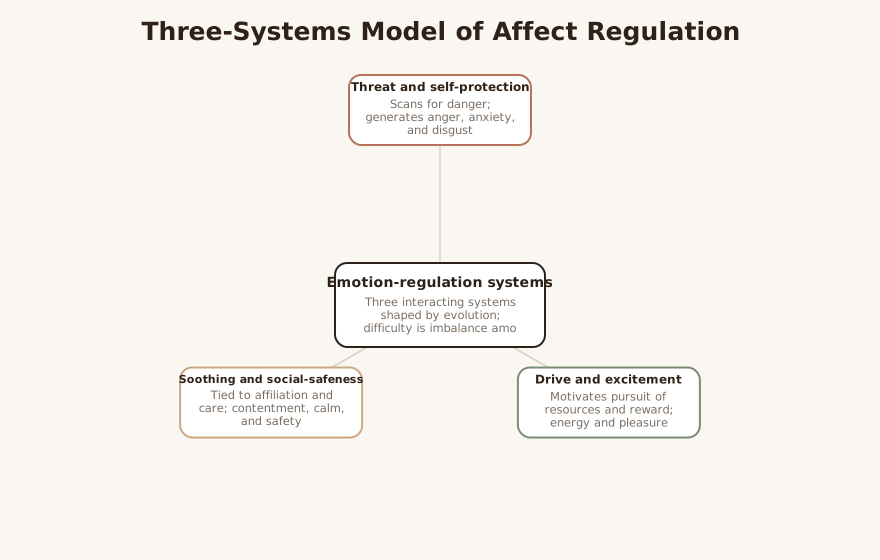
The theoretical spine of CFT is a model of three interacting emotion-regulation systems that evolution is held to have shaped 4. The first is the threat and self-protection system, which scans for danger and generates anger, anxiety, and disgust to drive avoidance or defense 4. The second is the drive and excitement system, which motivates the pursuit of resources, achievement, and reward and produces feelings of energy and pleasure 4. The third is the soothing and social-safeness system, which is tied to affiliation and care and produces contentment, calm, and a sense of safety when the person is neither under threat nor striving 4. Psychological difficulty is reframed in this model as a chronic imbalance among the three systems, typically an over-developed threat system and an under-developed soothing system 4.
A second core principle is that much of this is “not our fault” but is “our responsibility” to work with 5. Gilbert emphasizes that people did not design their own brains, their attachment histories, or their threat-driven reactions, and that recognizing this de-shames the very act of seeking help 5. Compassion in this model is not soft reassurance or letting oneself off the hook; it is defined as a sensitivity to suffering combined with a committed motivation to relieve and prevent it, which makes it an active, courageous, and at times demanding stance 5. A third principle is that the soothing system can be deliberately trained and strengthened through practice, much as a muscle is, so that it becomes more available to regulate threat 4.
Interventions & Techniques
The central vehicle for change is Compassionate Mind Training, a set of guided exercises that teach the skills and attributes of compassion and help transform patterns tied to anxiety, anger, shame, and self-criticism 4. A foundational practice is soothing rhythm breathing, in which the client slows the breath to engage the body’s calming physiology and access the soothing system before any cognitive work begins LLM. From there the work moves into imagery and embodied practice 4.
Compassionate imagery exercises ask the client to build and inhabit images of safety and care, including a “compassionate self” they deliberately step into, adopting its facial expression, posture, tone of voice, and intentions, and a “perfect nurturer” figure that embodies wisdom, strength, warmth, and non-judgment LLM. Importantly, clients often learn to direct compassion outward first, generating it from a third-person stance toward others, before turning these same processes back toward themselves, because self-directed compassion is frequently the hardest move 4. Chair work and dialogue methods are used to externalize and soften the self-critic and to give voice to the compassionate self in its place LLM. The treatment is structured and active, typically including role-play, visualization, meditation, and activities meant to foster appreciation of daily life, with between-session homework as standard practice 4.
LLM-generated illustrative example (not a guideline): A clinician notices that a client can list “evidence” against their self-criticism but says it in a clipped, sarcastic inner voice. Rather than adding more counter-evidence, the clinician guides soothing rhythm breathing, then invites the client to imagine speaking to a struggling friend in the same situation, and finally asks them to turn that warmer tone, word for word, back onto themselves and notice what shifts in the body LLM.
Evidence Base
CFT is best described as an established and theoretically mature modality with a developing, qualified outcome base, and clinicians should represent it that way to clients LLM. The model is institutionalized through dedicated training centers, certification pathways, and a substantial clinical literature, which places it well beyond the status of an untested approach 6. At the same time, its randomized-trial evidence is still thinner than that of older cognitive-behavioral protocols, and honest communication requires holding both facts at once LLM.
The most specific quantitative claims come from a meta-analysis of CFT’s effect on self-criticism and self-soothing, which pooled fourteen studies: seven controlled trials with 640 participants and seven uncontrolled observational studies with 207 participants 2. That analysis concluded that CFT decreases self-criticism and increases the ability to experience self-soothing, while noting that the effect varied by study design and by the subscale used to measure self-criticism 2. Its authors were explicit that, because the number of studies is small and only half were controlled trials, the results must be interpreted cautiously and more randomized controlled trials comparing CFT with other therapies are needed 2. A separate systematic review and meta-analysis of CFT with clinical populations likewise concluded that the approach is effective in reducing negative mental-health outcomes 3. A meta-analysis summarized in the model’s reference literature covered 7,875 participants across 17 countries and supported effectiveness in reducing negative outcomes, while the same summary stressed that studies often used small samples and called for larger, higher-quality randomized controlled trials 1.
The cautions are therefore baked into the evidence itself rather than added as a disclaimer LLM. Many supporting studies are small or lack proper controls, head-to-head comparisons against established treatments remain limited, and the effect of CFT is clearest on its proximal targets of self-criticism and self-compassion, with disorder-level outcomes less firmly established 2. The defensible clinical stance is to deploy CFT where shame and self-criticism are central drivers of distress, while using disorder-specific evidence-based treatments as first-line care where strong trial support already exists LLM.
Populations & Indications
CFT was designed for, and is especially appropriate for, people with high levels of shame and self-criticism who struggle to feel warmth toward themselves 4. It is frequently applied to mood disorders, including chronic and recurrent depression in which a punishing inner voice maintains low mood 4. It has shown promise in eating disorders, where an adapted form known as CFT-E targets the shame and bodily self-attack that sustain disordered eating 1. It is used with people experiencing psychosis, where it can address the shame, fear, and self-criticism that surround psychotic experience 1. It is applied with trauma survivors, for whom self-blame and shame are common sequelae, and with adults carrying personality-disorder presentations marked by harsh self-relating and unstable self-worth 4. Psychology Today’s overview lists anxiety disorders, mood disorders, personality disorders, eating disorders, hoarding, psychosis, anger problems, poor body image, and relationship difficulties among the conditions the approach addresses 4.
The common thread across these populations is transdiagnostic: CFT targets shame and self-criticism as mechanisms that run beneath many diagnostic labels rather than any single category LLM. This makes it a natural fit when a clinician’s formulation places self-attack at the center of a client’s suffering, regardless of the headline diagnosis LLM.
Problems-for-Work
CFT speaks most directly to shame and to self-criticism, the two problems the model was built to address, and it reframes both as products of an over-active threat system rather than as personal defects 4. It is well matched to self-attacking and self-loathing, where the practice of generating a compassionate inner voice directly competes with the hostile one 2. It is used for low self-esteem and chronic guilt, where the soothing system is recruited to provide the felt sense of acceptability that harsh inner standards have withheld LLM.
LLM-generated illustrative example (not a guideline): A client with longstanding perfectionism describes every achievement as “never enough” and drives themselves through fear of being exposed as a fraud. Within a CFT frame, the clinician helps the client see the perfectionistic driver as an over-developed threat-and-drive strategy that once kept them safe, then trains the soothing system so that effort can be motivated by care for themselves rather than terror of failure LLM.
CFT is also applied to major depressive disorder, social anxiety disorder, and the anxiety disorders more broadly, where shame about symptoms and self-criticism about coping amplify the primary problem 4. In post-traumatic stress disorder it addresses the self-blame and moral shame that frequently accompany the index trauma 4. Across these applications the unifying clinical move is to build the capacity for self-soothing so that the threat system no longer dominates the client’s inner life 4.
Contraindications, Cautions & Cultural Humility
CFT is not a crisis-stabilization protocol, and a contemplative, skills-building approach should not displace structure, safety planning, and evidence-based stabilization during acute suicidality, severe instability, or acute psychotic crisis LLM. The approach can be genuinely difficult for the very clients it targets: people who are intensely hypercritical of themselves often experience a backdraft of fear, grief, or even hostility when they first attempt to direct warmth toward themselves, and clinicians must pace this carefully and normalize the reaction rather than push through it 4. Clients should also be told that the benefits may take several sessions to appear, which protects against early dropout when the practices feel awkward or activating 4.
Cultural humility matters because compassion, shame, and self-criticism are shaped by culture, family, and religion, and the meaning of “being kind to yourself” is not universal LLM. In some cultural and religious contexts self-criticism is valued as conscientiousness or humility, and self-compassion can be misread as self-indulgence, so the clinician should explore the client’s own relationship to these ideas rather than importing a fixed value LLM. The model’s evolutionary framing and its imagery practices should be introduced flexibly, with the “perfect nurturer” and compassionate-self images built from materials that fit the client’s own world rather than the clinician’s LLM.
Treatment-Plan Suggestions & SMART Objectives
| Goal | SMART objective (example) | Mechanism |
|---|---|---|
| Reduce self-criticism | Over 8 weeks, client will identify the self-critical voice in 3 situations per week and record one compassionate-self response to each | Strengthening self-reassurance over self-attack 2 |
| Build self-soothing capacity | For 6 weeks, client will practice soothing rhythm breathing daily for 5 minutes and rate calm before and after | Activating the soothing/affiliative system 4 |
| Develop the compassionate self | Within 10 sessions, client will engage in compassionate imagery in 4 sessions and describe one shift in inner tone | Embodying a warm, wise self-perspective 4 |
| Decrease shame | Within 12 sessions, client will name 2 shame triggers and reframe each as a threat-system response that is “not their fault” | De-shaming through the evolutionary model 5 |
| Soften perfectionistic drive | Over 8 weeks, client will complete 2 tasks per week to “good enough” and note self-talk afterward | Rebalancing threat/drive toward soothing 4 |
| Increase self-directed compassion | Within 10 sessions, client will transfer 3 compassionate statements made toward others onto themselves | Reversing the outward-first compassion bias 4 |
| Generalize between sessions | For 6 weeks, client will complete assigned compassion homework at least 4 days per week | Practice-driven strengthening of skills 4 |
Common Misconceptions
A frequent misconception is that CFT is about being soft on oneself or lowering standards, when the model defines compassion as a sensitivity to suffering joined to a courageous, active commitment to relieve it, which is demanding rather than indulgent 5. A second is that self-compassion means avoiding accountability, when in fact the “not our fault, but our responsibility” stance is built to increase ownership of change by removing the paralysis that shame produces 5. A third is that CFT is simply positive self-talk; the model insists that the emotional tone of inner speech, carried by the soothing system, is the active ingredient, not merely the words 5. A fourth is treating the three-systems model as a literal claim about brain anatomy rather than as a clinically useful evolutionary heuristic for organizing emotion LLM. Finally, some clinicians assume CFT will feel immediately comforting to clients, when for high-shame clients the early experience is often activating, and that fear response is expected rather than a sign the approach is failing 4.
Training & Certification
There is no protected license titled “compassion-focused therapist”; CFT is practiced by licensed mental-health professionals who add the model to an existing scope of practice LLM. Structured training and certification are offered by dedicated organizations, including the Center for Compassion Focused Therapy, which provides practitioner training in the model 6. Paul Gilbert and colleagues have disseminated the approach through introductory lectures, workshops, and a substantial professional literature, giving clinicians accessible entry points before pursuing formal certification 5. Because the approach integrates cognitive-behavioral, mindfulness, and imagery methods, clinicians already grounded in those traditions can often build CFT competence efficiently, provided they represent their training level honestly and obtain supervision when working with high-risk presentations LLM.
Key Terms
Three systems model — the evolutionary framework of threat, drive, and soothing systems whose imbalance underlies distress 4. Threat system — the protection system generating anger, anxiety, and disgust 4. Drive system — the resource-seeking system producing energy and reward 4. Soothing / social-safeness system — the affiliative system producing calm and contentment, and CFT’s primary training target 4. Compassionate Mind Training — the structured exercises that teach the skills and attributes of compassion 4. Compassionate self — an embodied, deliberately adopted self-perspective characterized by wisdom, strength, and warmth LLM. Perfect nurturer — an imagery figure embodying ideal care and non-judgment LLM. Self-criticism — the harsh, self-attacking internal stance CFT works to reduce 2. Self-soothing / self-reassurance — the capacity to comfort and reassure oneself that CFT works to increase 2. “Not our fault, but our responsibility” — the de-shaming stance that separates blame from agency 5.
Resources & Further Reading
▶ Watch — a video introduction to this concept:
- Compassion-focused therapy — Wikipedia
- Effect of compassion-focused therapy on self-criticism and self-soothing: A meta-analysis (Vidal & Soldevila-Domenech, British Journal of Clinical Psychology)
- The effectiveness of compassion focused therapy with clinical populations: A systematic review and meta-analysis (Journal of Affective Disorders)
- Compassion-Focused Therapy — Psychology Today (Therapy Types)
- Compassion Focused Therapy: An Introduction — Prof. Paul Gilbert (YouTube)
- The Center for Compassion Focused Therapy
Reflective / Supervision Questions
- When my formulation places shame and self-criticism at the center of a client’s distress, am I choosing CFT for that reason, or defaulting to it out of familiarity LLM?
- How do I respond when a high-shame client experiences fear or hostility at the first attempt to direct compassion toward themselves, and do I pace and normalize that reaction rather than push through it LLM?
- Am I representing CFT’s evidence honestly, as an established and mature model whose outcome base is still developing on small samples, rather than as a fully trial-validated protocol for the client’s specific diagnosis LLM?
- Where a client’s culture or faith treats self-criticism as a virtue, am I exploring their own relationship to compassion rather than imposing self-kindness as a universal good LLM?
- Am I attending to the emotional tone of the client’s inner voice, not just its content, and modeling a warm tone in my own stance toward them LLM?
- When a client is in acute crisis, am I prioritizing stabilization and safety before contemplative compassion work LLM?