
Phronesis is not a therapy, and Aristotle never imagined it scoring a treatment outcome LLM. It is the intellectual virtue of practical wisdom: the capacity to deliberate well and discern the right action in a particular, context-laden situation, knowing not only what to do but why it is the right thing to do 5. For clinicians the concept matters precisely because the work is saturated with judgments that no manual fully scripts — when to push and when to hold, how much self-disclosure is too much, which of two competing goods to honor when they collide in a single session LLM. Naming this capacity, and understanding how it is built, lets a clinician treat clinical judgment as a developable skill rather than an ineffable knack LLM.
Type & Discipline
Phronesis is a construct in Western moral philosophy, specifically a virtue within the Aristotelian tradition of virtue ethics 2. Aristotle distinguished two kinds of intellectual virtue: sophia, theoretical reasoning that combines knowledge and logic about eternal truths, and phronesis, practical reasoning about what to do in changeable, particular circumstances 5. Phronesis is therefore neither a clinical model, a developmental stage theory, nor a treatment protocol, and it carries no outcome data of its own LLM. Its place in behavioral health is as an account of clinical judgment itself — the deliberative capacity that sits inside whatever evidence-based modality a clinician delivers LLM.
Virtue ethics, the family phronesis belongs to, defines itself by contrast with its rivals: it “emphasizes the virtues, or moral character, in contrast to the approach that emphasizes duties or rules (deontology) or that emphasizes the consequences of actions (consequentialism)” 2. Where a deontologist asks which rule applies and a consequentialist tallies outcomes, the virtue ethicist asks what a person of good character would perceive and do here 2. Phronesis is the capacity that makes that perception and that doing possible, which is why it has been called the master or keystone virtue: “for all the virtues will be present when the one virtue, practical wisdom, is present” 6.
Creators & Lineage
The concept is Aristotle’s, set out in the Nicomachean Ethics in the fourth century BCE 5. There he separated the intellectual virtues into theoretical and practical kinds and gave phronesis its enduring definition as “a true characteristic that is bound up with action, accompanied by reason, and concerned with things good and bad” 6. Aristotle’s central claims about it have proven remarkably durable: that ethical virtue is “fully developed only when it is combined with practical wisdom,” that “virtue makes the goal right, practical wisdom the things leading to it,” and that the wise person “sees the truth in each case, being as it were a standard and measure” of right action 1.
The lineage runs forward through the entire virtue-ethics tradition and into its twentieth- and twenty-first-century revival, where phronesis is treated as the capacity that answers the standing objection that virtue ethics cannot guide action 2. From there it has been imported, deliberately, into professional and applied ethics — into accounts of practical wisdom as “the intellectual meta-virtue that helps a moral agent to integrate and adjudicate upon the (sometimes) conflicting messaging coming from the different moral, civic, and performance virtues” in fields such as teaching 4. It has been carried explicitly into clinical territory as well, including book-length treatment of phronesis as a virtue in psychiatric practice 7. In behavioral health the nearest neighbors a clinician will meet are the eudaimonic strand of positive psychology, the values work of acceptance and commitment therapy, and the broader literature on wisdom — all of which trade on the same Aristotelian intuition that living and acting well is a skill of judgment, not a stock of rules LLM.
Core Principles
The first principle is the distinction from theoretical wisdom. Phronesis “addresses particular situations requiring reasoned judgment about action,” whereas sophia “concerns eternal truths” 1. This matters clinically because the knowledge that helps in a session is mostly of the first kind: not the abstract truth of a protocol but the situated truth of this client, this moment LLM. As Aristotle put it, practical wisdom “is also of particulars, which come to be known as a result of experience” 6.
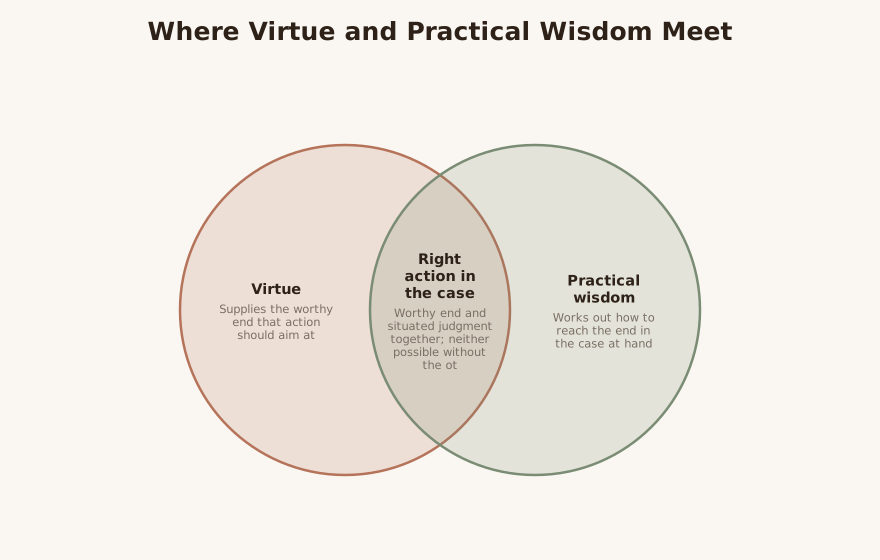
The second is the reciprocal dependence of wisdom and virtue. “One cannot possess genuine virtue without practical wisdom, nor can one have practical wisdom without virtue” 1. Virtue supplies the worthy end; phronesis works out how to reach it in the case at hand 1. This guards against two failure modes at once — good intentions with poor judgment, and skillful judgment in service of bad ends LLM.
The third is the mean relative to the situation. Aristotle’s doctrine of the mean is not a fixed midpoint but a context-sensitive target: “the intermediate point that is chosen by an expert in any of the crafts will vary from one situation to another,” determined “by logos … and in the way that the person of practical wisdom would determine it” 1. Every virtue has its flanking extremes — “frugality can become miserliness, courage can become recklessness” — and phronesis “navigates the middle path” appropriate to the circumstance 6.
The fourth is perception of the morally salient. Practical wisdom is “the capacity to recognise, in any particular situation, those features of it that are morally salient” 2. It is closer to a trained perception than to a calculation 1. The fifth is deliberation (bouleusis) about how a worthy goal “is to be accomplished,” extended beyond mere means-fitting into inquiry about what justice or care actually requires here 1. The sixth is the distinction from cleverness (deinotes): clever people possess “the rational skill needed to achieve their ends” but “may pursue worthless objectives,” so phronesis additionally requires “that the ends they seek are worthwhile” 1.
Interventions & Techniques
Because phronesis is a capacity rather than a procedure, “techniques” here means structured ways to cultivate and exercise practical judgment inside recognized clinical and supervisory activities LLM. The most useful organizing scheme comes from contemporary virtue-ethics scholarship, which decomposes phronesis into four working functions 4.
The constitutive function is “the capacity to perceive ethically salient aspects of situations” 4. In practice this is trained moral and clinical noticing — the deliberate cultivation of attention to what is actually at stake in the room, which formulation, case consultation, and reflective supervision all serve LLM. The blueprint function is “integrating one’s ethical identity, aims, and understanding of professional flourishing” — a clinician’s worked-out sense of what good care and a good clinical life look like, against which particular choices are measured 4. The emotional regulative function is “aligning emotional responses with ethical judgment,” the work of bringing one’s felt reactions into line with what the situation calls for rather than being driven by countertransference or aversion 4. The integrative/adjudicative function is “resolving conflicts between competing virtues or values,” enabling, for instance, a “compassionately honest or honestly compassionate” response when honesty and kindness pull in different directions 4.
That last function is the engine of phronesis: it permits virtues to be “blended” or for one to be “put on hold completely in a given situation in light of the overriding requirement of a conflicting virtue” 4. A second, defensive technique is recognizing where rules run out. Practical wisdom is needed precisely because “one-size-fits-all guidelines” and externally dictated rules “led to acutely unfortunate and unintended consequences” when they displace situated judgment 6. A third is deliberate reflection on particulars — structured case discussion of real dilemmas, which builds the storehouse of experience phronesis depends on 5.
LLM-generated illustrative example (not a guideline): A clinician notices that gentle honesty about a client’s missed sessions and warm reassurance are pulling against each other in the moment. Rather than defaulting to either script, she runs the adjudicative move explicitly — what does this client most need to hear, and which virtue should lead here — and lands on a “compassionately honest” framing that names the pattern without shaming. The judgment is phronetic, not algorithmic, and the modality work continues around it LLM.
Evidence Base
The maturity of phronesis is best labeled established — but, as with any imported philosophical construct, “established” means historically central, rigorously developed, and heavily debated within its own discipline, not validated as a clinical intervention 2. As a concept in moral philosophy it is foundational, traceable in a continuous line from Aristotle’s Nicomachean Ethics to a vigorous modern virtue-ethics literature and applied-ethics scholarship across professions 524. There is, however, no body of outcome research showing that “having phronesis” improves clinical outcomes, because it is not a treatment and has never been studied as one; its standing is conceptual rather than empirical LLM.
Intellectual honesty requires naming the standard objections to the framework, because each maps onto a real clinical risk LLM. The action-guidance objection holds that virtue ethics “is, in principle, unable to provide action-guidance” — that telling a clinician to “act wisely” says nothing concrete; defenders answer with “v-rules” such as “Do what is honest/charitable; do not do what is dishonest/uncharitable,” which do offer direction even if they require judgment to apply 2. The situationist challenge from social psychology presses harder, claiming “there are no such things as character traits and thereby no such things as virtues,” to which virtue ethicists reply that virtues are “multi-track disposition[s]” not reducible to single-situation behavior 2. The cultural-relativism objection notes that different cultures prize different virtues; the standard tu quoque reply is that “cultural variation in character traits regarded as virtues is no greater … than the cultural variation in rules of conduct” that besets every ethical framework 2. These are the reasons the field does not treat phronesis as a settled algorithm, and they are exactly the cautions a clinician should carry when using it LLM.
Populations & Indications
Phronesis is not indicated for a diagnosis; it is indicated for the practitioners and situations in which judgment under particularity is the live problem LLM. It speaks most directly to therapists and clinicians themselves, for whom it offers a precise account of the clinical judgment their work continually demands, alongside a developmental model — experience, role models, guided reflection — for cultivating it 4LLM. It is squarely relevant to professionals facing ethical dilemmas, where codes and rules underdetermine the right move and “the ‘moral middle’ of the profession” must be navigated case by case 4.
In direct work it is most apt for adults and people facing complex life decisions, where the therapeutic task is often to help a client deliberate well rather than to relieve a symptom LLM. It has natural resonance with older adults, given Aristotle’s insistence that practical wisdom “characteristically comes only with experience of life” and includes “being wise about human beings and human life” — a frame that dignifies accumulated life experience as a genuine competence 2. It also fits individuals in values-based therapy, where the client’s own worked-out sense of what is “truly worthwhile, truly important, and thereby truly advantageous in life” is the working material 2. The indication is always framing rather than treatment: phronesis clarifies how good judgment operates, while the clinical care proceeds through whatever evidence-based modality the work requires LLM.
Problems-for-Work
Several presenting problems map naturally onto a phronesis lens, always as an organizing frame rather than a treatment LLM. For decision-making difficulties, the deliberative core of phronesis — examining how a worthy goal “is to be accomplished” in the concrete particulars — gives a structured alternative to rumination or impulsive choice 1. For value conflicts, the integrative/adjudicative function is directly on point: helping a client see that competing goods can be “blended,” or one provisionally “put on hold” for an overriding one, replaces an experience of paralysis with a model of skilled adjudication 4.
For moral distress — the bind of knowing roughly what is right but being unable to act, or being forced to weigh incommensurable goods — naming the situation as a phronetic problem, and recognizing that even wise judgment cannot guarantee clean outcomes, can be clarifying and de-shaming LLM. For impulsivity, the contrast between phronesis and cleverness is useful: effective at reaching ends is not the same as choosing ends “that are worthwhile,” and deliberation is the corrective 1. For perfectionism, the doctrine of the mean reframes the goal from a flawless fixed standard to a context-sensitive “intermediate point” that “will vary from one situation to another,” loosening the grip of an internal rulebook 1. For loss of meaning and demoralization, the eudaimonic horizon — orienting toward what is “truly worthwhile” and toward flourishing rather than momentary feeling — can supply a direction the client had lost 2.
LLM-generated illustrative example (not a guideline): A client paralyzed between caring for an aging parent and protecting a fragile new marriage frames every option as a betrayal. The clinician introduces the adjudicative move — that two real goods are in genuine conflict, that honoring one more this season need not annihilate the other, and that a wise choice is judged by fit to the particulars, not by which rule it satisfies. The reframe does not dissolve the loss, but it converts a moral deadlock into a deliberable problem LLM.
Contraindications, Cautions & Cultural Humility
Phronesis has no contraindications in the pharmacological sense, but it carries cautions that matter because its failure modes are quiet LLM. The first is the cleverness trap: skill at achieving ends, untethered from worthy ends, is not wisdom, and a clinician can be technically deft while serving an aim that is subtly self-serving or harmful 1. The second is the rules-displacement risk in reverse — using “it requires judgment” to justify ignoring legitimate guidelines, when in fact phronesis is supposed to include knowing when standing rules encode hard-won wisdom and should be followed 6LLM.
A third caution is over-reliance on the clinician’s own perception. Phronesis is described as trained perception of the “morally salient,” but perception is also where bias hides, and the situationist critique is a standing reminder that confident character-based judgments outrun the evidence more often than we think 2. This is the argument for keeping judgment accountable to supervision, consultation, and the client’s own voice rather than treating clinical intuition as self-certifying LLM.
Cultural humility is essential. Phronesis is a product of Greek philosophy embedded in a particular vision of the good life, and the virtues it integrates are not culturally uniform 2. The honest reply to that fact is not to abandon the framework but to hold it the way virtue ethicists themselves do — acknowledging that “cultural variation in character traits regarded as virtues” is real and pervasive, and that a wise clinician’s blueprint of flourishing must be built with a client’s cultural world rather than imposed on it 2LLM. Treating one’s own culturally specific picture of “the good decision” as the neutral standard is itself a failure of practical wisdom LLM.
Treatment-Plan Suggestions & SMART Objectives
The construct can help structure measurable objectives around deliberation, values, and decision-related distress within a broader treatment or supervision plan; the examples below are illustrative templates to adapt, not prescriptions, and none is a treatment in its own right LLM.
| Goal | SMART objective (example) | Mechanism |
|---|---|---|
| Slow impulsive decisions into deliberation | Within 3 sessions, client will name the worthy end and two plausible means for one pending decision, in writing | Deliberation (bouleusis) about how a goal is accomplished 1 |
| Resolve a stuck value conflict | Over 4 weeks, client will identify the two competing goods in one bind and choose which leads, weekly | Integrative/adjudicative function blends or ranks virtues 4 |
| Loosen perfectionistic all-or-nothing standards | Within 5 sessions, client will reframe one decision as a context-dependent “mean” rather than a fixed rule, in 3 logged instances | Doctrine of the mean varies the target by situation 1 |
| Build situational moral perception | Over 6 sessions, client will log the most salient feature of three hard situations before acting | Constitutive function: perceiving the ethically salient 42 |
| Align emotion with considered judgment | By week 6, client will name one strong reaction and the judgment it pulled against, in 4 instances | Emotional regulative function aligns affect with judgment 4 |
| Clarify a working picture of the good life | Within 4 sessions, client will state two things they hold “truly worthwhile” and one choice that honors them | Blueprint/eudaimonic horizon orients deliberation 42 |
| Reduce decision paralysis from waiting for certainty | Over 8 weeks, client will make one bounded choice under uncertainty and review fit to particulars, not outcome alone | Phronesis judges by situated fit, not guaranteed results 1 |
Common Misconceptions
The most common misconception is that phronesis is just intelligence or cleverness — that a smart, capable person automatically has it LLM. Aristotle explicitly separated the two: cleverness is “the rational skill needed to achieve their ends” and can serve “worthless objectives,” whereas practical wisdom additionally requires that the ends “are worthwhile” 1. A second error is treating phronesis as a body of rules that could, with enough effort, be written down. The whole point is the opposite: it is “of particulars, which come to be known as a result of experience,” and rigid “one-size-fits-all guidelines” tend to produce “unfortunate and unintended consequences” when they crowd it out 6.
A third misconception is that the doctrine of the mean means mediocrity or always splitting the difference. The mean is “determined by logos” and varies “from one situation to another,” and in some cases the wise response is at an apparent extreme — full courage, total honesty — not a watered-down middle 1. A fourth is that phronesis can be fully taught in the classroom before practice. Much of it is “caught from the work environment … through ‘osmosis’” and is “experientially conditioned and embodied” in ways formal instruction cannot replace 4. A final, clinically important misconception is that because practical wisdom resists codification it is therefore vague or unteachable; in fact it has a describable structure — constitutive, blueprint, emotional-regulative, and integrative functions — and identifiable developmental pathways 4.
Training & Certification
There is no certification in phronesis, and none would be appropriate, because it is a public philosophical construct and a developmental capacity rather than a proprietary method LLM. Aristotle held that it cannot be acquired by study alone: “all free males are born with the potential to become ethically virtuous and practically wise, but to achieve these goals they must go through two stages” — first developing good habits in childhood, then, “when their reason is fully developed,” acquiring practical wisdom 1. The adult clinical analogue is that judgment is built through supervised experience, not lecture LLM.
The contemporary literature names concrete cultivation pathways 4. Much professional wisdom is “caught from the work environment and organisational culture through ‘osmosis’,” which dignifies the formative influence of the settings clinicians train in 4. Guided dialogue about realistic dilemmas, pitched within the learner’s “zone of proximal development,” builds the adjudicative function 4. Relatable role models matter more than distant exemplars: “the best role models for professional ethics education are attainable and relatable ones,” such as experienced colleagues 4. And the work is sustained rather than modular, because without integration “the different aspects of a [practitioner’s] virtuous make-up will fail to become integrated,” which the source frames as a kind of de-professionalisation 4. For clinicians, the operational translation is clear: reflective supervision, case consultation, mentorship, and deliberate practice on real dilemmas are where phronesis is grown LLM.
Key Terms
Phronesis — practical wisdom or prudence; “the intellectual virtue of knowing how to take the proper course of action and why it is the right thing to do” 5. Sophia — theoretical wisdom, the intellectual virtue “combining knowledge and logic” about eternal truths, contrasted with practical reasoning 5. Eudaimonia — flourishing or “true” happiness, “the sort of happiness worth seeking or having,” partially constituted by virtuous activity 2. Doctrine of the mean — the view that virtue lies at an intermediate point “determined by logos” that “will vary from one situation to another,” between flanking excess and deficiency 1. Deliberation (bouleusis) — rational inquiry into how a worthy goal “is to be accomplished,” extending into ethical inquiry about what a situation requires 1. Cleverness (deinotes) — “the rational skill needed to achieve … ends” that may be “worthless,” distinguished from wisdom by the worth of the ends 1. Phronimos — the person of practical wisdom who knows “what is truly worthwhile … in short, how to live well,” serving as a standard and measure 21. Moral salience / constitutive function — “the capacity to recognise, in any particular situation, those features of it that are morally salient” 24. Integrative/adjudicative function — the capacity for “resolving conflicts between competing virtues or values,” blending them or suspending one for an overriding other 4. Meta-virtue — phronesis as the “intellectual meta-virtue that helps a moral agent to integrate and adjudicate upon the (sometimes) conflicting messaging coming from the different … virtues” 4.
Resources & Further Reading
▶ Watch — a video introduction to this concept:
- Aristotle’s Ethics — Stanford Encyclopedia of Philosophy
- Virtue Ethics — Stanford Encyclopedia of Philosophy
- Phronesis (Practical Wisdom) as a Key to Moral Decision-Making — Jubilee Centre, University of Birmingham
- Aristotelian Practical Wisdom (Phronesis) as the Key to Professional Ethics in Teaching — PMC
- Phronesis — EBSCO Research Starters
- Practical Wisdom: The Master Virtue — The Art of Manliness
- Phronesis (Practical Wisdom) — The Virtues in Psychiatric Practice, Oxford Academic
Reflective / Supervision Questions
- When you call a clinical decision “intuitive,” can you reconstruct the deliberation behind it — the worthy end and the means — or are you trusting cleverness in place of wisdom? 1LLM
- In a recent value conflict with a client, which competing goods were really in tension, and did you blend them, rank them, or simply avoid the adjudication? 4LLM
- Where do you treat “it requires judgment” as license to bend a guideline, and where does it genuinely encode wisdom you should follow? 6LLM
- Whose blueprint of “the good decision” is operating in the room — yours or the client’s — and have you confused your culturally specific picture for a neutral standard? 2LLM
- Which settings, colleagues, and role models are quietly shaping your clinical judgment “through osmosis,” and are they the ones you’d choose? 4LLM
- For a decision that still troubles you, can you separate a wise process from an unlucky outcome, given that even sound practical wisdom cannot guarantee clean results? 1LLM