
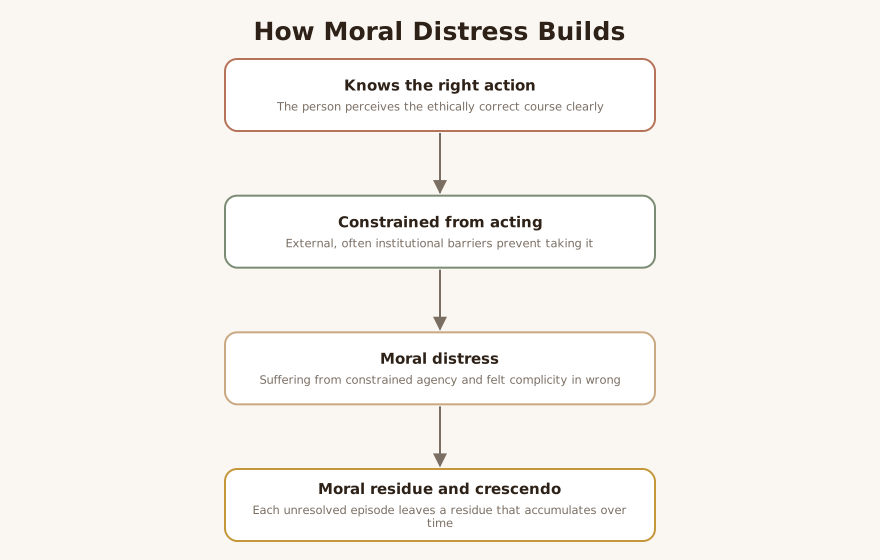
Moral distress is the particular suffering that arises when a person knows what is ethically right but is prevented, by institutional or structural constraints, from acting on that judgment — and so is left participating in something they believe to be wrong 1. The construct was named in nursing ethics to capture a distinct phenomenon: not the uncertainty of an ethical dilemma in which the right path is unclear, but the anguish of being clear about the right path and blocked from taking it 1. For the clinician, moral distress is doubly relevant — it names a recognizable category of suffering in clients whose work or circumstances trap their conscience, and it names an occupational hazard of clinical practice itself, increasingly tied to burnout and to clinicians leaving the field 2.
Type & Discipline
Moral distress is a construct — a defined psychological and ethical concept with its own measures and models — rather than a therapy or a diagnosis 1. Its disciplinary home is healthcare ethics, and more specifically nursing ethics, the field in which it was first articulated and has been most extensively developed, though it has since spread across medicine, allied health, and the human-service professions 2. It belongs to the broader family of moral suffering at work: forms of distress whose origin is not personal pathology but the collision between a person’s ethical convictions and the conditions under which they are required to act 1LLM.
The defining feature of the construct is its locus of causation 1. Where anxiety or depression are typically formulated as arising within the individual, moral distress is by definition relational and structural: it is produced by a constraint external to the person — a hierarchy, a policy, a resource shortage, a power differential — that stands between their moral knowledge and their moral action 14. This is what separates moral distress from a simple bad mood at work, and it is why the construct insists that the worker’s conscience is intact, not impaired: the distress is evidence that the person’s ethical sensibility is functioning, not failing 2LLM.
Creators & Lineage
The construct originates with Andrew Jameton, whose 1984 work Nursing Practice: The Ethical Issues introduced moral distress to describe what nurses experienced when they knew the right thing to do but institutional constraints made it nearly impossible to pursue 1. Jameton’s contribution was definitional and clarifying: he distinguished moral distress from moral uncertainty (not knowing what the ethical problem is or what values apply) and from moral dilemma (a genuine conflict between two defensible courses), carving out a third category in which the agent is sure of the right action but cannot enact it 1.
The construct’s empirical lineage runs through Mary Corley, whose work operationalized moral distress into a measurable variable through the development of the Moral Distress Scale (MDS), later refined into the widely used Moral Distress Scale–Revised (MDS-R) 5. This measurement work moved moral distress from an evocative description to a quantifiable phenomenon that could be studied in relation to outcomes such as burnout and turnover, anchoring it as a researchable construct rather than a metaphor 54.
A third strand of lineage extends the construct toward intervention through Cynda Rushton and the development of moral resilience as a complementary response — the capacity to preserve or restore integrity in the face of moral adversity, reframing the field’s task from merely documenting distress to cultivating the personal and organizational conditions that allow clinicians to act on their values 2LLM. Across these figures the construct evolved from a definition (Jameton), to a measure (Corley), to a body of intervention and policy work (Rushton and the professional organizations), with the American Association of Critical-Care Nurses (AACN) consolidating it into clinical resources and position statements that frame moral distress as an organizational responsibility, not only an individual burden 36.
Core Principles
The first principle is the knowledge–action gap: moral distress requires that the person knows the ethically correct action and is prevented from taking it, so the suffering is a function of constrained agency rather than confusion about values 1. This is the conceptual heart of the construct, and it is what makes moral distress a sign of moral perception, not moral failure 2.
The second principle is the centrality of constraint 4. The constraints are characteristically external and often institutional: hierarchical power differentials, lack of authority to act, organizational policy, time and staffing pressures, fear of reprisal, and the structures of medical decision-making that can leave frontline staff carrying out plans they judge to be wrong 4. An integrative review of nurses’ perspectives identifies these recurring sources — powerlessness, hierarchical conflict, and being required to provide care perceived as futile or harmful — as the soil in which moral distress grows 4.
The third principle is moral residue and the crescendo effect 2. Epstein and Hamric’s model holds that each episode of unresolved moral distress leaves a residue — a lasting trace that does not fully dissipate — so that repeated episodes do not simply recur at a constant level but build, producing a rising baseline (the “crescendo”) punctuated by acute spikes 2. Over time this accumulation can leave a clinician chronically distressed even between acute events, and it helps explain why moral distress is linked to burnout, disengagement, and the decision to leave a unit or the profession 2. The fourth principle follows: because the cause is structural, the remedy cannot be purely individual — addressing moral distress requires changing the constraints, building moral resilience, and creating organizational mechanisms for surfacing and acting on ethical concern 26.
Interventions & Techniques
Because moral distress is a construct rather than a packaged therapy, its “interventions” are a layered set of responses spanning the individual, the team, and the organization 2LLM. At the level of the individual clinician (or client), the first move is naming and validating — recognizing the experience as moral distress rather than as personal weakness, oversensitivity, or burnout-in-general, since the name itself reframes the suffering as evidence of intact conscience under constraint 2LLM. Reflective practices, ethics consultation, debriefing, and the cultivation of moral resilience — sustaining integrity and a sense of agency in the face of moral adversity — form the core of the personal-level response 2.
At the team and organizational level, the literature emphasizes that durable change targets the constraints 2. Recommended approaches include moral-distress education so that staff and leaders can identify it; structured forums — ethics rounds, moral-distress consultation services, schwartz-style reflective rounds — where clinicians can voice ethical concern; mechanisms that give frontline staff a real voice in decisions they must enact; and explicit attention to the power differentials and communication breakdowns that generate distress 24. The AACN’s framing positions the healthcare organization as bearing responsibility to create environments where staff can raise and act on moral concerns, rather than locating the problem solely in the resilience of the individual 36.
Assessment is itself an intervention 5. Using the Moral Distress Scale–Revised (or its logic) allows a unit or a clinician to identify which situations are generating distress and at what intensity and frequency, so that response is matched to the specific constraint rather than aimed at “stress” in the abstract 5LLM.
LLM-generated illustrative example (not a guideline): A therapist’s client, an ICU nurse, presents with insomnia, irritability, and a creeping sense of being “complicit in something cruel.” Exploration reveals she is repeatedly assigned to provide aggressive interventions to a dying patient whose family insists on continuing, against what she and the team believe is in the patient’s interest — and she has no standing to change the plan. Rather than treating this only as work stress, the therapist names it as moral distress, validates that her anguish reflects an intact ethical sense under institutional constraint, and works on tolerating the residue while supporting her in using the unit’s ethics consultation pathway to give her concern a legitimate channel LLM.
Evidence Base
The maturity of the construct is best described as established 1. Moral distress has a clear conceptual definition with a recognized intellectual history, a validated and widely replicated measure in the Moral Distress Scale and its revision, and a substantial empirical literature relating it to outcomes such as burnout, job dissatisfaction, and intent to leave 15. This is a well-defined, well-measured construct rather than a speculative proposal, and an integrative review of nurses’ perspectives demonstrates a coherent and repeatedly documented set of characteristics and sources 4.
What is established with most confidence is the phenomenon and its correlates 4. The recurring sources of moral distress — powerlessness, hierarchical conflict, perceived futile or harmful care, resource constraint — appear consistently across studies and settings, and the associations between moral distress and adverse occupational outcomes are robust enough to have driven professional-organization position statements 46. The residue/crescendo model provides a coherent and influential account of why repeated moral distress accumulates rather than simply recurring 2.
Honesty about limits matters LLM. Much of the underlying evidence is cross-sectional and self-report, drawn predominantly from nursing samples, so the directionality of the link between moral distress and outcomes like burnout is harder to establish than its existence 4LLM. There is ongoing conceptual debate about the boundaries of the construct — how sharply it is separated from burnout, compassion fatigue, and the related notion of moral injury — and the construct has been criticized and refined as it has spread beyond its nursing origins 1. The weakest part of the evidence base is intervention: while education, ethics structures, and moral-resilience approaches are widely recommended, rigorous outcome trials demonstrating that they reliably reduce moral distress remain limited, so the prescriptive side of the field is less mature than the descriptive side 2LLM.
Populations & Indications
The construct was developed for, and remains most directly indicated in, nurses and frontline healthcare workers, whose position — high moral responsibility paired with limited authority — places them squarely in the knowledge–action gap that defines moral distress 14. Critical care, ICU, emergency, and oncology clinicians are signature populations, because they routinely face end-of-life decisions, perceived futile care, and resource pressure under steep hierarchies 4.
Beyond its nursing origins, the construct is increasingly indicated for physicians, advanced-practice providers, allied-health staff, and long-term and palliative care workers, and it travels into any human-service role where conscience and constraint collide 2LLM. For the behavioral-health clinician, moral distress is relevant in two directions LLM. As a treatment focus, it names the suffering of clients whose work or caregiving roles force them to act against their values — healthcare workers, but also social workers, teachers, caregivers, and others in constrained institutional positions 4LLM. As an occupational reality, mental-health clinicians themselves experience moral distress when payer rules, documentation demands, caseload pressure, or organizational policy require care they judge to be inadequate 2LLM. The construct is especially salient during crises and resource scarcity — pandemics, mass-casualty events, severe understaffing — when clinicians are forced into triage and rationing that conflict with their commitments, a context the AACN addressed directly in its crisis position statement 6.
Problems-for-Work
The construct converts a vague sense of “this job is breaking me” into specific, trackable problems-for-work by locating the constraint 4LLM.
- Active moral distress is the flagship problem: a client (or clinician) repeatedly required to act against a clear ethical judgment, with intervention aimed at naming it, building moral resilience, and using legitimate channels to address the constraint 12.
- Moral residue and the crescendo effect become a problem-for-work when distress has accumulated across many episodes into a chronically elevated baseline; the target is processing the residue and interrupting the rising trajectory before it culminates in disengagement 2.
- Powerlessness and constrained agency is targeted when the core injury is the lack of standing to act; work focuses on restoring a realistic sense of agency and on advocacy through available structures 4.
- Burnout and intent to leave is the downstream problem moral distress drives; treating moral distress as the upstream cause changes the formulation from “compassion fatigue” to “constrained conscience,” with different implications for what would actually help 24.
- Hierarchical and interprofessional conflict is a frequent source; the problem-for-work is the relational and structural friction that leaves the person enacting plans they oppose 4.
LLM-generated illustrative example (not a guideline): A social worker presents with cynicism and a fantasy of quitting. Mapping her distress reveals it is not generic burnout but accumulated moral residue: agency policy repeatedly forces her to close cases she believes are unsafe to close, and each closure has left a trace. The plan names the crescendo pattern, distinguishes the moral residue from depression, supports her in documenting and escalating her safety concerns through formal channels, and works on sustaining her integrity and agency within a system she cannot single-handedly change LLM.
Contraindications, Cautions & Cultural Humility
The central caution is that moral distress is a problem of constraints, and an individualized response that asks the distressed person to simply become more “resilient” can relocate the blame onto the worker while leaving an unethical system untouched 2LLM. The construct’s own logic resists this: because the cause is structural, the responsibility is shared, and the AACN frames the creation of ethical work environments as an organizational obligation rather than a personal coping task 36. A clinician must be careful not to turn validation of moral distress into a counsel of mere endurance LLM.
A second caution concerns construct boundaries 1. Moral distress overlaps with — but is not identical to — burnout, compassion fatigue, and moral injury, and conflating them can lead to the wrong intervention: an antidepressant or a wellness program will not resolve distress whose true source is a coercive policy 1LLM. The clinician should also distinguish moral distress from genuine moral dilemma (where the right path is honestly unclear) and moral uncertainty (where the values themselves are in question), since each calls for different work 1.
A third caution is that the construct is not a license to override: a person’s conviction that they know the right action is sincere but not infallible, and naming distress should not foreclose the possibility that the disputed plan is in fact defensible LLM. On cultural humility, what counts as the “ethically right action,” how acceptable it is to challenge a hierarchy, and how a person weighs individual conscience against collective or familial duty all vary across cultures, professions, and care settings 4LLM. The construct emerged largely from Western nursing contexts, and the responsible stance is to ask what moral integrity and legitimate constraint mean within this person’s value framework and work culture rather than to import a single template 4LLM.
Treatment-Plan Suggestions & SMART Objectives
| Goal | SMART objective (example) | Mechanism |
|---|---|---|
| Name and distinguish moral distress | Within 2 sessions, client can describe a recurring work situation and correctly distinguish moral distress from burnout, dilemma, and uncertainty | Definitional clarity reframes the suffering as intact conscience under constraint 1 |
| Identify the controlling constraints | Within 3 sessions, client lists the specific external constraints (hierarchy, policy, resources) generating distress in their most charged situation | The construct locates causation in external constraint, not personal pathology 4 |
| Interrupt the crescendo | Over 6 weeks, client implements a structured post-episode processing routine and reports the moral residue no longer rising unchecked | Processing residue counters the accumulation that drives the crescendo effect 2 |
| Restore a realistic sense of agency | Within 4 weeks, client uses at least one legitimate channel (ethics consult, supervisor, formal report) to voice an ethical concern | Restoring constrained agency targets the powerlessness at the core of the injury 4 |
| Build moral resilience | Over 8 weeks, client practices a values-anchoring and self-stewardship routine and reports preserved integrity after a distressing episode | Moral resilience sustains integrity and agency under moral adversity 2 |
| Differentiate from co-occurring burnout | Within 3 sessions, clinician and client map which symptoms reflect moral distress versus burnout to match the right intervention to each | Boundary clarity prevents mistreating a structural problem as a mood problem 4 |
| Reduce isolation through shared forums | Within 6 weeks, client participates in at least one team debrief or reflective forum addressing the recurring ethical conflict | Structured forums and shared voice are core organizational-level responses 2 |
Common Misconceptions
A first misconception is that moral distress is just burnout by another name 1. The two are linked and often co-occur, but moral distress has a distinct cause — the knowledge–action gap under constraint — and a distinct implication: it points to a structural ethical problem, not to a generic depletion of energy that a vacation or a wellness app would address 12.
A second misconception is that moral distress reflects oversensitivity or a coping deficit in the worker 2. The construct holds the opposite: distress is a signal that the person’s moral perception is working, and that something in the environment is wrong 2. Treating it as personal fragility both misdiagnoses the cause and risks compounding the injury 2LLM.
A third misconception is that the right response is to toughen up the individual 6. Because the construct is structural, building individual resilience is necessary but not sufficient; durable change also requires altering the constraints and the organizational culture that generate distress, which professional bodies frame as a shared institutional responsibility 36. A fourth is that moral distress is an acute, episodic event that resolves when the situation ends — the residue/crescendo model specifically describes how it lingers and accumulates rather than fully clearing 2.
Training & Certification
There is no certification in “moral distress” as such, because it is a construct rather than a credentialed modality LLM. Competence comes instead through education in healthcare and nursing ethics, familiarity with the construct’s definition and models, and skill in the response practices — ethics consultation, reflective debriefing, moral-resilience cultivation — that the literature describes 2. Professional organizations such as the AACN provide clinical resources, toolkits, and position statements that function as the field’s practical training infrastructure, including frameworks for recognizing moral distress and for building the organizational responses to it 36.
For the behavioral-health clinician, the relevant preparation is twofold: learning to recognize and formulate moral distress in clients whose roles trap their conscience, and learning to recognize it in oneself as an occupational hazard of constrained clinical practice 2LLM. The Moral Distress Scale–Revised is the standard assessment instrument and is the natural entry point for a unit or clinician wishing to measure rather than merely intuit the problem 5.
Key Terms
- Moral distress — the suffering of knowing the ethically right action while being constrained from taking it 1.
- Moral uncertainty — not knowing what the ethical problem is or which values apply; distinct from moral distress 1.
- Moral dilemma — a genuine conflict between two defensible courses of action, where the right path is honestly unclear 1.
- Moral residue — the lasting trace left by an unresolved episode of moral distress that does not fully dissipate 2.
- Crescendo effect — the rising baseline of distress produced as residue accumulates across repeated episodes 2.
- Moral resilience — the capacity to preserve or restore integrity and agency in the face of moral adversity 2.
- Moral Distress Scale–Revised (MDS-R) — the validated instrument used to measure the frequency and intensity of moral distress 5.
- Constrained agency / powerlessness — the lack of standing or authority to act on one’s moral judgment, a core source of moral distress 4.
Resources & Further Reading
▶ Watch — a video introduction to this concept:
- Jameton — origin and evolution of moral distress (PMC overview) 1
- Epstein & Delgado — Understanding and Addressing Moral Distress (OJIN) 2
- AACN — Moral Distress (clinical resources) 3
- Characteristics of moral distress from nurses’ perspectives: an integrative review (PMC) 4
- Moral distress (nursing) — EBSCO Research Starters 5
- AACN Position Statement: Moral Distress in Times of Crisis 6
Reflective / Supervision Questions
- When a client describes work suffering, do I routinely test whether the formulation is burnout (depletion) or moral distress (constrained conscience) — and how would my plan differ if I named it correctly? 1LLM
- Where in my own caseload, documentation, or payer environment do I experience the knowledge–action gap, and what residue has it left in me? 2LLM
- For a distressed client, am I implicitly asking them to become more resilient within an unethical system, and is that the most honest framing of the problem? 6LLM
- How do I help a client distinguish the situations where advocacy can change the constraint from those where the realistic work is tolerating residue while protecting integrity? 4LLM
- Whose definition of the “ethically right action” am I privileging, and how does this client’s cultural and professional context shape what counts as moral integrity here? 4LLM