
Type & Discipline
The Zone of Proximal Development (ZPD) is a theoretical construct rather than a treatment modality or a discrete technique. LLM It originates in developmental and educational psychology and sits within the broader family of sociocultural theory of mind. 2 The ZPD describes the gap between what a learner can do independently and what that learner can achieve with guidance from a more knowledgeable person. 1 Vygotsky himself defined it as “the distance between the actual development level as determined by independent problem solving and the level of potential development as determined through problem solving under adult guidance or in collaboration with more capable peers.” 2
Because it is a construct, the ZPD does not stand alone as a billable or manualized intervention; it functions instead as an organizing principle that informs how clinicians, educators, and supervisors calibrate challenge and support. LLM In clinical settings it is most useful as a lens layered onto established interventions—graded task assignment, skills training, exposure hierarchies, and supervision—rather than as a therapy in its own right. LLM
Creators & Lineage
The ZPD was developed by Lev Semenovich Vygotsky during the late 1920s and elaborated progressively until his death in 1934. 2 Vygotsky (1896–1934) was a Soviet psychologist whose work was cut short, and he did not fully develop the construct before he died. 3 The ZPD was articulated in his posthumously influential Mind in Society: The Development of Higher Psychological Processes. 2
The construct grows directly out of Vygotsky’s sociocultural theory, which positions social rather than individual processes as primary in the development of higher mental functions. 2 Central to this lineage is Vygotsky’s “general genetic law of cultural development”: every higher function appears twice—first on the social plane, between people, and then on the psychological plane, within the individual—a movement Vygotsky called internalization. 2 Closely tied to this is the concept of intersubjectivity, the establishment of a shared understanding or shared perspective between an expert and a learner in a problem-solving task. 2
A crucial point of lineage frequently misattributed to Vygotsky: the term scaffolding was not coined by him. It was introduced by David Wood, Jerome Bruner, and Gail Ross in 1976 as they applied ZPD theory to educational contexts. 1 Scaffolding has since become so closely associated with the ZPD that the two are often treated as synonymous in the literature, though they are conceptually distinct—scaffolding is one way of operationalizing the zone, not the zone itself. 1 More recent theorists have reframed the ZPD again, proposing that it is best understood not as a fixed space but as an emergent, dynamic, self-organizing system arising from the interaction of individual psychological development and social context over time. 5
Core Principles
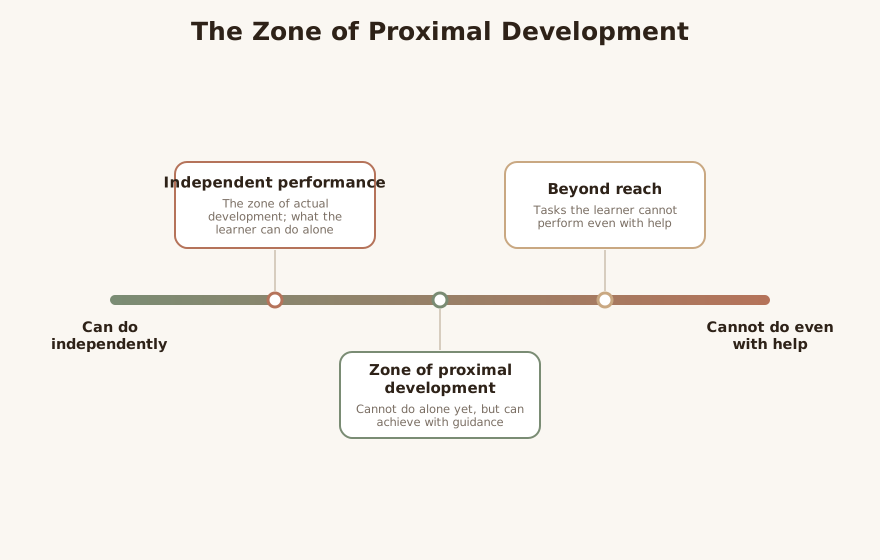
Three nested capability levels define the model. There is what the learner can accomplish alone, the ZPD itself, and a third band of tasks the learner cannot perform even with help. 4 Vygotsky distinguished the zone of actual development (ZAD)—what is already developed or achieved—from the ZPD, which reflects emerging behavior and what Vygotsky evocatively called the “tomorrow of development.” 2 The instructional target is the middle band: tasks the learner cannot yet do independently but has the potential to accomplish with guidance. 2
The term proximal is doing precise work. It signals that the assistance offered goes just slightly beyond the learner’s current competence, complementing and building on existing abilities rather than overwhelming them. 2 A task pitched too far ahead—Vygotsky’s example was teaching the average ten-year-old to solve quadratic equations—falls outside the zone and yields frustration rather than growth. 2
A second principle is that the zone is not static. As a learner accomplishes a task with assistance, the gap between independent and assisted performance shrinks; the same task that once required help becomes something the learner can do alone, and the zone for that task is effectively raised. 2 Learning, in this view, leads development rather than merely following it. 2 A third principle is the social origin of higher functioning: capability is first mediated socially through dialogue and shared activity before it is internalized as an independent skill. 2 This is why the quality of the helping relationship—the responsiveness of the more knowledgeable other—matters as much as the content of instruction. 1
Interventions & Techniques
Although the ZPD is a construct rather than a technique, it generates a recognizable set of operational moves, most of them gathered under the heading of scaffolding. LLM The more knowledgeable other (MKO)—a teacher, parent, peer, therapist, or supervisor—identifies the learner’s current developmental level and provides focused, contingent guidance during the task. 4 Support is high when the task is novel and is gradually withdrawn as competence increases, until the learner can perform independently; this graduated, diminishing support is the defining feature of scaffolding. 1
Concrete scaffolding techniques include breaking a task into small, manageable increments, modeling, prompting, hinting, asking structured questions, and tailoring the task to the individual’s zone. 4 Wood and Middleton’s classic observational work found that the most effective helpers were not those who gave the most assistance but those who varied their strategy responsively—offering more direction when the child struggled and stepping back as the child progressed. 1 This contingency, anchored in intersubjectivity, is arguably the active ingredient. 2
In clinical translation, these principles map onto familiar moves. LLM A clinician calibrates an exposure hierarchy so each step is reachable with coaching but not so easy it is trivial; a DBT skills trainer chains a new skill from therapist-prompted rehearsal to independent use; a parent-management coach demonstrates a praise statement, has the parent practice it in session, then fades support across the week. LLM
LLM-generated illustrative example (not a guideline): A socially anxious adolescent can introduce herself to one familiar peer unprompted (her zone of actual development) but freezes when asked to join an unfamiliar group. The clinician works the proximal step—joining a group of two with a rehearsed opening line and a pre-arranged signal—then fades the rehearsal as the adolescent succeeds, rather than jumping to “give a class presentation,” which sits outside the zone entirely. LLM
Evidence Base
The maturity of the ZPD as a construct is established: it is a foundational, widely taught idea in developmental and educational psychology and has shaped decades of instructional design. 2 Its conceptual offspring—scaffolding, dynamic assessment, reciprocal teaching—are well-represented in education research, and collaborative, assisted learning is broadly supported across settings. 3
Clinicians should hold two honest caveats. First, the bulk of the empirical and theoretical work sits in education and language learning, not psychotherapy; its application to clinical treatment is largely by analogy, and direct controlled outcome evidence for “ZPD-based therapy” as such is not what these sources establish. LLM Second, even within education the construct is acknowledged to be difficult to operationalize and to measure consistently across contexts; it offers an attractive metaphor for designing instruction but poses a real challenge when put into practice, and research on tangible procedures for assessing the zone remains comparatively scanty. 2 Other practical criticisms include over-reliance on the MKO potentially limiting independence, a heavy emphasis on verbal instruction that may undervalue non-verbal learning, and assumptions about “optimal” scaffolding that vary across cultures. 1 Newer dynamic-systems reformulations explicitly argue that treating the ZPD as a fixed, measurable zone misrepresents its genuinely emergent, non-linear nature. 5 The upshot for practice: use the ZPD as a heuristic for calibrating challenge, not as a validated, quantifiable clinical metric. LLM
Populations & Indications
The construct was originally developed to account for the learning potential of children, and children remain its core population. 2 It extends naturally to students and adolescents in any skills-acquisition context. 4 In clinical and professional settings it has been applied to therapists and supervisees—Shabani and colleagues explicitly extend the ZPD to teachers’ professional development, treating mentoring and collaboration as scaffolds for the practitioner’s own zone. 2 Parents function as the prototypical MKO in early development and are a natural target for ZPD-informed coaching. 1 Finally, clients in any skills-based treatment—where the work is the graded acquisition of a capability—are well suited to a ZPD framing. LLM
Indications cluster around situations where the gap between current and potential functioning is the clinical problem: skill deficits, learning difficulties, developmental delays, and low academic engagement. LLM It is equally relevant where motivational and affective barriers—low self-efficacy, frustration intolerance, avoidance of challenge, demoralization—keep a client stalled below their reachable next step. LLM
Problems-for-Work
Avoidance of challenge. When a client refuses tasks they read as “too hard,” the ZPD reframes the problem as miscalibration: the task may sit outside the zone, or the scaffolding may be absent. The intervention is to find the proximal step the client can complete with support. LLM
Low self-efficacy and demoralization. Repeated experiences of failure narrow a client’s sense of what is possible. Structuring tasks just slightly beyond current competence—so success is achievable with help—rebuilds mastery experiences within the zone rather than confirming helplessness. 2
Frustration intolerance. The model predicts that frustration spikes when demand exceeds the zone. Titrating challenge to the proximal band keeps arousal in a workable range while still stretching the client. LLM
Skill deficits and developmental delays. Here the zone framing is most literal: assess what the client can do alone, identify the next assisted step, and fade support as the skill internalizes. 2
LLM-generated illustrative example (not a guideline): A client in early recovery cannot yet tolerate a craving without acting on it, but with a coach prompting paced breathing and a written urge-surfing script she can ride out a ten-minute craving. The clinician treats independent urge-surfing as the proximal target, scaffolds it with prompts and the script, and gradually removes both as the client demonstrates the skill unaided. LLM
Contraindications, Cautions & Cultural Humility
The ZPD is a heuristic, not a protocol, so the cautions concern misuse rather than absolute contraindication. LLM Over-reliance on the more knowledgeable other can inadvertently foster dependence rather than independence, defeating the goal of internalization; fading the scaffold is not optional, it is the mechanism. 1 The construct’s heavy emphasis on verbal, dialogic instruction may undervalue non-verbal and experiential learning, which matters for clients with language differences, communication disabilities, or trauma presentations where verbal processing is limited. 1
Cultural humility is built into the critique of the construct itself: assumptions about what “optimal” scaffolding looks like vary substantially across cultures, and the responsiveness that defines good help is culturally shaped. 1 What reads as supportive guidance in one cultural frame may read as intrusive or, conversely, as insufficiently directive in another. LLM Clinicians should also resist treating the zone as a fixed property of the client; dynamic-systems work cautions that the ZPD is emergent and context-dependent, so a client’s “zone” can shift with mood, relationship, setting, and task, and should not be reified into a static label. 5 Finally, because the construct is hard to measure, clinicians should avoid presenting any informal estimate of a client’s zone as a precise or quantified assessment. 2
Treatment-Plan Suggestions & SMART Objectives
| Goal | SMART objective (example) | Mechanism |
|---|---|---|
| Reduce avoidance of challenge | Within 6 weeks, client will attempt one therapist-identified proximal task per session with verbal prompting on 4 of 5 occasions. LLM | Tasks pitched just beyond current competence keep work inside the zone, where success is achievable with support. 2 |
| Build a deficient skill | Over 8 weeks, client will perform the target skill independently (no prompts) in session on 3 consecutive occasions. LLM | Graduated, fading scaffolding moves performance from assisted to independent as the skill internalizes. 1 |
| Increase self-efficacy | Within 4 weeks, client will report a 2-point rise (0–10) in confidence for the target task after 3 scaffolded successes. LLM | Mastery experiences within the zone counter demoralization. 2 |
| Improve frustration tolerance | Over 6 weeks, client will remain engaged with a stretch task for 10 minutes without task refusal in 4 of 5 sessions. LLM | Titrating demand to the proximal band keeps arousal workable while still stretching capacity. LLM |
| Strengthen parent coaching | Within 5 sessions, parent will deliver a modeled praise statement unprompted in 3 of 4 home practice logs. LLM | Parent acts as more knowledgeable other; modeling then fading transfers the skill to the home setting. 1 |
| Support a supervisee’s growth | Over a quarter, supervisee will independently formulate a case conceptualization for 2 of 3 new intakes. LLM | Mentor collaboration scaffolds the practitioner’s own zone toward independent competence. 2 |
| Increase academic engagement | Within 6 weeks, student will initiate one assisted-then-independent problem set per session on 4 of 5 occasions. LLM | Assisted performance signals emerging behavior—the “tomorrow of development”—and is then consolidated independently. 2 |
Common Misconceptions
“Vygotsky invented scaffolding.” He did not; Wood, Bruner, and Ross introduced the term in 1976, decades after Vygotsky’s death, while applying his theory. 1 “The ZPD and scaffolding are the same thing.” They are routinely conflated, but the ZPD is the conceptual zone and scaffolding is one means of operating within it. 1 “More help is better help.” The evidence points the other way: contingent, responsive help that varies with the learner’s progress outperforms simply maximizing assistance, and unfaded support breeds dependence. 1 “The zone is a fixed trait you can measure precisely.” The construct is difficult to operationalize and is increasingly understood as emergent and dynamic rather than a stable, quantifiable property. 5 “It’s a therapy.” It is a developmental construct that informs interventions; it is not itself a standalone treatment. LLM
Training & Certification
There is no certification in the ZPD, because it is a theoretical construct rather than a credentialed modality. LLM Familiarity is typically acquired through coursework in developmental and educational psychology, where it is foundational, and through reading Vygotsky’s Mind in Society and secondary treatments of sociocultural theory. 2 For clinicians, the practical “training” pathway is competence in the established interventions the ZPD informs—graded task assignment, skills training, exposure, and supervision—where the principles of contingent support and fading are operationalized. LLM Notably, the construct has itself been used as a framework for professional development: mentor collaboration, peer collaboration, diary writing, action research, and supervised practicum are described as scaffolds that advance a practitioner’s own zone. 2
Key Terms
Zone of Proximal Development (ZPD): the distance between what a learner can do independently and what they can achieve with guidance. 2 Zone of Actual Development (ZAD): what the learner has already developed and can do alone. 2 More Knowledgeable Other (MKO): anyone—teacher, parent, peer, clinician—with greater skill who provides guidance. 1 Scaffolding: temporary, graduated support that diminishes as competence grows. 1 Intersubjectivity: the shared understanding established between helper and learner in a joint task. 2 Internalization: the process by which a socially mediated function becomes an independent mental one. 2 Mediation: the use of cultural and psychological tools, especially language, to support development. 2 Dynamic assessment: an approach that measures learning potential by observing performance under guidance rather than only independent performance. 3
Resources & Further Reading
▶ Watch — a video introduction to this concept:
- Zone of Proximal Development and Scaffolding — Simply Psychology
- Vygotsky’s Zone of Proximal Development: Instructional Implications (Shabani, Khatib & Ebadi, 2010 — ERIC EJ1081990)
- Zone of proximal development — Wikipedia
- A Guide To Vygotsky’s Zone Of Proximal Development And Scaffolding — eLearning Industry
- Zone of Proximal Development as an Emergent System: A Dynamic Systems Theory Perspective (PubMed)
- Assessment in the zone of proximal development: simulator-based competence tests and dynamic evaluation (Taylor & Francis)
- Mind in Society: The Development of Higher Psychological Processes (Vygotsky, 1978) — Harvard University Press
Reflective / Supervision Questions
- For a current client, can you name their zone of actual development and the single proximal step beyond it—and is the work you are assigning actually pitched at that step, or outside the zone? LLM
- Where in your caseload might your support be too generous or insufficiently faded, fostering dependence rather than internalization? 1
- How would you know a client’s zone has shifted—and how do you guard against reifying it into a fixed label given its emergent, context-dependent nature? 5
- In what ways might your assumptions about “good” scaffolding be culturally specific, and how does that land with clients from different backgrounds? 1
- How does the ZPD describe your own development as a clinician—who are your more knowledgeable others, and what scaffolds (supervision, peer consultation, reflective writing) are advancing your zone? 2