
Type & Discipline
Virtue ethics is a theory within Western philosophy, specifically a major branch of normative ethics that asks how one ought to live 1. It is normally contrasted with the two other dominant approaches in the field: deontology, which centers on duty and rules, and consequentialism (including utilitarianism), which centers on outcomes 1. Where those traditions ask primarily “What should I do?”, virtue ethics reframes the question as “What kind of person should I be?” and treats character, rather than discrete actions or results, as the fundamental unit of ethical evaluation 1. Its most influential historical form is Aristotelian ethics, and its governing aim is eudaimonia—usually translated as flourishing or living well 6.
It is important to state at the outset what this is and is not for clinical purposes. Virtue ethics is a philosophical theory, not a manualized psychotherapy, an assessment instrument, or an evidence-based treatment protocol LLM. Its relevance to practice is as a conceptual scaffold for values clarification, meaning-making, and case formulation—an account of what a good life consists in that clinicians can borrow from while delivering empirically supported interventions LLM.
Creators & Lineage
The canonical originator is Aristotle (384–322 BCE), whose Nicomachean Ethics is the foundational text of the tradition, though the broader inquiry into virtue and the good life predates him in the work of Plato and Socrates 2. Aristotle’s project was eudaimonistic: he argued that there is an ultimate end (the human good) that we pursue for its own sake, and that this end is eudaimonia 2. Plato had earlier treated a cluster of cardinal virtues—wisdom, courage, temperance, and justice—as central to a well-ordered soul, and this list persisted in later thought 6.
Virtue ethics was the dominant Western approach through antiquity and the medieval period but was largely eclipsed during the Enlightenment by deontological and consequentialist theories 1. Its twentieth-century revival is conventionally dated to G. E. M. (Elizabeth) Anscombe’s 1958 essay “Modern Moral Philosophy,” which argued that modern rule-based ethics had become incoherent without its theological scaffolding and pointed back toward concepts of character and virtue 1. The revival was carried forward by philosophers including Philippa Foot, Alasdair MacIntyre, and Rosalind Hursthouse, who developed neo-Aristotelian accounts that remain influential today 1.
In the lineage relevant to clinicians, virtue ethics is a direct intellectual ancestor of contemporary positive psychology, whose interest in character strengths, well-being, and flourishing draws explicitly on the eudaimonic tradition LLM. It also resonates with—though it is distinct from—acceptance and commitment therapy, which centers committed action in the service of chosen values, and it sits in deliberate contrast to utilitarianism within normative ethics LLM.
Core Principles
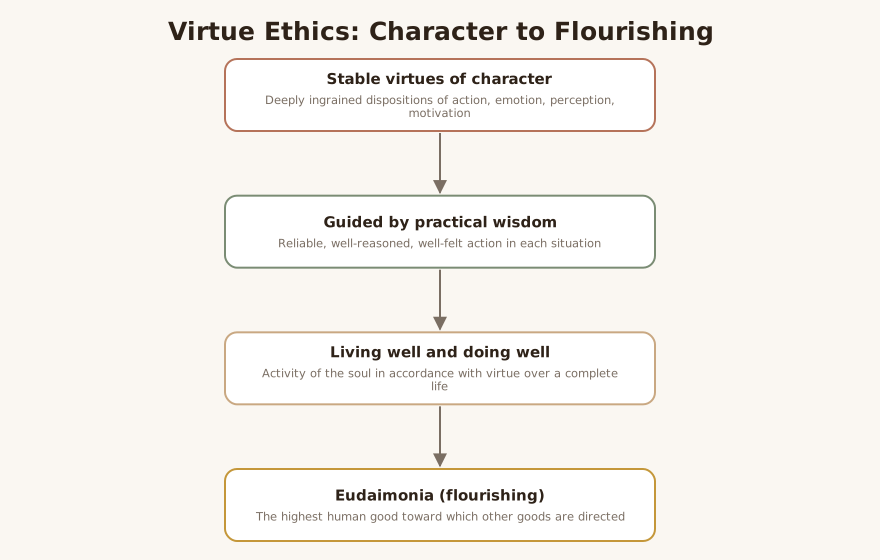
The first principle is the primacy of character. Virtue ethics holds that a virtue is a stable, deeply ingrained trait or disposition—not a fleeting habit or a single good deed—that reliably issues in characteristic patterns of action, emotion, perception, and motivation 1. A truly generous person, for example, gives reliably, gives for the right reasons, and feels appropriately about giving; the trait is woven into how they see situations, not bolted on as a rule 1.
The second principle is eudaimonia as the final end. Eudaimonia is frequently rendered “happiness,” but this is misleading: it does not denote a transient pleasant feeling but rather the activity of living well and doing well—a life that is objectively good and fully realized, sometimes glossed as flourishing or “human flourishing” 4. For Aristotle, eudaimonia is the activity of the soul in accordance with virtue, sustained over a complete life rather than captured in a single moment 2. The Ethics Centre frames it as the highest human good, the end toward which other goods are ultimately directed 5.
The third principle is the function (or ergon) argument: Aristotle reasoned that just as a flute-player or craftsman has a characteristic function whose excellent performance constitutes doing well, the human good consists in the excellent exercise of our distinctively human capacity—rational activity 2. The fourth is the doctrine of the mean: many virtues lie between two vices, one of excess and one of deficiency, so that courage sits between recklessness and cowardice, and the right action is sensitive to the particulars of the situation rather than fixed by formula 6.
The fifth and, for clinicians, perhaps most useful principle is phronesis, or practical wisdom—the intellectual virtue of discerning what the situation actually calls for and acting on it 1. Practical wisdom is what allows a person to apply the virtues well in concrete, messy, particular circumstances; without it, well-intentioned traits can misfire 1. Virtue ethics also generally holds that the virtues are good for their possessor: living virtuously is constitutive of, not merely instrumental to, the flourishing life 1.
Interventions & Techniques
Virtue ethics did not generate clinical interventions; it supplies a vocabulary and a set of reflective practices that clinicians adapt LLM. Several translations into practice are worth naming.
First, values clarification grounded in character. Rather than asking only what a client wants, a clinician can ask what kind of person the client wants to be and which qualities they admire and want to embody—reframing goals from acquisition toward character LLM. This maps naturally onto the values work already central to acceptance and commitment therapy LLM.
Second, the function/flourishing question. Aristotle’s idea that the good life is the active exercise of one’s capacities, not a passive state of feeling good, can be operationalized by helping clients identify and re-engage capacities and activities that express who they are 2. This is conceptually close to behavioral activation, where the therapeutic move is toward valued activity rather than mood repair as such LLM.
Third, the doctrine of the mean as a balance heuristic. Clients struggling with extremes—over-control versus impulsivity, self-sacrifice versus self-protection—can use the “neither too much nor too little” frame to locate a fitting middle calibrated to context 6.
Fourth, cultivating practical wisdom. Because virtues require discernment of particulars, clinical work can emphasize building the judgment to read situations accurately, rather than applying rigid rules—an emphasis congenial to reflective, formulation-driven therapies 1.
LLM-generated illustrative example (not a guideline): A mid-career client reports that despite professional success they feel “empty.” Rather than treating emptiness as a symptom to be eliminated, the clinician introduces the eudaimonic frame: which of their capacities feel underused, and what kind of person they want to be in the next decade. Over sessions, “being a present father and a mentor” emerges as a character aim, and behavioral goals are built backward from it. LLM
Evidence Base
Honesty about evidentiary status matters here. As a philosophical tradition, virtue ethics is highly mature and established: it is one of the three principal approaches in normative ethics, with a continuous scholarly literature from antiquity to the present and a robust modern revival 1. In that sense its standing is not in dispute 1.
As a clinical intervention, however, virtue ethics has no independent evidence base, because it is not a treatment LLM. The provided sources are philosophical reference works and do not report clinical trials, effect sizes, or outcome data LLM. What can be said is that the eudaimonic conception of well-being it inspired has become a recognized strand in contemporary well-being research and positive psychology, where flourishing and meaning are studied as distinct from hedonic (pleasure-based) well-being LLM. Clinicians should therefore treat virtue ethics as a framing and formulation resource whose constructs (meaning, character strengths, flourishing) are operationalized and tested within other, empirically evaluated approaches—not as a stand-alone evidence-based therapy LLM.
A further philosophical caution worth knowing is that the tradition faces well-rehearsed internal objections—chiefly that it can seem to give insufficient action-guidance (telling us to act as the virtuous person would, which may feel circular) and that empirical “situationist” findings have challenged how stable cross-situational character traits really are 1. These debates do not undermine its clinical usefulness as a meaning framework, but they should temper any claim that it delivers crisp behavioral prescriptions 1.
Populations & Indications
Because it is a general account of the good life rather than a diagnosis-specific protocol, virtue ethics is broadly applicable to the general adult population and is particularly resonant for clients explicitly seeking meaning or grappling with the question of how to live 4. It is well suited to people in life transitions—career change, retirement, parenthood, recovery, bereavement—where the relevant question is less “how do I reduce a symptom” and more “what life do I now want to build” LLM.
It has natural appeal for students, clinicians, and ethicists who are reasoning explicitly about how to act and who they want to become LLM. For clients facing values conflicts or identity questions, the character-first orientation offers language that many find more dignifying than a purely symptom-focused frame LLM. The indication, in short, is not a disorder but a clinical theme: meaning, values, character, and flourishing LLM.
Problems-for-Work
The following are presenting concerns where a eudaimonic, character-centered frame can usefully supplement evidence-based treatment.
- Lack of meaning or purpose. The eudaimonic claim that the good life is the active exercise of one’s capacities reframes “no purpose” as “underused capacities,” opening behavioral pathways 2.
- Demoralization. Distinguishing flourishing (a life going well over time) from momentary feeling can reduce the catastrophizing equation of a bad period with a ruined life 4.
- Low life satisfaction. Shifting from hedonic metrics toward whether one is living in accordance with valued character can recalibrate how satisfaction is judged 4.
- Values clarification. The virtues offer a concrete inventory (courage, temperance, justice, generosity, practical wisdom) clients can sort and prioritize 6.
- Existential distress. The tradition supplies a non-religious account of how a life can be objectively good and worth living 5.
- Languishing. The active, function-based conception of well-being targets exactly the “running on empty but not clinically depressed” state 2.
- Identity confusion. “What kind of person do I want to be?” is a workable organizing question when role-based identity is unsettled LLM.
- Low self-esteem. Anchoring worth in cultivable character traits, rather than fixed comparison, offers a growth-oriented basis for self-regard LLM.
Contraindications, Cautions & Cultural Humility
Virtue ethics is not a treatment and should never displace indicated evidence-based care for acute conditions—suicidality, psychosis, severe depression, trauma, or substance use disorders require their respective protocols, and a meaning conversation is an adjunct, not a substitute LLM. Introducing high-level reflection on “the good life” during acute crisis or destabilization can be invalidating or premature, so timing and stabilization come first LLM.
There are genuine philosophical and cultural cautions. The classical Aristotelian list of virtues, and indeed the concept of eudaimonia, arose in a specific ancient Greek context, and what counts as a virtue or as flourishing is shaped by culture and community 6. A clinician who imports a fixed virtue list risks imposing culturally particular ideals; cultural humility means eliciting the client’s own conception of a good life and admired character rather than prescribing one LLM. A second caution is the charge that virtue ethics can valorize individual self-perfection; clinicians should guard against framings that make a client feel that distress reflects a deficiency of character, which can compound shame in clients with low self-esteem or in those whose suffering is driven by oppression, deprivation, or systemic factors rather than personal flaw 1. Finally, because the theory is sometimes criticized for thin action-guidance, it should not be used to adjudicate concrete behavioral dilemmas where the client needs more specific support 1.
Treatment-Plan Suggestions & SMART Objectives
The table below offers illustrative goals translating eudaimonic ideas into measurable objectives; the mechanism column names the working ingredient.
| Goal | SMART objective (example) | Mechanism |
|---|---|---|
| Clarify a personally meaningful conception of the good life | Within 4 sessions, client will articulate and rank 5 admired character qualities and one corresponding life aim, in writing | Values clarification via the virtues as a concrete inventory 6 |
| Re-engage underused capacities to counter languishing | Over 6 weeks, client will schedule and complete 2 valued, capacity-expressing activities weekly, logging completion | Function/active-exercise conception of flourishing 2 |
| Reduce demoralization by distinguishing flourishing from momentary mood | Within 3 sessions, client will correctly differentiate eudaimonic vs. hedonic framing in 3 of their own examples | Reconceptualizing well-being as a life lived well over time 4 |
| Build practical wisdom for a recurring dilemma | Over 5 sessions, client will apply a “what would the person I want to be do here?” reflection to 3 real situations and review outcomes | Cultivation of phronesis / situational discernment 1 |
| Locate a balanced response to an over-/under-extreme pattern | Within 4 weeks, client will identify the deficiency and excess of one target trait and practice a calibrated middle response twice weekly | Doctrine of the mean as a balance heuristic 6 |
| Strengthen self-regard through cultivable character | Over 8 weeks, client will record 1 daily instance of acting in line with a chosen virtue and rate associated self-worth | Worth anchored in growable traits rather than fixed comparison 1 |
| Construct a non-religious account of a worthwhile life | Within 3 sessions, client will write a one-paragraph personal statement of what makes their life worth living | Eudaimonia as the highest human good 5 |
Common Misconceptions
The most common misconception is that eudaimonia means happiness in the modern sense. It does not denote a subjective feeling of pleasure or contentment; it denotes living and doing well across a whole life, which is why “flourishing” is the preferred translation 4. A client can be flourishing through a hard but meaningful stretch while feeling considerable distress 5.
A second misconception is that virtue ethics is anti-feeling or merely about willpower. On the contrary, for Aristotle the virtuous person feels the right emotions, toward the right objects, to the right degree—emotional attunement is part of virtue, not opposed to it 1. A third is that it is a rigid rulebook; in fact it deliberately resists fixed rules in favor of practical wisdom sensitive to particulars 1. A fourth, especially relevant clinically, is that virtue is a single act: it is a stable, cultivated disposition, so neither one good deed nor one lapse defines character 1. Finally, some assume virtue ethics is religious; it can be, but the core Aristotelian account is a secular, naturalistic theory of the human good 5.
Training & Certification
There is no clinical certification in “virtue ethics,” because it is not a therapeutic modality; competence comes from familiarity with the philosophical literature rather than a credentialing pathway LLM. Clinicians who wish to ground their practice in this tradition can read primary and secondary sources—the encyclopedia entries listed below are reputable starting points, and Aristotle’s Nicomachean Ethics is the primary text 2. For application, the relevant trainable skills (values work, behavioral activation, meaning-centered methods) are taught within established, evidence-based frameworks such as acceptance and commitment therapy and positive-psychology-informed practice, and clinicians should pursue supervised training in those modalities rather than in the philosophy as such LLM.
Key Terms
- Virtue (arete): A stable, deeply ingrained excellence of character that reliably produces characteristic action, emotion, and perception 1.
- Eudaimonia: The activity of living and doing well over a complete life; flourishing; the highest human good—not transient pleasure 4.
- Phronesis (practical wisdom): The intellectual virtue of discerning what a particular situation calls for and acting accordingly 1.
- Doctrine of the mean: The view that many virtues lie between an excess and a deficiency, with the right action sensitive to context 6.
- Function argument (ergon): Aristotle’s reasoning that the human good lies in the excellent exercise of our distinctively rational activity 2.
- Cardinal virtues: The classical cluster of wisdom, courage, temperance, and justice 6.
- Normative ethics: The branch of philosophy asking how one ought to act and live, within which virtue ethics is one of three main approaches 1.
Resources & Further Reading
▶ Watch — a video introduction to this concept:
- Virtue Ethics — Stanford Encyclopedia of Philosophy
- Aristotle’s Ethics — Stanford Encyclopedia of Philosophy
- Virtue Ethics — Internet Encyclopedia of Philosophy
- Eudaimonia | Definition & Facts — Encyclopaedia Britannica
- Ethics Explainer: What is eudaimonia? — The Ethics Centre
- Virtue ethics — Wikipedia
Reflective / Supervision Questions
- When I introduce “the good life” or character language with a client, am I eliciting their conception of flourishing, or importing my own culturally particular ideals? LLM
- For this client, is a meaning-and-character frame an appropriate adjunct, or am I reaching for it because I lack a clearer evidence-based formulation of their presenting problem? LLM
- Could a virtue framing inadvertently imply that this client’s distress reflects a defect of character, and how would I guard against compounding shame? LLM
- Have I distinguished eudaimonic flourishing from momentary mood clearly enough that the client does not hear “you should just feel happier”? LLM
- Where the tradition gives thin action-guidance, what concrete, supported behavioral steps am I pairing it with so the client is not left only with abstraction? LLM
- Am I timing meaning-of-life reflection appropriately relative to the client’s stability, or introducing it during acute crisis when stabilization should come first? LLM