
Type & Discipline
Reflective Supervision/Consultation (RS/C) is the signature relationship-based supervision modality of the infant and early childhood mental health (IECMH) field — a regular, collaborative practice in which a provider and a supervisor reflect together on the emotional content of the provider’s work with infants, young children, and their families 12. It is not a technique applied to clients but a sustained working relationship between two professionals, organized around the premise that the quality of that relationship shapes the quality of every relationship downstream of it 3. The Michigan/Alliance Best Practice Guidelines define RS/C specifically as work done “on behalf of the infant and young child’s primary caregiving relationships,” which locates the modality squarely within infant mental health rather than generic clinical oversight 3.
The field distinguishes RS/C from the two other functions supervision is often asked to carry LLM. Administrative supervision manages caseloads, compliance, and accountability; clinical supervision in the traditional sense teaches technique and reviews casework for competence LLM. Reflective supervision attends instead to the practitioner’s internal experience of the work — the thoughts, feelings, and reactions evoked by being close to vulnerable infants and struggling caregivers — and treats that experience as primary data, not as a distraction from the “real” work 3. A guiding aphorism from the field, drawn from Pawl and St. John, captures the stance: how you are is as important as what you do 3.
What makes it a distinct modality rather than a soft add-on is that it has an operationalized structure LLM. The Reflective Interactive Observation Scale (RIOS), co-developed by the Alliance for the Advancement of Infant Mental Health and researchers at the University of Minnesota, names the essential elements and collaborative process tasks that occur within the “Reflective Alliance” — the working relationship at the heart of RS/C 3. The modality, in other words, has a definable anatomy, even though it lives or dies on relationship rather than on protocol 3.
Creators & Lineage
RS/C did not emerge from a single founder but from the convergent work of the early infant mental health movement LLM. Its conceptual taproot is Selma Fraiberg’s clinical infant programs of the 1970s, where the practice of sitting with practitioners’ own emotional responses to harrowing family work first took shape; the MI-AIMH guidelines trace the “strengths are supported, and vulnerabilities are partnered” formulation to Fenichel and to Shahmoon-Shanok 3. Rebecca Shahmoon-Shanok is among the field’s defining voices, and her 1992 description still anchors the modality: “When it’s going well, supervision is a holding environment, a place to feel secure enough to expose insecurities, mistakes, questions and differences” 3.
Jeree Pawl, with Maria St. John, gave the field its enduring axiom in the 1998 ZERO TO THREE volume How You Are Is as Important as What You Do, which crystallized the relational ethic that the practitioner’s way of being — attuned, present, regulated — is itself the instrument of change 3. Deborah Weatherston, a central figure in the Michigan/Alliance Endorsement system, helped translate these clinical intuitions into trainable competencies and into the standards that now govern who may provide RS/C and how, including the considerations involved in delivering it through distance technology 3. Mary Claire Heffron is widely associated with reflective supervision practice and writing in this lineage, contributing to how the field thinks about the supervisory relationship and its emotional demands LLM.
The intellectual surround is broader than infant mental health alone LLM. Donald Schön’s work on the reflective practitioner — thinking-in-action and reflecting on practice — sits behind the modality’s name and is cited in the field’s foundational reference lists 3. Psychoanalytic ideas of the holding environment (Winnicott) and of parallel process supply the mechanism the field leans on most heavily, and attachment theory supplies the developmental logic that the security a practitioner is offered is the security they can pass on 3LLM.
Core Principles
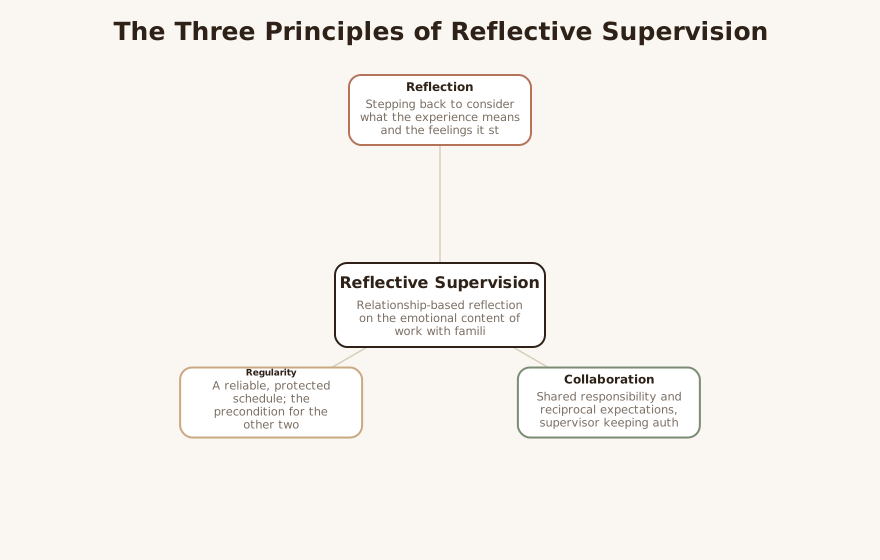
Three principles are named, almost universally, as the load-bearing elements: reflection, collaboration, and regularity 2. Reflection means stepping back from the immediate, intense experience of hands-on work to consider what the experience means — for the family and for the practitioner — and to notice the feelings the work stirs up before acting on them 2. ZERO TO THREE describes this as creating an environment of “safety, calmness, and support,” often using concrete material such as visit notes or video to stimulate dialogue, and it is explicit that the aim is professional development, not therapy for the supervisee 2.
Collaboration means sharing responsibility and a measure of control, while the supervisor retains appropriate authority 2. It is built through reciprocal, jointly developed expectations — sometimes a literal contract — and through communication that runs in both directions and is protected from outside judgment 2. Regularity is the precondition for the other two: “neither reflection nor collaboration will occur without regularity of interactions,” which requires a reliable, protected schedule that is treated as an investment in the workforce rather than as the first thing cancelled when caseloads surge 2.
Underneath these three sits the field’s central wager, the parallel process 3. RS/C attends deliberately to the whole chain of relationships — supervisor to practitioner, practitioner to parent, parent to infant — on the understanding that each affects the others 3. The clinical corollary is directional: if we want caregivers to see, hold, and respond to their infants, the caregivers must have experienced being held themselves; and for practitioners to provide that holding environment to caregivers, the practitioners must have someone providing a safe place for them 3. Reflective supervision is the place where that holding begins 3.
A further principle, easy to lose, is that RS/C keeps the baby in mind 3. The RIOS framework names “Holding the Baby in Mind” as an essential element — prioritizing the infant’s experience and well-being within the web of relationships — so that the practitioner’s distress and the family’s story never fully eclipse the child whose development is the point of the work 3.
Interventions & Techniques
Because RS/C is a relationship rather than a procedure, its “techniques” are mostly disciplines of attention and stance LLM. The RIOS names the essential elements that a good session moves among: Understanding the Family Story (discussing what is known about the baby’s world, the adults around the baby, and the relationships among them, with attention to history and culture); Holding the Baby in Mind (keeping the infant’s experience central); and Professional Use of Self (careful attention to how the practitioner’s own reactions, history, and presence enter the work) 3. These are not steps to complete but threads to weave within the Reflective Alliance 3.
Practically, the field offers concrete structuring moves LLM. The MI-AIMH guidelines suggest establishing a framework or format for each session and beginning with a brief transitional pause — a one-to-five-minute quiet, relaxation, or mindfulness moment — to help participants settle out of multitasking and into shared attention 3. Reviewing real material from the work — visit notes, video, a troubling moment from a home visit — anchors reflection in specifics rather than abstractions 2. The supervisor’s core moves are to wonder aloud, to ask rather than tell, to slow the pace, and to make space for the feelings the work evokes, supporting strengths while partnering vulnerabilities 3.
RS/C is delivered in individual and group formats, and increasingly via distance technology 23. Group RS/C offers a larger holding environment and the chance to practice reflection with peers, though the guidelines note it does not, on its own, meet most criteria for Endorsement and is not a full substitute for individual reflective work 3. When technology is the primary medium, the field advises building in face-to-face contact where possible — at minimum an initial in-person session — because relationship is the instrument and a screen complicates its formation 3.
LLM-generated illustrative example (not a guideline): A home visitor arrives at reflective supervision flat and irritable after a visit in which a depressed mother barely engaged her infant. The supervisor does not move to fix the case. She invites a brief pause, then asks what the visit felt like in the room. As the practitioner describes her own helplessness and a flicker of anger at the mother, the supervisor wonders aloud whether the practitioner’s helplessness might mirror the mother’s, and whether the mother’s flatness might mirror something the mother herself never received. Naming the parallel process loosens it. The practitioner leaves able to hold the mother in mind with more compassion — and with the baby’s needs back in view LLM.
Evidence Base
The honest label for RS/C’s maturity is established — meaning it is a field-defining, widely implemented modality with formal standards and a growing literature, while still being thin on the kind of controlled evidence that would let anyone call it empirically validated 1LLM. The field has implemented RS/C since the 1990s largely on the basis of theory and accumulated clinical wisdom rather than trial data, and a clinician should hold both halves of that sentence at once 1.
The most rigorous summary available is a systematic review of RS/C in early childhood-serving programs, which screened the literature down to 28 articles representing 24 unique samples and found no randomized controlled trials and only a single study using a comparison group 1. The evidence is overwhelmingly about the workforce, not directly about children or families 1. On the workforce side the signal is real: studies associate RS/C with increased reflective capacity and self-efficacy, better observational and perspective-taking skills, less directive practice, and improved well-being — reduced burnout and secondary traumatic stress, higher compassion satisfaction, lower intention to quit, and better emotional regulation 1. Notably, qualitative studies showed more consistent positive results than quantitative ones, a pattern worth sitting with rather than glossing 1.
The gaps are specific and important LLM. No study in the review directly measured child or family outcomes; the closest evidence is three qualitative studies suggesting improved provider–family relationships and communication 1. The review’s own verdict is appropriately restrained: “While RS/C shows great promise, it was difficult to ascertain its overall effectiveness from an empirical standpoint,” and establishing it as empirically supported “will be possible with more rigorous research” 1. The supervisees themselves are clear that RS/C supports their work with infants and families, which is meaningful first-person testimony even where controlled outcome data lag 4. The fair stance for practice is to treat RS/C as a well-justified standard of care for the workforce whose downstream effects on children remain plausible and under-tested 1LLM.
Populations & Indications
RS/C is, by design, a workforce intervention — its direct “population” is the practitioner, and its ultimate beneficiary is the infant LLM. The professionals for whom it is intended are those working in the infant and early childhood field: home visitors, early interventionists, early care and education staff, child welfare workers, IECMH clinicians and consultants, and the policy leaders who steer this work 3. The systematic review’s settings map this directly — early care and education, home visiting, child welfare, early intervention, and community mental health — and RS/C is explicitly used in Head Start and Early Head Start to build staff capacity for relationship-based work with young children and families 16.
The indication is essentially universal within the field rather than diagnostic LLM. Any practitioner whose work brings them into sustained, emotionally demanding contact with vulnerable infants and caregivers is a candidate, because the work reliably stirs up reactions that, unattended, distort care 3. RS/C is also written into the Alliance’s Endorsement for Culturally Sensitive, Relationship-Focused Practice as a required experience, which means that for many IECMH professionals it is not optional enrichment but a credentialing standard 3.
One honest caveat about the existing evidence and population reach: in the reviewed studies the participants were predominantly White, non-Hispanic women, and nearly all studies were conducted in the United States 1. The modality’s relevance to a more diverse workforce and to other national contexts is asserted by the field but under-documented in the controlled literature 1LLM.
Problems-for-Work
The problems RS/C addresses sit at the provider level, and naming them concretely matters because they are the documented targets of the modality LLM. Secondary traumatic stress and burnout are central: the work of bearing witness to maltreatment, loss, and caregiver suffering accumulates, and RS/C is associated with reducing this load and increasing compassion satisfaction 1. Eroded reflective capacity — the slide into reactive, directive, “just fix it” practice under caseload pressure — is a primary target; RS/C is linked to more observation, more wondering, and less directiveness 1.
LLM-generated illustrative example (not a guideline): An early-intervention provider notices she has started dreading one family and quietly hoping they cancel. In reflective supervision she and her supervisor name the avoidance rather than judging it, trace it to a particular interaction that frightened her, and consider what in the family’s history might be driving the dynamic she keeps colliding with. The avoidance, once spoken, stops running the case from underground LLM.
Parallel-process enactments are a distinctive problem-for-work: when a practitioner unknowingly reenacts a family’s dynamic — withdrawing from a withdrawn parent, controlling a chaotic case — RS/C is the place those enactments become visible and workable 3. Practitioner isolation and intention to quit are addressed structurally, because regular reflective contact reduces the loneliness of emotionally heavy work and is associated with lower turnover intention 1. And losing the baby in mind — the drift of attention onto adult crises until the infant disappears from the formulation — is named directly by the RIOS as something the reflective pair must actively guard against 3.
Contraindications, Cautions & Cultural Humility
The first caution is conceptual: RS/C is not therapy for the supervisee, and the boundary matters 2. ZERO TO THREE is explicit that the work is professional development focused on work-related experience, not treatment of the practitioner’s personal life, and a supervisor who lets the sessions slide into the practitioner’s own psychotherapy has crossed a line the modality deliberately draws 2LLM. A related structural hazard is the dual relationship: when the reflective supervisor is also the administrative supervisor who evaluates and can discipline, the safety required for honest disclosure is harder to establish, which is part of why the field also recognizes reflective consultation from an outside, non-evaluative provider 3.
RS/C also has real prerequisites that function as soft contraindications LLM. It cannot work without regularity and protected time; in a program unwilling to defend the schedule, what gets called reflective supervision degrades into case management or crisis triage and should not be mistaken for the modality 2. Distance-only delivery without any face-to-face contact is cautioned against, because the relationship that is the instrument is harder to build through a screen 3.
Cultural humility is not an add-on here but a named demand of the work LLM. The RIOS frames Understanding the Family Story as requiring attention to the family’s history and culture, and the Alliance’s Endorsement is explicitly for “Culturally Sensitive, Relationship-Focused Practice,” signaling that reflecting on one’s own biases and shifting perspective is core to the competency 3. The evidence caveat reinforces the humility: because the studied workforce has been predominantly White women in the United States, a supervisor should be wary of treating the modality’s norms — about emotional disclosure, hierarchy, and what a “good” reflective conversation sounds like — as culturally neutral 1LLM.
Treatment-Plan Suggestions & SMART Objectives
| Goal | SMART objective (example) | Mechanism |
|---|---|---|
| Establish protected reflective time | Provider and supervisor hold a scheduled reflective session at a fixed regular interval, rescheduled (not cancelled) when conflicts arise, sustained across the period | Regularity is the precondition for reflection and collaboration 2 |
| Build the reflective alliance | Within the opening sessions, the pair jointly develop a working agreement defining expectations and confidentiality before substantive case reflection begins | Collaboration is built through reciprocal, jointly held expectations 2 |
| Reduce reactive, directive practice | Over a defined number of sessions, the provider shifts from problem-solving a case to first describing the feelings it evokes, in the majority of sessions | Reflection means pausing on meaning and affect before acting 2 |
| Surface and work a parallel process | The pair names at least one parallel-process dynamic linking the provider’s reaction to a family relationship, and traces its effect on care | Parallel process connects supervisor–provider–parent–infant relationships 3 |
| Keep the infant central | In each case discussion, the pair explicitly returns attention to the baby’s experience and developmental needs before closing | “Holding the Baby in Mind” guards against the infant disappearing from the work 3 |
| Address secondary traumatic stress | The provider names accumulating emotional load in supervision and identifies one supported response, with reduced distress tracked over time | RS/C is associated with reduced secondary traumatic stress and burnout 1 |
| Strengthen professional use of self | The provider articulates how their own history or reaction entered a specific case and what to do with that awareness | “Professional Use of Self” makes the practitioner’s reactions usable data 3 |
| Sustain workforce retention | The provider reports, over the supervision period, increased compassion satisfaction and reduced intention to leave the role | RS/C is associated with higher compassion satisfaction and lower turnover intention 1 |
Common Misconceptions
The first misconception is that reflective supervision is just supportive supervision under a nicer name LLM. It has an operationalized structure — the RIOS essential elements and collaborative process tasks within a defined Reflective Alliance — and a formal standards framework, which makes it a specifiable modality rather than a vibe 3. A second is that it is therapy for the supervisee; the field is emphatic that it is professional development focused on the work, not treatment of the practitioner’s personal history 2.
A third misconception is that it is unstructured chatting that “anyone can do” LLM. The Endorsement system specifies who may provide RS/C, with requirements about the provider’s qualifications and the source and continuity of the supervision, precisely because the relationship is the instrument and not just any relationship will do 3. A fourth is that group reflective supervision can simply replace individual work; it is valuable and offers a wider holding environment, but the guidelines note it does not by itself meet most Endorsement criteria 3.
A fifth, and the most consequential for an honest field, is that the evidence base is robust LLM. The systematic review found no randomized controlled trials, only one controlled study, and essentially no direct measurement of child outcomes — so RS/C should be presented as a theory-rich, workforce-supported standard of practice, not as an empirically validated treatment with proven effects on children 1.
Training & Certification
There is no single license that owns RS/C; it is provided by appropriately qualified professionals within the IECMH field, and the most developed credentialing pathway runs through the Alliance for the Advancement of Infant Mental Health’s Endorsement for Culturally Sensitive, Relationship-Focused Practice 3. Within that system, receiving RS/C is itself a documented requirement for Endorsement, and providing it is governed by best-practice guidelines that specify the provider’s preparation, the expectation of continuity with one supervisor over time, and the responsibilities providers carry — including completing reference ratings of applicants’ competencies in Reflection, Working with Others, and Thinking 3.
The Best Practice Guidelines distinguish the reflective supervisor (often internal, sometimes also the program supervisor) from the reflective consultant (contracted from outside the organization), and set out distinct guidelines for the provider and for the supervisee/consultee, signaling that being a good reflective supervisee is also a learned competency 3. Training emphasizes the RIOS framework, the disciplines of holding a reflective stance, and the practicalities of delivery — including how to sustain a relationship across distance technology when in-person contact is limited 3. ZERO TO THREE and the state and national AIMH affiliates supply much of the accessible training and orientation material that introduces practitioners to the three building blocks before they pursue formal Endorsement 25.
Key Terms
Reflective Supervision/Consultation (RS/C) — a regular, collaborative, reflective relationship between a provider and a supervisor focused on the emotional content of work with infants, young children, and families 13. Reflective supervisor vs. reflective consultant — a provider internal to the organization (often also the program supervisor) versus one contracted from outside; the distinction matters for evaluative safety 3. The three building blocks — reflection, collaboration, and regularity, the foundational elements of effective RS/C 2. Parallel process — the field’s central mechanism: the recognition that the supervisor–provider, provider–parent, and parent–infant relationships each shape the others 3. Holding environment — the secure, steadying relational space in which a practitioner can expose insecurities and mistakes, which they can then extend to caregivers 3. RIOS (Reflective Interactive Observation Scale) — the measurement-and-practice tool defining the essential elements (Understanding the Family Story, Holding the Baby in Mind, Professional Use of Self) and collaborative process tasks of RS/C 3. “How you are is as important as what you do” — the field’s defining axiom (Pawl & St. John) that the practitioner’s way of being is itself the instrument of change 3. Endorsement — the Alliance credential (Culturally Sensitive, Relationship-Focused Practice) for which RS/C is a required experience 3.
Resources & Further Reading
▶ Watch — a video introduction to this concept:
- Barron, C. (2022). From the voices of supervisees: What is reflective supervision and how does it support their work? — Infant Mental Health Journal
- Reflective Supervision and Consultation and its Impact Within Early Childhood-Serving Programs: A Systematic Review — PMC
- Best Practice Guidelines for Reflective Supervision/Consultation — MI-AIMH / Alliance for the Advancement of Infant Mental Health (PDF)
- Three Building Blocks of Reflective Supervision for Early Childhood Professionals — ZERO TO THREE
- What Is Reflective Supervision? — New Mexico AIMH
- Using Reflective Supervision to Build Capacity — HeadStart.gov
Reflective / Supervision Questions
- When you sit with a supervisee who arrives flat or irritable after a hard visit, how do you decide whether the most useful move is to help with the case or to pause on what the work stirred up in them? LLM
- How do you tell the difference between reflective supervision that has deepened into the supervisee’s own emotional experience of the work and supervision that has drifted into therapy for the supervisee, and where do you draw that line in practice? LLM
- If you hold both administrative authority over a supervisee and their reflective supervision, what concrete steps do you take to protect the safety they need to disclose mistakes and uncertainty? LLM
- When a supervisee seems to be reenacting a family’s dynamic — withdrawing, over-controlling, rescuing — how do you name the parallel process without it landing as accusation? LLM
- How do you keep the baby in mind in supervision when the adult crises in a case are loud enough to crowd the infant out of the conversation? LLM
- Given that the controlled evidence for reflective supervision is thin and concentrated on workforce rather than child outcomes, how do you justify the protected time it requires to a program under caseload pressure — and what would change your own confidence in it? LLM
- Whose cultural norms about emotional disclosure, hierarchy, and “good” reflection are operating in your reflective sessions, and how would you know if your stance fit you better than it fit your supervisee? LLM