
Type & Discipline
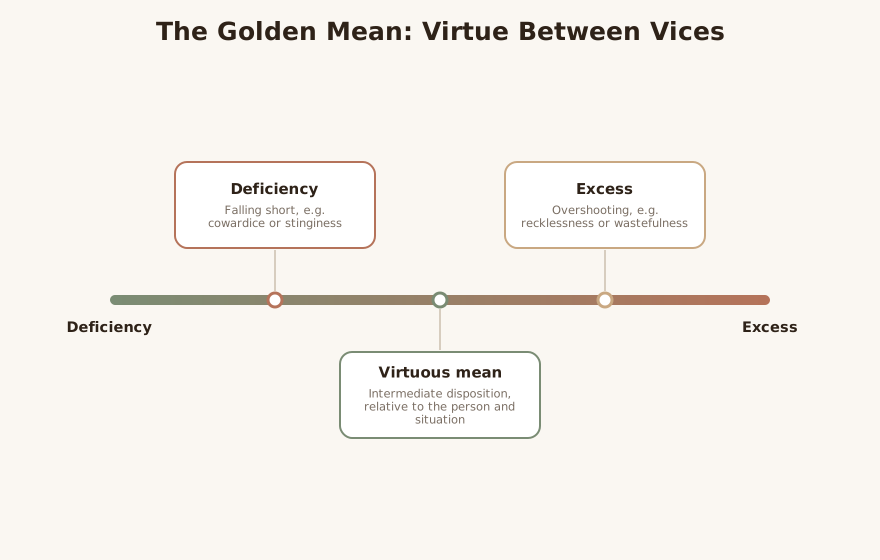
The Golden Mean, also called the doctrine of the mean, is a concept from Western moral philosophy rather than a clinical treatment or psychological theory 6. It belongs to virtue ethics, the tradition that locates morality in stable traits of character rather than in rules or consequences alone 1. In its classical form the doctrine holds that moral virtue is a kind of balance: a disposition that aims at an intermediate point between two vices, one of excess and one of deficiency 6. The often-cited example is courage, understood as the mean between the deficiency of cowardice and the excess of rashness or recklessness 2.
For clinicians, the Golden Mean is best treated as an organizing heuristic and a piece of philosophical scaffolding, not a billable modality or an evidence-based protocol LLM. It offers a vocabulary for thinking about balance, calibration, and “enough” that maps onto familiar clinical problems such as perfectionism, emotional extremes, and all-or-nothing thinking, but any clinical use sits inside a recognized therapy rather than standing on its own LLM. Understanding both what the doctrine claims and what it does not claim keeps its application appropriately modest LLM.
Creators & Lineage
The doctrine is most closely associated with Aristotle, who developed it in his Nicomachean Ethics in the fourth century BCE 3. Aristotle did not invent the underlying intuition that virtue lies in moderation; versions of a “nothing in excess” ideal appear across ancient Greek thought, and comparable doctrines of the mean appear independently in other traditions, including Confucian and Buddhist thought 2. What Aristotle contributed was a systematic ethical theory in which the mean is not an abstract slogan but a structural feature of every moral virtue 1.
In the Nicomachean Ethics, Aristotle situates the doctrine within a larger account of the human good 3. He argues that the highest human end is eudaimonia, usually translated as happiness or flourishing, and that flourishing consists in activity of the soul in accordance with virtue over a complete life 1. Virtues of character, such as courage, temperance, and generosity, are acquired through habituation, repeated practice that gradually shapes stable dispositions 1. It is within this developmental picture that the mean appears: a virtuous person is one who has been trained to feel and act in the right way, to the right degree, at the right time, toward the right people, for the right reason 3.
The doctrine’s later lineage runs through the medieval reception of Aristotle and into modern virtue ethics, and its balance logic has informal echoes in several contemporary clinical traditions LLM. The dialectical stance in dialectical behavior therapy, which holds opposing truths such as acceptance and change in tension, resonates with the mean’s refusal of extremes LLM. Values-based work in acceptance and commitment therapy, and the focus on character strengths in positive psychology, likewise share the Aristotelian premise that a good life is built from cultivated dispositions rather than the mere absence of symptoms LLM. These are conceptual affinities, not historical derivations, and should be presented as such LLM.
Core Principles
The first principle is that virtue is a mean between two vices 6. For each sphere of feeling or action there is a way of overshooting and a way of falling short, and the virtuous disposition occupies the intermediate territory between them 2. Generosity, for instance, sits between the deficiency of stinginess and the excess of wastefulness, and proper ambition between sloth and grasping over-ambition 6.
The second principle is that the mean is relative to us, not a fixed arithmetic midpoint 2. Aristotle is explicit that the intermediate is not the same quantity for everyone; the right amount of food for a trained athlete differs from the right amount for a beginner, and by analogy the right degree of a response depends on the person and the circumstances 6. The mean is therefore determined by practical wisdom in context, not by a formula 1.
The third principle is that hitting the mean is difficult, while missing it is easy 4. Aristotle compares the target of virtue to a single point that can be missed in many directions, whereas error has a wide field 4. He also notes that we are not all pulled equally toward both vices; each person tends by temperament toward one extreme, and part of practical wisdom is knowing one’s own characteristic pull and leaning deliberately toward the opposite 4.
A fourth and important qualification is that the mean applies to feelings and actions that admit of degrees, not to acts that are wrong in themselves 1. Aristotle holds that some actions and emotions, such as spite, envy, murder, or adultery, are bad as such and have no virtuous mean; there is no “right amount” of them to aim at 3. The doctrine is thus a structure for calibrating morally legitimate responses, not a licence to seek a comfortable middle in every situation LLM.
Finally, the mean is bound up with practical wisdom, phronesis, the capacity to perceive what a situation calls for and to act accordingly 1. The virtuous person is defined partly by feeling the right emotions to the right degree, so the doctrine concerns the regulation of affect and not merely outward behavior 3. This makes it unusually relevant to emotional life: virtue, for Aristotle, includes feeling anger or fear neither too much nor too little but as the situation warrants 1.
Interventions & Techniques
Because the Golden Mean is a framework rather than a therapy, “techniques” here means structured ways to embed its logic inside recognized clinical work LLM. The most direct application is the continuum or dimensional reframe: helping a client locate a trait, emotion, or behavior on a line running from deficiency through a workable middle to excess, rather than treating it as simply good or bad LLM. This externalizes the balance question and gives client and clinician a shared map LLM.
A second technique is identifying the client’s characteristic pull, in the spirit of Aristotle’s advice to lean toward the opposite of one’s besetting extreme 4. A clinician can help a client name whether they habitually overshoot or undershoot in a given domain, then practice a corrective tilt: a chronically conflict-avoidant client deliberately voicing mild disagreement, or a chronically reactive client deliberately delaying a response LLM.
A third technique is the “relative to us, in context” inquiry, which converts a global judgment into a situational one 6. Instead of asking whether the client is “too much” or “not enough” in general, the work asks what this situation, with these people and stakes, actually calls for, which is precisely the practical-wisdom move Aristotle describes 1. This pairs naturally with the dialectical idea of holding two valid considerations at once and synthesizing a response rather than collapsing into one pole LLM.
A fourth application is habituation, treating virtuous responses as skills built by repetition rather than insights arrived at once 1. This aligns the doctrine with the behavioral-rehearsal and skills-practice spine of much evidence-based therapy: the client does not wait to “feel” balanced but practices balanced action until the disposition takes hold LLM.
LLM-generated illustrative example (not a guideline): A client with anger problems describes himself as either “completely calm” or “blowing up,” with nothing in between. Using a continuum, the clinician maps the deficiency end (swallowing every grievance until resentment builds) against the excess end (explosive aggression) and frames assertive, proportionate expression as the workable middle. They identify the client’s characteristic pull toward suppression, then practice graded assertion scripts so the proportionate response becomes available before the next provocation LLM.
Evidence Base
Honesty about evidence requires a clear distinction here LLM. The Golden Mean is an established and historically central doctrine within philosophy, foundational to virtue ethics and continuously studied and debated for over two millennia 1. “Established” in this sense refers to its philosophical standing and influence, not to validation as a clinical intervention LLM. There are no randomized trials of “the Golden Mean,” because it is not a treatment and has not been studied as one LLM.
Within philosophy itself the doctrine is not uncontested LLM. A recurring scholarly criticism is that the mean is, on its own, indeterminate: telling someone to feel anger “neither too much nor too little” does not specify how much is right, so the doctrine arguably presupposes the practical wisdom it is meant to explain rather than supplying an independent decision rule 4. Aristotle’s own response is that the mean is fixed by the judgment of the practically wise person in context, which critics regard as either a strength (it resists rigid formulas) or a weakness (it lacks operational content), depending on one’s view 1.
For clinical purposes, then, the defensible claim is narrow: the doctrine offers a coherent and intuitively powerful conceptual frame for balance, calibration, and proportionality, and that frame overlaps with mechanisms in therapies that do have outcome evidence, such as the dialectics of DBT and values work in ACT LLM. The frame should be presented to clients as an organizing idea, not as an evidence-based therapy for a specific condition, and the actual change should be delivered through a recognized modality LLM.
Populations & Indications
The doctrine’s clinical fit is strongest with adults in psychotherapy who are working on character, values, and patterns of over- or under-doing rather than acute symptom relief LLM. It is well suited to people seeking personal growth, for whom the language of flourishing and cultivated disposition is congenial and non-pathologizing 2. Coaching clients are a natural population as well, since much of coaching concerns calibrating ambition, assertiveness, and effort to a sustainable middle LLM.
Clients with perfectionism are a particularly apt indication, because perfectionism is, in Aristotelian terms, a failure of the mean, an excess of standard-setting that overshoots what the situation requires LLM. Clients with emotion regulation difficulties are addressed by the doctrine’s claim that virtue includes feeling emotions to the right degree, which reframes regulation as proportionality rather than suppression 3. The framework can also be relevant for individuals with personality disorders, where rigid, extreme dispositions, whether of avoidance, intensity, or self-regard, can be re-described as departures from a workable mean, though this must be done within a structured, evidence-based treatment and never as a moral judgment LLM.
The doctrine is largely diagnosis-neutral: it shapes how a clinician frames balance and habituation rather than dictating which condition is treated LLM.
Problems-for-Work
Several presenting problems map cleanly onto the deficiency–mean–excess structure LLM. For perfectionism and all-or-nothing thinking, the continuum reframe directly counters the binary that drives both: the client practices identifying a “good enough” middle rather than oscillating between flawless and worthless LLM.
For emotion dysregulation and anger management problems, the doctrine’s insistence on the right emotion to the right degree gives a target that is neither numb suppression nor unchecked discharge, but proportionate response 3. For impulsivity, the work names the excess pole and builds the practical-wisdom pause in which context is weighed before action 1.
For avoidant behavior and certain forms of anxiety, the deficiency end is the operative one: the client is undershooting on engagement, and the corrective tilt is toward graded approach, consistent with Aristotle’s advice to lean against one’s characteristic pull 4. For low self-esteem, the framework can locate self-regard on a continuum between excessive self-deprecation and inflated self-importance, with healthy self-respect as the mean 6. For moral and value conflicts, the doctrine supplies an explicit ethical vocabulary, while respecting Aristotle’s caution that some acts have no virtuous mean and are simply to be avoided 3.
LLM-generated illustrative example (not a guideline): A client with social anxiety avoids speaking in meetings, then berates herself for being “weak.” Using the mean, the clinician frames silence as the deficiency end and reckless oversharing as the excess end, with measured contribution as the middle. The plan is graded: one prepared comment per meeting, building the disposition through repetition rather than waiting to feel confident first LLM.
Contraindications, Cautions & Cultural Humility
The doctrine has no contraindications in a pharmacological sense, but several cautions matter LLM. The first is the misuse of “balance” to counsel a harmful middle where one does not exist LLM. Aristotle himself excludes acts that are wrong in themselves from the doctrine, so the framework must never be used to suggest a “moderate” amount of self-harm, abuse tolerance, or other categorically harmful behavior 3. In situations of safety, victimization, or trauma, there is no virtuous mean to seek, and the clinician should say so plainly LLM.
A second caution is that the mean can become a covert vehicle for the clinician’s own values about how much is “too much” LLM. Because the mean is relative to the person and is fixed by judgment rather than formula, it is easy to smuggle in a normative standard the client never endorsed 1. The corrective is to keep the client as the arbiter of what their situation calls for, using the structure as a question rather than an answer LLM.
A third caution concerns acute presentations LLM. A reflective, character-oriented framing is poorly matched to acute crisis, active psychosis, or acute suicidality, where structure, containment, safety planning, and evidence-based stabilization take priority over philosophical reframing LLM.
Cultural humility is essential because Aristotle’s account of flourishing emerged from a specific ancient Greek context and carries assumptions, including an individual-centered picture of virtue and a historically bounded list of admirable traits 5. What counts as the right degree of assertiveness, emotional expression, or self-assertion varies substantially across cultures, families, and gendered expectations, and a “mean” that is healthy in one context may be excess or deficiency in another LLM. Clinicians should treat the doctrine as one cultural articulation of balance and calibrate every continuum to the client’s own values and context, not to a presumed universal midpoint LLM.
Treatment-Plan Suggestions & SMART Objectives
The deficiency–mean–excess structure makes the Golden Mean a practical engine for writing balance-oriented objectives within a broader treatment plan LLM. The examples below are illustrative templates to adapt, not prescriptions LLM.
| Goal | SMART objective (example) | Mechanism |
|---|---|---|
| Reduce perfectionistic over-functioning | Within 8 sessions, client will identify 3 recurring tasks and define a written “good enough” standard for each, then complete 2 per week to that standard without revision | Locating the excess pole and rehearsing a workable mean 6 |
| Soften all-or-nothing thinking | Over 6 weeks, client will record 2 situations per week using a 0–10 continuum rather than a pass/fail label, noting the middle option each time | Replacing binary judgment with dimensional calibration 2 |
| Improve proportionate emotional response | Within 10 sessions, client will name, in 3 logged incidents, what a right-sized emotional response would have been between numbing and overreaction | Aiming at the mean in feeling, not only action 3 |
| Build the practical-wisdom pause for impulsivity | For 6 weeks, client will use a brief context-check (stakes, people, timing) before acting in 1 identified high-risk situation per week | Weighing context before action per practical wisdom 1 |
| Increase approach toward avoided situations | Over 8 weeks, client will complete 1 graded approach task per week in a domain they currently undershoot | Leaning deliberately against the deficiency pull 4 |
| Calibrate healthy self-regard | Within 10 sessions, client will distinguish, in writing, self-deprecating, accurate, and inflated appraisals of 3 recent events | Locating self-respect between two extremes 6 |
| Strengthen assertiveness to a workable middle | Over 6 weeks, client will practice 1 proportionate assertion per week, neither suppressing nor escalating, and review outcomes | Habituating the mean through repetition 1 |
Common Misconceptions
A frequent error is reading the mean as a strict arithmetic average, a fixed midpoint equidistant from both extremes 2. Aristotle explicitly denies this; the intermediate is relative to the person and situation and is not the same quantity for everyone 6. A second misconception treats the doctrine as a counsel of bland moderation in all things, when in fact the right response may sit much closer to one extreme, and courage in a genuine emergency may call for a near-maximal response that is still the mean for that situation 4.
A third error is supposing that every feeling and action has a virtuous mean 1. Aristotle holds that some emotions and acts are bad in themselves and admit of no mean, so the framework is not a tool for finding a moderate amount of envy, spite, or cruelty 3. A fourth is collapsing the mean into a decision procedure; the doctrine describes the structure of virtue but relies on practical wisdom to determine the right amount in any case, which is why it cannot be applied mechanically 1. Finally, clinicians sometimes mistake the doctrine for an evidence-based therapy; it is an established philosophical framework whose clinical value is conceptual and must be delivered through a validated modality LLM.
Training & Certification
There is no certification in “the Golden Mean,” and no clinician practices it as a standalone credentialed modality LLM. The concept is learned through philosophy and ethics education, primarily through reading Aristotle’s Nicomachean Ethics and secondary scholarship on virtue ethics 3. For clinicians, the relevant competence is not in the doctrine itself but in the evidence-based therapies through which its balance logic is delivered, such as cognitive behavioral therapy, DBT, and ACT, each of which has its own established training and supervision pathways LLM.
Clinicians who wish to integrate virtue-ethics language into their work are best served by grounding it in a strong reading of the primary and reference literature so the concept is represented accurately, and by being explicit, in both consent and documentation, that it functions as an organizing frame rather than a discrete treatment LLM. As with any integrative element, competence and scope should be represented honestly LLM.
Key Terms
Golden mean / doctrine of the mean — the principle that moral virtue is an intermediate disposition between an excess and a deficiency 6. Virtue (of character) — a stable, habituated disposition to feel and act well, acquired through practice 1. Excess and deficiency — the two vices flanking each virtue, the ways of overshooting and undershooting the mean 2. Relative to us — Aristotle’s qualification that the mean is determined by the person and situation, not by a fixed quantity 6. Eudaimonia — flourishing or the good life, the highest human end, consisting in virtuous activity over a complete life 1. Practical wisdom (phronesis) — the capacity to perceive what a situation calls for and act accordingly, which determines the mean in context 1. Habituation — the acquisition of virtues through repeated practice rather than instruction alone 1. Acts wrong in themselves — emotions and actions that admit of no virtuous mean and are simply to be avoided 3.
Resources & Further Reading
▶ Watch — a video introduction to this concept:
- Aristotle’s Ethics — Stanford Encyclopedia of Philosophy
- Golden mean | Definition, Aristotle, Maimonides, Buddhism, Confucianism, & Facts — Encyclopaedia Britannica
- Nicomachean Ethics — Wikipedia
- The ‘Golden Mean’: Aristotle’s Guide to Living Excellently — Philosophy Break
- Aristotle’s Concept of Virtue: The Golden Mean and Human Excellence — PolSci Institute
- Golden mean (philosophy) — Wikipedia
Reflective / Supervision Questions
- When I help a client find “balance,” whose standard of the mean am I using — theirs, or my own values about how much is too much LLM?
- Am I applying the deficiency–mean–excess frame only where it fits, and naming clearly the situations (abuse, self-harm, safety) where there is no virtuous middle to seek LLM?
- How do I distinguish a client ready for reflective character work from one who first needs structure, stabilization, and an evidence-based protocol LLM?
- For this client, which extreme is their characteristic pull, and am I helping them lean against it without overshooting into the opposite vice LLM?
- Does the cultural context of this client redraw where the mean actually lies for assertiveness, emotional expression, or self-regard, and have I calibrated to their world rather than a presumed universal LLM?
- Am I representing this honestly to the client — as an established philosophical frame delivered through a recognized therapy, not as a validated treatment for their condition LLM?