
Type & Discipline
Philia and eudaimonia are not a therapy. They are linked concepts from Aristotle’s moral philosophy — specifically his Nicomachean Ethics — and they sit within the family of virtue ethics and the philosophical theory of well-being 1. Eudaimonia is usually rendered “happiness” but is better translated as “flourishing” or “living well,” and Aristotle defines it as activity of the rational soul in accordance with virtue 1. Philia is the broad Greek term for friendship and love, encompassing companionship, family bonds, and civic affection, and Aristotle treats it as indispensable to the flourishing life 5. LLM
For clinicians, the relevance is conceptual rather than procedural: this is a framework that names what a good life consists of and why relationships matter to it, supplying language and aims that sit upstream of any particular technique. LLM It has become foundational to “eudaimonic” models of well-being in psychology, which distinguish flourishing (growth, meaning, authenticity, excellence) from mere pleasant feeling 4. LLM
Creators & Lineage
The originating figure is Aristotle (384–322 BCE), whose Nicomachean Ethics is the primary text 2. The argument unfolds across that work, with friendship treated at length in Books VIII and IX 6. The core idea is the “function argument”: the human good must relate to what is distinctive about being human — the rational part of the soul — so the good life is “activity of the rational part of the soul in accordance with virtue” 1.
The modern clinical lineage runs through positive psychology and well-being research. Carol Ryff’s six-factor model of psychological well-being explicitly draws on Aristotelian flourishing, measuring constructs tied to “fulfilling one’s virtuous potentials” rather than momentary pleasure 4. Martin Seligman’s work moved positive psychology from “authentic happiness” toward a broader account of flourishing 4. Richard Ryan and Frank Martela connect Aristotle directly to self-determination theory, reframing eudaimonia as a way of living rather than a feeling or outcome 3. The framework also resonates with existential therapy and well-being therapy, which target meaning, purpose, and personal growth rather than symptom reduction alone. LLM
Core Principles
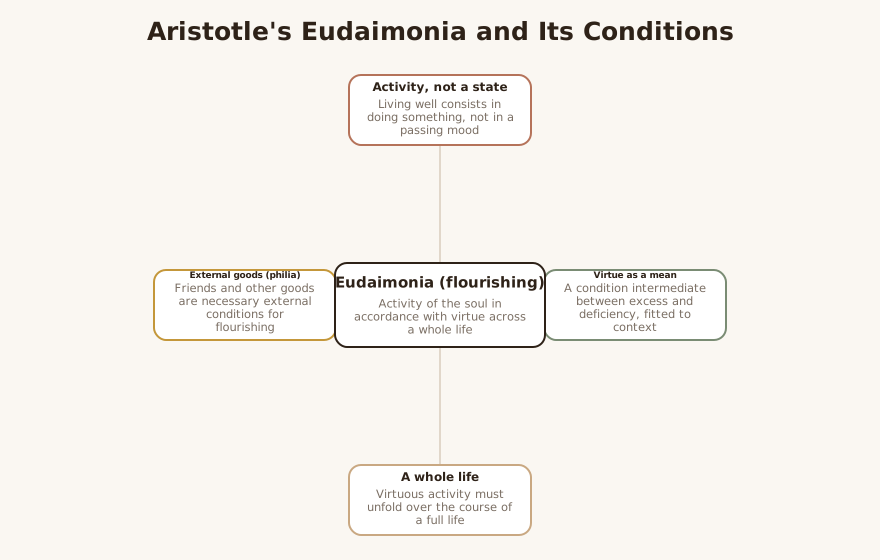
Flourishing is activity, not a state. Aristotle insists that “living well consists in doing something, not just being in a certain state or condition” 1. Eudaimonia is something you do over time, not a mood you happen to be in — a point with obvious resonance for behavioral activation and values-based work. LLM
Virtue is a mean between extremes. Each ethical virtue is “a condition intermediate between two other states, one involving excess, and the other deficiency,” and the mean is not arithmetic but contextual, fitted to “the particular circumstances of the individual” 1. Courage sits between recklessness and cowardice; the practical task is calibration to the situation, not the elimination of feeling. LLM
Eudaimonia requires a whole life. Virtuous activity must unfold “over the course of a full life”; a single good act or a good afternoon does not constitute flourishing 1. This temporal framing pushes clinical conversation away from momentary affect and toward trajectory and narrative. LLM
External goods, including friends, are necessary. Aristotle is not a Stoic on this point: he holds that one must also possess goods “such as friends, wealth, and power,” without which virtuous activity becomes “diminished or defective” 1. Flourishing is not purely internal; relationships and circumstances genuinely matter 1.
Eudaimonia is distinct from pleasure (hedonia). Pleasure accompanies virtuous activity but is not identical to happiness 1. Well-being researchers preserve this split: eudaimonic elements are growth, authenticity, meaning, and excellence, whereas hedonic elements are pleasure, enjoyment, and life satisfaction 4. A client can feel good and not be flourishing, or be doing well and not feel especially good. LLM
Philia comes in three kinds. Aristotle distinguishes friendships of utility (based on mutual usefulness), friendships of pleasure (based on shared enjoyment), and friendships of virtue — the complete or “perfect” friendship in which each person values the other for their character and wills the other’s good for the other’s own sake 5. Only virtue friendship is stable and central to flourishing, because it does not dissolve when usefulness or pleasure fades 5.
Interventions & Techniques
Because this is a philosophy rather than a protocol, “interventions” means clinical applications of the concepts, typically woven into existential, meaning-centered, positive-psychology, or values-based work. LLM None of the following is a manualized Aristotelian technique; each is a translation of the framework into practice. LLM
- Eudaimonic case formulation. Reframe the goal of treatment, where appropriate, from symptom absence toward flourishing — meaning, growth, authentic engagement, and good relationships 4. This parallels Ryff’s six well-being domains as concrete targets 4. LLM
- Friendship inventory. Map a client’s relationships against Aristotle’s three types: which are utility, which pleasure, which approach virtue friendship 5. Loneliness often coexists with many utility/pleasure ties but few in which the client is loved “for themselves” 5. LLM
- Willing-the-good practice. Cultivate the stance of wanting another’s good for their own sake, the defining feature of virtue friendship, as an antidote to transactional or anxiously dependent relating 5. LLM
- Values-as-virtues clarification. Treat virtues as dispositions to feel and act well “in the right way at the right time,” and locate the client’s behavior relative to excess and deficiency rather than asking only whether they feel good 1. LLM
- The “another self” reframe. Use Aristotle’s image of the good friend as “another self” to explore mutuality, and to examine whether a client can be a friend to themselves — connecting self-love to the capacity to love others 5. LLM
- Activity over affect. Anchor between-session work in doing — relational reach-outs, meaningful projects — consistent with the principle that living well is an activity 1. LLM
LLM-generated illustrative example (not a guideline): A 58-year-old widower reports that he “has plenty of people around” but feels profoundly alone. Using the three-friendship frame, he recognizes that most of his contacts are golf partners and former colleagues — pleasure and utility ties — and that his only virtue friendship died with his wife. The clinical work shifts from “meet more people” to deliberately deepening one or two relationships toward mutual, character-based regard. LLM
Evidence Base
Maturity here is established, but the claim must be stated precisely. As philosophy, Aristotle’s ethics is canonical and foundational; it is among the most studied texts in the Western tradition 2. As a psychological framework, the eudaimonic tradition is well developed: it has validated measures and decades of research distinguishing eudaimonic from hedonic well-being 4. LLM
What is not established is “Aristotelian therapy” as an evidence-based treatment, because no such manualized modality exists to be trialed 1. The evidence supports the constructs — that eudaimonic well-being is measurable and distinct from hedonic well-being, and that relatedness is a basic ingredient of flourishing 34 — not a specific Aristotle-branded intervention. LLM Clinicians should therefore present these ideas as an organizing philosophy and a source of goals, deployed inside established modalities, rather than as a standalone empirically supported treatment. LLM
Self-determination theory provides the most direct empirical bridge: Ryan and Martela explicitly connect Aristotle’s eudaimonia to a research program built on basic psychological needs, including relatedness, recasting flourishing as a way of living that can be studied 3. LLM
Populations & Indications
The framework is most useful for adults facing questions of meaning, relationship, and life direction rather than acute crisis 1. It is especially apt for clients in existential therapy, where flourishing and the good life are already on the table. LLM
People experiencing loneliness and social isolation are natural candidates: the three-types-of-friendship model gives a precise, non-shaming vocabulary for why a socially busy life can still feel empty 5. Older adults, who often face shrinking social networks and bereavement, may find the distinction between losing contacts and losing virtue friendships clarifying 5. LLM Couples can use the framework to examine whether their bond rests on utility, pleasure, or character-based mutual regard, and whether each partner wills the other’s good for their own sake 5. Caregivers can use eudaimonic framing to locate meaning and purpose in demanding roles where hedonic pleasure is scarce 4. LLM
Problems-for-Work
- Loneliness / social isolation. Distinguish quantity of contact from depth, and target movement toward at least one virtue friendship 5. LLM
- Lack of meaning or purpose / demoralization. Reframe toward eudaimonic aims — growth, contribution, excellence — rather than chasing pleasant feeling 4. LLM
- Anhedonia / low life satisfaction / languishing. Separate “not feeling good” from “not doing well,” and build activity in valued domains rather than waiting for motivation 1. LLM
- Relationship difficulties. Examine which friendship type a relationship is, and whether it can deepen toward mutual, character-based regard or is structurally transactional 5. LLM
- Grief. Name the specific loss of a virtue friendship — being known and loved “for oneself” — and the work of slowly rebuilding such mutuality 5. LLM
- Persistent depressive disorder. As an adjunct to evidence-based depression treatment, eudaimonic goals can supply direction once acute symptoms ease, paralleling well-being therapy’s growth focus 4. LLM
LLM-generated illustrative example (not a guideline): A languishing 34-year-old meets every external marker of success but describes life as “fine and flat.” Rather than treating this as subclinical depression alone, the clinician introduces the eudaimonic/hedonic distinction: the client is hedonically comfortable but eudaimonically idle. Sessions pivot toward identifying an activity that is “personally expressive” and a relationship worth deepening. LLM
Contraindications, Cautions & Cultural Humility
This is a philosophy, so the cautions are about misuse, not side effects. LLM First, it is not a substitute for symptom-focused, evidence-based care in acute depression, suicidality, psychosis, or active crisis; meaning-of-life work belongs after safety and stabilization 1. LLM
Second, beware moralizing. Aristotle’s framework is normative — it makes claims about virtue and the good life — and a clinician can slide into implying a client’s relationships or choices are “deficient” 1. The therapeutic stance must hold the client’s autonomy, not impose the therapist’s conception of flourishing 3. LLM
Third, attend to cultural and individual variation. The mean is explicitly relative to “the particular circumstances of the individual,” and what counts as a flourishing life, a good friendship, or an appropriate emotional response varies across cultures, family structures, neurotypes, and life stages 1. LLM Aristotle’s own context excluded many groups from full citizenship and friendship, and his elitism about who can flourish should be named and set aside rather than imported 2. LLM
Fourth, the “external goods are necessary” principle cuts two ways: it validates that material and social circumstances genuinely constrain flourishing, which guards against blaming clients for adversity, but it should not be used to imply that disabled, poor, or isolated clients cannot flourish 1. LLM Hold it as a statement about justice and resources, not a verdict on the client. LLM
Treatment-Plan Suggestions & SMART Objectives
| Goal | SMART objective (example) | Mechanism |
|---|---|---|
| Reduce loneliness | Within 8 weeks, initiate one depth-oriented contact per week with a person the client wants to know better, logged between sessions | Builds toward virtue friendship by increasing character-based, mutual relating 5 |
| Clarify meaning/purpose | Within 4 sessions, articulate two eudaimonic life aims (growth, contribution, or excellence) and one concrete action toward each | Shifts orientation from hedonic feeling to flourishing as activity 14 |
| Counter languishing | Over 6 weeks, schedule three “personally expressive” activities weekly and rate engagement, not just enjoyment | Distinguishes well-doing from well-feeling; activates valued behavior 4 |
| Deepen a key relationship | Within 10 weeks, practice one “willing-the-other’s-good” act weekly with a chosen person and reflect on reciprocity | Cultivates the defining stance of virtue friendship 5 |
| Improve self-relationship | Within 6 sessions, identify three ways the client can be “another self / friend” to themselves and apply one weekly | Links self-love to capacity for friendship and flourishing 5 |
| Process grief of a lost friendship | Over 12 weeks, name what the lost virtue friendship provided and identify one relationship to slowly deepen | Restores being known “for oneself” as a route through grief 5 |
| Audit relational portfolio | Within 3 sessions, classify current relationships as utility, pleasure, or virtue and choose one to invest in | Makes the structure of the social world explicit and actionable 5 |
Common Misconceptions
“Eudaimonia just means happiness.” It is better understood as flourishing or living well — virtuous activity over a whole life — not a pleasant emotional state, and Aristotle explicitly separates it from pleasure 14. LLM
“Flourishing is a feeling you wait for.” Living well “consists in doing something, not just being in a certain state,” so eudaimonia is achieved through activity, not arrived at passively 1. LLM
“Virtue means total selflessness or extremes of goodness.” Virtue is a mean between excess and deficiency, calibrated to circumstances, not maximal self-denial 1. LLM
“Aristotle says you don’t need anything but a good character.” On the contrary, he holds that friends, resources, and favorable circumstances are necessary external goods for flourishing 1.
“Friendship is one thing.” Aristotle’s philia spans three distinct types — utility, pleasure, and virtue — and is broader than the modern English “friendship,” reaching into family and civic life 5. LLM
“Virtue friendship is easy to find.” It is rare, takes years to develop, and requires mutuality between people of good character; most relationships are utility or pleasure based 5. LLM
Training & Certification
There is no certification in “Aristotelian therapy,” because it is a philosophy rather than a credentialed modality 1. LLM Clinicians typically encounter these ideas through training in positive psychology, existential therapy, well-being therapy, or self-determination-theory–informed practice, and through primary reading of the Nicomachean Ethics and reputable secondary sources 234. LLM Familiarity with Ryff’s psychological well-being framework and Seligman’s flourishing models gives the most directly clinical operationalization of the concepts 4. LLM Ongoing study is best paired with supervision that keeps the normative content from becoming prescriptive in session. LLM
Key Terms
- Eudaimonia — Flourishing or living well; activity of the rational soul in accordance with virtue across a whole life 1.
- Philia — Friendship/love in a broad sense, including companionship, family, and civic affection 5.
- Virtue friendship (complete/perfect friendship) — The highest philia, valuing the other for their character and willing their good for their own sake 5.
- Friendship of utility / of pleasure — Bonds based on usefulness or enjoyment; they dissolve when the benefit fades 5.
- Arete (virtue/excellence) — A disposition to feel and act well, lying as a mean between excess and deficiency 1.
- The mean — The contextually appropriate middle between two faulty extremes, relative to the individual’s circumstances 1.
- Function argument — The reasoning that the human good lies in the distinctive activity of the rational soul 1.
- External goods — Friends, resources, and circumstances necessary for, but not identical to, virtue 1.
- Another self — Aristotle’s description of the good friend, grounding the link between self-love and love of others 5.
- Eudaimonic vs. hedonic well-being — Flourishing (growth, meaning, authenticity, excellence) versus pleasant feeling (enjoyment, comfort, life satisfaction) 4.
Resources & Further Reading
▶ Watch — a video introduction to this concept:
- Aristotle’s Ethics — Stanford Encyclopedia of Philosophy
- Nicomachean Ethics — Wikipedia
- Eudaimonia as a Way of Living: Connecting Aristotle with Self-Determination Theory (Martela & Ryan)
- What is Eudaimonia? Aristotle and Eudaimonic Wellbeing — PositivePsychology.com
- Aristotle on the 3 Types of Friendship — Philosophy Break
- Best Friends: Nicomachean Ethics, Books VIII & IX — Philosophy Teaching Library, Notre Dame
Reflective / Supervision Questions
- When I set treatment goals, am I implicitly equating “better” with “feels better” (hedonic) and missing eudaimonic aims like growth, meaning, and good relationships? 4 LLM
- For a lonely client, have I mapped the type of their relationships rather than just their number? 5 LLM
- Where might Aristotle’s normative framework lead me to subtly moralize about a client’s choices, and how do I protect their autonomy? 3 LLM
- Am I honoring that the “mean” and the good life are relative to this client’s culture, circumstances, and identity, not my own? 1 LLM
- When I invoke “external goods,” am I validating real constraints without implying that an adverse-circumstance client cannot flourish? 1 LLM
- Can this client be “another self” to themselves — and what would self-friendship look like in their case? 5 LLM