
Utilitarianism is not a therapy, and it was never meant to guide a clinical hour LLM. It is a family of moral theories holding that the right action is the one that produces the best overall consequences for well-being 1. For clinicians it matters anyway, because much of the moral weather inside a session and around it is consequentialist in shape: a client weighing whether to leave a marriage by tallying who gets hurt, an ethics committee rationing a scarce treatment slot, a therapist feeling that a “small” boundary bend is justified because it would help LLM. Knowing the theory by name, with its real strengths and its well-documented failure points, lets a clinician use consequentialist reasoning deliberately rather than fall into it by default LLM.
Type & Discipline
Utilitarianism is a normative ethical theory, the most influential member of the broader family called consequentialism, which holds that “normative properties depend only on consequences” 1. It belongs to Western moral philosophy and to the subfield of normative ethics, which asks what makes actions right or wrong rather than describing how people actually reason 1. It is not a clinical model, a developmental stage theory, or a treatment protocol, and it carries no outcome data of its own LLM. Its place in behavioral health is as an ethical lens and a decision-framework that sits inside clinical and supervisory reasoning, most visibly in clinical ethics, bioethics, and the everyday balancing of benefits against harms LLM.
Consequentialism is best understood by contrast with its two main rivals in normative ethics. Deontology derives rightness “from the nature of the behavior itself rather than outcomes,” treating some rules and duties as binding regardless of results 6. Virtue ethics shifts the question again, concerning itself “with the agent’s character rather than the act’s nature or consequences” 6. Utilitarianism stands apart from both by insisting that consequences, and specifically their effect on overall well-being, are the whole of what matters morally 1. Holding all three in view is itself clinically useful, because clients and clinicians rarely reason in only one register LLM.
Creators & Lineage
Classical utilitarianism emerged as a systematic doctrine in the 19th century, though proto-utilitarian ideas appeared much earlier, including in ancient China and medieval India 2. Its immediate precursors include Francis Hutcheson, who stated that “that action is best, which procures the greatest happiness for the greatest numbers,” and the moral-sentimentalist tradition of Hume and Shaftesbury, which grounded morality in sympathy rather than pure self-interest 2. William Godwin, often overlooked, articulated the core commitments to maximization and impartiality while advocating radical social reform 2.
The two figures most associated with the theory are Jeremy Bentham and John Stuart Mill 2. Bentham systematized utilitarianism around the principle that actions promoting pleasure or happiness are right and those causing pain are wrong, and he was animated throughout by reformist questions and the animating challenge “What good is it?” 2. He rendered the theory in its recognizably secular and systematic form, dismissing natural-rights talk as “nonsense on stilts” and allying himself with the progressive, empirical elements of the Enlightenment 4. He made utility — the promotion of happiness and avoidance of pain — the decisive test for laws and institutions, judging them by their consequences for human welfare rather than by tradition or authority, across penal law, the poor law, education, and parliamentary reform 4. Mill, raised within Bentham’s circle, inherited the framework and then complicated it, applying a utility-centered lens to causes such as women’s suffrage and free speech 2. The lineage runs forward into modern bioethics and clinical ethics, where consequentialist reasoning sits in productive tension with deontology, virtue ethics, and principlism LLM. That same intellectual neighborhood — virtue ethics, deontology, Western philosophy, and bioethics — is where a clinician will most often meet utilitarian arguments in practice LLM.
Core Principles
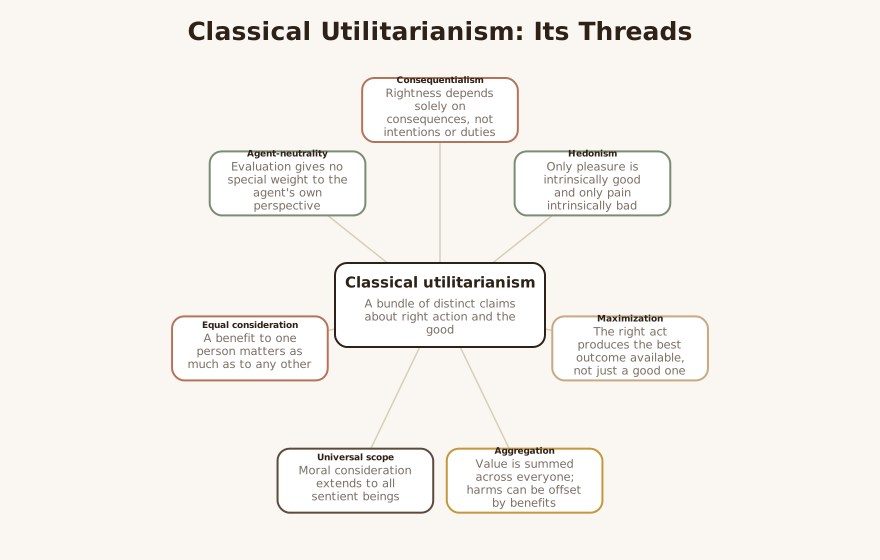
Classical utilitarianism is not a single claim but a bundle of them, and pulling the bundle apart is the key to using it carefully 1. The first thread is consequentialism itself: moral rightness depends solely on consequences, not on intentions, duties, or the inherent character of the act 1. The second is hedonism in its classical form: only pleasure is intrinsically good and only pain intrinsically bad, so consequences are measured ultimately in terms of well-being or happiness 1. The third is maximization: the right act is the one that produces the best outcome available, not merely a good one 1.
The remaining threads concern whose good counts and how it is combined. Aggregation means value is summed across everyone affected, so harms to some can in principle be offset by larger benefits to others 1. Universal scope extends moral consideration to all sentient beings, and equal consideration holds that “benefits to one person matter just as much as similar benefits to any other person” 1. Agent-neutrality completes the picture: the evaluation of outcomes does not give special weight to the agent’s own perspective, projects, or loved ones 1. Bentham gave this machinery a concrete procedure in the hedonic calculus, which proposed to weigh pleasures and pains along dimensions including “intensity, duration, certainty or uncertainty, propinquity or remoteness, fecundity, purity, and extent” 2. The popular slogan that captures the whole — the greatest good, or greatest happiness, for the greatest number — traces directly to Hutcheson’s formulation and Bentham’s systematization of it 2.
Mill’s most famous amendment targets the hedonism. He introduced qualitative distinctions between pleasures, ranking intellectual and moral pleasures above merely sensual ones and arguing that “it is better to be Socrates dissatisfied than a fool satisfied” 2. Mill also stressed the social dimensions of human nature and the internal sanctions — guilt and conscience — that regulate conduct, softening the caricature of utilitarianism as cold arithmetic 2.
Interventions & Techniques
Because utilitarianism is a theory rather than a therapy, “techniques” here means structured ways to put consequentialist reasoning to work inside recognized clinical, ethical, and supervisory activities LLM. The most direct is structured consequence-mapping: making explicit, for a given decision, who is affected, what the plausible outcomes are, and how benefits and harms distribute — a disciplined version of Bentham’s calculus stripped of any pretense of precise measurement 2LLM. This is the engine inside formal clinical-ethics deliberation, where committees weigh the consequences of competing courses of action for patients, families, staff, and the institution LLM.
A second application is the criterion-versus-procedure distinction, which is one of the most clinically useful ideas the theory offers 1. Sophisticated consequentialists clarify that the principle “functions as a criterion of rightness, not a decision procedure”; one need not, and usually should not, calculate consequences in the moment 1. Translated into practice, this licenses the use of reliable rules and habits — informed-consent procedures, mandatory-reporting protocols, standing boundaries — precisely because following them reliably produces better outcomes than ad hoc case-by-case calculation, which humans perform poorly under pressure 3LLM. This is the bridge to rule-based reasoning, the rule-utilitarian recognition that “general rules promote greater utility than case-by-case decisions because humans judge poorly under pressure” 3.
A third application is values clarification through outcome-weighing in direct work with clients, where examining the anticipated consequences of competing choices, and naming whose well-being is being counted, can surface what a client actually values LLM. Here the theory functions as a scaffold for reflection, not as a verdict the clinician imposes LLM.
LLM-generated illustrative example (not a guideline): A hospital social worker faces a discharge decision where sending a frail patient home frees a needed bed but raises readmission risk. Rather than deciding by gut feeling, she runs a structured consequence-map with the team — naming who benefits, who is exposed to harm, and over what time horizon — and then checks the result against standing safe-discharge rules, treating those rules as the considered consequentialist wisdom they encode rather than as obstacles LLM.
Evidence Base
The maturity of utilitarianism is best labeled established — but, as with any imported philosophical framework, “established” means historically central, rigorously developed, and heavily debated within its own discipline, not validated as a clinical intervention 1. As a theory of normative ethics it is foundational: it is one of the dominant positions in moral philosophy, with a continuous scholarly tradition from the 18th century to the present and a vast critical literature 12. There is, however, no body of outcome research showing that “applying utilitarianism” improves clinical outcomes, because it is not a treatment and has never been studied as one; its standing is philosophical rather than empirical LLM.
Intellectual honesty requires naming the theory’s well-documented objections, because each maps onto a real clinical risk LLM. The demandingness objection holds that classical utilitarianism “appears to require constant self-sacrifice for strangers, making nearly all everyday choices morally wrong,” since any time spent on oneself could instead relieve greater suffering elsewhere 1. The justice and rights objection is sharpest: the transplant case shows how maximizing utility “might justify killing one healthy person to harvest organs for five dying patients — violating basic rights intuitions” 1. The alienation objection, associated with Bernard Williams, charges that strict impartiality is incompatible with special relationships, producing “one thought too many” when, for instance, a person pauses to calculate before saving a drowning spouse 16. The calculation problem notes that fully computing all consequences for everyone indefinitely is practically impossible, which is why consequentialists retreat to the criterion-not-procedure defense described above 1. These are not fringe complaints; they are the standard reasons the field does not treat utilitarianism as self-evidently correct, and they are exactly the failure modes a clinician must guard against when consequentialist reasoning shows up in the room LLM.
Populations & Indications
The framework is not indicated for a diagnosis; it is indicated for situations in which the moral question is genuinely about weighing consequences LLM. It is most directly relevant to clinical ethics committees and healthcare providers, whose deliberations about competing courses of action are frequently consequentialist in structure even when no one names the theory LLM. It is squarely relevant to policy makers and organizations, where Bentham’s original reformist project — judging laws and institutions by their effect on aggregate welfare — finds its natural home, and where the aggregation and equal-consideration principles directly inform population-level choices 24.
In the consulting room, the framework is indicated for clinicians facing ethical dilemmas, who can use consequence-mapping and the criterion-versus-procedure distinction to reason transparently rather than defensively LLM. It also speaks to researchers, for whom risk-benefit analysis and the welfare of participants versus future beneficiaries are explicitly consequentialist trade-offs LLM. The indication is always situational and adjunctive: utilitarian reasoning clarifies how a decision is being weighed, while the actual clinical care is delivered through whatever evidence-based modality the work requires LLM.
Problems-for-Work
Several presenting and contextual problems map naturally onto a consequentialist lens, always as an organizing frame rather than a treatment LLM. For resource allocation dilemmas — who gets the scarce bed, the limited group slot, the clinician’s finite time — the aggregation and equal-consideration principles give a defensible language for distributing benefit, while the justice objection warns against letting the sum override an individual’s basic claims 1. For ethical decision-making more broadly, structured consequence-mapping paired with the criterion-not-procedure caveat lets a clinician or team reason explicitly without succumbing to the calculation problem 13.
For values clarification, examining the anticipated consequences of competing choices and naming whose well-being a client is counting can reveal what the client actually prizes, which is often the live question beneath an ostensibly practical decision LLM. For moral distress — the suffering of knowing the right action but being constrained from taking it, or of being forced to weigh incommensurable goods — naming the consequentialist structure of the bind can be clarifying, and naming the demandingness objection can relieve a clinician’s sense that they must sacrifice without limit 1LLM. For guilt and decision-making conflict, particularly the self-blame that follows a hard trade-off, distinguishing a bad outcome from a defensible decision process — and recognizing that even rigorous consequentialism cannot guarantee good outcomes under uncertainty — can loosen rumination LLM.
LLM-generated illustrative example (not a guideline): A clinician in private practice carries persistent guilt for declining a low-fee client she lacked capacity to treat well, telling herself she “should have found a way.” In supervision she reframes the choice consequentially: taking the case would have spread her thin enough to harm existing clients, so the aggregate welfare picture supported her boundary. The reframe does not erase the discomfort, but it separates a painful outcome from a sound decision, easing the guilt LLM.
Contraindications, Cautions & Cultural Humility
Utilitarianism has no contraindications in the pharmacological sense, but it carries several cautions that are unusually important because the theory’s failure modes are subtle and seductive LLM. The first is the rights-and-justice trap: because aggregation lets large benefits offset harms to a few, naive consequentialist reasoning can rationalize sacrificing an individual’s basic interests “for the greater good,” the very move the transplant case exposes as monstrous 1. In a clinical context this is the logic that can justify coercion, deception, or boundary violations on the grounds that they would help — and it must be checked against the rights-based and duty-based constraints that deontology supplies 16.
A second caution is the demandingness failure mode turned inward: a clinician who internalizes strict impartiality can slide toward self-sacrificial overwork, treating any attention to their own well-being as a failure to relieve greater suffering elsewhere, a direct route to burnout 1LLM. A third is the alienation risk: rigid agent-neutrality is, as Williams argued, corrosive to the special relationships and personal commitments that make a life and a therapeutic alliance meaningful, and a therapist who reasons as a pure impartial calculator can become “one thought too many” removed from the client in front of them 16.
Cultural humility is essential here. Classical utilitarianism is a product of secular, Enlightenment Western philosophy, individual-welfare-centered in its assumptions, and its hedonistic and aggregative commitments are not culturally neutral 4LLM. Many traditions weight duty, honor, sacredness, communal obligation, or relational harmony in ways that a consequence-summing calculus cannot capture, and treating those commitments as irrational because they do not maximize measurable welfare is itself an ethical error LLM. The theory’s own internal pluralism — variants that prioritize state welfare, preference satisfaction, or non-hedonic goods over Bentham’s pleasure-pain ledger — should remind clinicians that “the best consequences” is a contested notion, not a settled measurement 6LLM.
Treatment-Plan Suggestions & SMART Objectives
The framework can help structure measurable objectives around ethical reasoning, values, and decision-related distress within a broader treatment or supervision plan; the examples below are illustrative templates to adapt, not prescriptions, and none of them is a treatment in its own right LLM.
| Goal | SMART objective (example) | Mechanism |
|---|---|---|
| Make a stuck ethical decision reasoning explicit | Within 2 sessions, client will map the affected parties and plausible consequences of one pending decision in writing | Structured consequence-mapping externalizes the trade-off 2 |
| Reduce decision paralysis from over-calculation | Over 4 weeks, client will identify 2 standing personal rules to apply instead of recalculating each instance | Criterion-not-procedure: reliable rules beat in-the-moment calculation 13 |
| Loosen guilt after a hard trade-off | Within 5 sessions, client will distinguish a poor outcome from a defensible process in 3 logged instances | Separating outcome from decision quality counters self-blame LLM |
| Address moral distress in a constrained role | Over 6 sessions, client will name the competing goods in one bind and the constraint blocking action, weekly | Naming the consequentialist structure clarifies the bind 1 |
| Clarify values via whose-well-being-counts | Within 4 sessions, client will state, for two choices, whose welfare they are weighting and why | Equal-consideration prompts surface implicit value priorities 1 |
| Counter self-sacrificial overextension | Over 8 weeks, client will set one limit that protects their own functioning and log the aggregate effect | Demandingness objection legitimizes bounded self-care 1 |
| Build a rights check into outcome reasoning | By week 6, client will test each consequence-based plan against one “is anyone’s basic claim being overridden?” question | Guards against the justice/transplant failure mode 1 |
Common Misconceptions
The most common misconception is that utilitarianism means “the ends justify the means” in an unrestricted, anything-goes sense; in fact serious consequentialists build in heavy constraints, distinguish criterion from procedure, and most reject the rights-violating conclusions naive versions appear to license 1. A related error is treating the theory as a literal calculator: Bentham’s hedonic calculus is a heuristic framework, and the calculation problem makes precise summation impossible, which is why the principle functions as a standard of rightness rather than a moment-to-moment algorithm 12.
A second misconception is that utilitarianism is uniform. There are many variants — act versus rule, hedonistic versus preference versus broader welfare consequentialism, total versus average, state-focused versus agent-focused — and they reach different conclusions 16. Conflating “utilitarianism” with one crude version obscures this internal diversity LLM. A third is that the theory is necessarily cold or anti-relationship; Mill explicitly grounded it in the social dimensions of human nature and in conscience, and the alienation objection is a critique of over-rigid versions rather than a description of the whole tradition 26. A final, clinically important misconception is that because consequentialism is intuitive and widely used, it is therefore safe to apply unreflectively; its best-documented feature is precisely the set of objections — justice, demandingness, alienation — that show why unreflective use is hazardous 1.
Training & Certification
There is no certification in utilitarianism or consequentialism, and none would be appropriate, because it is a public philosophical tradition rather than a proprietary clinical method LLM. Clinicians typically encounter it within graduate ethics coursework, professional-ethics and bioethics training, and continuing education on clinical-ethics deliberation, where it is taught alongside deontology, virtue ethics, and principlism as one of the standard frameworks for moral reasoning LLM. Authoritative, freely available primers are maintained by academic encyclopedias of philosophy, which lay out the theory’s structure, its history, and its objections in depth 123. Competence to use the framework responsibly comes not from a credential but from understanding its mechanics and, crucially, its failure points — the justice, demandingness, and alienation objections — and from holding it as one lens among several rather than as a master key 1LLM. Clinical ethics committees and consultation services are the settings where this competence is most often developed in supervised practice LLM.
Key Terms
Consequentialism — the broad family of theories holding that “normative properties depend only on consequences,” so an act’s rightness is fixed entirely by its outcomes 1. Utilitarianism — the leading consequentialist theory, judging actions by how much they promote overall well-being or happiness 1. Hedonism (classical) — the value claim that only pleasure is intrinsically good and only pain intrinsically bad 1. Maximization — the requirement to produce the best available outcome, not merely a good one 1. Aggregation — summing benefits and harms across everyone affected, so gains to some can offset losses to others 1. Equal consideration — the principle that a given benefit counts the same no matter whose it is 1. Agent-neutrality — evaluating outcomes without giving special weight to the agent’s own perspective or relationships 1. Hedonic (felicific) calculus — Bentham’s proposed method of weighing pleasures and pains by intensity, duration, certainty, propinquity, fecundity, purity, and extent 2. Act consequentialism — judging each individual action by its own consequences 3. Rule consequentialism — judging actions by conformity to rules whose general acceptance would maximize good 13. Higher vs. lower pleasures — Mill’s qualitative ranking of pleasures, holding intellectual and moral goods above sensual ones 2. Demandingness / justice / alienation objections — the three standard criticisms: that the theory asks too much, that it can override individual rights, and that strict impartiality erodes special relationships 16.
Resources & Further Reading
▶ Watch — a video introduction to this concept:
- Consequentialism — Stanford Encyclopedia of Philosophy
- The History of Utilitarianism — Stanford Encyclopedia of Philosophy
- Utilitarianism, Act and Rule — Internet Encyclopedia of Philosophy
- Jeremy Bentham — Stanford Encyclopedia of Philosophy
- Mill’s Moral and Political Philosophy — Stanford Encyclopedia of Philosophy
- Consequentialism — Wikipedia
Reflective / Supervision Questions
- When you find yourself justifying a boundary bend, a small deception, or a coercive nudge because it “would help,” whose welfare are you summing — and have you checked whether anyone’s basic claim is being overridden for the greater good? 1LLM
- Where in your caseload might an internalized, impartial “I should always relieve more suffering” be driving self-sacrificial overwork rather than sound care? 1LLM
- For a decision that haunts you, can you separate a bad outcome from the quality of the decision you actually made under uncertainty, and does that distinction change your guilt? LLM
- When a client weighs a hard choice by tallying consequences, are you helping them name whose well-being they count and whose they leave out? 1LLM
- How do you hold consequentialist reasoning alongside a client’s duty-based, communal, or sacred commitments without dismissing the latter as irrational? 46LLM
- In what situations do you, like the agent in Williams’s example, risk having “one thought too many” — reasoning impartially where the relationship itself was the right ground for acting? 16