
Type & Discipline
The hedonic/eudaimonic distinction is a theoretical framework rather than a treatment protocol, sitting at the intersection of positive psychology and moral philosophy 1. It organizes the empirical study of wellbeing into two broad traditions: a hedonic view that equates wellbeing with pleasure attainment and pain avoidance, and a eudaimonic view that equates wellbeing with meaning, self-realization, and the degree to which a person is fully functioning 1. Ryan and Deci frame these as answers to an ancient question — what does it mean to live well, and what is “the good life”? — that wellbeing science inherited from philosophy 1. For clinicians, the practical value is diagnostic and conceptual rather than procedural: it gives a vocabulary for the common situation in which a client’s distress has lifted but a sense of vitality and purpose has not returned LLM.
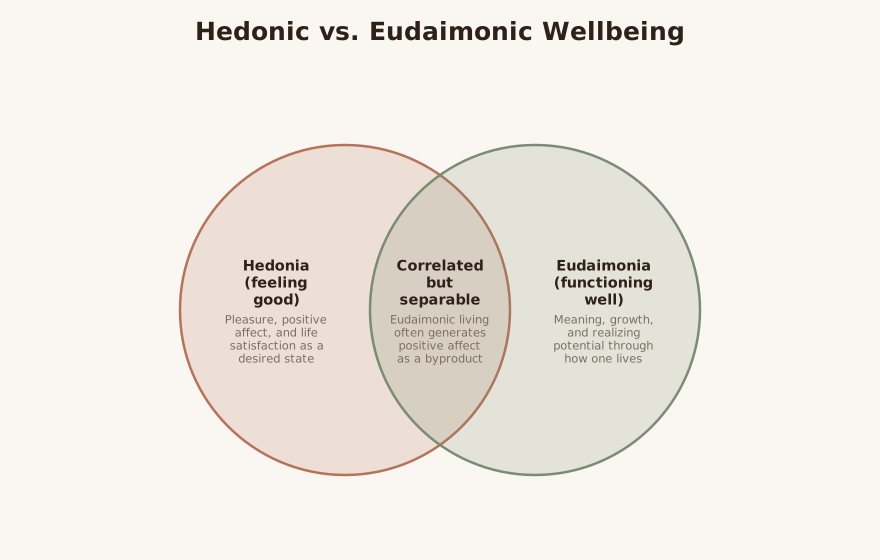
Hedonic wellbeing is typically operationalized in research as subjective wellbeing (SWB): the presence of positive affect, the relative absence of negative affect, and global life satisfaction 1. Eudaimonic wellbeing is operationalized through constructs such as Ryff’s six dimensions of psychological wellbeing and Self-Determination Theory’s account of needs and growth, emphasizing how well a person is living rather than how good they feel 1. The two are correlated but empirically separable, which is the core reason the distinction earns its place in clinical thinking 2.
Creators & Lineage
The philosophical lineage runs back to Aristotle, for whom eudaimonia — often translated “happiness” but more accurately “flourishing” or “living well” — was the highest human good, achieved through the exercise of virtue and reason over a complete life rather than through momentary pleasure 4. Aristotle held that eudaimonia is an activity of the soul in accordance with virtue, an account that treats wellbeing as a way of living rather than a transient feeling state 4. The contrasting hedonic tradition traces to Aristippus and later utilitarian thinkers who located the good life in pleasure and the satisfaction of desire 3. The Greek term itself decomposes roughly into eu (good) and daimon (spirit), and is distinguished from mere pleasant feeling in both ancient and modern usage 3.
The modern psychological revival of this contrast is associated most closely with Carol Ryff, who in the late 1980s and 1990s built a multidimensional model of psychological wellbeing explicitly grounded in eudaimonic and humanistic theory, and with Edward Deci and Richard Ryan, whose Self-Determination Theory (SDT) supplied a process account of eudaimonic living 1. Ryan and Deci’s 2001 Annual Review of Psychology paper consolidated the two literatures and made the hedonic/eudaimonic distinction a standard organizing frame for the field 1. Deci and Ryan, with Veronika Huta, later refined the SDT reading of eudaimonia, arguing that eudaimonia is best understood not as an outcome feeling but as a manner of living — pursuing intrinsic goals, acting autonomously, being mindful, and behaving in ways that satisfy basic psychological needs 6. The distinction also draws on existential and humanistic psychology, which had long insisted that meaning and authenticity, not comfort, are the engines of a worthwhile life 5.
Core Principles
Wellbeing is not a single thing. The framework’s first principle is that “feeling good” and “functioning well” are distinct, correlated-but-separable facets of wellbeing, and that a complete account must address both 2. A person can report high life satisfaction while showing little personal growth or purpose, and conversely can be engaged in deeply meaningful, growthful activity while experiencing considerable difficulty and negative affect 1.
Hedonia centers on outcomes; eudaimonia centers on process and content. In the SDT reading, hedonic wellbeing is a desired psychological state (pleasure, satisfaction), whereas eudaimonia describes the kind of living that tends to produce wellbeing as a byproduct — living that is autonomous, intrinsically motivated, mindful, and need-satisfying 6. Importantly, this means eudaimonia and hedonic feeling are not opposed; eudaimonic living often generates positive affect, but the affect is a consequence, not the target 6.
Eudaimonic wellbeing is multidimensional. Ryff’s influential model specifies dimensions such as self-acceptance, positive relations with others, autonomy, environmental mastery, purpose in life, and personal growth — a structure that operationalizes “positive functioning” rather than positive mood 5. Lee summarizes this tradition by framing eudaimonic wellbeing as the core of positive functioning, distinct from the affect-balance emphasis of subjective wellbeing 5.
Basic psychological needs are the proposed mechanism. SDT holds that eudaimonic activity promotes wellbeing because it satisfies the needs for autonomy, competence, and relatedness; when activities thwart these needs, wellbeing suffers even if they deliver short-term pleasure 1. This gives the otherwise philosophical distinction a testable, mechanistic spine 6.
Interventions & Techniques
The distinction is not itself a therapy, but it informs a set of intervention emphases LLM. Eudaimonically oriented work tends to target what a person pursues and how, rather than only how they feel 6. Concretely, this includes values clarification and intrinsic-goal work — helping clients identify aspirations tied to growth, relationships, and contribution rather than wealth, image, or fame, which SDT research associates with poorer wellbeing 1. It includes purpose- and meaning-focused interventions that build the “purpose in life” and “personal growth” dimensions of psychological wellbeing 5.
SDT-informed technique emphasizes supporting autonomy (helping clients act from genuine endorsement rather than internal or external pressure), competence (structuring graded, masterable challenges), and relatedness (strengthening authentic connection) 6. Mindfulness is also implicated, because the SDT account treats present-moment awareness as part of the eudaimonic manner of living that allows behavior to be need-congruent and autonomously chosen 6.
LLM-generated illustrative example (not a guideline): A client whose panic attacks have remitted under CBT but who feels “flat and pointless” might be guided from symptom-monitoring toward identifying one intrinsic, growth-oriented project (re-engaging a lapsed creative practice) and examining whether daily activities satisfy or thwart autonomy and relatedness — shifting the work from reducing negative affect to building eudaimonic engagement LLM.
Hedonically oriented techniques — savoring, scheduling pleasant activities, gratitude — remain legitimate and useful, particularly for anhedonia and depression, but the framework cautions against treating positive mood as the sole endpoint of treatment 2.
Evidence Base
The maturity of this area is best described as established at the construct level but uneven at the intervention level LLM. The distinction itself is strongly supported: factor-analytic and longitudinal work consistently shows that hedonic and eudaimonic measures load onto related but separable factors, justifying the dual conceptualization 2. Ryan and Deci’s review documents that the two literatures predict overlapping but non-identical outcomes, and that some activities raise hedonic wellbeing without raising eudaimonic wellbeing and vice versa 1.
There is, however, genuine and ongoing controversy. Some researchers argue that eudaimonic and hedonic wellbeing are so highly correlated empirically that the distinction adds little predictive value beyond subjective wellbeing, and that “eudaimonia” is defined inconsistently across studies — sometimes as an outcome, sometimes as a process, sometimes as a set of behaviors 2. Deci and Ryan’s introduction to the Journal of Happiness Studies special issue explicitly engages these definitional disputes, which is itself a marker of an active rather than settled literature 2. The SDT camp responds by insisting eudaimonia be defined as a way of living, not a feeling, precisely to avoid collapsing it into hedonic affect 6.
For clinicians, the honest summary is: the conceptual distinction is robust and clinically useful for case formulation, but it does not yet license claims that “eudaimonic interventions” are an evidence-based treatment in the way that, say, CBT for depression is LLM. The framework should inform goal-setting and formulation within established modalities, not replace them LLM.
Populations & Indications
The distinction is most clinically valuable with adults for whom symptom reduction is incomplete or insufficient as a treatment goal LLM. It is particularly apt for clients seeking meaning and people pursuing personal growth, who may arrive without a diagnosable disorder but with a sense that life lacks direction — a presentation the eudaimonic literature is well suited to describe 5. It applies to people in existential distress, where the relevant deficit is in purpose and self-realization rather than affect regulation 5.
For people with depression, the framework helps distinguish anhedonia (a hedonic deficit in the capacity for pleasure) from a eudaimonic deficit in meaning and engagement; the two often co-occur but call for different therapeutic emphases LLM. Older adults are a notable population because eudaimonic dimensions such as purpose and personal growth have been studied as protective factors across the lifespan, and because hedonic and eudaimonic trajectories can diverge with age 1.
Problems-for-Work
Low wellbeing and life-satisfaction deficits. When a client reports low life satisfaction, the framework prompts the clinician to ask whether the deficit is hedonic (low positive affect, high negative affect) or eudaimonic (low purpose, autonomy, or growth), because the two suggest different intervention targets 1.
Lack of meaning and purpose. This maps directly onto the eudaimonic “purpose in life” dimension; treatment focuses on intrinsic-goal identification and value-congruent action rather than mood elevation 5.
Anhedonia. Here the deficit is squarely hedonic; behavioral activation and savoring may be primary, while eudaimonic work supports durable re-engagement LLM.
Burnout. The framework reframes burnout as need-thwarting — chronic frustration of autonomy and competence — rather than simple overwork, pointing toward restoring autonomous motivation and meaningful engagement 6.
Values clarification. SDT’s distinction between intrinsic and extrinsic aspirations gives a structured way to examine whether a client’s goals are likely to support or undermine wellbeing 1.
LLM-generated illustrative example (not a guideline): A high-earning client presenting with burnout describes pursuing promotions for status and income. Using the intrinsic/extrinsic aspiration frame, the clinician helps the client notice that these extrinsic goals coincide with declining wellbeing, and collaboratively shifts attention toward autonomy-supportive, relationally meaningful activities LLM.
Contraindications, Cautions & Cultural Humility
The framework has no direct “contraindications” in the medical sense, but it carries real cautions LLM. First, eudaimonic language about “realizing one’s potential” and “living virtuously” can shade into moralizing or imposing the therapist’s values; the SDT emphasis on autonomy is itself a safeguard, because genuinely eudaimonic living must be self-endorsed, not prescribed by the clinician 6. Second, the construct emerged largely within Western, individualistic, and historically Aristotelian intellectual traditions, and concepts such as autonomy and self-realization may be expressed and weighted differently across cultures 4. Clinicians should hold the dimensions as hypotheses to explore with the client rather than universal endpoints LLM.
Third, the framework should not be used to dismiss legitimate hedonic suffering — telling a depressed or grieving client that they should pursue “meaning rather than pleasure” risks invalidation LLM. Deci and Ryan are explicit that hedonic and eudaimonic wellbeing are complementary, not a hierarchy in which pleasure is inferior 2. Finally, because the intervention evidence is immature, the distinction should supplement, not displace, evidence-based treatment for diagnosable conditions LLM.
Treatment-Plan Suggestions & SMART Objectives
| Goal | SMART objective (example) | Mechanism |
|---|---|---|
| Increase sense of purpose | Within 8 weeks, client will identify and articulate two personally meaningful long-term aims and take at least one weekly action toward them, tracked in session | Builds eudaimonic “purpose in life” dimension 5 |
| Shift toward intrinsic goals | Within 6 weeks, client will name three current goals, classify each as intrinsic vs. extrinsic, and reframe one extrinsic goal toward growth or relationship | Intrinsic-aspiration congruence linked to better wellbeing 1 |
| Restore autonomous motivation (burnout) | Within 4 weeks, client will identify two daily activities done from pressure and renegotiate one toward self-endorsement | Need for autonomy satisfaction 6 |
| Strengthen relatedness | Over 8 weeks, client will initiate one meaningful connecting interaction per week and reflect on its felt impact | Relatedness need satisfaction supports eudaimonia 6 |
| Distinguish and target anhedonia | Within 3 weeks, client will schedule and complete 3 savoring/pleasant activities weekly and rate hedonic response | Restores hedonic capacity (positive affect) 2 |
| Build personal growth orientation | Within 12 weeks, client will undertake one skill-building challenge with graded difficulty and review competence gains | Eudaimonic growth + competence need 5 |
| Clarify values | Within 4 weeks, client will complete a values exploration and select two values to guide weekly behavioral commitments | Supports value-congruent, autonomous action 6 |
Common Misconceptions
“Eudaimonia just means happiness.” It does not; even in Aristotle it denotes living and doing well over a whole life, not a pleasant feeling, and conflating the two erases the entire point of the distinction 4.
“Hedonic wellbeing is shallow or inferior.” The framework treats hedonic and eudaimonic wellbeing as complementary facets, not a moral ranking; pleasure and life satisfaction are legitimate, important components of a good life 2.
“Eudaimonia is an emotion you can measure like positive affect.” In the SDT reading, eudaimonia is a way of living — a set of motives and behaviors — whose wellbeing benefits are downstream consequences, so measuring it purely as a feeling state mistakes the construct 6.
“The two are basically the same construct.” Although highly correlated, they are empirically separable and predict partly different outcomes, which is why the distinction survives despite recurring critiques 1.
Training & Certification
There is no certification in “hedonic/eudaimonic wellbeing” because it is a theoretical framework, not a credentialed therapy LLM. Clinicians develop competence by grounding themselves in the primary literature — Ryan and Deci’s review and Deci and Ryan’s special-issue introduction are the standard entry points — and by training in the modalities that operationalize these ideas, such as SDT-informed practice, ACT, and existential-humanistic therapy 12. Familiarity with the philosophical source material, particularly Aristotle’s account of eudaimonia, deepens understanding of why the distinction is drawn as it is 4. Reviews aimed at trainees, such as Lee’s overview of eudaimonic wellbeing as positive functioning, offer accessible orientation 5.
Key Terms
Hedonia / hedonic wellbeing — wellbeing conceived as pleasure attainment and pain avoidance; typically measured as subjective wellbeing (positive affect, low negative affect, life satisfaction) 1.
Eudaimonia / eudaimonic wellbeing — wellbeing conceived as living well, realizing one’s potential, and meaningful, virtuous functioning; not reducible to pleasant feeling 4.
Subjective wellbeing (SWB) — the standard hedonic operationalization: the balance of positive over negative affect plus cognitive life satisfaction 1.
Psychological wellbeing (PWB) — Ryff’s multidimensional eudaimonic model (self-acceptance, autonomy, purpose, growth, mastery, positive relations) 5.
Basic psychological needs — in SDT, autonomy, competence, and relatedness; their satisfaction is the proposed mechanism by which eudaimonic living produces wellbeing 6.
Intrinsic vs. extrinsic aspirations — goals oriented toward growth, relationships, and community versus wealth, image, and fame; the former are associated with greater wellbeing 1.
Resources & Further Reading
▶ Watch — a video introduction to this concept:
- Ryan & Deci (2001), On Happiness and Human Potentials: A Review of Research on Hedonic and Eudaimonic Well-Being (Annual Review of Psychology)
- Deci & Ryan (2008), Hedonia, eudaimonia, and well-being: an introduction (Journal of Happiness Studies)
- Ryan, Huta & Deci, Living Well: A Self-Determination Theory Perspective on Eudaimonia
- Lee, Eudaimonic Well-Being as a Core Concept of Positive Functioning (MindPad, Canadian Psychological Association)
- Kraut, Aristotle’s Ethics (Stanford Encyclopedia of Philosophy)
- Eudaimonia (Wikipedia)
Reflective / Supervision Questions
- When a client’s symptoms have remitted but they still feel that life is empty, do I have language and tools to address the eudaimonic deficit, or do I default to declaring treatment complete? LLM
- In my current cases, where am I (perhaps implicitly) treating positive affect as the endpoint of therapy, and where might functioning-well be the more apt target? 2
- How do I guard against imposing my own vision of “the good life” while still doing meaning- and values-oriented work — and does my approach genuinely support the client’s autonomy? 6
- Which of my clients’ presenting problems are primarily hedonic (anhedonia, low life satisfaction) versus primarily eudaimonic (lack of purpose, thwarted growth), and does my treatment plan reflect that distinction? 1
- How do the eudaimonic dimensions — autonomy, purpose, growth — translate across the cultural backgrounds of the clients I serve, and where might I be assuming a Western, individualistic frame? 4