
Type & Discipline
The Middle Way, or Madhyamaka, is a philosophy rather than a manualized treatment, and it belongs to the discipline of Buddhist philosophy within the broader family of Mahayana thought.3 The Sanskrit term madhyamaka literally means “middle way” or “middle path,” and it names a major school of Mahayana Buddhist thought.3 The school’s name points back to a claim made of Buddhism generally — that it is a middle path (madhyama pratipad) steering between two extremes.1 Clinicians should hold a clear boundary here: Madhyamaka is a contemplative and metaphysical framework, not an empirically validated psychotherapy, even though several validated therapies have absorbed its sensibility. LLM
The concept carries two layers that are useful to keep distinct in clinical work. The first is behavioral and practical — a path of balance between extremes of conduct and craving.4 The second is metaphysical and epistemic — a stance that avoids fixed positions about how things ultimately exist.1 Both layers, as we will see, translate into recognizable therapeutic targets such as rigidity, all-or-nothing thinking, and clinging. LLM
Creators & Lineage
The behavioral Middle Way is traditionally traced to the Buddha’s first sermon, the Dhammacakkappavattana Sutta, delivered after his awakening.4 There he described avoiding two extremes — “addiction to indulgence of sense-pleasures” and “addiction to self-mortification” — both of which he called “unprofitable.”4 The practical embodiment of this balanced path is the Noble Eightfold Path, encompassing right understanding, speech, action, livelihood, effort, mindfulness, and concentration.4 One contemporary teacher frames the origin experientially: the Buddha discovered this approach after living both luxurious palace life and extreme asceticism and finding that neither ended suffering.5
The philosophical Middle Way as a formal school was developed by the Indian philosopher Nagarjuna, who lived approximately 150–250 CE in southern India.2 He is often regarded as the most important Buddhist philosopher after the historical Buddha himself.2 His principal text, the Mulamadhyamakakarika (“Fundamental Wisdom of the Middle Way”), comprises some 450 stanzas that establish the framework of the Madhyamaka school.2 Nagarjuna advanced the concept by arguing against inherent existence while equally rejecting complete non-existence.4 Later figures in the lineage include Aryadeva, who warned that attachment to one’s own views is itself an obstacle, and the sub-school founders Candrakirti and Bhavaviveka, whose methodological disagreement we touch on below.13
For clinicians, the relevant downstream lineage runs into modern contemplative psychotherapy. The interdependent, non-grasping stance of Madhyamaka is recognizably present in Mindfulness-Based Stress Reduction, in the dialectics of Dialectical Behavior Therapy, and in the defusion and acceptance moves of Acceptance and Commitment Therapy, even where those therapies do not cite the philosophy by name. LLM
Core Principles
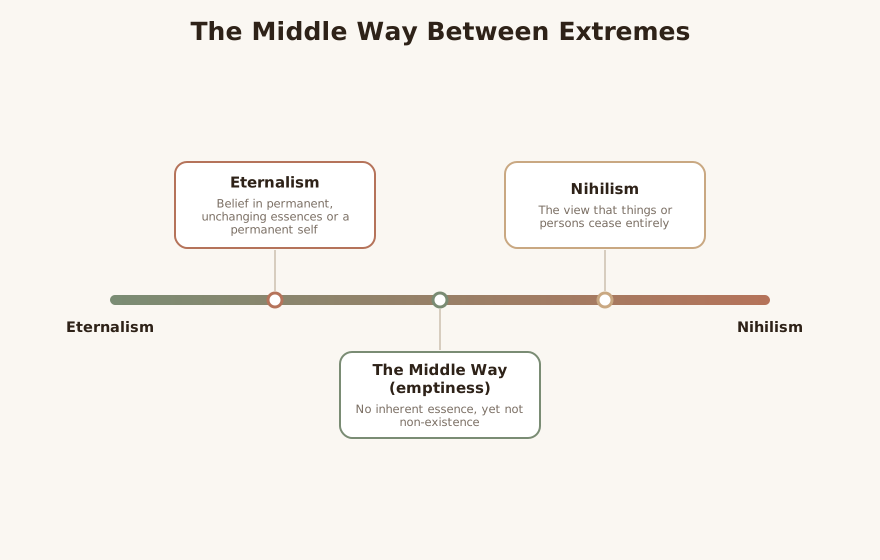
The first principle is the avoidance of two extremes. Behaviorally, these are self-indulgence and self-mortification.4 Metaphysically, they are eternalism — the belief that things possess permanent, unchanging essences or that a permanent self truly exists — and annihilationism or nihilism — the view that things, or persons, cease entirely.13 The Internet Encyclopedia of Philosophy frames it sharply: “the relevant extremes between which any Buddhist account of the person must steer are ‘eternalism’ and ‘nihilism.’”3
The second and central principle is emptiness (sunyata). This is the doctrine of universal emptiness of inherent natures (svabhava-sunyata), described as the hallmark of the school.1 Crucially, emptiness does not mean non-existence; it means the absence of inherent essence — things lack svabhava, an independent self-nature.3 Nagarjuna systematically denied that phenomena possess “ontological rock-bottom” status, holding instead that all phenomena depend on causes, conditions, and conceptual frameworks.2
The third principle is dependent origination (pratityasamutpada), and in Madhyamaka it is treated as identical to emptiness.3 The foundational verse states: “Since there is no dharma whatsoever that is not dependently originated, therefore there is no dharma whatsoever that is not empty.”3 In other words, phenomena are dependently originated “all the way down” and exist only in relation to other things.3 Dependent origination is precisely what bridges the two extremes, explaining continuity without a permanent self.4
The fourth principle is the two truths. Madhyamaka distinguishes conventional truth (samvrtisat) — the everyday world of ordinary experience and language — from ultimate truth (paramarthasat) — the realization that nothing possesses independent essence.3 Importantly, language is held to be limited to the everyday level, with the liberating truth lying beyond the reach of conceptual thought.1 For practice, this licenses a both/and stance: a person is irreducibly real at the conventional level even while being “empty” of fixed essence at the ultimate level. LLM
Interventions & Techniques
Madhyamaka is not a protocol, so its “techniques” are contemplative and analytic methods that a clinician can adapt rather than deliver verbatim. LLM The signature analytic method is the tetralemma or four-cornered negation (catuskoti): rather than affirming a positive position, it systematically negates four alternatives — that a phenomenon arises from itself, from another, from both, or from neither.13 The purpose is to show that no rigid category can coherently explain phenomena on its own, thereby loosening attachment to any fixed view.3
A related method is prasanga, or reductio: the Prasangika approach associated with Candrakirti proceeds by reducing an opponent’s position to absurdity rather than defending an independent thesis of its own.3 Clinically, this resembles the gentle, non-coercive examination of a rigidly held belief from the inside until its all-or-nothing structure collapses, without the clinician installing a new dogma in its place. LLM
On the experiential side, the contemplative method is mindful observation without grasping. Modern interpreters describe the Middle Way as a meditation practice of observing phenomena without grasping or rejecting them.4 In practice this means developing awareness to observe “sensations, feelings, states of mind, and thoughts,” then noticing the habitual grasping, clinging, and aversion responses so they can be released into equanimity.5 One teacher adds an embodied anchor: visualize your harmonious middle ground, breathe with that image, and notice the accompanying bodily sensations.5
LLM-generated illustrative example (not a guideline): A clinician working with a client who oscillates between “I’m a total failure” and “I have to be flawless” might invite the client to notice both poles as passing mental states, name the grasping toward perfection and the aversion toward any flaw, and locate a felt sense of a steadier middle in the body before re-rating the situation. LLM
Evidence Base
Honest framing matters here. As a philosophy and contemplative tradition, Madhyamaka is established — it is a centuries-old, textually rich Mahayana school with a documented founder, canonical texts, and sustained scholarly commentary.21 That maturity, however, is philosophical and historical, not the maturity of a randomized clinical literature, and Madhyamaka has never been packaged or tested as a standalone treatment. LLM
The provided sources are academic and explanatory references describing doctrine, lineage, and practice; they are not clinical trials and make no efficacy claims about treating diagnoses.123 What can be said responsibly is that the contemplative posture Madhyamaka articulates — non-grasping observation of experience, loosening of fixed views — overlaps substantially with mechanisms targeted by evidence-based mindfulness and acceptance therapies. LLM Clinicians should therefore present the Middle Way to clients as a meaning frame and a set of contemplative practices, and rely on the established empirical therapies for the formal evidence of benefit. LLM
Populations & Indications
The tradition itself speaks first to meditation practitioners and to people seeking spiritual growth, since its methods are contemplative and its aim is liberation from suffering through the release of clinging.53 The Lion’s Roar framing extends naturally to adults navigating everyday extremes — swinging between attachment and aversion, overindulgence and deprivation, highs and lows.5
Clinically, the framework is most apt for adults with the capacity for reflective, abstract work, including people with perfectionism, people prone to emotional extremes, and people who are explicitly oriented toward spiritual growth and find meaning frameworks motivating. LLM It can also resonate with people with addiction, where the language of craving and aversion, and the path between indulgence and harsh self-denial, maps directly onto the original Middle Way teaching.45 As always, indication depends less on diagnosis than on whether a contemplative, view-loosening frame fits the client’s goals and meaning system. LLM
Problems-for-Work
Black-and-white thinking and cognitive inflexibility. The catuskoti’s refusal of all four fixed positions is, in effect, a structured dismantling of either/or thinking, and the tradition is explicitly said to “pry open the insecure rigidity of our minds.”53 A clinician can borrow this to help a client hold a third option beyond two opposed certainties. LLM
Perfectionism and rigidity. The behavioral Middle Way directly addresses the extreme of self-mortification — including, in modern terms, meditation rigidity, exercise obsession, and restrictive patterns — by inviting recognition of one’s personal extremes.54 As the article puts it, “to find our own middle way, we must recognize our extremes.”5
Emotional extremes. The practice of observing feelings and states of mind without grasping or aversion is offered precisely for emotional volatility, cultivating equanimity rather than oscillation between poles.5 LLM
Attachment, craving, and compulsive behaviors. The path between indulgence of sense-pleasures and harsh self-denial is the original clinical content of the teaching, and noticing habitual clinging and aversion is its core move.45
Existential distress. The two-truths frame — that persons are irreducibly real conventionally even while empty of fixed essence — can hold continuity and impermanence together, which is the same tension at the heart of much existential distress.34 LLM
Contraindications, Cautions & Cultural Humility
The most important caution is doctrinal and is built into the tradition itself: Madhyamaka warns against clinging to its own conclusions. Aryadeva held that “attachment to one’s own views and disparaging the views of others is an obstacle to nirvana.”1 A clinician who deploys “emptiness” as a new certainty has missed the point and may inadvertently model rigidity. LLM
A clinical caution concerns nihilistic misreading. Emptiness is explicitly not non-existence, and the tradition guards against the nihilist extreme — the view that actions lack consequence.3 For a client who is depressed, hopeless, or prone to a “nothing matters” stance, language about emptiness can be misheard as confirmation, so the dependent-origination half of the teaching — that suffering is real and can be caused to cease — must be foregrounded.3 LLM The framework’s reliance on abstract, non-conceptual insight also makes it a poor fit during acute crisis, active psychosis, or any state where reality-testing or concreteness is needed rather than deconstruction of fixed views. LLM
Cultural humility is essential. This is a living religious and philosophical tradition embedded in Mahayana and Tibetan and East Asian Buddhist contexts, integrated into structured curricula as a culminating view, not a free-floating self-help technique.3 Clinicians should name when they are borrowing a secularized fragment, avoid claiming authority they do not have, and follow the client’s own relationship to Buddhism rather than imposing one. LLM
Treatment-Plan Suggestions & SMART Objectives
| Goal | SMART objective (example) | Mechanism |
|---|---|---|
| Reduce black-and-white thinking | Over 8 weeks, client will identify a “third option” beyond two opposed certainties in at least 3 logged situations per week | Tetralemma-style refusal of fixed either/or positions 13 |
| Loosen perfectionistic rigidity | Within 6 weeks, client will name their personal “extremes” and choose one balanced middle action in 2 recurring situations weekly | Recognizing one’s own extremes to find a middle way 5 |
| Increase emotional equanimity | Daily for 4 weeks, client will observe one strong feeling without acting on grasping or aversion and rate equanimity 0–10 | Mindful observation without grasping or rejecting 54 |
| Reduce craving-driven behavior | Over 8 weeks, client will use a “pause and notice clinging” practice before 80% of identified urges | Path between indulgence and self-denial; noticing clinging 45 |
| Soften view-attachment | Weekly, client will articulate one held belief and examine where it depends on conditions rather than being fixed | Emptiness as absence of inherent, independent essence 12 |
| Ease existential distress | Within 10 weeks, client will hold impermanence and continuity together in a written reflection without distress escalation | Two truths: conventionally real, ultimately empty 3 |
| Build embodied balance | 3x weekly, client will visualize a “middle ground” image, breathe with it, and note bodily sensations | Embodied anchoring of the middle way 5 |
Common Misconceptions
A first misconception is that emptiness means nothingness or non-existence; in fact it denotes the absence of inherent, independent essence, while phenomena continue to function and persons remain real at the conventional level.31 A second is that the Middle Way is mere moderation or splitting the difference; it is more precisely a refusal of fixed extremes that can leave the “middle” looking different for each person.5 LLM
A third misconception is that Madhyamaka is anti-rational or that it abandons logic; on the contrary, its tetralemma and reductio methods are rigorously analytic tools used to expose the incoherence of fixed positions.13 A fourth is that it is purely abstract metaphysics with no behavioral content; yet its oldest formulation is unmistakably behavioral, addressing indulgence and self-mortification directly.4 A fifth, and the one Madhyamaka most insists upon, is treating emptiness as a new dogma to defend, which the tradition itself names as an obstacle.1 LLM
Training & Certification
There is no clinical certification in “Madhyamaka therapy,” and clinicians should not imply otherwise. LLM Authentic study of the philosophy proceeds through the scholarly and contemplative tradition — engagement with primary texts such as the Mulamadhyamakakarika and with academic treatments of the school’s doctrine and sub-schools — and, in Buddhist settings, through structured curricula where Madhyamaka is studied as a culminating view under qualified teachers.23
For practitioners who want to use the spirit of the Middle Way responsibly in therapy, the appropriate path is training in the established contemplative therapies that already operationalize non-grasping awareness and dialectical balance, paired with honest acknowledgment of the philosophy’s religious roots. LLM The provided academic sources are a credible starting point for accurate conceptual grounding before any clinical application.123
Key Terms
Madhyamaka / Middle Way — the Mahayana school and path that steers between extremes, both behavioral and metaphysical.31
Sunyata (emptiness) — the absence of inherent, independent essence (svabhava) in all phenomena; the hallmark doctrine of the school.13
Svabhava — intrinsic nature or independent self-existence, which Madhyamaka denies that anything possesses.2
Pratityasamutpada (dependent origination) — the principle that phenomena arise only in mutual dependence; in Madhyamaka, identical to emptiness.3
Two truths — the distinction between conventional truth (everyday experience and language) and ultimate truth (absence of inherent essence).31
Catuskoti (tetralemma) — the four-cornered negation that rejects arising from self, other, both, and neither.13
Eternalism / nihilism (annihilationism) — the two metaphysical extremes the Middle Way avoids.13
Resources & Further Reading
▶ Watch — a video introduction to this concept:
- Madhyamaka — Stanford Encyclopedia of Philosophy
- Nagarjuna — Stanford Encyclopedia of Philosophy
- Madhyamaka Buddhist Philosophy — Internet Encyclopedia of Philosophy
- Middle Way — Wikipedia
- How to Find Your Middle Way — Lion’s Roar
Reflective / Supervision Questions
- Where in my own clinical stance do I cling to a fixed view — about a client, a diagnosis, or “the right” intervention — in a way Aryadeva would flag as an obstacle?1 LLM
- With a given client, am I clear about which layer of the Middle Way I am working with — the behavioral path between extremes, or the metaphysical loosening of fixed views — and have I chosen the one that fits their goals?41 LLM
- How would I guard against a depressed or hopeless client misreading “emptiness” as nihilism, and am I foregrounding dependent origination and the reality of suffering’s ceasing?3 LLM
- Am I borrowing a secularized fragment of a living religious tradition, and have I named that honestly, with humility, in supervision and with the client?3 LLM
- When I help a client find their “middle,” am I imposing a midpoint, or am I helping them recognize their own particular extremes?5 LLM