
Type & Discipline
Deliberate practice is a construct from cognitive psychology and the field of expertise studies, not a therapy in itself LLM. It names a specific kind of training activity rather than a general disposition to work hard, and it was developed to explain why some people reach elite performance in a domain while others plateau 1. The construct originated in studies of musicians, chess players, athletes, and typists, and was later imported into professional domains including medicine 2. For clinicians, deliberate practice is best understood as a meta-skill — a method for improving any therapeutic competency — rather than a treatment delivered to clients LLM.
The core claim distinguishes deliberate practice from mere experience or routine repetition: accumulating hours of doing a thing is not the same as systematically trying to get better at it 1. This distinction matters clinically because length of professional experience correlates only weakly with measured performance, a finding Ericsson emphasized when extending the framework to medicine 7.
Creators & Lineage
The construct was formalized by K. Anders Ericsson with Ralf Th. Krampe and Clemens Tesch-Römer in their 1993 Psychological Review paper, the most-cited source in this literature 1. Their landmark study compared violinists at a Berlin music academy and concluded that “individual differences in ultimate performance can largely be accounted for by differential amounts of past and current levels of practice” 3. Ericsson spent the following decades extending the framework across domains and into professional training, including a general overview aimed at medicine and emergency medicine 2.
The intellectual lineage runs through expertise studies and cognitive psychology, and in the clinical world it converges with clinical supervision and feedback-informed treatment, both of which supply the structured feedback that deliberate practice requires 25. Popularizers later compressed the framework into the “10,000-hour rule,” but Ericsson’s own emphasis was always on the quality and structure of practice, not a raw hour count LLM. His broader argument — articulated in The Making of an Expert — was that expertise is mainly the product of training rather than innate talent, illustrated by cases such as the systematically trained Polgár chess sisters 4.
Core Principles
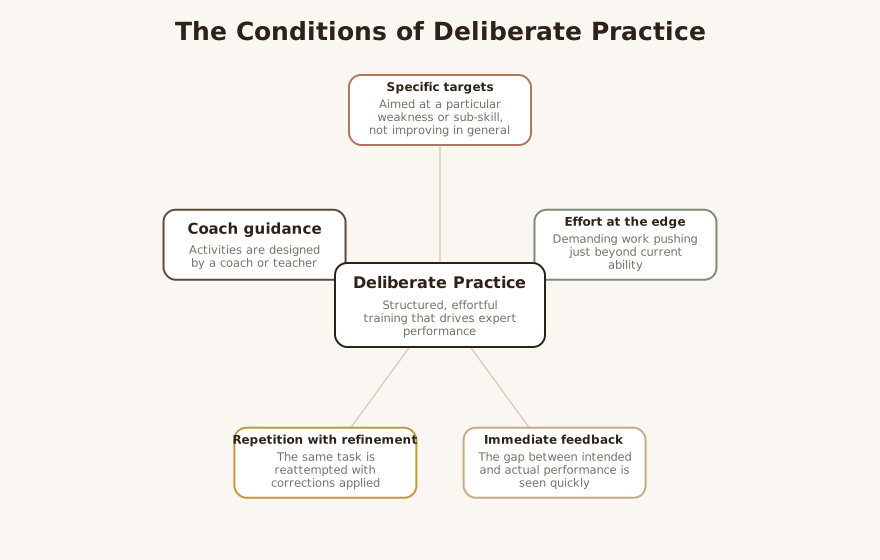
Deliberate practice is defined by a tight set of conditions, and removing any one of them tends to collapse it back into ordinary practice LLM. Ericsson’s 2008 overview names the essentials clearly: a well-defined task, the provision of immediate feedback, time for problem-solving and evaluation, and opportunities for repeated performance to refine behavior 27.
- Specific, well-defined targets. Practice is aimed at a particular weakness or sub-skill, not at “getting better” in general 2. Training is individualized and matched to the learner’s current ability level 5.
- Effortful work at the edge of competence. The activity is demanding and not inherently enjoyable; it pushes just beyond current ability rather than rehearsing what is already mastered 1.
- Immediate, informative feedback. The learner must see the gap between intended and actual performance quickly enough to adjust 27.
- Repetition with refinement. The same task is attempted again, with corrections applied, rather than moving on after a single pass 2.
- Guidance from a coach or teacher. Activities are often “specially designed by a coach or teacher to improve specific aspects” of performance 57.
A key empirical anchor is that experience alone is a poor proxy for skill: observed performance does not necessarily improve with greater professional experience 7. This is the principle that makes deliberate practice so relevant to clinicians who have logged thousands of session hours yet whose outcomes have stagnated LLM.
Interventions & Techniques
Translated into psychotherapy training, deliberate practice typically combines several concrete activities LLM. The Sentio University model — built explicitly on Ericsson’s framework — is a useful exemplar 5.
- In-class or in-supervision skill rehearsal. Roughly half of training time is devoted to hands-on rehearsal of therapy techniques with peers, with real-time instructor feedback, rather than lecture 5.
- Video review of recorded sessions. Recording client work allows precise, data-informed feedback rather than reliance on the clinician’s selective memory of the hour 5.
- Outcome tracking. Monitoring actual client progress over time supplies the longer feedback loop and a measure of whether practice is transferring to results 5.
- Trained coaches and supervisors. Supervisors complete intensive training in the deliberate-practice framework before guiding learners, because the method depends on skilled feedback delivery 5.
The mechanism in each case is the same loop: isolate a specific skill, attempt it, receive immediate feedback against a clear standard, problem-solve the gap, and repeat with refinement 27.
LLM-generated illustrative example (not a guideline): A clinician whose clients frequently drop out early might isolate “responding to client expressions of doubt about therapy” as a target. With a coach, they watch a recorded moment where a client expressed ambivalence, rehearse three alternative responses aloud, get immediate feedback on warmth and specificity, and re-record the attempt until the response lands cleanly — then bring the refined skill back to live sessions. LLM
Evidence Base
The evidence base is established but contested, and honesty here matters LLM. The construct is well-defined and has generated decades of research across domains 2. What has been revised is the magnitude of its effect.
The original 1993 study reported a large effect, with η² = 0.48 when comparing expert groups of violinists, and concluded that practice could “largely” account for skill differences 3. A 2019 pre-registered replication by Macnamara and Maitra failed to reproduce the core finding 3. With double-blind procedures and more appropriate statistics — the original lacked experimenter blinding and used analyses that inflated significance — they found no significant difference in accumulated practice between the “best” and “good” violinists (p = 0.364), and an effect size roughly half the original at η² = 0.26 3. In their data, deliberate practice explained about 26% of the variance in performance, consistent with meta-analytic averages of around 23% for music 3. They also found that teacher-designed practice was not rated as more relevant than self-guided practice (9.38 vs. 9.87), challenging the claim that teacher-directed activity is essential 3.
The takeaway is not that deliberate practice is unimportant — roughly a quarter of variance is substantial and modifiable LLM. It is that practice is one major contributor rather than a near-total explanation, and clinicians should resist both the original overclaim and a dismissive backlash 3. In clinical training specifically, proponents cite over 15 independent studies suggesting deliberate-practice methods outperform traditional training for skill development, though this is an applied claim distinct from the elite-performance variance debate 5.
Populations & Indications
Deliberate practice was first studied in performers and athletes, students, and other adults pursuing skill development, and these remain core populations 14. Its most relevant clinical application is to psychotherapists and clinicians in training, who can use it to build specific competencies systematically 5. Supervisees are a natural fit because the supervisory relationship already supplies the coach role and a feedback channel 5. Coaching clients pursuing concrete performance goals also map onto the framework LLM.
It is indicated wherever a learner has a clear, repeatable skill to build and access to informative feedback 2. It is less applicable where the “skill” is diffuse, where feedback is unavailable or delayed beyond usefulness, or where the goal is symptom relief rather than performance improvement LLM.
Problems-for-Work
For practicing therapists, deliberate practice is most directly a developmental tool, but several of its target problems overlap with clinical and self-development work LLM.
- Skill deficits and professional competence gaps. The framework’s primary use: isolate the missing competency, drill it with feedback, and refine 25.
- Stagnation in therapeutic outcomes. Because experience does not reliably improve performance, a clinician whose outcomes have flattened can use outcome tracking plus targeted practice to re-engage growth 57.
- Avoidance of difficult tasks and procrastination. Deliberate practice deliberately confronts the effortful, non-enjoyable edge of competence; structuring that confrontation can be applied to client avoidance patterns within a behavioral frame 1.
- Low self-efficacy. Repetition with mastery experiences and concrete feedback can build a sense of competence as graded successes accumulate LLM.
- Performance anxiety. Rehearsing the specific feared task under feedback, in graded steps, can reduce anxiety through familiarity and demonstrated competence LLM.
LLM-generated illustrative example (not a guideline): A graduate student paralyzed by avoidance of writing breaks the task into a 25-minute targeted block on one paragraph, sets a clear sub-goal, and reviews the output immediately against a model paragraph — converting an overwhelming, feedback-poor task into a structured, feedback-rich repetition. LLM
Contraindications, Cautions & Cultural Humility
Deliberate practice is a training construct, not a psychotherapy, so the main cautions concern misapplication rather than client harm LLM. The most important caution is overclaiming: the replication evidence shows practice accounts for a minority of performance variance, so framing it as the sole route to mastery is empirically unsupported and can induce shame in learners who work hard yet plateau 3.
The construct emerged largely from Western, high-resource performance domains — conservatory musicians, competitive chess, professional sport — and its assumptions about access to coaches, recording equipment, and protected practice time are not culturally or economically neutral LLM. Importing it into supervision should account for trainees with caregiving demands, limited resources, or different cultural norms around feedback and authority LLM. When used with clients around problems like procrastination or self-efficacy, the effortful “edge of ability” demand can interact poorly with trauma, burnout, or perfectionism, and the clinician should titrate difficulty rather than valorize grind LLM. Finally, the finding that teacher-designed and self-guided practice did not differ meaningfully cautions against assuming expert direction is always superior to a learner’s own structured practice 3.
Treatment-Plan Suggestions & SMART Objectives
| Goal | SMART objective (example) | Mechanism |
|---|---|---|
| Reduce procrastination on a feared task | Client completes three 25-minute focused work blocks per week on the avoided task and logs each, for 4 weeks | Repetition with refinement; graded approach to effortful tasks 1 |
| Build a specific clinical/communication skill | Learner rehearses the target skill from a recorded sample and re-attempts until two consecutive feedback-rated “competent” reps, weekly for 6 weeks | Well-defined task plus immediate feedback 25 |
| Increase self-efficacy for a stalled goal | Client identifies one sub-skill weekly, practices it to a defined standard, and rates confidence (0-10) pre/post for 8 weeks | Mastery experiences with informative feedback 5 |
| Reduce performance anxiety in a defined situation | Client rehearses the feared performance in graded steps with feedback 2x/week, tracking SUDS before and after, for 5 weeks | Repeated performance and error correction reduce uncertainty 2 |
| Re-engage growth after outcome stagnation | Clinician monitors client outcome data monthly and targets one feedback-identified weakness in structured practice each month for one quarter | Outcome tracking plus targeted practice 57 |
| Strengthen tolerance of difficult tasks | Client schedules and completes one “edge of ability” task daily, recording difficulty and completion, for 3 weeks | Working just beyond current competence 1 |
| Close a professional competence gap | Supervisee selects one competency per month, drills it in supervision with video review, and demonstrates it in a live session by month’s end | Coach-guided, feedback-rich repetition 5 |
Common Misconceptions
- “It’s the 10,000-hour rule.” The construct is about the structure and quality of practice, not a fixed hour threshold; raw hours of experience correlate only weakly with performance 7LLM.
- “More practice automatically means more skill.” Only deliberate practice — specific, effortful, feedback-rich, repeated with refinement — drives improvement; routine repetition does not 12.
- “Practice explains almost all of expertise.” The original “largely accounted for” claim was not replicated; practice explains roughly a quarter of performance variance, not the bulk of it 3.
- “A coach is essential.” Teacher-designed practice did not outperform self-guided practice in the replication, so structured solo practice can be valuable 3.
- “Talent is irrelevant.” The framework foregrounds training over innate gifts, but the revised evidence leaves substantial variance to other factors, so “talent doesn’t matter” overstates the case 34.
Training & Certification
There is no formal certification or licensure in deliberate practice; it is a research construct, not a credentialed treatment LLM. Clinicians most often encounter formal instruction in it through graduate programs and supervision models that have adopted the framework, such as the deliberate-practice training that Sentio University requires of its supervisors before they work with students 5. Practitioners typically learn it by reading the primary literature — the 1993 paper and Ericsson’s 2008 medical overview — and by structuring their own supervision and outcome-monitoring around its principles 12. Because the method depends on skilled feedback, the practical “training” is largely in becoming a competent feedback provider and in building the recording and outcome-tracking infrastructure it requires 5.
Key Terms
- Deliberate practice: Individualized, effortful training on specific aspects of performance, with immediate feedback and repetition with refinement, often designed by a coach 57.
- Edge of ability: The zone just beyond current competence where deliberate practice operates; comfortable repetition does not qualify 1.
- Immediate feedback: Rapid, informative knowledge of the gap between intended and actual performance, a necessary condition of deliberate practice 2.
- Repetition with refinement: Repeated attempts at the same task with corrections applied between attempts 2.
- Effect size (η²): A measure of how much variance a factor explains; reported as 0.48 in the original study and 0.26 in the replication 3.
- Outcome tracking: Systematic monitoring of client progress over time, supplying the longer feedback loop in clinical deliberate practice 5.
Resources & Further Reading
- Ericsson, Krampe & Tesch-Römer (1993), The role of deliberate practice in the acquisition of expert performance (Psychological Review)
- Ericsson (2008), Deliberate practice and acquisition of expert performance: a general overview (Academic Emergency Medicine)
- Ericsson (2008) overview — PubMed abstract
- Macnamara & Maitra (2019), Revisiting Ericsson, Krampe & Tesch-Römer (1993) — PMC
- Ericsson, The Making of an Expert (Harvard Business Review, 2007)
- What Is Deliberate Practice? The Science of Expert Performance — Sentio University
- Deliberate Practice | Peak by Anders Ericsson (YouTube)
Reflective / Supervision Questions
- Which one specific clinical skill, if improved, would most change my outcomes — and how would I get immediate feedback on it? LLM
- Where in my current caseload am I logging experience without genuinely practicing — repeating what I already do well rather than working at my edge? LLM
- Given that experience correlates weakly with performance, what objective data (recordings, outcome measures) do I actually have on my own competence? 7
- As a supervisor, am I designing feedback-rich repetition, or mostly discussing cases after the fact? 5
- How do I hold the evidence honestly — taking deliberate practice seriously as a modifiable contributor while not overclaiming that it explains most of expertise? 3
- Where might the resource assumptions of deliberate practice (time, equipment, coaching access) disadvantage a particular supervisee or client, and how can I adapt? LLM