
Type & Discipline
Kantian ethics is a normative moral theory within Western philosophy, belonging to the family of deontological (duty-based) ethics, in which the rightness of an action is determined by its conformity to moral duty rather than by its consequences 1. The position contrasts directly with consequentialist theories such as utilitarianism, which judge actions by the goodness of their outcomes; for Kant, a good will and the motive of duty carry moral worth even when the consequences are unfavorable 4. It is foundational rather than clinical: there is no “Kantian therapy” with a treatment manual, and clinicians encounter it primarily as the philosophical substrate of bioethics, informed consent, and patient autonomy LLM.
For practicing therapists, the relevant point is that Kantian ethics offers a principled language for the dignity-preserving stance already embedded in professional codes of conduct, and a reasoned account of why autonomy and consent are non-negotiable rather than merely customary LLM. Treat it as a conceptual tool for moral reasoning under conflict, not as an intervention to be administered LLM.
Creators & Lineage
The framework originates almost entirely with the German philosopher Immanuel Kant (1724–1804), principally in his Groundwork of the Metaphysics of Morals and the Critique of Practical Reason, where he sought to ground morality in reason alone rather than in religion, sentiment, or desire 1. Kant argued that moral law must be universal and necessary, binding on any rational agent independent of contingent inclinations, which is why he located the source of obligation in the structure of practical reason itself 1.
The lineage running forward from Kant is what makes the theory clinically alive. His insistence on the unconditional worth of rational beings became a cornerstone of modern bioethics and the doctrine of respect for persons, and it informs autonomy-supportive models of care across medicine and psychotherapy LLM. Later “Kantian” theorists, including 20th-century constructivists, refined and extended his account, and the broad tradition of deontological ethics that he anchors remains one of the two or three dominant frameworks in applied and professional ethics 5. Existential philosophy, with its emphasis on freedom and self-determined choice, shares conceptual territory with Kant’s account of autonomy, though the two traditions diverge sharply on the role of universal reason LLM.
Core Principles
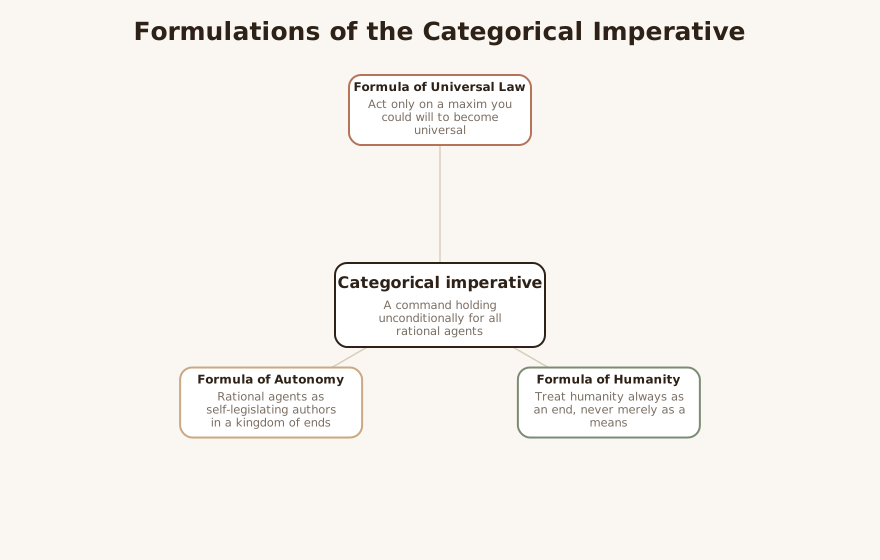
The central organizing idea is the categorical imperative: a command that holds unconditionally for all rational agents, regardless of their particular goals 2. Kant distinguishes it from hypothetical imperatives, which bind only conditionally (“if you want X, do Y”); moral duty, by contrast, is categorical and admits no “if” 6. He offered several formulations of this single principle 2.
- The Formula of Universal Law: act only on a maxim that you could will to become a universal law followed by everyone 2. A maxim that cannot be universalized without contradiction (for example, lying to get what one wants, which would destroy the very practice of truth-telling it relies on) is morally impermissible 4.
- The Formula of Humanity (Formula of the End in Itself): act so as to treat humanity, whether in yourself or in any other person, always as an end and never merely as a means 2. This is the formulation most directly relevant to clinical work, because it forbids using a person purely instrumentally and grounds the obligation to obtain genuine consent 4.
- The Formula of Autonomy and the Kingdom of Ends: rational agents are self-legislating authors of the moral law, and we should act as members of an ideal community in which each person is both lawgiver and subject 1.
Underlying all of these is autonomy in Kant’s technical sense: the capacity of a rational will to give the moral law to itself, rather than being governed by external authority or by appetite 1. Dignity follows directly: because rational agents are ends in themselves and not mere objects of use, they possess an intrinsic worth that has no price and cannot be traded off against utility 5. The morally good action is one done from duty, out of respect for the moral law, not merely in accordance with duty for self-interested reasons 4.
Interventions & Techniques
Because Kantian ethics is a philosophical framework rather than a therapy, its “techniques” are forms of structured moral reasoning that a clinician can apply to ethically loaded decisions LLM. Several are practically usable.
- The universalizability test: when facing a course of action, articulate the underlying maxim and ask whether you could consistently will that everyone act on it; a maxim that becomes self-defeating when universalized signals an impermissible action 2.
- The ends-not-merely-means check: ask whether a proposed action treats the patient (or a third party) as a person whose rational consent has been or could be obtained, or whether it instrumentalizes them 4. This is the operational heart of informed consent LLM.
- Distinguishing duty from inclination: separate what you are obligated to do from what is merely convenient, profitable, or emotionally comfortable, which clarifies the moral demand in conflicts of interest 4.
- Identifying perfect versus imperfect duties: Kant distinguishes strict duties that admit no exception (for example, not deceiving a patient) from wide duties that require judgment about how and when to fulfill them (for example, beneficence) 1.
LLM-generated illustrative example (not a guideline): A therapist is tempted to withhold a discouraging prognosis from a client “for their own good.” The Formula of Humanity check reframes this: deciding unilaterally what the client may know treats them merely as an object to be managed rather than as a rational agent entitled to author their own decisions. The clinical move is to find a compassionate way to share the information that preserves the client’s standing as an end in themselves LLM.
Evidence Base
Maturity here should be read carefully. As a philosophical theory, Kantian ethics is established: it is one of the most thoroughly developed, debated, and influential positions in the history of moral philosophy, and it remains a standard pillar of ethics curricula and bioethical reasoning 1. Its influence on the modern doctrine of respect for persons and on autonomy-centered care is substantial and durable 5.
What it is not is an empirically validated treatment. There are no randomized trials of “Kantian ethics” as an intervention, no effect sizes, and no outcome literature in the sense psychotherapy researchers use the term, because it is a framework for moral justification rather than a clinical procedure LLM. Its standing rests on argument, coherence, and intellectual influence, not on outcome data LLM. Clinicians should therefore present it honestly: it grounds why we respect autonomy and dignity, but claims about clinical effectiveness must come from the actual modalities within which these principles are enacted LLM.
The theory is also genuinely contested on philosophical grounds. Critics charge that strict, exceptionless duties can yield rigid or counterintuitive conclusions (the much-discussed problem of whether one may lie to a would-be murderer to protect a victim), that the universalizability test can be gamed by carefully specifying maxims, and that the theory underweights consequences and relational care 4. These are live debates, not settled questions, and a competent clinician should hold the framework as a powerful tool rather than an infallible algorithm LLM.
Populations & Indications
Kantian reasoning is most directly indicated wherever respect for persons, consent, and dignity are at stake LLM. Relevant populations and contexts include:
- Adults with intact decision-making capacity, for whom the autonomy principle straightforwardly grounds informed consent and the right to refuse treatment 1.
- Patients in medical and psychiatric care, where the Formula of Humanity underwrites transparency, shared decision-making, and the prohibition on purely instrumental use of a person 4.
- Clinicians and ethicists themselves, who use the framework to reason through ethical conflict and to articulate the grounds of professional obligation LLM.
- Vulnerable and incapacitated populations, where the picture is more complex: Kant’s emphasis on rational autonomy raises hard questions about how to honor dignity when capacity is diminished, which is precisely where careful clinical and ethical judgment is required LLM.
- People in coercive care settings (involuntary commitment, mandated treatment, custodial environments), where the tension between protective intervention and respect for autonomy is sharpest LLM.
Problems-for-Work
The framework is especially useful for naming and reasoning through the following clinical problems LLM.
- Informed consent and autonomy concerns: the Formula of Humanity gives a principled account of why consent must be genuine and uncoerced rather than a signature on a form, because treating someone as an end requires that they rationally endorse what is done to them 4.
- Coercion in care: Kantian reasoning sharpens the worry that mandated or pressured treatment may instrumentalize the patient, and it presses clinicians to justify any constraint on autonomy rather than assume it LLM.
- Moral injury and caregiver moral distress: when clinicians are made to act against their sense of duty, the resulting distress can be reframed as a violation of one’s own self-legislated moral law, which validates the experience as morally meaningful rather than mere stress LLM.
- Decision-making capacity issues: the autonomy principle motivates the obligation to assess capacity accurately and to support, not bypass, a patient’s own reasoning wherever possible LLM.
- Self-respect and dignity violations: Kant’s notion of dignity as priceless, intrinsic worth offers clients language for why degrading treatment is a genuine harm, useful in work on shame, trauma, and self-worth 5.
- Boundary and consent violations: the prohibition on treating a person merely as a means provides a clear ethical articulation of why exploitation of the therapeutic relationship is categorically wrong LLM.
LLM-generated illustrative example (not a guideline): A client describes years of being “the family fixer,” used by relatives only when convenient. Naming this through the lens of being treated “merely as a means” rather than as an end can help the client articulate a felt but unspoken injury, and can scaffold work on self-respect and boundary-setting within an existing modality such as CBT or schema-focused work LLM.
Contraindications, Cautions & Cultural Humility
There is no “contraindication” in the pharmacological sense, but there are real cautions LLM. First, Kantian ethics is not a substitute for clinical judgment or for the patient’s own values; importing a rigid duty-based stance into therapy can become coercive in its own right if the clinician treats the framework as the only legitimate moral language LLM. The exceptionless character of strict duties can yield conclusions that feel harsh in practice, which is exactly why the philosophical literature treats this rigidity as a serious objection rather than a feature 4.
Second, Kant’s grounding of dignity in rational autonomy invites a cultural and clinical caution LLM. A strong individualist reading of autonomy may sit uneasily with collectivist value systems in which decisions are properly made within families or communities, and with clients for whom relational and care-based ethics are central LLM. Cultural humility here means using the dignity principle to protect the person while remaining genuinely curious about whose reasoning and what relational context the person endorses, rather than imposing a narrow autonomy script LLM. Kant’s own historical writings also contain prejudicial views that the tradition has since had to disentangle from the core moral theory, which is reason for critical, rather than reverential, application 5.
Finally, with vulnerable or incapacitated clients, an unreflective demand that everyone exercise full rational autonomy can become a way of withdrawing needed support; dignity for these populations often means supported decision-making, not abandonment to “respect for choice” LLM.
Treatment-Plan Suggestions & SMART Objectives
The following table treats Kantian principles as a framing layer applied within standard, billable psychotherapy, not as a standalone treatment LLM.
| Goal | SMART objective (example) | Mechanism |
|---|---|---|
| Strengthen autonomous decision-making | Within 8 sessions, client will independently identify and articulate two value-based reasons for a major life decision, rated in session | Engages rational self-legislation; reinforces autonomy as self-authored choice 1 |
| Repair self-respect after exploitation | Over 6 weeks, client will name three situations of being “used” and reframe each using dignity language, logged in a worksheet | Applies the “ends, not merely means” principle to validate injury and rebuild intrinsic self-worth 4 |
| Reduce moral distress in a caregiver client | Within 5 sessions, client will distinguish duty from guilt in two recurring caregiving conflicts, verbalized in session | Separates self-legislated obligation from inclination and external pressure 4 |
| Improve consent literacy and assertiveness | By session 10, client will rehearse and use two scripts for giving or withholding informed consent in real-world settings | Operationalizes autonomy and consent as enacted rights 1 |
| Address shame from dignity violations | Over 8 sessions, client will reduce self-report shame intensity by a meaningful margin on a tracked scale while practicing self-dignity statements | Grounds worth as intrinsic and unconditional rather than performance-contingent 5 |
| Clarify ethical conflict for a clinician client | Within 4 sessions, client will apply the universalizability and ends-in-themselves checks to one workplace dilemma and document the reasoning | Provides a structured moral-reasoning procedure to reduce rumination 2 |
| Support relational autonomy | By session 12, client will articulate how their decisions integrate personal and family values without self-erasure, reviewed jointly | Balances autonomy with cultural and relational context LLM |
Common Misconceptions
- “Kant only cares about following rules blindly.” The theory is rule-governed, but the rules derive from reason and the goal of treating persons as ends; it is a demand for principled justification, not unreflective rule-worship 1.
- “Consequences don’t matter at all to Kant.” Kant denies that consequences determine moral worth, but the universalizability test and the duty of beneficence still attend to the real effects of acting on a maxim; the claim is narrower than “ignore outcomes” 4.
- “Autonomy means doing whatever you want.” In Kant’s sense autonomy is self-governance by reason and the moral law, the opposite of mere impulse-following or unconstrained preference 1.
- “The categorical imperative is many different rules.” The several formulations are intended by Kant as expressions of one underlying principle, viewed from different angles, not as separate commandments 2.
- “Treating someone as a means is always wrong.” The prohibition is against treating someone merely as a means; ordinary cooperation (paying a clinician, relying on a colleague) is permissible as long as the other’s rational consent and dignity are respected 4.
Training & Certification
There is no certification in “Kantian ethics” and no credentialing body, because it is an academic and applied-ethics framework rather than a clinical modality LLM. Clinicians typically encounter it through philosophy and bioethics coursework, professional ethics training, and continuing education in clinical ethics rather than through a manualized program LLM. For self-directed learning, the standard entry points are the academic reference works and open textbooks listed below, beginning with the Stanford Encyclopedia of Philosophy for rigor and the open-textbook chapters for accessible orientation 134. Therapists seeking to deepen applied competence are usually better served by clinical-ethics training and ethics consultation experience than by any “Kantian” credential LLM.
Key Terms
- Categorical imperative: an unconditional moral command binding on all rational agents regardless of their desires or goals 2.
- Hypothetical imperative: a conditional command that holds only relative to a particular end one happens to want 6.
- Maxim: the subjective principle or rule on which a person actually acts, which the universalizability test evaluates 2.
- Formula of Universal Law: act only on maxims you could will to be universal laws for everyone 2.
- Formula of Humanity: treat humanity, in yourself and others, always as an end and never merely as a means 2.
- Autonomy: the capacity of a rational will to legislate the moral law for itself, free of external determination by authority or appetite 1.
- Dignity: the intrinsic, unconditional worth of rational persons, which has no price and cannot be traded for utility 5.
- Duty: a moral obligation grounded in reason; an action has moral worth when done from duty rather than merely in accordance with it 4.
- Good will: for Kant, the only thing good without qualification — a will that acts from respect for the moral law 4.
- Perfect vs. imperfect duties: strict, exceptionless obligations versus wide obligations that require judgment in how they are fulfilled 1.
Resources & Further Reading
▶ Watch — a video introduction to this concept:
- Kant’s Moral Philosophy — Stanford Encyclopedia of Philosophy
- Categorical imperative — Wikipedia
- Kantian Deontology — Introduction to Philosophy: Ethics (Rebus open textbook)
- Kantian Deontology — Humanities LibreTexts
- Kantian ethics — Wikipedia
- Kant’s Deontological Ethics: Duty and the Categorical Imperative — Philosophy Institute
Reflective / Supervision Questions
- In a recent case, where did you make a decision for a client rather than with them, and would that decision survive the “ends, not merely means” check? LLM
- Can you articulate the maxim behind a clinical choice you felt uneasy about, and would you be willing to have every clinician act on it? LLM
- When you invoke “autonomy” with a client, do you mean self-governance by their own reasoning, or are you tacitly importing your own values about what they should choose? LLM
- How do you hold respect for autonomy alongside the relational and family-based decision-making of clients from collectivist backgrounds? LLM
- Where in your practice does protective intervention risk shading into coercion, and how do you justify the constraint on the patient’s autonomy? LLM
- When you experience moral distress, can you locate the specific duty you feel you were made to violate, and what would repair look like? LLM
- With clients of diminished capacity, does your practice default to supported decision-making, or does “respect for choice” sometimes become a reason to withdraw needed help? LLM