
Type & Discipline
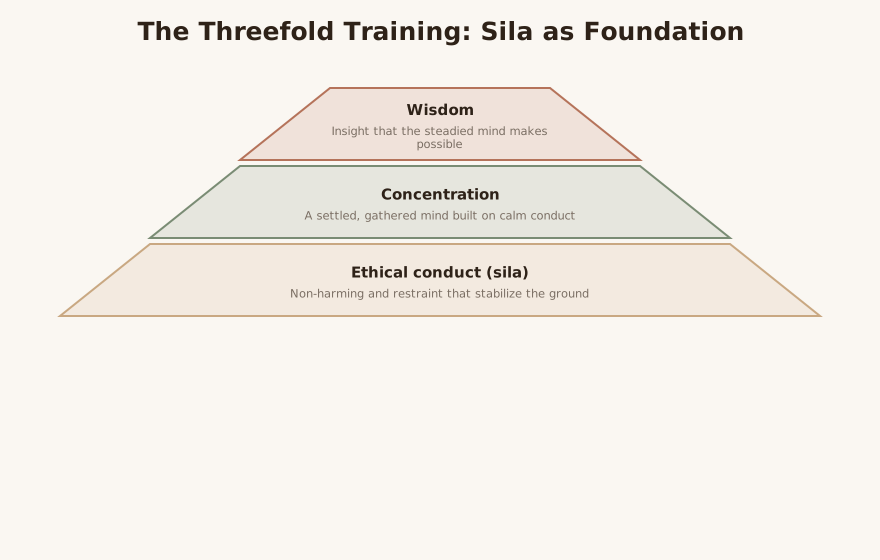
Sila (Pali; Sanskrit sila) is a construct of Buddhist philosophy and ethics — the dimension of the path concerned with moral conduct, virtue, and restraint — rather than a treatment protocol or clinical technique 1. The word is commonly rendered as “morality,” “virtue,” “moral discipline,” or “ethical conduct,” and it denotes both outward behavior (refraining from harm in body and speech) and the inner disposition of integrity from which such behavior flows 12. Within the classical threefold training (tisikkha), sila is the first of three trainings — sila (ethical conduct), samadhi (concentration/meditation), and panna (wisdom) — and is treated as the indispensable foundation on which the other two are built 45.
For practicing therapists, the relevant framing is that sila is a contemplative-ethical lens, not a stand-alone modality LLM. Its clinical usefulness lies in how its functional logic — non-harming, truthfulness, and behavioral restraint as preconditions for a settled mind — converges with secular, evidence-based work already operationalized inside mindfulness-based interventions and the values components of acceptance and commitment therapy LLM. Treating sila as a frame rather than as a stand-alone therapy of its own keeps the work honest, defensible, and respectful of its source tradition LLM.
Creators & Lineage
The teaching is attributed to the Buddha (Siddhartha Gautama) and belongs to the foundational architecture of early Buddhism, where ethical conduct is presented not as obedience to external commandment but as skillful action conducive to the end of suffering 23. In the Buddha’s analysis, conduct that harms self or others agitates the mind and obstructs meditative stability, whereas conduct grounded in restraint and goodwill produces the freedom from remorse that allows concentration to deepen 23.
Structurally, sila is woven through the Noble Eightfold Path, the practical program the Buddha laid out as the way to the end of suffering 3. Of the path’s eight factors, three are classically grouped under the heading of moral discipline: right speech, right action, and right livelihood 3. In the threefold-training schema these three factors constitute the sila division, while right effort, right mindfulness, and right concentration form the samadhi (meditation) division, and right view and right intention form the panna (wisdom) division 34. The orderings reinforce each other: ethical conduct supports concentration, concentration supports the arising of wisdom, and wisdom in turn refines conduct 45.
In lay and monastic practice, sila is operationalized most familiarly through training rules, the best known being the five precepts undertaken by lay practitioners: to refrain from killing, stealing, sexual misconduct, false speech, and intoxicants that cloud the mind 26. These are typically understood not as absolute prohibitions imposed from outside but as voluntary “training rules” (sikkhapada) — commitments a practitioner takes on to reduce harm and steady the mind 26.
The therapeutic lineage most relevant to clinicians runs through Buddhist psychology and the secular mindfulness-based interventions (MBSR and MBCT) that draw on it, as well as the values and committed-action processes of acceptance and commitment therapy, all of which import a recognizable analogue of sila — values-consistent, harm-reducing conduct as a stabilizing base for awareness LLM. A parallel lineage in Western moral philosophy is virtue ethics, which similarly locates the moral life in cultivated character and disposition rather than in rules or consequences alone, and which has been examined for its bearing on ethical conduct across cultures 67.
Core Principles
The central claim is that ethical conduct is not a moral add-on to contemplative practice but its structural precondition: a mind disturbed by harm, deception, or unrestrained impulse cannot easily settle, while a mind at ease with its own conduct can 23. Several principles organize this for clinical use LLM.
First, sila is foundational, not optional. In the threefold training, ethical conduct comes first because it stabilizes the ground on which concentration and wisdom can develop; without it, the later trainings have no firm footing 45. The sequence is developmental rather than merely moralistic LLM.
Second, conduct and mind-state are reciprocally linked. Harmful or deceptive action generates agitation, remorse, and self-division, which fragment attention; restraint and non-harming generate the “blamelessness” or freedom from remorse that allows the mind to grow calm 23. The mechanism is psychological as much as moral: behavior shapes inner state LLM.
Third, the precepts are training rules, not commandments. Sila is framed as voluntary commitments a practitioner undertakes to reduce harm and steady the mind, not as externally imposed law enforced by punishment 26. This is the principle clinicians can borrow most directly: the question is less “Is this forbidden?” than “Does this action increase or decrease harm and agitation in my life?” LLM.
Fourth, restraint is in service of freedom, not suppression for its own sake. The point of refraining is to remove the sources of remorse and turbulence that bind the mind, thereby creating the conditions for clarity and ease 23. Restraint is instrumental to liberation, not an end in itself LLM.
Interventions & Techniques
Sila itself prescribes no clinical technique; the usable techniques come from the secular modalities whose logic converges with it LLM. The following are the most clinically translatable LLM.
Values clarification and values-consistent action (ACT). Helping clients articulate what kind of person they want to be and then commit to behavior aligned with those values closely parallels sila’s emphasis on cultivated conduct as a foundation for a steadier life LLM. The functional move — choosing harm-reducing, integrity-consistent action — mirrors the voluntary undertaking of training rules 26.
Behavioral commitments and restraint practices. Structured commitments to refrain from specific harmful behaviors (for example, harm-reduction or abstinence plans in addiction work, or “urge-surfing” before acting on an impulse) operationalize sila’s restraint dimension within evidence-based behavioral frameworks LLM. The aim is to reduce the cycle of remorse and agitation that harmful action perpetuates 23.
Truthfulness and repair in the therapeutic relationship. Right speech — refraining from false, harsh, divisive, or idle speech — maps onto clinical work on honest communication, accountability, and relational repair, where reducing deception and harm in speech lowers interpersonal conflict and internal division 3LLM.
Conduct as a stabilizing base for mindfulness. Mindfulness-based programs implicitly assume that a less harmful, less chaotic daily life supports more stable attention; framing harm-reducing conduct as the soil for meditative practice gives clients a concrete, behavioral on-ramp to the awareness work 45LLM.
LLM-generated illustrative example (not a guideline): A client in early recovery reports that meditation “never works” — he sits down and his mind races with shame about things said and done while using. The clinician reframes: before expecting the mind to settle, they work on a few concrete commitments — making one honest amends, pausing before reactive texts, a daily plan to avoid a high-risk setting. Over weeks, as the daily wreckage of harm decreases, the client notices his attempts at brief mindfulness become less turbulent. The conduct work was not separate from the calming work; it was its precondition. LLM
Evidence Base
Honesty about maturity is essential. As a philosophical and ethical construct, sila is well established within the Buddhist canon and centuries of commentarial, monastic, and scholarly literature; its textual and conceptual basis is mature and thoroughly documented 126. It is “established” in the sense of being a stable, well-attested teaching with a clear place in the threefold training and the Eightfold Path — not in the sense of being a validated clinical intervention LLM.
There is no body of randomized controlled trials testing “sila therapy,” because sila is not a discrete therapy LLM. The defensible clinical evidence belongs to the secular modalities whose mechanisms overlap with it — mindfulness-based interventions such as MBSR and MBCT, and the values and committed-action processes of acceptance and commitment therapy — and clinicians should anchor evidentiary claims there rather than to the doctrine itself LLM. Stated plainly: the philosophy is mature; the secular mechanisms it informs have their own evidence base; the construct as such has not been independently trialed and should not be presented to clients as a proven treatment LLM. The cross-cultural literature on virtue ethics likewise raises the construct as a subject of scholarly examination rather than as a manualized, outcome-validated protocol 7.
Populations & Indications
The framing is most apt for meditators and contemplative practitioners, for whom ethical conduct is already understood as the foundation of practice and who can use the sila frame to make sense of why a chaotic or harm-saturated life undermines their meditation 45. It is especially relevant for people in addiction recovery, where harm-reduction, restraint, and the repair of damage done while using map directly onto sila’s logic of reducing remorse-generating conduct to steady the mind LLM.
It supports adults seeking values-based living, where the convergence with ACT values work is strongest, and clients in mindfulness-based programs, for whom conduct can be framed as the behavioral base that supports stable attention 45LLM. It is also indicated, with care, for people with moral injury and people with guilt and shame, where a non-punitive, training-rule framing of ethics can support accountability and repair without collapsing into self-condemnation LLM.
Problems-for-Work
Substance use disorders and impulse-control problems. Sila’s restraint dimension and its account of conduct-driven agitation map onto harm-reduction, urge management, and the rebuilding of a less chaotic daily life 23.
LLM-generated illustrative example (not a guideline): A client with binge-pattern drinking and reactive spending notices that each episode is followed by days of remorse that fuel the next episode. The clinician frames small, voluntary “training rules” — not as moral verdicts but as experiments in reducing the harm-then-remorse loop — and tracks how the quieter aftermath supports steadier mood. LLM
Guilt, shame, and moral injury. A training-rule framing reframes ethics as cultivable conduct rather than fixed condemnation, supporting accountability and repair; the work is to reduce future harm and remorse rather than to ratify a global “bad person” verdict 2LLM.
Values clarification and values-based living. Sila’s emphasis on cultivated, integrity-consistent conduct aligns with ACT values work, helping clients translate “who I want to be” into concrete, harm-reducing action LLM.
Behavioral activation and self-regulation; anger, aggression, and relationship conflict. Right speech and right action map onto reducing harmful speech, managing aggressive impulses, and repairing relational ruptures, which in turn lowers the interpersonal turbulence that destabilizes mood 3LLM.
Existential distress, anxiety, and restlessness. Framing conduct as the foundation of a settled mind can give anxious or restless clients a concrete, behavioral foothold — addressing the agitation that disordered conduct sustains rather than only its cognitive symptoms 23LLM.
Contraindications, Cautions & Cultural Humility
The most important caution is that ethics language can be weaponized against clients already burdened by guilt, shame, scrupulosity, or moral injury LLM. Introduced clumsily, sila can be heard as confirmation of a punishing “I am bad” narrative, deepening self-condemnation rather than supporting repair LLM. The tradition’s own framing guards against this: the precepts are voluntary training rules aimed at reducing harm and remorse, not commandments whose breach proves wickedness, and clinicians should preserve that non-punitive, accountability-oriented stance 26. For clients with obsessive-compulsive or scrupulosity presentations, an emphasis on moral rules can feed pathological over-responsibility and should be approached with particular caution or deferred LLM.
Avoid presenting sila as a moral mandate the client must adopt; keep it functional (“Does this conduct increase or decrease harm and agitation in your life?”) rather than doctrinal or coercive 2LLM. Be alert to spiritual bypassing — using “right conduct” to suppress legitimate anger, enforce passivity, or avoid grief and accountability — which inverts the intended effect LLM.
Cultural humility matters in both directions LLM. Sila is a sacred component of living Buddhist traditions, and extracting it for secular therapy risks decontextualization or appropriation; name its origins, hold it with respect, and do not present a stripped-down version as the whole tradition 126. The cross-cultural literature on virtue ethics underscores that conceptions of virtue and right conduct are culturally embedded, so clinicians should not assume their own moral framework is universal when working across cultures 7. For clients with their own religious or ethical commitments, the secular analogues — values clarification, harm reduction, relational repair — can be offered without imposing Buddhist metaphysics LLM.
Treatment-Plan Suggestions & SMART Objectives
| Goal | SMART objective (example) | Mechanism |
|---|---|---|
| Reduce harm-then-remorse cycle in substance use | Within 8 weeks, client will implement one self-chosen restraint commitment and log harm-reduction outcomes 5 of 7 days | Restraint as reduction of remorse-driven agitation 23 |
| Clarify and act on personal values | Within 6 weeks, client will articulate 3 core values and complete one values-consistent action weekly, reviewed each session | Values-consistent conduct; ACT values analogue LLM |
| Reduce harmful speech in conflict | Within 8 weeks, client will use a pause-and-rephrase strategy before reactive messages in 4 of 5 logged instances | Right speech; lowering interpersonal turbulence 3 |
| Support repair after moral injury | Within 10 weeks, client will complete one accountability-and-repair action and reframe one global self-judgment per session | Training-rule (non-punitive) framing of ethics 26 |
| Stabilize daily conduct as base for mindfulness | Within 6 weeks, client will maintain 3 harm-reducing daily commitments and rate post-practice agitation ≤4/10 | Conduct as precondition for settled attention 45 |
| Improve impulse control | Within 8 weeks, client will use urge-delay before a target impulsive behavior ≥4x/week (self-report) | Behavioral restraint; freedom from remorse 23 |
| Reduce shame-driven self-condemnation | Within 10 weeks, client will distinguish accountability from self-condemnation in 4 of 5 sessions | Non-punitive ethics; accountability without verdict 2LLM |
| Reduce restlessness/anxiety via steadier conduct | Within 8 weeks, client will link reduced reactive conduct to lower self-rated restlessness in weekly logs | Conduct–mind reciprocity 23 |
Common Misconceptions
“Sila is a list of commandments you must obey.” The precepts are voluntary training rules a practitioner undertakes to reduce harm and steady the mind, not externally imposed law enforced by punishment 26. The framing is developmental and functional, not legalistic LLM.
“Ethics and meditation are separate spheres.” In the threefold training, ethical conduct is the explicit foundation for concentration and wisdom; conduct and mind-state are reciprocally linked, not independent 45. Disordered conduct destabilizes attention 23.
“Sila is about being good for its own sake.” The restraint and non-harming of sila are framed instrumentally — they remove the remorse and agitation that bind the mind, in service of clarity and freedom rather than moral merit alone 23.
“Restraint means suppression.” Sila is not the white-knuckling of unwanted impulses but the cultivation of conduct that reduces harm and thereby quiets the mind; the goal is ease, not rigid self-denial 23LLM.
“It’s the same as Western rule-based morality.” Sila is closer to virtue ethics — concerned with cultivated character and disposition — than to rule-following or consequence-calculation alone, and conceptions of virtue are themselves culturally embedded 67.
Training & Certification
There is no certification in “sila” as a clinical method, because it is a philosophical and ethical construct rather than a credentialed therapy LLM. Clinicians who wish to use its functional core responsibly should pursue training in the secular modalities that carry analogous mechanisms: mindfulness-based intervention teacher training (MBSR/MBCT) and acceptance and commitment therapy training, including supervised practice in values clarification and committed action LLM. Personal contemplative practice and study of the source teaching — accessible expositions of the threefold training, the Eightfold Path, and the precepts — deepen the clinician’s ability to use the concept skillfully and respectfully 234. Familiarity with the tradition’s own framing (precepts as voluntary training rules rather than commandments) protects against the punitive, shame-amplifying misuse described above 26.
Key Terms
- Sila — ethical conduct, virtue, or moral discipline; the conduct dimension of the path and the first of the threefold training 12.
- Threefold training (tisikkha) — sila (ethical conduct), samadhi (concentration/meditation), and panna (wisdom), undertaken in mutually supporting sequence 45.
- Samadhi — concentration or meditative stability, the second training, supported by sila 45.
- Panna — wisdom or insight, the third training, supported by samadhi 45.
- Noble Eightfold Path — the Buddha’s practical program to the end of suffering, whose right speech, right action, and right livelihood constitute the sila division 3.
- Five precepts — the lay training rules: refraining from killing, stealing, sexual misconduct, false speech, and intoxicants 26.
- Training rules (sikkhapada) — voluntary commitments to reduce harm and steady the mind, not externally enforced commandments 26.
- Right speech — refraining from false, harsh, divisive, and idle speech; a sila factor of the Eightfold Path 3.
- Virtue ethics — a Western moral framework locating ethics in cultivated character and disposition, examined for relevance across cultures 67.
Resources & Further Reading
▶ Watch — a video introduction to this concept:
- Sila | Ethics, Morality & Virtue — Encyclopaedia Britannica
- Virtue: sila — Access to Insight
- The Noble Eightfold Path: The Way to the End of Suffering — Bhikkhu Bodhi (Access to Insight)
- What is the Threefold Training? — Buddhism A–Z (Lion’s Roar)
- What Is the Threefold Training: Sila, Samadhi, Panna? — Buddhism Way
- Buddhist ethics — Wikipedia
- Will Virtue Ethics Improve Ethical Conduct in Multicultural Settings and Interactions? — The Counseling Psychologist
Reflective / Supervision Questions
- Before introducing ethics language, am I assessing whether this client’s guilt, shame, or scrupulosity makes a “right conduct” frame more likely to wound than to help? LLM
- Am I presenting sila as voluntary, harm-reducing training rules — keeping the focus functional (“Does this increase or decrease harm and agitation?”) — rather than as commandments that prove a client good or bad? 26
- How am I distinguishing healthy accountability and repair from self-condemnation in this client’s work? LLM
- Am I documenting the active clinical mechanism (values-consistent action, behavioral restraint, relational repair) within a recognized modality, rather than charting a philosophy? LLM
- Am I holding this teaching with cultural humility — naming its Buddhist origins and avoiding a decontextualized, appropriated version — and not assuming my own moral framework is universal across cultures? 17
- For a client whose own ethical or religious framework differs, can I offer the secular analogues without imposing Buddhist ethics? LLM