
Type & Discipline
Shaping is a technique within behavioral psychology, specifically a procedure of operant conditioning 6. It is most precisely defined as the “differential reinforcement of successive approximations” toward a target behavior, a conditioning paradigm used originally in the experimental analysis of behavior 6. Put in working clinical terms, shaping is the method of building a behavior the client cannot yet perform by reinforcing progressively closer versions of it until the full target is reached 3. The clinical literature names it directly as “shaping by successive approximations for the desired behavior,” locating it within abnormal and clinical psychology rather than only the animal laboratory 1.
For practicing therapists, the most useful framing is that shaping is not a standalone therapy but a transferable operant procedure embedded inside larger modalities 6. It belongs to the operant-conditioning family and is one of the engine parts of applied behavior analysis, behavior modification, and graded exposure work 6. Wherever a behavior is simply absent from the repertoire, and waiting for it to occur spontaneously so it can be reinforced would mean waiting indefinitely, shaping is the procedure that constructs it 63.
Creators & Lineage
Shaping was introduced by B. F. Skinner, who developed it as part of his operant-conditioning framework in the mid-twentieth century and described it formally in 1951 32. Skinner first demonstrated the method with pigeons before extending it to dogs, dolphins, humans, and other species 6. He was a Harvard psychologist, and his work on operant conditioning is central to the behavioral tradition 5. Skinner’s most cited image for the procedure is sculptural: the finished behavior may look like a single coherent unit, but it is “constructed by a continual process of differential reinforcement from undifferentiated behavior, just as the sculptor shapes his figure from a lump of clay” 6.
The technique’s intellectual parent is Edward Thorndike’s law of effect, which held that behavior followed by pleasant consequences is strengthened and behavior followed by unpleasant consequences is weakened 2. Skinner translated Thorndike’s subjective language into observable terms, reinforcement to strengthen and punishment to weaken, and demonstrated these principles in controlled experiments using the operant chamber, popularly the Skinner box 2. From this base, shaping flowed downstream into applied behavior analysis, behavior modification, and the graded-task logic of exposure therapy, all of which inherit the same successive-approximation mechanism 61.
Core Principles
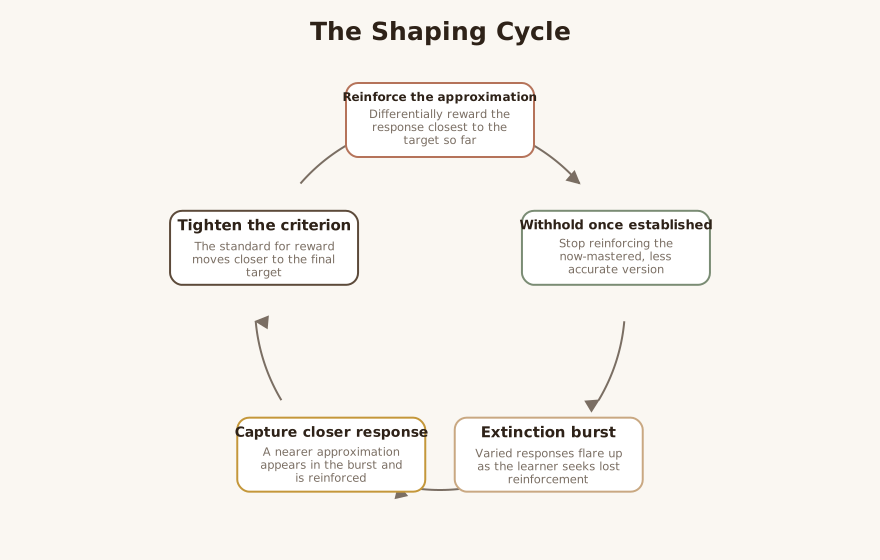
The governing mechanism is differential reinforcement of successive approximations: the clinician selectively reinforces behaviors that move closer to the target while withholding reinforcement from less accurate versions 6. As the behavior develops, the criterion for reinforcement tightens, so that what earned a reward at one stage no longer does at the next 3. Over time these small, individually reinforced steps accumulate into a behavior change too large to have been reinforced directly at the outset 2.
A second principle is the productive use of extinction. When the trainer stops reinforcing a less accurate approximation, the learner typically produces an extinction burst, a flurry of varied responses in an effort to regain reinforcement, and it is within this burst that a closer approximation usually appears and can be captured 6. The cycle then repeats: reinforce the new, closer approximation; withhold once it is established; capture the next one 6. This is why shaping is sometimes described as riding the variability that extinction generates LLM.
A third principle concerns reinforcement scheduling. Continuous reinforcement, rewarding every instance, is used to establish an initial response, after which partial or intermittent schedules maintain the behavior once it is reliable 3. Timing is decisive: reinforcement delivered late risks strengthening whatever the client happened to be doing at the moment of reward rather than the intended approximation 3. The reinforcer can be positive (adding something preferred) or negative (removing something aversive), and both increase the likelihood of the behavior they follow 2.
Interventions & Techniques
In practice, shaping is operationalized through a small set of design decisions 3. The clinician first establishes a clearly defined target behavior, then chooses an appropriate starting point already within the client’s repertoire, plans the intermediate approximations, and moves through them at the correct pace 3. The classic laboratory illustration is teaching a rat to press a lever, progressing from merely turning toward the lever, to moving toward it, to touching it, to depressing it partially, and finally to a full press, with each step reinforced in turn before the criterion advances 6.
Shaping rarely operates alone. It interlocks with prompting and fading, chaining of multi-step skills, and stimulus discrimination and generalization, the last helping a learner tell reinforced from non-reinforced situations and apply a learned response across new contexts 6. Within applied behavior analysis it is one of the standard tools for modifying maladaptive or absent behaviors in humans, and in rehabilitation it underwrites concrete protocols such as training on parallel bars as an approximation of independent walking, or progressively extending the interval a patient can wait between bathroom visits 6. In exposure-based treatment, the same logic appears as graded approach: the clinician reinforces small, manageable steps toward a feared situation rather than demanding the full confrontation at once 32.
LLM-generated illustrative example (not a guideline): For a client with severe social anxiety who cannot yet make a phone call, a clinician might first reinforce writing a script, then rehearsing it aloud alone, then leaving a voicemail to a friendly contact, then a brief live call, advancing the criterion only once each step is performed with manageable distress LLM.
Evidence Base
The maturity of shaping is best labeled established. It is not an experimental candidate technique but a foundational operant procedure that has been part of the science of behavior since Skinner formalized it in 1951 and demonstrated it across species 26. Its standing rests less on individual outcome trials of “shaping alone” and more on its status as a basic building block whose principles are embedded throughout applied behavior analysis, behavior modification, and exposure therapy, each of which carries its own evidence base 61.
Honesty about what that means is important. Because shaping is almost always delivered as one component inside a larger package, isolating its specific contribution to outcome in clinical populations is methodologically difficult, and much of its foundational demonstration comes from the experimental analysis of behavior rather than randomized clinical trials of the technique in isolation 6. The procedure also has documented limits. The Brelands’ work with a pig and a raccoon showed that species-typical, instinctive behaviors can override conditioned approximations: the animals reverted to food-handling routines that blocked the trained response, a phenomenon that introduced the idea of biological constraints on learning 6. The clinical reading is that shaping is powerful but not omnipotent, and that pre-existing dispositions and competing reinforcers can derail a well-designed program 6LLM.
Populations & Indications
Shaping is indicated whenever a needed behavior is missing or too weak to reinforce directly, and this cuts across many populations 6. It is heavily used with children with developmental disabilities and people with autism spectrum disorder, where it builds communication, self-care, and social responses that are not yet in the repertoire, most often as a component of applied behavior analysis 6. It is central to skills training generally, including teaching learners who refuse or struggle with a target behavior, because it lets the clinician start far below the goal and advance gradually 6.
The procedure is equally at home with people who have anxiety disorders, where graded approach to feared stimuli is, mechanistically, shaping of approach behavior, and modern cognitive-behavioral therapists use successive approximation to help clients overcome phobias and severe anxiety by reinforcing small steps toward the feared situation 23. In rehabilitation, shaping structures the recovery of motor and self-management behaviors such as walking with aids or bladder-interval training 6. It is also applied with people who have severe mental illness within behavior-modification programs aimed at building adaptive and self-care behaviors 16.
Problems-for-Work
- Skill deficits. When a self-care or vocational skill is absent, the clinician reinforces the nearest existing behavior and advances the criterion step by step until the full skill is performed 63.
- Autism spectrum disorder. Communication and social responses absent from the repertoire are built through reinforced approximations, often within applied behavior analysis 6.
- Avoidance behavior and phobias. Approach to a feared situation is shaped through graded, reinforced steps rather than a single confrontation 23.
- Behavioral activation and task-initiation difficulties. A withdrawn or inert client can be moved toward activity by reinforcing successively larger increments of engagement 3LLM.
- Social skills deficits. Component social behaviors (eye contact, greeting, turn-taking) are each reinforced as approximations and chained toward fluent interaction 6LLM.
- Selective mutism. Vocal behavior is built from non-verbal approximations upward, reinforcing whispered or partial vocalizations before full audible speech, within a behavioral framework 1LLM.
LLM-generated illustrative example (not a guideline): For a child with selective mutism, a clinician might first reinforce mouthing a word silently, then a whisper to a parent, then an audible word to the parent with the clinician present, then a direct word to the clinician, advancing only as each level becomes reliable LLM.
Contraindications, Cautions & Cultural Humility
Shaping has no medical contraindication in the usual sense, but it carries real cautions. The first is reinforcer selection and timing: a poorly chosen or mistimed reinforcer can strengthen an unintended behavior, and satiation (a reinforcer losing potency through overuse) and overjustification (extrinsic rewards undermining intrinsic motivation) can both blunt or distort the program 3. The second is biological and individual constraint: instinctive or strongly pre-established behavior can override conditioned approximations, so a stalled program may reflect a competing disposition rather than clinician error 6.
A pacing caution is central. Moving the criterion too fast can place the client in repeated extinction without an attainable next step, producing frustration rather than progress, while moving too slowly stalls the work; the “correct pace” is itself a clinical judgment that must be calibrated to the individual 3LLM. Cultural humility matters because the choice of target behavior is never value-neutral: shaping toward a clinician-defined “desired behavior” can drift into enforcing conformity to a dominant norm rather than serving the client’s own goals 1LLM. This caution is sharpest with autistic and neurodivergent clients, where reinforced approximation toward neurotypical presentation can amount to teaching masking; responsible practice anchors targets in the client’s quality of life and assent rather than appearance 6LLM.
Treatment-Plan Suggestions & SMART Objectives
| Goal | SMART objective (example) | Mechanism |
|---|---|---|
| Build an absent self-care skill | Within 6 weeks, client completes a 4-step handwashing routine with no more than 1 prompt across 3 consecutive sessions | Reinforce successive approximations of each step, advancing criterion as each is mastered 63 |
| Increase social initiation | Within 8 weeks, client initiates one greeting per session in 70% of sessions | Differential reinforcement of greeting approximations, then chaining 6 |
| Graded approach to a feared stimulus | Within 10 weeks, client remains in the presence of the feared stimulus for 5 minutes at manageable distress | Reinforce successive approach steps; advance only when distress is tolerable 23 |
| Build vocal/verbal behavior (mutism) | Within 12 weeks, client speaks one audible word to the clinician in 60% of opportunities | Shape from non-verbal/whispered approximations toward audible speech 1 |
| Behavioral activation | Within 4 weeks, client completes one 10-minute scheduled activity 4 days per week | Reinforce successively larger increments of engagement 3 |
| Extend a tolerance interval (rehab) | Within 6 weeks, client extends the interval between target events by a set increment, data-tracked | Progressive interval extension with reinforcement of each lengthened interval 6 |
| Maintain a newly built skill | Within 4 weeks of mastery, client performs the skill across 2 new settings and 1 new person | Thin to intermittent reinforcement; program for generalization 36 |
Common Misconceptions
- “Shaping just means rewarding the behavior.” It specifically means differentially reinforcing closer and closer approximations while withholding reinforcement from previously accepted ones, not rewarding a fixed behavior every time 63.
- “You wait for the behavior, then reinforce it.” For absent behaviors that would be the point: shaping exists precisely because the target may never occur on its own, so the clinician constructs it from existing behavior upward 6.
- “Shaping is only for animals and the laboratory.” Although Skinner demonstrated it with pigeons and rats, it is an established clinical procedure named in abnormal and clinical psychology and applied across autism, anxiety, rehabilitation, and skills training 61.
- “Shaping always works if you reinforce enough.” Biological constraints and competing instinctive behaviors can override conditioned approximations, and satiation or overjustification can undermine the reinforcer 63.
- “Shaping and exposure are unrelated.” Graded exposure is, mechanistically, the shaping of approach behavior toward a feared stimulus through reinforced successive approximations 23.
Training & Certification
Shaping is a technique rather than a credentialed modality, so there is no certification in shaping as such; competence is acquired within training in the broader frameworks that use it 6LLM. Clinicians most often learn it as part of applied behavior analysis, behavior modification, or cognitive-behavioral and exposure-based training, where it is taught alongside reinforcement schedules, prompting and fading, chaining, and functional assessment 6. The underlying principles trace to Skinner’s operant work and to the experimental analysis of behavior, which remains the conceptual home for the procedure 26. Practitioners who want to use shaping responsibly should ground it in a working knowledge of operant principles and apply it within their own scope of practice rather than presenting it as a freestanding intervention LLM.
Key Terms
- Successive approximations — the series of intermediate behaviors that move incrementally from a starting point toward the target 3.
- Differential reinforcement — reinforcing closer approximations while withholding reinforcement from less accurate ones 6.
- Target behavior — the clearly defined end behavior the program is built to produce 3.
- Extinction burst — the surge of varied responding that follows withholding reinforcement, within which a closer approximation can be captured 6.
- Continuous vs. intermittent reinforcement — rewarding every instance to establish a response, then partial schedules to maintain it 3.
- Reinforcement (positive/negative) — adding a preferred stimulus or removing an aversive one to increase a behavior 2.
- Law of effect — Thorndike’s principle that consequences strengthen or weaken behavior, the antecedent of operant reinforcement 2.
- Autoshaping (sign tracking) — a related Pavlovian phenomenon in which responses develop toward a reward-predictive stimulus regardless of behavior, distinct from operant shaping 6.
Resources & Further Reading
▶ Watch — a video introduction to this concept:
- Shaping by Successive Approximations for the Desired Behavior (SAGE Encyclopedia of Abnormal and Clinical Psychology) 1
- Operant Conditioning: B.F. Skinner Theory (Simply Psychology) 2
- What Is Shaping In Psychology? (Explore Psychology) 3
- Role of Shaping in Operant Conditioning (JoVE Science Education) 4
- B. F. Skinner (Harvard Department of Psychology) 5
- Shaping (psychology) (Wikipedia) 6
Reflective / Supervision Questions
- Have I defined the target behavior concretely enough that I can recognize and reinforce a genuine approximation to it, rather than reinforcing inconsistently? 3
- Where is this client’s current behavior on the path to the target, and is my chosen starting point actually within their existing repertoire? 3
- Am I advancing the criterion at a pace that keeps the next step attainable, or am I leaving the client in unproductive extinction? 36
- Whose goal is the “desired behavior,” and have I checked it against the client’s own values and assent rather than a conformity norm? 1LLM
- Could a competing reinforcer, satiation, or a strongly pre-established behavior be the reason a program is stalling, rather than insufficient effort? 63
- Am I using shaping within a framework I am trained in, and integrating it with prompting, chaining, and generalization rather than in isolation? 6