
Type & Discipline
Classical (Pavlovian) conditioning is a theory of associative learning within behavioral psychology, not a packaged treatment protocol 1. It describes how organisms learn that one event predicts another and, as a result, come to respond to a previously meaningless cue as if it carried the significance of the event it now forecasts 4. For clinicians, it sits in the same conceptual family as operant conditioning and forms the learning-theory foundation beneath behavior therapy and exposure-based treatments 1.
The reason it earns a place in a clinical wiki, despite being “just” a theory, is that a large share of what we treat is conditioned in this sense: the panic that swells on a bridge, the nausea that arrives in the oncology waiting room before the drip is hung, the craving that fires when an old using buddy texts, the startle that detonates at a car backfire 13. Understanding the mechanism tells you why these responses are involuntary, why telling a patient “you’re safe” rarely dissolves them, and why the corrective work is structured the way it is LLM.
Creators & Lineage
The phenomenon is named for Ivan Pavlov (1849-1936), the Russian physiologist who, while studying digestion in dogs in the 1890s and early 1900s, noticed that his animals began salivating not only to food but to the sight of the technician who fed them 4. He systematized the observation by pairing a neutral cue, such as a metronome or bell, with food until the cue alone produced salivation 45. Edwin Twitmyer published related findings at roughly the same time, but Pavlov’s program of work became the influential one 5.
The bridge to clinical psychology was built by John B. Watson and Rosalie Rayner, whose 1920 “Little Albert” demonstration conditioned fear in an infant by pairing a white rat with a loud noise until the rat alone elicited fear, which then generalized to other furry stimuli 2. Mary Cover Jones answered with “Little Peter,” using counterconditioning, pairing a feared animal with pleasant stimuli, to reverse a child’s fear; this is the historical seed of systematic desensitization 2. Later, Robert Rescorla reframed conditioning as learning about prediction rather than mere pairing, formalized in the Rescorla-Wagner model, and John Garcia showed that biology constrains what can be conditioned, work that reshaped how we think about preparedness 53. The downstream lineage runs directly into behavior therapy, systematic desensitization, aversion therapy, and modern exposure therapy 25.
Core Principles
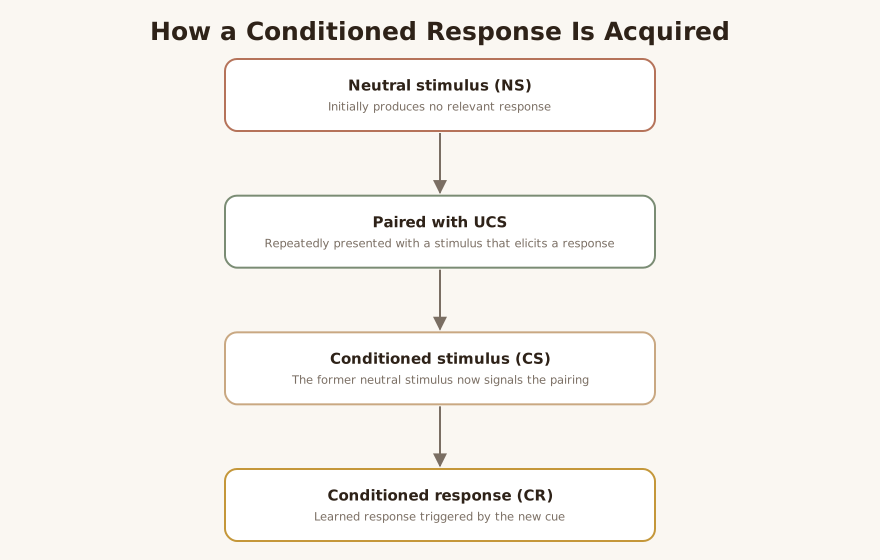
The vocabulary is worth getting precise, because clinicians use it loosely and then confuse themselves. An unconditioned stimulus (UCS) naturally elicits an unconditioned response (UCR) without prior learning, food producing salivation, a loud noise producing startle 14. A neutral stimulus (NS) initially produces no relevant response 2. When the NS is repeatedly paired with the UCS it becomes a conditioned stimulus (CS), and the response it now elicits is the conditioned response (CR), often resembling the UCR but triggered by the new cue 14.
Several lawful phenomena follow 5:
- Acquisition: the CR strengthens across repeated CS-UCS pairings; speed depends on stimulus salience, intensity, and timing 15.
- Timing matters: forward conditioning (CS before UCS) is most effective, with delay and trace variants; simultaneous and backward arrangements are weak or inhibitory 5.
- Extinction: presenting the CS repeatedly without the UCS gradually weakens the CR, but does not erase the original learning 15.
- Spontaneous recovery: an extinguished CR can reappear, usually weaker, after a rest interval 14.
- Renewal and reinstatement: an extinguished response can return when the patient re-enters the original context (renewal) or re-encounters the UCS alone (reinstatement) 5.
- Generalization and discrimination: stimuli similar to the CS also elicit the CR, while discrimination training narrows the response to the predictive cue 45.
- Higher-order (second-order) conditioning: an established CS can itself condition a new neutral stimulus, letting fear or craving spread to cues never paired with the original UCS 35.
- Blocking and latent inhibition: a cue that already predicts the UCS blocks learning to a redundant new cue, and a heavily pre-exposed stimulus is harder to condition later 5.
The single most clinically important of these is that extinction is new learning layered over old, not deletion 15. Renewal, reinstatement, and spontaneous recovery are why gains made in one room, on one day, relapse in another, and why relapse is a learning problem rather than a failure of will LLM.
Interventions & Techniques
Classical conditioning is the mechanism inside several recognized techniques rather than a billable therapy on its own LLM. Systematic desensitization pairs a graduated hierarchy of feared stimuli with relaxation, a counterconditioning procedure meant to attach a response incompatible with anxiety to the feared cue 52. Exposure therapy more broadly engineers repeated, safe encounters with the CS so that extinction occurs and the predicted catastrophe fails to materialize 1. Flooding/imaginal implosion uses prolonged exposure to high-intensity stimuli until anxiety extinguishes 5. Aversion therapy runs the logic in reverse, pairing an unwanted behavior or substance with an unpleasant UCS such as a nausea-inducing medication 25. The enuresis (bed-wetting) alarm pairs bladder distension with an arousal stimulus, with reported success in the range of 50-70% 1.
LLM-generated illustrative example (not a guideline): A patient with a driving phobia after a collision is guided through an in-vivo hierarchy, sitting in the parked car, idling in the driveway, driving an empty lot, then a quiet street, each step held until anxiety drops by half and no crash occurs, so the cue “being behind the wheel” gradually stops predicting danger LLM.
Evidence Base
The maturity of classical conditioning as a body of knowledge is established 1. Its core phenomena are among the most replicated findings in psychology, demonstrated across species and refined by formal models such as Rescorla-Wagner 5. As an explanatory framework, it robustly accounts for the formation and maintenance of phobias, panic, PTSD symptom clusters, and addiction cue reactivity 35.
Honesty requires two distinctions, however. First, the theory’s descriptive and mechanistic validity is far stronger than any claim that “applying conditioning principles” automatically yields good outcomes; StatPearls itself frames effective conditioning-based care as requiring a strategic, evidence-based, team approach 1. Second, the treatments derived from it carry their own evidence ratings, exposure therapy and systematic desensitization are well supported for anxiety disorders, whereas aversion therapy has a far more mixed and contested record 5. The Rescorla-Wagner model itself, though influential, does not explain latent inhibition, recovery phenomena, or contextual effects 5. Treat the theory as durable and the specific applications as each needing their own evidentiary check LLM.
Populations & Indications
Conditioning principles are relevant across general clinical populations but are especially load-bearing for several groups 1. Individuals with anxiety and phobic disorders present the cleanest case: a discrete CS reliably triggers a CR, and graded exposure targets exactly that link 13. People with substance use disorders show cue reactivity, drug-associated people, places, and paraphernalia function as conditioned stimuli that provoke craving and physiological responses long after cessation 5. Trauma-exposed individuals carry conditioned fear to trauma-linked cues, the model behind much of PTSD symptomatology 3. Children are frequent subjects of conditioning-based interventions, from the enuresis alarm to the original counterconditioning of childhood fears 12. Patients with conditioned medical responses, classically anticipatory nausea before chemotherapy, illustrate how even immune and physiological responses can be conditioned 1.
Problems-for-Work
- Specific phobias map most directly: the feared object is the CS, and exposure drives extinction 1.
- Panic disorder can be understood as conditioning to interoceptive cues, bodily sensations themselves becoming the CS that signals catastrophe 2.
- PTSD: situational and sensory cues become conditioned stimuli that trigger fear and arousal 3.
- Generalized anxiety can reflect broad stimulus generalization, where many loosely related cues elicit the CR 4.
- Substance use and cravings: environmental cues elicit conditioned responses, and conditioned compensatory responses underlie tolerance, with overdose risk rising when a person uses in a novel context lacking the usual cues 5.
- Conditioned nausea and anticipatory anxiety: a taste, smell, or waiting room paired with an aversive UCS later elicits the response on its own 1.
- Insomnia (conditioned arousal): the bed and bedtime routine, repeatedly paired with wakeful frustration, become a CS for arousal rather than sleep LLM.
- Enuresis: the alarm pairs bladder fullness with waking to build a new conditioned response 1.
LLM-generated illustrative example (not a guideline): For conditioned insomnia, stimulus-control instructions deliberately break the bed-arousal pairing, get out of bed when wakeful, return only when sleepy, so the bed regains its association with sleep, a clinical application of discrimination and extinction logic LLM.
Contraindications, Cautions & Cultural Humility
There are no contraindications to understanding conditioning, but its derived procedures carry real ones LLM. Exposure and flooding can be destabilizing if pacing outstrips the patient’s window of tolerance, and exposure conducted without adequate safety or in a still-dangerous environment can sensitize rather than extinguish fear LLM. Because extinction is context-dependent and prone to renewal and reinstatement, single-setting work risks fragile gains; varying contexts and anticipating relapse are part of competent practice 5. Aversion therapy raises distinct ethical and consent concerns and should not be applied casually LLM.
Cultural humility matters because what functions as a UCS, a CS, or a “safe” context is not universal LLM. Stimuli that are neutral or even positive in one cultural frame may be aversive or sacred in another, and biological preparedness reminds us that not all associations form equally easily, fear conditions readily to some stimuli and not others 3. Clinicians should let the patient define the meaning and threat value of cues rather than assuming them LLM.
Treatment-Plan Suggestions & SMART Objectives
| Goal | SMART objective (example) | Mechanism |
|---|---|---|
| Reduce phobic avoidance | Within 8 sessions, complete a 10-step in-vivo exposure hierarchy with peak SUDS dropping below 30 on the final two steps | Extinction of the CS-fear association via repeated unreinforced exposure 1 |
| Decondition panic to body sensations | Within 6 weeks, tolerate 5 interoceptive exposure exercises (e.g., controlled overbreathing) without escape behavior, twice weekly | Extinction of conditioning to interoceptive CS 2 |
| Lower substance cue reactivity | Over 4 weeks, identify top 5 personal cues and report craving intensity reduced by half during in-session cue exposure | Extinction of conditioned cravings to drug-associated CS 5 |
| Reduce trauma-cue reactivity | Within 12 sessions, process 3 trauma-linked cues with subjective distress reduced by 50% and no avoidance of associated daily activities | Extinction and contextual safety learning over conditioned fear 3 |
| Restore sleep-conducive cue control | Within 3 weeks, follow stimulus-control rules nightly so that time-to-sleep onset falls below 30 minutes on 5 of 7 nights | Discrimination training: re-pair bed with sleep, extinguish bed-arousal link LLM |
| Counter-condition a feared stimulus | Within 6 sessions, pair graded feared cues with a relaxation response, achieving relaxed engagement at hierarchy step 8 | Counterconditioning of an incompatible response to the CS 5 |
| Prevent relapse of extinguished fear | By discharge, complete exposures across at least 3 distinct contexts and rehearse a written relapse-recovery plan | Counter renewal/reinstatement by generalizing extinction across contexts 5 |
Common Misconceptions
A frequent error is conflating classical with operant conditioning: classical learning concerns involuntary, elicited responses to antecedent cues, whereas operant learning concerns voluntary behavior shaped by its consequences 1. Another is believing extinction erases the original learning; it instead builds competing learning, which is why spontaneous recovery, renewal, and reinstatement occur 15. Clinicians also overestimate how arbitrary conditioning is, Garcia’s work shows biological preparedness makes some associations far easier to form than others 3. Finally, conditioned responses are often miscast as quirky lab curiosities, when in patients they include clinically potent reactions like anticipatory nausea, panic, and craving 13.
Training & Certification
There is no certification in “classical conditioning”; it is foundational knowledge taught in introductory and learning-theory coursework across psychology, counseling, and medical training 41. Clinical competence comes instead from training in the derived treatments, supervised practice in exposure therapy, systematic desensitization, and CBT for anxiety and substance use, where the conditioning logic is applied responsibly 5. Clinicians seeking to apply these principles should pursue modality-specific training and supervision rather than treating familiarity with Pavlov as a clinical credential LLM.
Key Terms
- Unconditioned stimulus (UCS): a stimulus that naturally elicits a response without learning 1.
- Unconditioned response (UCR): the innate, automatic response to the UCS 4.
- Neutral stimulus (NS): a stimulus that initially produces no relevant response 2.
- Conditioned stimulus (CS): a formerly neutral stimulus that, after pairing, elicits a learned response 1.
- Conditioned response (CR): the learned response to the CS 4.
- Acquisition / Extinction: strengthening of the CR through pairing / weakening when the CS is presented without the UCS 15.
- Spontaneous recovery / Renewal / Reinstatement: ways an extinguished CR returns 15.
- Generalization / Discrimination: spread of the CR to similar cues / narrowing to the predictive cue 4.
- Higher-order conditioning: an established CS conditions a new neutral stimulus 35.
- Biological preparedness: evolutionary bias making some associations easier to learn (Garcia effect) 3.
- Counterconditioning: replacing the CR with an incompatible response, as in systematic desensitization 5.
Resources & Further Reading
▶ Watch — a video introduction to this concept:
- Classical Conditioning (StatPearls, NCBI Bookshelf)
- Learning by Association: Classical Conditioning (Introduction to Psychology, open textbook)
- Classical Conditioning: How It Works With Examples (Simply Psychology)
- Classical Conditioning: Exploring Pavlov’s Famous Experiment (WebMD)
- Classical conditioning (Wikipedia)
- How to Train a Brain: Crash Course Psychology #11 (video)
Reflective / Supervision Questions
- For a given patient, can you name the specific UCS, CS, and CR you believe are operating, and what evidence supports that formulation? LLM
- Are your exposure gains being built in enough varied contexts to withstand renewal and reinstatement, or are they fragile and room-specific? 5
- When a patient relapses after good in-session progress, do you frame it as a learning phenomenon (spontaneous recovery, renewal) rather than as resistance or failure? LLM
- Have you let the patient define which cues carry threat or meaning, rather than importing your own cultural assumptions about what is neutral or aversive? LLM
- For substance-use cases, have you mapped the conditioned cues that drive craving and considered the overdose risk that conditioned compensatory responses imply when use occurs in novel settings? 5