
Family-Based Treatment (FBT), commonly known as the Maudsley Approach, is the most empirically supported treatment for adolescent anorexia nervosa and is delivered in the least restrictive outpatient setting wherever medically safe.6 Rather than treating the adolescent in individual therapy, FBT enlists parents as the primary agents of recovery, coaching them to do at home the renourishment work that nurses would otherwise do on an inpatient unit.5 This article orients practicing clinicians to its principles, phases, evidence, and the practical and ethical considerations of delivering it well. LLM
Type & Discipline
FBT is a manualized, time-limited outpatient psychotherapy situated at the intersection of clinical psychology and family therapy.2 It is most often described as a family-based or family therapy modality for eating disorders, though it diverges sharply from traditional family therapy in that it does not seek to “fix” the family or interpret family dynamics as the cause of illness.5 The treatment is structured across three phases and typically delivered in roughly 20 sessions over 9 to 12 months by a single therapist working alongside medical oversight.1 Eligible disciplines for the lead role include psychiatrists, psychologists, and social workers, reflecting its design as a transportable, manual-driven intervention rather than a discipline-restricted one.1
Creators & Lineage
The approach originated at the Maudsley Hospital in London, where Christopher Dare and Ivan Eisler developed a family-oriented treatment for anorexia nervosa, which is why it is still widely called the Maudsley Approach.7 James Lock and Daniel Le Grange subsequently operationalized this clinical work into a structured treatment manual, demonstrating that the approach could be manualized while preserving fidelity to outcomes seen in clinically supervised practice.2 Their manual, co-authored with W. Stewart Agras and Christopher Dare, provided the first detailed account of an approach shown to be consistently efficacious in randomized clinical trials for adolescent anorexia nervosa.2
Conceptually, FBT draws on the family-systems tradition, including structural and systemic family therapy, in its attention to the family as the unit of intervention and to organizing parental authority around the meal.5 It also borrows pragmatically from cognitive behavioral and behavioral methods in its emphasis on behavior change (eating, weight restoration) ahead of insight, and from narrative therapy in its technique of externalizing the illness so the adolescent is distinguished from the disorder.5 Importantly, FBT explicitly repudiates the older clinical assumption that families cause eating disorders. LLM
Core Principles
F.E.A.S.T., a leading caregiver advocacy organization, summarizes three foundational principles that distinguish FBT.6 First is an agnostic stance toward cause: the therapist takes no position on what caused the eating disorder, which removes blame and shame from parents.6 Second is the presumption that parents are competent agents of change who can be mobilized to restore their child’s health.6 Third is respect for the adolescent’s autonomy in all domains outside of the disordered eating, calibrated to developmental readiness.6
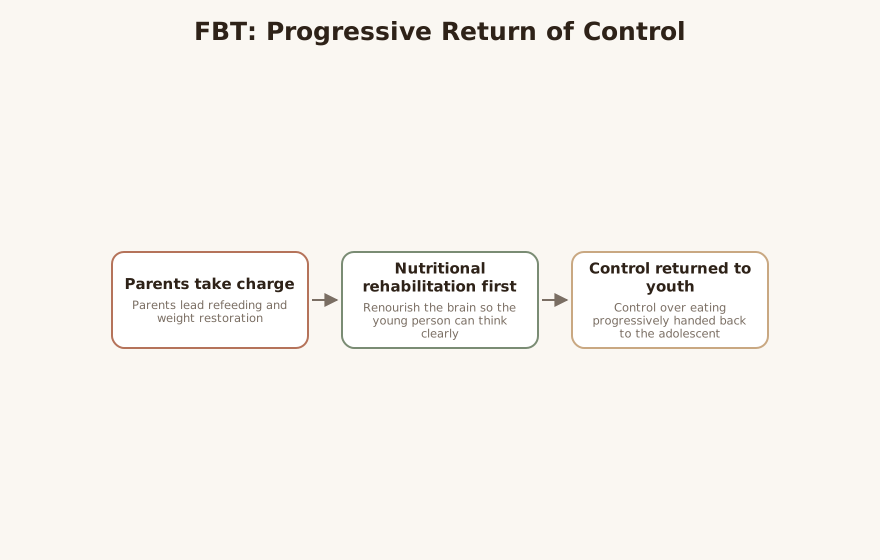
A further organizing principle is the recognition that much of the rigidity, distorted thinking, and distress around food is itself a product of starvation.5 FBT therefore prioritizes nutritional rehabilitation first, on the premise that once the brain is renourished the young person can think more clearly and engage other issues.5 This is why clinicians are coached to sidestep the “anorexic debate” — the futile argument with the illness about whether and what the patient will eat — and focus instead on getting food in.5 The treatment is delivered in the least restrictive environment possible, keeping the adolescent at home, in school, and within their family wherever medically feasible.6
Interventions & Techniques
The signature intervention of FBT is the family meal, observed in session during the first phase, in which the therapist watches the family eat together and offers concrete feedback to enhance the parents’ effectiveness at helping their child eat.6 The therapist functions as an expert consultant and coach to the parents rather than as the adolescent’s individual therapist.6
A second core technique is externalizing the illness, separating the adolescent from the anorexia so that parents can align with their child against the disorder rather than against the child. LLM A third is non-negotiable parental management of food and, where indicated, activity, in which parents select, prepare, and serve all food and hold firm, empathic boundaries during the renourishment phase.5 Across the arc of treatment, control is deliberately and gradually handed back to the adolescent as weight and behavior stabilize.6
LLM-generated illustrative example (not a guideline): A 15-year-old refuses to finish a plated breakfast, insisting she “isn’t hungry.” Rather than negotiate calories or interpret the refusal, the therapist coaches the parents to sit beside her, calmly reflect that “this is the anorexia talking, not you,” and remain present until the meal is completed — modeling unified, persistent, non-punitive parental authority. LLM
Evidence Base
The evidence base for FBT is mature and best characterized as established for adolescent anorexia nervosa. The treatment manual was built on a clinical approach shown to be consistently efficacious in randomized clinical trials.2 A dissemination study in a community clinic reported an average weight gain of 7.8 kg, with 86% of patients reaching at least 85% of ideal body weight and 57% reaching at least 95%; menstrual function returned in 8 of 9 patients who had secondary amenorrhea at baseline.1 In prior controlled trials, 96% of patients no longer met diagnostic criteria for anorexia nervosa.1 The same dissemination study documented an 85.7% treatment completion rate and acceptable fidelity outside the original research setting, supporting transportability into routine care.1
Major practice guidance reflects this evidence. The American Psychiatric Association Practice Guideline for the Treatment of Patients With Eating Disorders supports family-based treatment for adolescents and emerging adults with anorexia nervosa.3 Honest caveats remain: much of the strongest evidence concerns relatively short-illness-duration adolescents living with their families, outcomes are typically measured at end of treatment and short follow-up, and a meaningful minority of families do not respond and require step-up to more intensive care.1 Evidence for adaptations to bulimia nervosa is supportive but less extensive, and use in ARFID and atypical anorexia is promising but less robustly established.5
Populations & Indications
FBT was designed for, and is best supported in, adolescents with anorexia nervosa who are medically stable enough for outpatient care and who live with at least one engaged caregiver.1 The central populations are therefore the adolescent or young person, their parents and caregivers, and the family as the unit of treatment.6 It is also applied to young adults with anorexia nervosa, children, and to adolescents with bulimia nervosa, with growing application to avoidant/restrictive food intake disorder (ARFID) and atypical presentations.5
The strongest indication is a relatively short illness duration in a young person still embedded in family life, where parents can be deployed daily across multiple meals.1 FBT is particularly suited to families willing to take on the demanding role of renourishment, because the modality’s efficacy depends on parental engagement rather than on the adolescent’s motivation or “buy-in.”6
Problems-for-Work
FBT directly targets a cluster of presenting problems centered on anorexia nervosa, malnutrition, and disordered eating, with weight restoration as the immediate behavioral aim of phase one.1 It is adapted for bulimia nervosa and increasingly for ARFID.5
Because renourishment is the gateway to cognitive recovery, FBT also indirectly addresses comorbid anxiety and comorbid depression that are frequently amplified by starvation, on the expectation that mood and rigidity often improve as nutritional status is restored.5 Treatment refusal is reframed as a feature of the illness rather than a barrier, since FBT does not require the patient’s consent to begin renourishment, instead mobilizing parents to act.6 Family conflict around food is worked with directly through the in-session family meal and parental coaching.6
LLM-generated illustrative example (not a guideline): For a family paralyzed by mealtime conflict, the therapist might assign both parents to jointly plate and supervise every meal and snack for two weeks, framing this as a temporary, illness-specific division of labor rather than a permanent shift in parenting, with the explicit goal of reducing the daily negotiation that the illness exploits. LLM
Contraindications, Cautions & Cultural Humility
FBT presumes a medically stable patient; acute medical instability, severe electrolyte derangement, or other markers requiring hospitalization take precedence and may require medical stabilization before or alongside outpatient FBT.1 The model also presumes at least one available, capable caregiver, which limits its applicability where caregivers are absent, incapacitated, or themselves unsafe. LLM
Clinicians should hold the model’s demands honestly: parental refeeding is intensive, can strain employment and the family system, and is not equally feasible for every family configuration or socioeconomic situation. LLM Cultural humility is essential — assumptions about who prepares food, family hierarchy, mealtime norms, and acceptable parental authority vary across families and cultures, and the therapist must adapt the coaching role to the family’s structure rather than imposing a single template. LLM The agnostic, no-blame stance is itself a cultural-humility commitment, deliberately abandoning the historical and stigmatizing assumption that families cause eating disorders.6 Where a family cannot take on the renourishment role, or where the adolescent does not respond, clinicians should be prepared to step up to higher levels of care rather than persist with an ineffective outpatient plan.1
Treatment-Plan Suggestions & SMART Objectives
| Goal | SMART objective (example) | Mechanism |
|---|---|---|
| Restore weight to a medically safe range | Patient will gain weight toward the treatment team’s target at a clinically appropriate rate over the first 3 months, verified at weekly weigh-ins | Parental management of all meals and snacks in phase one1 |
| Establish unified parental authority over eating | Within 4 weeks, both caregivers will jointly plate and supervise 100% of meals and snacks without negotiating portions, documented in a meal log | In-session family meal and parental coaching6 |
| Reduce mealtime conflict | Within 6 weeks, caregivers will report a reduction in escalations at meals as the “anorexic debate” is replaced by calm persistence | Externalizing the illness; sidestepping debate5 |
| Renourish to support cognitive recovery | Over phase one, patient will complete all prescribed meals so that starvation-driven rigidity and distress measurably decrease by mid-treatment | Nutrition-first sequencing5 |
| Gradually return developmentally appropriate eating autonomy | In phase two, patient will independently plate one self-selected meal per day for 2 weeks without relapse in weight or behavior | Staged transfer of control to the adolescent6 |
| Restore normative adolescent development | By phase three, patient and family will identify and address one developmental task (e.g., peer activities, school re-engagement) not centered on food | Phase-three focus on adolescent development1 |
| Recover and maintain remission criteria | At end of treatment, patient will no longer meet diagnostic criteria for the eating disorder, confirmed at the final assessment | Sustained renourishment and relapse monitoring1 |
Common Misconceptions
A persistent misconception is that FBT blames or “fixes” the family; in fact the model is explicitly agnostic about cause and removes blame and shame from parents.6 A second is that the adolescent must be motivated or must consent before treatment can begin — FBT instead positions parents as the agents of recovery and does not require the young person’s buy-in to start renourishment.6 A third is that early FBT is conventional insight-oriented or interpretive family therapy; it is deliberately behavior-first, prioritizing eating and weight restoration over exploration of underlying meaning until nutrition is restored.5 A fourth is that FBT is “just feeding” the patient — it is a phased treatment that ultimately returns control to the adolescent and addresses developmental tasks once weight is restored.1 Finally, some clinicians assume FBT cannot be standardized; the manualization research established that it can be delivered to manual with preserved outcomes.2
Training & Certification
FBT is delivered to a published treatment manual, and clinicians typically build competence by studying that manual and the underlying clinical approach.4 In dissemination research, therapists were prepared through a structured workshop led by one of the treatment’s developers, supplemented by weekly group supervision to support fidelity in a new setting.1 This combination of manual-based training plus ongoing supervision is the practical pathway most therapists follow to deliver FBT competently. LLM Because the model is designed to be transportable across psychiatry, psychology, and social work, the central credential is demonstrated fidelity to the manualized approach rather than a single discipline.1 Clinicians seeking structured training should consult the foundational manual and pursue workshop training and supervision in the model. LLM
Key Terms
- Maudsley Approach — the original name for the family-oriented treatment for anorexia nervosa developed at the Maudsley Hospital in London.7
- Family-Based Treatment (FBT) — the manualized, three-phase operationalization of the Maudsley Approach for adolescent eating disorders.2
- The family meal — an in-session meal observed by the therapist in phase one to coach parents toward effective renourishment.6
- Externalizing the illness — separating the adolescent from the eating disorder so the family can ally against the illness rather than the child. LLM
- Agnostic stance — the therapist’s deliberate neutrality about what caused the disorder, which removes parental blame.6
- The anorexic debate — the unproductive argument with the illness over eating that FBT teaches families to sidestep.5
- Phase transfer of control — the staged return of eating autonomy from parents to the adolescent across the three phases.6
Resources & Further Reading
▶ Watch — a video introduction to this concept:
- Family-Based Treatment for Adolescents with Anorexia Nervosa: A Dissemination Study (PMC)
- Can family-based treatment of anorexia nervosa be manualized? (PubMed)
- APA Practice Guideline for the Treatment of Patients With Eating Disorders
- Treatment Manual for Anorexia Nervosa: A Family-Based Approach (Lock, Le Grange, Agras & Dare)
- Family-Based Treatment for Eating Disorders (Child Mind Institute)
- What is Family Based Treatment (FBT)? (F.E.A.S.T.)
- Treating Anorexia with the Maudsley Approach (Lindner Center of HOPE)
Reflective / Supervision Questions
- Where in my current practice am I implicitly or explicitly blaming families for an eating disorder, and how would adopting the agnostic stance change my case formulation? LLM
- When a session stalls, am I being drawn into the “anorexic debate,” and how can I redirect parents back to renourishment? LLM
- How do I assess whether a given family has the capacity, time, and structure to take on parental refeeding, and what is my threshold for stepping up to a higher level of care?1
- Am I adapting the coaching role to this family’s cultural norms around food, authority, and mealtime, or imposing a single template? LLM
- How will I know when control can be safely transferred back to the adolescent, and what observable markers am I tracking across phases?6
- For non-responders, how will I recognize early that FBT is not working, and what is my plan?1