
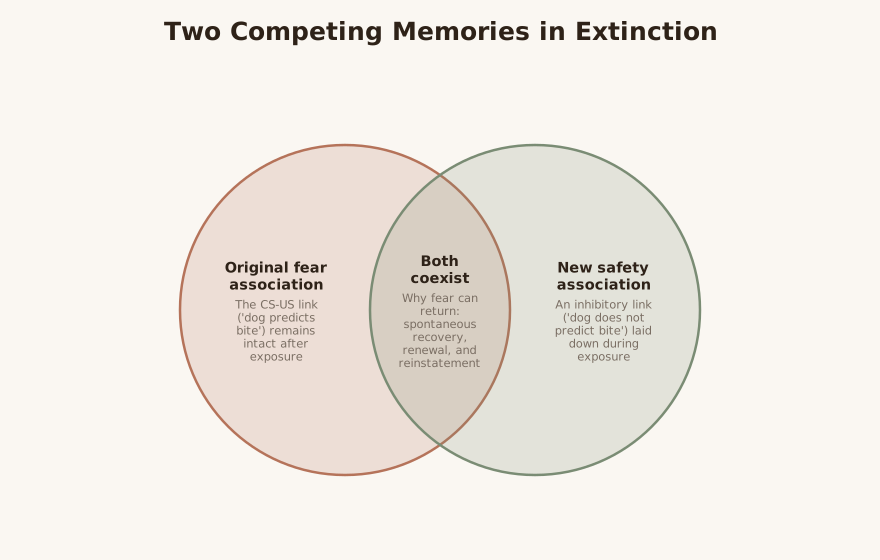
The inhibitory-learning model reframes what actually changes inside a successful exposure session. It argues that the original fear memory is never deleted; instead, a new, competing “this is safe” memory is laid down alongside it, and the clinical task is to make that new memory strong, accessible, and retrievable across contexts and time 1. For practicing therapists, the practical payoff is a shift in how we design, run, and debrief exposures — away from “wait until anxiety drops” and toward “violate the prediction and consolidate the learning” 1.
Type & Discipline
This is a theoretical and mechanistic model rather than a packaged, standalone therapy LLM. It sits at the intersection of clinical psychology and behavioral neuroscience, drawing directly on Pavlovian conditioning research and translating laboratory findings about fear extinction into the conduct of clinical exposure therapy 1. It is best understood as a mechanism-of-action account that informs how existing exposure-based treatments — exposure therapy, exposure and response prevention (ERP), and the exposure components of CBT — should be delivered, not as a new diagnostic-specific protocol 4. Because it specifies the active ingredient of exposure, it functions as an optimization framework layered onto modalities clinicians already bill and deliver LLM.
Creators & Lineage
The model’s intellectual roots lie in basic Pavlovian extinction research, particularly Mark Bouton’s work demonstrating that extinguished fear is context-dependent and prone to return 1. Michelle Craske and colleagues are the figures most responsible for translating this animal-and-laboratory literature into a clinical optimization framework, first in a 2008 review of strategies to optimize inhibitory learning during exposure and then in a widely cited 2014 synthesis 21. Jonathan Abramowitz and collaborators extended the model into obsessive-compulsive disorder and ERP, both in a critical review and in practitioner-facing guidance 64. Craske’s group later refined the framework into an inhibitory retrieval approach organized through the “OptEx Nexus,” emphasizing that learning is only as good as one’s ability to retrieve it when it matters 3.
The lineage is therefore a braid of three traditions: classical conditioning and Pavlovian extinction theory, the broader cognitive-behavioral tradition that operationalized exposure, and emotional processing theory, against which the inhibitory-learning model was partly defined as an alternative explanation of how exposure works 1.
Core Principles
The foundational claim is that extinction is not unlearning. The original conditioned stimulus–unconditioned stimulus (CS–US) association — for example, “dog predicts bite” — remains intact in memory after successful exposure; what changes is the addition of a new inhibitory association (“dog does not predict bite”) that, when retrieved, suppresses the fear response 5. Both associations coexist, which is precisely why fear can return 5.
This explains the well-documented phenomena of return of fear: spontaneous recovery with the passage of time, renewal when the person encounters the cue in a new context, and reinstatement after an aversive event 1. If extinction merely erased the original learning, these relapse phenomena would not occur; their existence is direct evidence that two competing memories are in play 1.
The second core principle follows from the first: within-session fear reduction (habituation) is not the mechanism of lasting change and does not reliably predict outcome 2. The degree to which fear declines during a given exposure trial says little about how much durable inhibitory learning has occurred 2. The therapeutic target shifts from fear reduction to expectancy violation — generating a mismatch between what the client predicts will happen and what actually happens 1. The model also reframes the goal as building tolerance of distress and uncertainty rather than eliminating distress, since the new safety memory must be retrievable even when anxiety is present 4.
Interventions & Techniques
Craske and colleagues operationalized the model into a concrete set of strategies that any clinician already doing exposure can adopt 1:
- Expectancy violation. Identify the client’s specific prediction (“If I touch the doorknob, I’ll get sick and can’t cope”), design the exposure to test it, and run it until the prediction is clearly disconfirmed — not until anxiety subsides 1. Deliberately design exposures that exceed what the client believes is “safe” to maximize the surprise 4.
- Removal of safety signals and safety behaviors. Eliminate the crutches (carrying medication, mental reassurance, a trusted companion) that prevent the client from learning that the feared outcome does not occur on its own; the degree of interference depends on how much a given safety behavior alters the predicted outcome 5.
- Deepened (compound) extinction. Combine multiple feared cues simultaneously once each has been addressed separately, layering triggers to strengthen safety learning 4.
- Occasional reinforced extinction. Allow occasional, tolerable contact with the feared outcome (or mild versions of it) so the new learning becomes robust to the unpredictability of real life 1.
- Variability. Replace a rigid, ascending fear hierarchy with randomized order, varying durations, intensities, and emotional states; this “desirable difficulty” improves long-term retention even if it feels harder in the moment 5.
- Multiple contexts. Conduct exposures across different locations, times, and interpersonal settings to counteract context-dependent renewal of fear 1.
- Retrieval cues. Use reminder cues that the client can carry into daily life to reactivate the safety memory at the moments it is most needed — the heart of the later inhibitory-retrieval refinement 3.
- Affect labeling. Have the client verbally label the emotional experience during exposure as a form of processing that supports extinction 1.
LLM-generated illustrative example (not a guideline): A client with panic disorder predicts, “If my heart races past 120, I’ll faint.” Rather than running interoceptive exposure (e.g., step-ups) until the racing settles, the therapist runs it specifically to push past 120 and asks afterward: “You predicted fainting — what actually happened?” The surprise that no fainting occurred, repeated across the clinic, a stairwell, and a busy café, is the learning. LLM
Evidence Base
Honest appraisal: the theory is well-established, but the clinical optimization claims are at an earlier stage of maturity LLM. The core mechanistic account — that extinction creates new inhibitory learning rather than erasing the original association, and that return-of-fear phenomena reflect retrieval failure — rests on a robust and replicated Pavlovian literature 1. The motivating clinical problem is also well-documented: a substantial subset of patients fail to benefit or relapse after exposure treatment, which the model attributes to deficits in inhibitory learning or its retrieval 1.
Where the evidence is thinner is in whether each individual optimization strategy reliably outperforms standard, well-delivered exposure in clinical samples 6. Much of the supporting data comes from analog studies (e.g., conditioning paradigms or sub-clinical fearful volunteers), and translation to clinical populations has produced mixed and sometimes null findings 6. Even strong advocates frame these procedures as research-derived and recommend reserving the more aggressive ones for cases where standard evidence-based exposure has already been tried 4. The fair summary for clinicians is that the framework should inform exposure design now, while specific dose-response questions about each technique remain open LLM.
Populations & Indications
The model is indicated wherever exposure-based treatment is indicated, which spans the anxiety and related disorders 1. It has been applied to adults with anxiety disorders, people with specific phobias, panic disorder, social anxiety disorder, generalized anxiety disorder, agoraphobia, OCD, and PTSD 1. The OCD application is particularly well-developed, where the framework reshapes how ERP is delivered 4. It has been described for social anxiety disorder, where expectancy violation and dropping subtle safety behaviors (over-rehearsing, avoiding eye contact) are central 5. The principles extend to children and adolescents with anxiety, and to transdiagnostic presentations such as health anxiety, where the feared prediction concerns catastrophic illness LLM.
Problems-for-Work
- Specific phobia. Test the catastrophic prediction directly (e.g., the spider will jump and the person will lose control), varying spider, room, and proximity rather than holding still until calm 1.
- Panic disorder & agoraphobia. Interoceptive and situational exposures designed to disconfirm “these sensations mean catastrophe,” run across multiple contexts to prevent renewal 1.
- Social anxiety disorder. Behavioral experiments that violate social-catastrophe predictions while dropping safety behaviors and tolerating the uncertainty of others’ judgments 5.
- OCD. ERP reframed as learning new safety information while tolerating doubt, deliberately foregoing rituals and reassurance so the non-occurrence of feared outcomes can be learned 4.
- PTSD. Imaginal and in-vivo exposure understood as building a competing safety memory rather than erasing the trauma memory 1.
- Return of fear / relapse. When fear returns, the model directs the clinician to retrieval and context strategies (booster exposures, multi-context practice, retrieval cues) rather than concluding the original treatment “failed” 13.
LLM-generated illustrative example (not a guideline): A client with contamination OCD has “habituated” in session but relapses at home. The inhibitory-learning lens reframes this as context-dependent renewal, not treatment failure: the safety memory was learned in the clinic and isn’t retrieved in the kitchen. The plan becomes home-based exposures plus a retrieval cue the client uses before entering the kitchen. LLM
Contraindications, Cautions & Cultural Humility
The model does not change the standard prerequisites for exposure: medical clearance for interoceptive work, attention to current safety, and avoidance of exposures that risk genuine harm LLM. A specific caution flows from the model itself — because the goal is expectancy violation, clinicians must ensure the feared outcome truly will not occur; an exposure that confirms a realistic danger teaches the wrong lesson LLM. Leading clinicians also advise that the more demanding optimization strategies be used judiciously, after standard evidence-based exposure has been delivered competently, rather than as a first move 4.
Tolerating distress and “desirable difficulty” must be titrated to the individual, the alliance, and the client’s window of tolerance, particularly in trauma survivors for whom flooding can be destabilizing LLM. Cultural humility matters in defining what counts as a “feared outcome” and a “safety behavior”: behaviors that look like avoidance in one cultural frame may be adaptive, valued, or protective in another, and prediction-testing should be co-constructed in the client’s own terms rather than imposed LLM.
Treatment-Plan Suggestions & SMART Objectives
| Goal | SMART objective (example) | Mechanism |
|---|---|---|
| Reduce avoidance of feared situation | Within 8 weeks, client completes 3 previously-avoided situations per week without safety behaviors, logged in a diary | Removal of safety signals; expectancy violation 15 |
| Build accurate threat predictions | By session 6, client states a specific prediction before each exposure and rates prediction-vs-outcome mismatch afterward (target gap ≥ 50%) | Expectancy violation 1 |
| Increase distress tolerance | Within 6 weeks, client remains in exposure to a pre-set learning endpoint (prediction tested), not to a fear-rating drop, in 80% of trials | Tolerance over reduction 4 |
| Generalize learning across contexts | Over 4 weeks, client completes the target exposure in ≥ 3 distinct settings (home, work, public) | Multiple contexts; counter renewal 1 |
| Strengthen durable safety learning | By week 10, client combines two previously-mastered feared cues in one exposure twice weekly | Deepened/compound extinction 4 |
| Improve retrieval of safety learning | Client uses an agreed retrieval cue before high-risk situations daily for 3 weeks, logging recall of the safety lesson | Retrieval cues / inhibitory retrieval 3 |
| Prevent relapse | At discharge, client has a written return-of-fear plan (booster exposures, multi-context practice) and demonstrates it once | Address spontaneous recovery, renewal, reinstatement 1 |
Common Misconceptions
- “Exposure works by habituation, so wait until fear drops.” Within-session fear reduction does not reliably predict outcome; the active ingredient is disconfirmed expectancy, not a lower SUDS rating 2.
- “Successful extinction erases the fear.” The original association persists; only a competing inhibitory memory is added, which is why fear can return 5.
- “Relapse means the treatment failed.” Return of fear is predicted by the model as a retrieval problem (renewal, spontaneous recovery, reinstatement) and is addressed with context and retrieval strategies 1.
- “A neat ascending hierarchy is essential.” Variability and randomized intensity (“desirable difficulties”) can produce better long-term retention than a smooth, predictable hierarchy 5.
- “More distress is always better.” The aim is calibrated expectancy violation and tolerance-building, used judiciously and after standard exposure is delivered well — not maximal arousal for its own sake 4.
Training & Certification
There is no separate credential for the inhibitory-learning model itself; it is learned as part of training in exposure-based CBT and disseminated through the primary literature and practitioner guidance LLM. The foundational readings are the Craske et al. 2008 and 2014 papers and the 2022 inhibitory-retrieval/OptEx Nexus update 213. For OCD specifically, the International OCD Foundation’s expert guidance and the Jacoby & Abramowitz review translate the model into ERP practice 46. Clinicians typically build competence through supervised exposure practice within established protocols (ERP, Prolonged Exposure, panic-control treatment) and then adopt the optimization strategies as a refinement of that delivery LLM.
Key Terms
- Inhibitory learning — new “safety” association (CS–noUS) that competes with and suppresses, but does not erase, the original fear memory 5.
- Expectancy violation — the mismatch between the client’s predicted feared outcome and the actual (non-)outcome, posited as the core mechanism of exposure 1.
- Habituation (contrast) — within-session decline in fear; in this model, not the mechanism of durable change and not a reliable outcome predictor 2.
- Return of fear — umbrella term for relapse phenomena: spontaneous recovery, renewal, and reinstatement 1.
- Renewal — return of fear when the extinguished cue is encountered in a context different from where extinction occurred 1.
- Desirable difficulties — variability and effortful conditions that feel harder in-session but improve long-term retention of learning 5.
- Inhibitory retrieval — later refinement emphasizing that learning must be retrievable across time and context, organized via the OptEx Nexus 3.
Resources & Further Reading
▶ Watch — a video introduction to this concept:
- Maximizing exposure therapy: An inhibitory learning approach (Craske et al., 2014)
- Optimizing inhibitory learning during exposure therapy (Craske et al., 2008)
- Optimizing exposure therapy with an inhibitory retrieval approach and the OptEx Nexus (Craske et al., 2022)
- The Inhibitory Learning Approach to Exposure and Response Prevention (International OCD Foundation)
- Inhibitory Learning in Exposure Therapy for Social Anxiety and Other Anxiety-Related Disorders (National Social Anxiety Center)
- Inhibitory learning approaches to exposure therapy (Jacoby & Abramowitz, 2016 review)
Reflective / Supervision Questions
- For my last three exposure sessions, did I run the exposure to a fear-rating drop or to a clearly tested prediction — and what would change if I switched? LLM
- Can I articulate, for a current client, exactly what they predict will happen and how the exposure is designed to violate it? LLM
- Which safety behaviors am I tolerating “for now,” and how might each be blocking the expectancy violation I’m aiming for? 5
- When a client relapses, do I reflexively read it as failure, or do I assess it as renewal/spontaneous recovery and respond with context and retrieval strategies? 1
- Am I applying the more demanding optimization strategies prematurely, before standard evidence-based exposure has been delivered competently? 4
- How am I building variability and multiple contexts into homework so learning generalizes beyond my office? 1