
Type & Discipline
Exposure and Response Prevention (ERP, also abbreviated EX/RP) is a specific behavioral technique within clinical psychology, not a freestanding “school” of therapy 7. It is the active behavioral engine of cognitive behavioral therapy (CBT) for obsessive-compulsive disorder, and most contemporary manuals embed it inside a broader CBT package with psychoeducation and, often, cognitive work 6. The Society of Clinical Psychology lists ERP under its empirically supported psychological treatments for OCD 1. Functionally, ERP belongs to the family of condition-specific exposure protocols: it adapts the general logic of exposure therapy to the particular architecture of obsessions and compulsions 2. The core procedural innovation that distinguishes ERP from generic exposure is the deliberate prevention of the response — the compulsion or neutralizing ritual — rather than simply confronting a feared stimulus 2.
Creators & Lineage
ERP descends from behaviorism and the broader exposure-therapy tradition, in which feared stimuli are confronted systematically so that learned fear can be modified 7. The technique’s distinctive ritual-blocking element is generally traced to Victor Meyer, who in the late 1960s pioneered preventing hospitalized OCD patients from carrying out their compulsions while exposing them to triggers, with striking results that overturned the prevailing pessimism about OCD LLM. Edna Foa, working with Michael Kozak and later colleagues including Elna Yadin and Tracey Lichner, operationalized and manualized the approach into the structured EX/RP protocols used today 6. Foa and Kozak’s 1986 paper introduced emotional processing theory, the influential framework proposing that exposure works by activating a fear structure and supplying corrective information that modifies it 3. That theory shaped a generation of exposure research, even as the field’s mechanistic account has since evolved 5. The lineage therefore runs from extinction learning and behaviorism, through emotional processing theory, to contemporary inhibitory learning models 5.
Core Principles
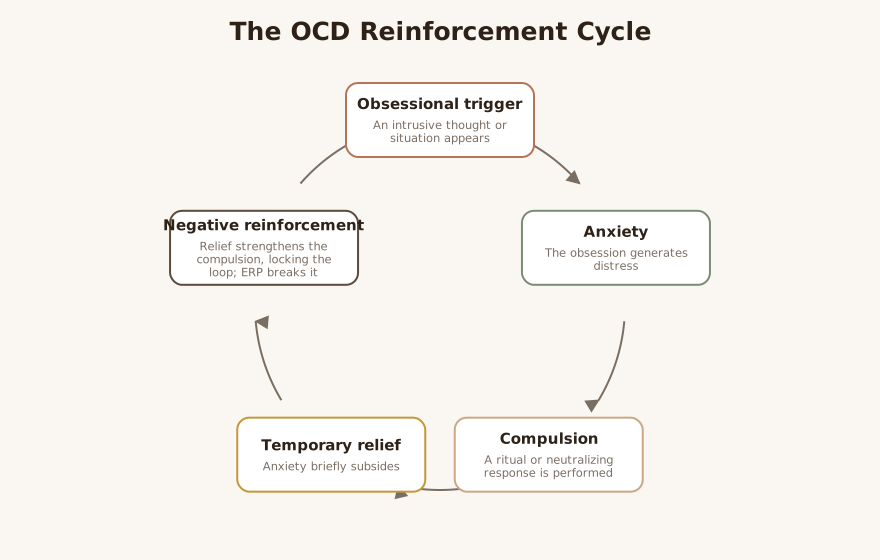
ERP rests on a simple but counterintuitive premise: obsessions generate anxiety, compulsions temporarily relieve it, and that relief negatively reinforces the compulsion — locking the cycle in place 2. By confronting the trigger and not performing the ritual, the patient breaks the reinforcement loop and creates the conditions for new learning 2. The two halves are inseparable: exposure without response prevention lets the patient escape via covert or overt rituals, and response prevention without exposure provides nothing to learn from 7. Critically, “response prevention” means blocking the full repertoire of neutralizing behaviors — not only overt acts like washing or checking but covert ones like mental reviewing, reassurance-seeking, and subtle avoidance or safety behaviors 7. Older accounts framed the goal as habituation — staying in the situation until anxiety falls and the patient “learns there is nothing to fear” 1. Contemporary models reframe the target as learning, not anxiety reduction: the aim is tolerating distress and discovering that feared outcomes do not occur, building new non-threatening associations that compete with the original fear 5.
Interventions & Techniques
A standard course begins with assessment and a shared formulation: mapping the patient’s specific obsessions, the compulsions and avoidance they drive, and the feared consequences that maintain them 6. Psychoeducation reframes intrusive thoughts as normal mental events and explains why ritualizing perpetuates the problem 6. The clinician and patient then build an exposure hierarchy, typically using Subjective Units of Distress (SUDS) ratings to rank triggers from mildly to severely provoking 7. Exposures may be in vivo (touching a “contaminated” surface, leaving a door unchecked) or imaginal (vividly confronting a feared catastrophe that cannot be staged in reality, such as causing harm) 6. During each exposure the patient confronts the trigger while abstaining from rituals, and SUDS are tracked before, during, and after to monitor learning 7. The therapist coaches, models, and progressively withdraws support so the patient becomes their own therapist 2. From an inhibitory-learning standpoint, clinicians increasingly emphasize expectancy violation, varied and unpredictable exposures, and dropping safety behaviors over simply waiting for anxiety to subside 5. Foa’s manual introduces in vivo exposure early (around session three) and treats imaginal exposure and ritual prevention as integrated, ongoing components, closing with relapse prevention 6.
LLM-generated illustrative example (not a guideline): A patient with contamination OCD rates touching a public doorknob at 80/100 SUDS. After formulation and consent, she touches the knob and then refrains from washing for a planned interval. The clinician helps her notice that her catastrophic prediction (“I will get seriously ill and it will be my fault”) does not come true, and that she can tolerate the discomfort — the learning target — rather than fixating on whether her anxiety has dropped LLM.
Evidence Base
ERP is an established, gold-standard treatment: Division 12 rates it as having Strong empirical support for OCD 1, and it is recommended by major bodies including the American Psychiatric Association and NICE 6. A 2021 systematic review and meta-analysis of 36 randomized controlled trials (2,020 patients) found a large pooled effect favoring CBT with ERP (Hedges’ g = 0.74; 95% CI 0.51-0.97), rising to g = 1.13 against psychological placebo 4. Honesty about the evidence requires two caveats from that same review. First, ERP showed no significant advantage over other active psychological therapies (g = -0.05) 4. Second, effect size was strongly tied to researcher allegiance: trials with suspected allegiance bias showed large effects (g = 0.95) while those without showed negligible effects (g = 0.02) 4. Real-world response is also partial: roughly 50-60% of completers show clinically significant improvement, about 25-30% drop out, and a substantial fraction respond insufficiently 5. ERP’s durability is a genuine strength — gains tend to persist, whereas 45-89% of medication-only patients relapse after stopping an SSRI 5. Mechanistically, the field has moved away from within-session habituation, which does not predict outcome, toward inhibitory learning 5.
Populations & Indications
ERP is first-line for OCD across the lifespan, with strong support in adults and adolescents 1. Because its logic targets the obsession-compulsion-avoidance cycle, it is also applied to related conditions on the OCD spectrum and to other disorders maintained by ritualized neutralizing or avoidance LLM. These include body dysmorphic disorder, where exposure addresses appearance-related triggers and response prevention targets mirror-checking and reassurance-seeking; health anxiety (illness anxiety disorder), where the rituals are body-checking and medical reassurance-seeking; and hoarding disorder, where exposure involves discarding and resisting acquisition LLM. ERP principles also inform treatment of trichotillomania and other body-focused repetitive behaviors, where the “response” being prevented is the pulling or picking itself, often combined with habit-reversal strategies LLM. Scrupulosity — religious or moral OCD — is a common presentation requiring ERP tailored sensitively to the patient’s values LLM. Across all of these, candidacy depends on the presence of identifiable triggers, a maintaining ritual or avoidance, and the patient’s capacity to engage with planned distress 2.
Problems-for-Work
ERP gives the clinician a concrete way to operationalize otherwise sticky problems. Contamination fears: exposure to feared surfaces with prevention of washing and sanitizing 2. Checking compulsions: leaving appliances, locks, or emails unchecked while tolerating uncertainty about harm 2. Intrusive thoughts and “pure-O” obsessions (harm, sexual, or blasphemous themes): imaginal exposure to the feared content while preventing mental neutralizing, reassurance-seeking, and avoidance 6. Scrupulosity: exposure to feared moral or religious “transgressions” while preventing confession and prayer rituals LLM. Health anxiety: refraining from body-checking, symptom-googling, and reassurance-seeking after exposure to illness-related cues LLM. Safety behaviors and avoidance of all kinds are explicitly named and dropped, because they function as covert rituals that block disconfirmation 7.
LLM-generated illustrative example (not a guideline): A man with harm-OCD reports intrusive images of stabbing his infant and has hidden every knife in the house. ERP might pair imaginal exposure to the feared image with in vivo exposure to holding a knife near his child, while preventing the rituals — mentally “checking” whether he is a dangerous person and seeking reassurance from his partner LLM.
Contraindications, Cautions & Cultural Humility
ERP deliberately provokes distress, so informed consent, a clear rationale, and a collaborative formulation are non-negotiable before exposures begin 6. Clinicians should screen carefully when comorbidities may interfere: active suicidality, untreated psychosis, severe substance use, or limited insight can require stabilization first LLM. Family accommodation — relatives participating in or enabling rituals — undermines ERP and often must be addressed directly 5. Therapist factors are a real barrier: many clinicians experience delivering exposure as strenuous and may inadvertently dilute it, which weakens outcomes 5. Distinguishing a clinical compulsion from a culturally or religiously normative practice is essential, particularly in scrupulosity, where prayer or ritual washing may be valued behavior rather than pathology; consultation with the patient and, where appropriate, faith leaders supports culturally humble exposure design LLM. Exposures should never humiliate, coerce, or violate the patient’s genuine values, and pacing should follow a shared hierarchy rather than the therapist’s agenda 7. Finally, ERP is not a standalone cure-all: a meaningful minority do not respond, and clinicians should hold realistic, honestly communicated expectations 5.
Treatment-Plan Suggestions & SMART Objectives
| Goal | SMART objective (example) | Mechanism |
|---|---|---|
| Reduce contamination-driven washing | Within 8 weeks, complete 3 in-vivo exposures/week and reduce handwashing episodes from 30/day to under 10/day | Response prevention breaks the negative-reinforcement loop 2 |
| Tolerate uncertainty about harm | Over 6 sessions, leave the front door unchecked on departure 5/5 days/week without returning | Expectancy violation; new safety learning 5 |
| Address intrusive harm thoughts | Within 6 weeks, complete daily imaginal exposure scripts with no mental neutralizing, logging SUDS each time | Emotional processing of feared content; ritual prevention 6 |
| Eliminate reassurance-seeking | Within 4 weeks, reduce reassurance requests to partner from 10/day to 0, tracked on a daily log | Removes covert ritual that blocks disconfirmation 7 |
| Build a usable hierarchy | By session 3, co-construct a 10-item SUDS-ranked exposure hierarchy the patient endorses | Collaborative formulation; structured graded exposure 6 |
| Shift goal from anxiety drop to distress tolerance | Across treatment, patient verbalizes “I can tolerate this” rather than waiting for anxiety to fall, in 4/5 exposures | Inhibitory learning framing 5 |
| Generalize and prevent relapse | In the final 2 sessions, design a self-directed maintenance plan and rehearse responses to 3 high-risk scenarios | Patient becomes own therapist; relapse prevention 6 |
Common Misconceptions
“ERP just means flooding the patient until anxiety drops.” Modern ERP targets new learning and distress tolerance, not within-session habituation, which does not predict outcome 5. “It’s only for contamination and checking.” ERP applies across OCD presentations — including purely mental obsessions via imaginal exposure — and to related disorders 6. “Talking therapy alone treats OCD.” Generic supportive talk lacks the evidence base that ERP carries 2. “Exposure is dangerous or retraumatizing.” With consent, formulation, and a graded hierarchy, planned exposure is safe and collaborative, not coercive 7. “More is always better — skip the hierarchy.” Exposures follow a shared, SUDS-informed plan; pacing and patient buy-in matter 7. “ERP works for everyone.” Roughly half of completers improve significantly and a quarter or more drop out, so honest expectation-setting is part of good practice 5.
Training & Certification
ERP is delivered by trained clinicians who develop the exposure plan and coach the patient through it 2. The Foa, Yadin, and Lichner therapist guide, part of the Treatments That Work series, provides a session-by-session manual with checklists, monitoring tools, and case examples, and is the canonical training text 6. Division 12 points to formal training opportunities, including workshops at the University of Pennsylvania’s Center for the Treatment and Study of Anxiety, the Beck Institute, the American Institute for Cognitive Therapy, and conferences of the Association for Behavioral and Cognitive Therapies 1. The International OCD Foundation is a further professional resource for OCD-specific training 2. There is no single mandatory ERP certificate; competence is built through manual-based study, supervised practice, and OCD-focused workshops LLM.
Key Terms
- Obsession — an intrusive, unwanted thought, image, or urge that provokes anxiety 2.
- Compulsion / ritual — a repetitive behavior or mental act performed to reduce obsessional distress 2.
- Response (ritual) prevention — deliberately refraining from compulsions and neutralizing acts, including covert ones 7.
- In vivo exposure — confronting a feared trigger directly in reality 6.
- Imaginal exposure — vividly confronting a feared scenario in imagination when it cannot be staged 6.
- SUDS — Subjective Units of Distress Scale, used to rank triggers and track exposures 7.
- Inhibitory learning — the contemporary model in which new, non-threatening associations compete with the original fear 5.
- Emotional processing theory — Foa and Kozak’s framework of fear-structure activation and corrective information 3.
- Safety behavior — a subtle avoidance or neutralizing act that blocks disconfirmation of the feared outcome 7.
Resources & Further Reading
▶ Watch — a video introduction to this concept:
- Society of Clinical Psychology (APA Division 12) — ERP for OCD 1
- International OCD Foundation — Exposure and Response Prevention 2
- Foa & Kozak (1986), Emotional processing of fear, Psychological Bulletin 3
- Reid et al. (2021), CBT with ERP for OCD: systematic review and meta-analysis, Comprehensive Psychiatry 4
- Law & Boisseau (2019), ERP for OCD: Current Perspectives (PMC) 5
- Foa, Yadin & Lichner — ERP for OCD Therapist Guide 6
- Psychology Tools — Exposure And Response Prevention 7
Reflective / Supervision Questions
- When I introduce exposure, am I framing the goal as anxiety reduction or as new learning and distress tolerance, and how does that framing show up in my language? 5
- Have I mapped the patient’s full ritual repertoire, including covert mental rituals and reassurance-seeking, or am I only blocking the obvious behaviors? 7
- Do I experience my patient’s distress as something to rescue them from, and is that pulling me to dilute exposures? 5
- How am I addressing family accommodation that may be maintaining the symptoms? 5
- For this patient, where is the line between a clinical compulsion and a culturally or religiously valued practice, and have I checked that with them? LLM
- Am I setting honest expectations about partial response and dropout, or implying ERP is a guaranteed cure? 5