
Type & Discipline
Counterconditioning is a behavioral technique, and reciprocal inhibition is the principle that explains why it works; together they belong to clinical behavior therapy rather than to any cognitive or insight-oriented tradition 4. Counterconditioning is the broad strategy of replacing an unwanted conditioned response with a new, incompatible one, while reciprocal inhibition is Joseph Wolpe’s specific claim that if a response antagonistic to anxiety can be made to occur in the presence of anxiety-evoking stimuli, it will weaken the bond between those stimuli and the anxiety 4. The technique sits within the family of classical-conditioning-based interventions, treating fear as a learned association that can be unlearned by deliberately pairing the feared cue with a competing state such as relaxation 1. For the practicing clinician, the most important distinction to hold is that counterconditioning and reciprocal inhibition are the engine, while systematic desensitization is the clinical procedure that operationalizes them at the bedside 2. This article keeps those three terms separate throughout, because conflating the mechanism with the procedure is the source of most confusion about what is actually established and what is not LLM.
Creators & Lineage
The principle is the work of Joseph Wolpe, a South African-born psychiatrist whose 1958 book Psychotherapy by Reciprocal Inhibition gave behavior therapy one of its founding texts 3. Wolpe developed his ideas from experimental work on conditioned fear in cats, observing that fear responses installed by laboratory procedures could be reduced by introducing a competing response, and he translated that animal-laboratory finding into a human treatment rationale 4. His framework was a deliberate reaction against the psychodynamic orthodoxy of the era, proposing that neurotic anxiety was learned behavior that could be directly unlearned rather than the surface expression of unconscious conflict 4.
The intellectual lineage runs directly back to Ivan Pavlov and the classical-conditioning paradigm, from which Wolpe borrowed the idea that a neutral stimulus paired with an aversive one acquires the capacity to evoke a conditioned response 1. Wolpe’s contribution was to ask how such an acquired response could be dismantled, and his answer — pairing the feared stimulus with an incompatible state — became the basis of systematic desensitization 2. Looking forward, the lineage extends into modern exposure therapy and into cognitive behavioral therapy more broadly; the BJPsych Advances account frames reciprocal inhibition as Wolpe’s distinctive and lasting legacy to the evolution of cognitive behavioral therapy, even as the field’s explanation of why exposure works moved beyond his original mechanism 4. Wolpe is therefore best understood as a bridge figure: he carried Pavlovian learning theory into the clinic and, in doing so, helped launch the behavioral tradition from which contemporary exposure-based treatments descend LLM.
Core Principles
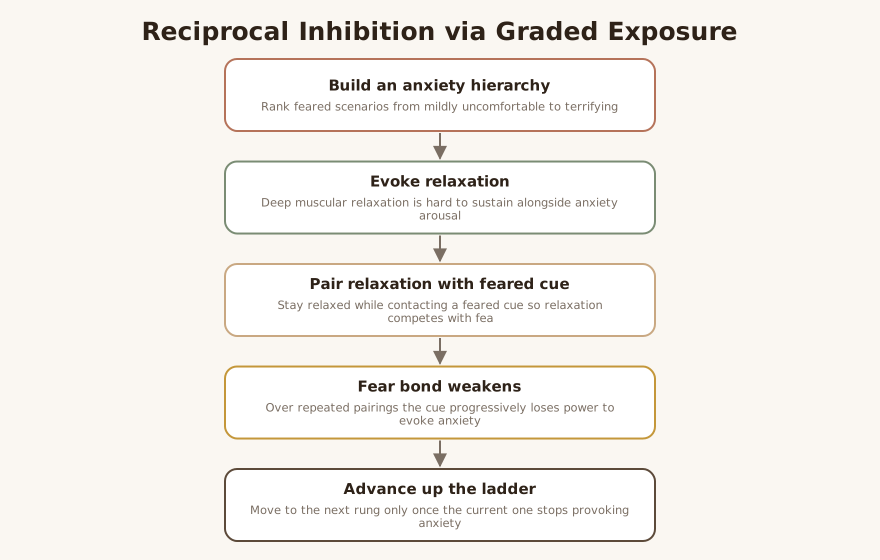
The central principle is reciprocal inhibition itself: two responses that cannot physiologically coexist will compete, and when an anti-anxiety response is repeatedly evoked in the presence of an anxiety-provoking stimulus, the stimulus progressively loses its power to evoke anxiety 4. Relaxation is the response Wolpe relied on most, because deep muscular relaxation and the physiological arousal of anxiety are difficult to sustain simultaneously 1. The clinical wager is that if the client can stay relaxed while contacting a feared cue, the relaxation will inhibit the fear and, over repeated pairings, the learned fear bond will weaken 2.
A second principle is graded exposure to the feared material, arranged along an anxiety hierarchy 1. Rather than confronting the most frightening situation at once, the client and clinician build a ranked list of feared scenarios, from mildly uncomfortable to terrifying, and work up the ladder only as each lower rung stops provoking anxiety 1. This graduation is what makes it possible to keep the competing relaxation response dominant; if the fear stimulus were too strong, it would overwhelm the relaxation and the pairing would fail 6.
A third principle is that the new learning replaces, or at least competes with, the old 1. Counterconditioning does not aim to suppress fear by willpower; it installs a different conditioned response to the same cue so that the cue comes to evoke calm, or at least neutrality, instead of alarm 1. Wolpe presented this as an active substitution rather than mere fading, which is part of what distinguishes counterconditioning as a concept from simple habituation LLM.
Interventions & Techniques
The flagship intervention built on these principles is systematic desensitization, which proceeds in three classic phases 1. First, the clinician teaches an incompatible response, most often progressive muscular relaxation, until the client can reliably reach a relaxed state on cue 1. Second, clinician and client construct an anxiety hierarchy: a ranked sequence of feared situations related to the target fear, ordered by the intensity of anxiety each evokes 1. Third, the client, while maintaining relaxation, is exposed to the hierarchy items in ascending order — classically through imagination, though in vivo exposure to real situations is also used — moving up only when the current item no longer disturbs the relaxed state 2.
Desensitization can be delivered imaginally, with the client visualizing each scene, or in vivo, with the client encountering the actual feared object or situation, and the in vivo form is generally regarded as more powerful 2. The relaxation component itself can be substituted: any genuinely anti-anxiety response — controlled breathing, assertive responding in social contexts, or other competing states — can in principle serve the reciprocal-inhibition role, though relaxation remains the prototype 4. The encyclopedia account underscores that careful hierarchy construction and adequate relaxation training are what separate competent desensitization from a haphazard, potentially sensitizing exposure 6.
LLM-generated illustrative example (not a guideline): A clinician treating a client with a driving phobia after a minor collision first spends two sessions teaching progressive muscular relaxation, then builds a hierarchy that runs from “looking at a photo of a highway” through “sitting in a parked car” up to “merging onto a busy interstate.” The client practices reaching deep relaxation, then visualizes each step while staying relaxed, advancing only when the lower step no longer raises their pulse, before repeating the ladder in vivo. LLM
Evidence Base
Honesty here requires separating the procedure from the mechanism, because they have different evidentiary standings LLM. As a clinical procedure, systematic desensitization is among the better-validated behavioral treatments for phobic and anxiety presentations, and Wolpe’s broader influence on the development of cognitive behavioral therapy is widely acknowledged 4. On that basis the technique’s overall maturity can fairly be called established 2.
The mechanism is a different matter, and this is where clinicians most often overstate the case LLM. Wolpe’s claim that relaxation reciprocally inhibits anxiety was contested early and was never settled in his favor 5. A dismantling-style comparison published in Behaviour Research and Therapy directly tested reciprocal inhibition against an operant-conditioning account in the systematic desensitization of snake fear, part of a wider research program asking whether the relaxation pairing was actually the active ingredient 5. The field’s later consensus, reflected in the BJPsych Advances retrospective, is that the procedure’s effectiveness is better explained by exposure and extinction — repeated contact with the feared cue in the absence of harm — than by Wolpe’s reciprocal-inhibition mechanism, and that the relaxation component may be helpful but is often not essential 4. In other words, the thing Wolpe built works, but probably not for the reason he proposed LLM. The defensible clinical stance is to use systematic desensitization with confidence as an established procedure while treating “relaxation inhibits the fear” as a historically important but empirically superseded explanation LLM.
Populations & Indications
The technique is most directly indicated for circumscribed, cue-bound fears, which is why specific phobia is the paradigm case: a discrete feared object or situation maps cleanly onto a hierarchy, and graded counterconditioning is well suited to it 1. It is applied across the lifespan, with adults the most studied group but children and adolescents also treated, the hierarchy and relaxation methods adapted to developmental level 1. People with anxiety disorders broadly — including social anxiety disorder, panic disorder, generalized anxiety, and agoraphobia — are candidates wherever a feared cue or situation can be specified and approached gradually 2.
Beyond the anxiety disorders, Wolpe and the behavioral tradition extended reciprocal-inhibition logic to other domains where a competing response can be paired with a feared cue 4. Trauma survivors are an indicated population insofar as conditioned fear of trauma-linked cues responds to graded exposure under a competing calm response 2. Wolpe also applied the principle to sexual dysfunction, where anxiety inhibits sexual response and a graded, relaxation-paired approach aims to let the incompatible arousal response re-emerge 4. Across all of these, the common thread is a learned fear or anxiety attached to identifiable cues that can be ranked and approached LLM.
Problems-for-Work
The technique reframes a recognizable set of presenting problems as conditioned fear bonds amenable to graded counterconditioning LLM. Specific phobia is the cleanest application: the spider, the elevator, the needle, or the highway functions as a conditioned cue, and the client ascends a hierarchy while maintaining a competing relaxed state until the cue no longer evokes alarm 1. Conditioned fear responses more generally — any cue that was once neutral but now reliably triggers anxiety — are the core target the principle was designed to address 4.
Anticipatory anxiety and avoidance behavior are worked by exposing the client, in graded steps, to the anticipated or avoided situation so that approach replaces escape and the dreaded cue loses its charge 2. Social anxiety disorder and performance anxiety can be addressed by building hierarchies of social or performance situations and pairing them with a competing response, whether relaxation or assertive action 4. Panic disorder and agoraphobia are approached by hierarchies of feared sensations and places, and PTSD by graded contact with trauma-linked cues under a calming response 2. Sexual dysfunction, in Wolpe’s extension, is treated by reducing the anxiety that inhibits sexual response through graded, relaxed approach 4.
LLM-generated illustrative example (not a guideline): A client with social anxiety who avoids speaking in meetings works up a hierarchy from “asking one question in a two-person conversation” to “presenting to the full team,” pairing each rehearsed and then real situation with paced breathing and, higher up the ladder, with deliberately assertive participation rather than silent endurance, so that the meeting room gradually stops cueing dread. LLM
Contraindications, Cautions & Cultural Humility
A technique has few absolute contraindications, but several cautions matter LLM. The first is that graded exposure must be genuinely graded; a hierarchy step that overwhelms the client’s competing response can sensitize rather than desensitize, deepening the fear, which is why adequate relaxation training and careful hierarchy construction are not optional refinements but core safeguards 6. The second is that the feared situation must actually be safe in the client’s real life before its avoidance is framed as a fear to be counterconditioned; exposing someone to a genuinely dangerous situation is not therapy LLM. The third is that relaxation is not universally calming — for some clients, deep relaxation or interoceptive stillness can itself provoke anxiety — so the clinician should confirm that the chosen competing response is in fact incompatible with this person’s anxiety rather than assuming it LLM.
Cultural humility is required in two places LLM. First, what counts as a feared cue, and which avoidance behaviors are reasonable versus pathological, depend on the client’s lived context; vigilance that looks like a phobia in one environment may be a sane response to a genuinely threatening one in another LLM. Second, relaxation practices and the very idea of confronting feared situations carry different meanings across cultures, and the clinician should present the rationale tentatively, check how the graded-approach frame lands, and adapt the competing response and the pacing to fit the person rather than imposing a fixed protocol LLM.
Treatment-Plan Suggestions & SMART Objectives
| Goal | SMART objective (example) | Mechanism |
|---|---|---|
| Establish a competing anti-anxiety response | Client will reach a self-rated deep-relaxation state within 5 minutes on cue in 4 of 5 practice trials by session 3 LLM | Builds the incompatible response reciprocal inhibition requires 1 |
| Construct an anxiety hierarchy | Client and clinician will produce a ranked 8-to-12-item hierarchy of the feared situation by session 2 LLM | Enables graded pairing that keeps the competing response dominant 1 |
| Reduce phobic reactivity | Client will complete the bottom 3 hierarchy items while maintaining relaxation, with peak distress falling at least 40% across sessions, within 6 weeks LLM | Graded counterconditioning weakens the conditioned fear bond 4 |
| Transfer gains to real situations | Client will complete 3 in vivo hierarchy steps without escape over 4 weeks, logged LLM | In vivo exposure consolidates and generalizes the new learning 2 |
| Reduce avoidance | Client will enter the previously avoided situation on 3 occasions weekly without leaving prematurely, for 4 weeks LLM | Sustained approach allows extinction that avoidance prevents 2 |
| Address anticipatory anxiety | Client will use the trained competing response before 5 anticipated triggers weekly and rate anticipatory distress, for 3 weeks LLM | Pairs the dreaded anticipation with a calming response 2 |
| Apply to social or performance situations | Client will complete a graded social hierarchy culminating in one full-team presentation within 8 weeks LLM | Counterconditions social-evaluative cues via graded approach 4 |
Common Misconceptions
The most consequential misconception is that the relaxation pairing is what makes systematic desensitization work 4. Wolpe believed this, but later research indicated that exposure and extinction — repeated safe contact with the feared cue — likely do the heavy lifting, and that relaxation, while sometimes useful, is often not the essential ingredient 4. A clinician who insists a client must achieve perfect relaxation before any exposure can help is over-applying a mechanism the field has largely revised LLM.
A second misconception is that counterconditioning, reciprocal inhibition, and systematic desensitization are interchangeable names for one thing 4. They are nested but distinct: reciprocal inhibition is the principle, counterconditioning is the broad technique of replacing one conditioned response with an incompatible one, and systematic desensitization is the specific procedure that puts both to work with relaxation and a hierarchy 1. A third error is treating desensitization as flooding; it is the opposite of flooding, advancing gradually and keeping anxiety low rather than maximizing it 1. Finally, the technique is sometimes thought to erase the original fear, when in the modern extinction account the old learning persists and new learning competes with it, which is why fear can return and why exposure should be thorough LLM.
Training & Certification
There is no certification specific to counterconditioning or reciprocal inhibition, because they are a technique and a principle rather than a credentialed therapy LLM. Clinicians typically learn systematic desensitization within graduate training in behavior therapy and cognitive behavioral therapy, and through supervised practice in exposure-based methods, each of which carries its own established training pathways LLM. The foundational primary source remains Wolpe’s Psychotherapy by Reciprocal Inhibition, and accessible explainer and reference summaries are sufficient for grasping the procedure’s structure 3.
For applied competence the relevant skill set is the broader exposure-based repertoire: constructing valid hierarchies, training a reliable competing response, pacing graded exposure to avoid sensitization, and recognizing when in vivo work should replace imaginal work 6. Because the field now understands desensitization as one member of the exposure family, the most useful preparation is credentialed training in exposure therapy and cognitive behavioral therapy, within which counterconditioning techniques are delivered LLM.
Key Terms
Reciprocal inhibition: Wolpe’s principle that evoking a response antagonistic to anxiety in the presence of an anxiety-provoking stimulus weakens the bond between that stimulus and the anxiety 4.
Counterconditioning: the broad behavioral technique of replacing an unwanted conditioned response with a new, incompatible one 1.
Systematic desensitization: the clinical procedure operationalizing reciprocal inhibition through relaxation training, an anxiety hierarchy, and graded exposure 1.
Anxiety hierarchy: a ranked list of feared situations, ordered from least to most anxiety-provoking, used to graduate exposure 1.
Progressive muscular relaxation: the trained deep-relaxation response most commonly used as the anti-anxiety response in desensitization 1.
In vivo exposure: confronting the actual feared object or situation rather than imagining it, generally regarded as more powerful than imaginal exposure 2.
Extinction: the modern account of why exposure works — the conditioned response weakens through repeated safe contact with the cue — increasingly seen as the operative mechanism rather than reciprocal inhibition 4.
Resources & Further Reading
▶ Watch — a video introduction to this concept:
- Systematic Desensitization Therapy in Psychology — Simply Psychology
- Systematic desensitization — Britannica
- Wolpe, J. (1958). Psychotherapy by Reciprocal Inhibition — Internet Archive
- Psychotherapy by Reciprocal Inhibition: Wolpe’s unique legacy to the evolution of cognitive-behavioural therapy — BJPsych Advances (Cambridge Core)
- A comparison of reciprocal inhibition and operant conditioning in the systematic desensitization of fear of snakes — Behaviour Research and Therapy (ScienceDirect)
- Systematic Desensitization — Encyclopedia of Behavior Modification and Cognitive Behavior Therapy (Sage, PDF)
Reflective / Supervision Questions
- When I attribute a client’s improvement to relaxation, am I sure the relaxation is doing the work, or am I repeating Wolpe’s mechanism even though exposure and extinction may be the actual engine? 4
- Have I confirmed that the feared situation is genuinely safe in this client’s real-life context before framing their avoidance as a fear to be counterconditioned? LLM
- Is my anxiety hierarchy genuinely graded, and am I advancing slowly enough that the competing response stays dominant rather than risking sensitization at too-large a step? 6
- Have I checked that my chosen competing response — relaxation, breathing, or assertive action — is actually incompatible with this particular client’s anxiety, rather than assuming relaxation calms everyone? LLM
- How do I keep reciprocal inhibition, counterconditioning, and systematic desensitization distinct in my own formulation, so I am clear about which I am claiming and why? 4