
Type & Discipline
Prolonged Exposure (PE) is a manualized, time-limited individual psychotherapy for posttraumatic stress disorder, situated within clinical psychology and the broader family of trauma-focused cognitive behavioral therapies 1. It is fundamentally an exposure therapy: the active ingredient is structured, repeated confrontation with trauma-related memories and situations that the patient has come to avoid 3. PE is one of a small set of treatments that carry a first-line, strong recommendation for PTSD across virtually all major clinical practice guidelines 3. For practicing therapists, the practical identity of PE is a short protocol — typically delivered across roughly 8 to 15 weekly sessions — rather than an open-ended trauma exploration 3. Its place in the CBT family is defined less by cognitive restructuring and more by behavioral fear extinction principles operationalized through exposure 1.
Creators & Lineage
PE was developed primarily by Edna Foa and colleagues at the University of Pennsylvania, building directly on emotional processing theory as the explanatory framework for both how trauma symptoms persist and how exposure resolves them 3. The canonical clinician text is the Prolonged Exposure Therapy for PTSD: Emotional Processing of Traumatic Experiences — Therapist Guide, authored by Foa, Elizabeth Hembree, Barbara Olasov Rothbaum, and Sheila Rauch, which operationalizes the protocol session by session 4. The intellectual lineage runs through behavioral exposure therapy and fear-extinction research, through cognitive behavioral therapy, and is closely related to other trauma-focused protocols such as cognitive processing therapy that emerged from the same era of empirically supported PTSD treatment development 2. PE is best understood as the exposure-forward member of that family, where emotional processing theory supplies the bridge between behavioral extinction mechanisms and the clinical phenomenology of PTSD 3.
Core Principles
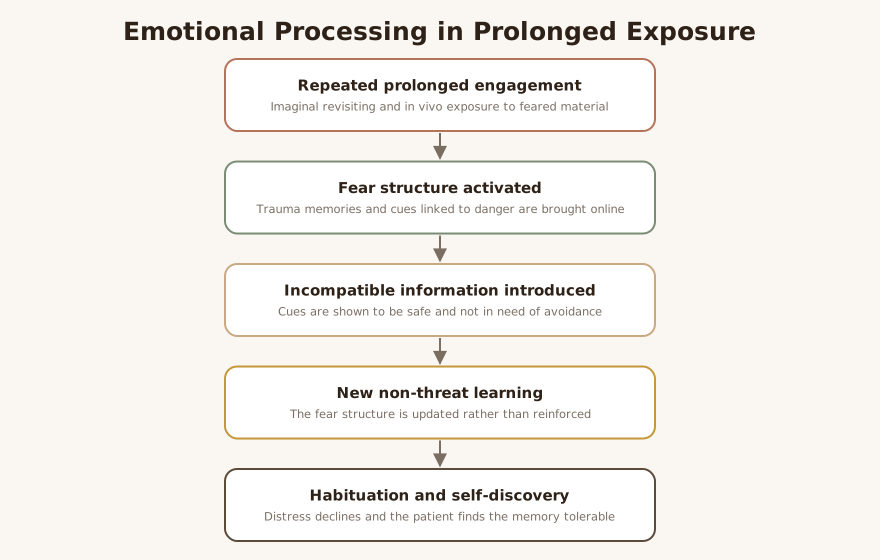
The governing model is emotional processing theory, which holds that PTSD is maintained by a pathological “fear structure” in which trauma memories, reminders, and benign cues become linked to danger and to escape responses 3. Within this model, avoidance is the central maintaining mechanism: by avoiding memories and reminders, the person never has the corrective experience that would update the structure, so distress is reinforced rather than resolved 1. PE therefore rests on a deceptively simple corrective principle — that trauma-related memories and cues are not themselves dangerous and do not need to be avoided 1. Repeated, prolonged engagement with the feared material is designed to activate the fear structure and then introduce information incompatible with it, allowing new, non-threat learning to occur 3. Two further principles are habituation of distress with repeated exposure and the patient’s own discovery, through experience rather than persuasion, that they can tolerate the memory and that anxiety declines over time 1. The therapist’s stance is collaborative and coaching: exposure is done with the patient, at a pace they consent to, never imposed 4.
Interventions & Techniques
PE is built from a small number of components delivered in a predictable sequence 3. The first is psychoeducation about common reactions to trauma, which normalizes symptoms and lays out the rationale for approaching rather than avoiding 3. The second is in vivo exposure: the patient and therapist build a hierarchy of safe but avoided real-world situations — places, activities, or sensory triggers — and the patient approaches them as graded between-session homework 1. The third, and signature, component is imaginal exposure: in session, the patient revisits and recounts the trauma memory in imagery, typically in the present tense and with eyes closed, repeatedly across the session 3. Imaginal exposure is followed by processing, in which therapist and patient discuss what came up, what shifted, and what the memory now means 3. Many protocol versions also include breathing retraining as an early skill, though guideline and provider descriptions vary in whether they treat it as a core element 3. Sessions in the original protocol run about 90 minutes, with recent research supporting shorter 60-minute formats and even abbreviated primary-care versions with comparable outcomes 3. Recorded imaginal exposures are commonly assigned for between-session listening to extend exposure dosage 4.
LLM-generated illustrative example (not a guideline): A clinician treating a survivor of a motor-vehicle collision might build an in vivo hierarchy ranging from sitting in a parked car (lower distress) up to driving on the highway where the crash occurred (higher distress), while in session the patient repeatedly narrates the collision in the present tense. Over several weeks, the narration becomes less overwhelming and the patient resumes driving — not because the memory was argued away, but because approach produced new learning LLM.
Evidence Base
The evidence maturity for PE is best described as established: it has strong randomized controlled trial support and is among the most extensively researched psychological treatments for PTSD 3. The APA Clinical Practice Guideline designates PE a first-line treatment and recommends it for the treatment of PTSD 1. APA Division 12 (the Society of Clinical Psychology) lists PE among treatments with strong research support for PTSD 2. The VA National Center for PTSD reports that PE receives the strongest recommendation across major guidelines, including APA, ISTSS, NICE, VA/DoD, and Australian guidelines 3. On outcomes, the VA cites figures in which roughly half of participants no longer meet PTSD criteria after treatment, with higher rates among those who complete a full course and durable gains at long-term follow-up 3. Honest framing matters here for clinicians: although PE is reliably effective and first-line, the broader literature does not consistently show it to be superior to other trauma-focused therapies such as cognitive processing therapy, and tolerability and dropout are recognized practical concerns rather than settled questions 5. The science is mature enough to recommend PE confidently while continuing to refine questions about who benefits most, optimal dose, and how to reduce premature termination 5.
Populations & Indications
PE has been studied and applied across a wide range of trauma populations 3. It has a strong evidence base with military personnel and veterans, sexual assault survivors, and survivors of accidents and disasters 3. The core indication is adults with PTSD, including those with comorbid conditions such as depression or substance use disorder, where research supports effectiveness across diverse presentations rather than only “clean,” single-diagnosis cases 3. The provided population scope also extends to refugees and survivors of violence and to adolescents with trauma histories, reflecting the protocol’s adaptation beyond its original adult-civilian and veteran samples 7. Clinically, the strongest indication is a patient whose PTSD is organized around identifiable trauma memories and avoidance, where the model’s mechanism — approaching what is feared but safe — maps directly onto the presenting problem 1. PE is also relevant where trauma-related avoidance has narrowed the patient’s life through phobic-style restriction of activities and places 1.
Problems-for-Work
PE targets the full PTSD symptom cluster and several closely related problems 3. Posttraumatic stress disorder is the primary indication, with the protocol designed around its re-experiencing, avoidance, and arousal symptoms 1. Trauma-related avoidance and phobic avoidance are addressed directly through the in vivo hierarchy, which is the behavioral engine of recovery 1. Intrusive memories and flashbacks are worked through imaginal exposure and processing, which reduce the memory’s power to hijack the present 3. Hyperarousal typically declines as the fear structure updates and avoidance lifts, with breathing retraining offered as an adjunct skill in some protocol versions 3. Trauma-related guilt and shame are commonly engaged during processing, where the meaning of the event is examined after exposure has reduced raw distress 3. Comorbid depression frequently improves alongside PTSD as activity and engagement return 3. Acute stress disorder and nightmares sit at the edges of the evidence base and are approached with more individualized judgment 7.
LLM-generated illustrative example (not a guideline): For a patient whose dominant problem is shame after an assault (“I should have fought back”), a clinician might first reduce the memory’s overwhelming charge through imaginal exposure, then use the processing portion to revisit that belief once the patient can think about the event without flooding — turning a previously unspeakable memory into something examinable LLM.
Contraindications, Cautions & Cultural Humility
Provider guidance frames PE as effective across diverse patient presentations and does not enumerate a long list of absolute contraindications 3. The cautions that matter in practice are clinical judgment calls rather than hard rules LLM. Imminent risk — active suicidality with intent, ongoing exposure to the trauma (current abuse or unsafe environment), or acute psychosis or intoxication — generally needs stabilization or safety before trauma-focused exposure begins LLM. Tolerability is a genuine concern: exposure can transiently increase distress, and dropout is a recognized practical issue, so pacing, rationale, and informed consent are not optional niceties but part of the method 5. The therapeutic alliance and the patient’s understanding of why approaching the memory helps are protective against premature termination 4. Cultural humility is explicitly part of competent delivery: the VA emphasizes attention to cultural competence, including for race-based trauma, and clinicians should adapt language, examples, and the framing of avoidance to the patient’s context rather than assuming a single universal exposure script 3. What counts as “safe but avoided” is itself culturally and contextually shaped, and the in vivo hierarchy must distinguish genuinely safe situations from those that carry real ongoing risk for a given patient LLM.
Treatment-Plan Suggestions & SMART Objectives
| Goal | SMART objective (example) | Mechanism |
|---|---|---|
| Reduce overall PTSD severity | Patient’s standardized PTSD measure (e.g., PCL-5) score will decrease by a clinically meaningful margin over 12 weekly sessions | Repeated exposure updates the pathological fear structure 3 |
| Decrease behavioral avoidance | Patient will complete at least 4 in vivo exposures from the hierarchy per week, progressing up at least 2 hierarchy levels within 8 weeks | Graded approach disconfirms danger expectancies 1 |
| Process the trauma memory | Patient will complete repeated imaginal exposure to the index memory and report reduced peak distress across 6 sessions | Activation plus incompatible information enables new learning 3 |
| Build distress-tolerance skill | Patient will demonstrate breathing retraining and use it before and after exposure tasks within 3 sessions | Provides a self-regulation anchor supporting engagement 3 |
| Restore valued activities | Patient will resume 3 previously avoided meaningful activities (e.g., driving, social outings) within 10 weeks | Reduced avoidance restores functioning and reinforces gains 1 |
| Revise trauma-related beliefs | During processing, patient will articulate a more balanced appraisal of one guilt/shame belief by session 8 | Post-exposure meaning revision reduces secondary emotions 3 |
| Consolidate and prevent relapse | Patient will identify early-warning signs and an approach (not avoidance) plan before discharge | Generalizes non-threat learning beyond therapy 4 |
Common Misconceptions
A frequent misconception is that PE forces patients to relive trauma against their will or “rips off the bandage”; in practice it is collaborative, consented, and paced, with the patient as an active partner in choosing exposures 4. A second is that PE is dangerous or destabilizing for most patients — provider guidance describes it as effective across diverse presentations, and transient distress during exposure is expected and time-limited rather than evidence of harm 3. A third misconception is that PE is purely cognitive talk therapy; its mechanism is behavioral and experiential, with insight following from new learning rather than driving it 1. Some clinicians believe PE requires the patient to remember every detail or to have a single discrete trauma; the protocol works with the memory as the patient holds it and has been applied across varied and complex trauma histories 7. Finally, the belief that PE simply teaches people to “stop feeling” misreads the model — the aim is that distress becomes tolerable and the memory loses its grip, not emotional numbing 3.
Training & Certification
Competent PE delivery is built on the published therapist guide, which provides the session-by-session structure, rationale scripts, and exposure procedures clinicians use as their primary reference 4. Structured learning resources include the APA video series on PE featuring Sheila Rauch and Peter Tuerk, which demonstrates the techniques in practice 6. Beyond reading, supervised practice with feedback on actual or role-played cases is the standard route to competence, given how much the method depends on managing in-session exposure and pacing 4. The VA and other systems have invested heavily in PE training and dissemination, reflecting its first-line status and the demand for clinicians who can deliver it with fidelity 3. Clinicians new to PE are generally advised to learn it through formal workshop training plus consultation rather than from the manual alone LLM.
Key Terms
- Emotional processing theory — the model holding that PTSD reflects a pathological fear structure that exposure activates and updates 3.
- Fear structure — the network linking trauma memories, reminders, and benign cues to danger and escape, which maintains symptoms when avoided 3.
- Imaginal exposure — in-session revisiting and recounting of the trauma memory in imagery, usually present tense, repeated within and across sessions 3.
- In vivo exposure — graded, real-world approach to safe but avoided situations, assigned as homework 1.
- Processing — the structured discussion following imaginal exposure, where meaning and shifts are examined 3.
- Avoidance — the central maintaining mechanism PE targets, encompassing both internal (memories) and external (situations) avoidance 1.
- Habituation / new learning — the decline in distress and acquisition of non-threat information that exposure is designed to produce 1.
Resources & Further Reading
▶ Watch — a video introduction to this concept:
- Prolonged Exposure (PE) — APA Clinical Practice Guideline for PTSD 1
- Prolonged Exposure Therapy for PTSD — APA Division 12 (Society of Clinical Psychology) 2
- Prolonged Exposure (PE) for PTSD — VA National Center for PTSD (provider page) 3
- Prolonged Exposure Therapy for PTSD: Emotional Processing of Traumatic Experiences — Therapist Guide (Foa, Hembree, Rothbaum, Rauch) 4
- Reflecting on the State of the Science of Prolonged Exposure Therapy — ISTSS 5
- APA Prolonged Exposure Therapy video series (Rauch & Tuerk) 6
- Prolonged Exposure Therapy — Psychology Today 7
Reflective / Supervision Questions
- How do I distinguish a patient’s genuine “too much, too soon” signal from anxiety-driven avoidance that the protocol expects me to gently approach? LLM
- When a patient’s distress spikes during imaginal exposure, do I trust the model and stay with it, or do I rescue prematurely — and what does my own discomfort contribute to that choice? LLM
- How am I assessing real-world safety when building the in vivo hierarchy, so that “exposure” never means approaching genuinely dangerous situations? LLM
- For this particular patient’s cultural context, how should I adapt the framing of avoidance, the examples I use, and the meaning of the trauma during processing? 3
- What is my plan for the recognized risk of dropout — how am I building rationale, alliance, and pacing to keep this patient engaged through a full course? 5
- Am I delivering PE with fidelity to the protocol, or have I drifted toward open-ended trauma talk that loses the active mechanism? 4