
Type & Discipline
Systematic desensitization is a behavioral technique within the broader family of exposure therapy, rooted in clinical psychology and the learning-theory tradition.5 It is not a complete treatment package or stand-alone modality so much as a structured procedure: graded exposure to feared stimuli, presented in ascending order of difficulty, with each step deliberately paired with a competing relaxation response.2 Its theoretical home is classical conditioning, and it is most often deployed today as one tool inside a cognitive behavioral therapy course of care rather than as a therapy in its own right.5 Clinicians should understand it as the historical bridge between Pavlovian learning principles and the in-vivo exposure protocols that dominate contemporary anxiety treatment. LLM
Creators & Lineage
Systematic desensitization was developed by the South African-born psychiatrist Joseph Wolpe in the 1950s.2 Working from his observations of cats at the University of the Witwatersrand who overcame conditioned fears through gradual, food-paired exposure, Wolpe substituted relaxation for feeding as the response that would compete with anxiety in humans.5 His lineage runs directly through Ivan Pavlov’s work on experimental neurosis and through early demonstrations that childhood fears could be unlearned through graded contact.5 The technique sits within the classical-conditioning paradigm and is closely related to progressive muscle relaxation, which Wolpe adopted as his preferred anxiety-competing response.2 It is the conceptual ancestor of modern exposure therapy, standing alongside flooding and implosive therapy as the behavioral approaches that displaced purely insight-oriented treatment of phobias.5
Core Principles
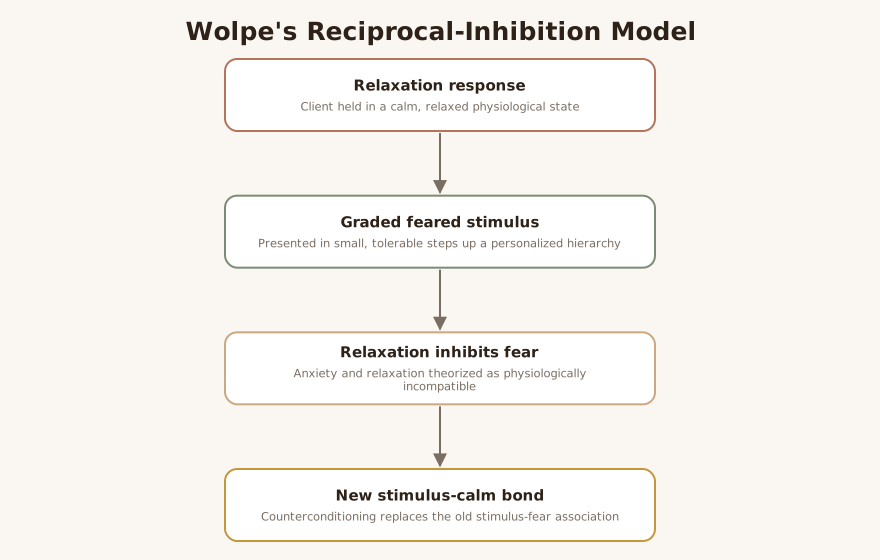
The organizing concept Wolpe proposed was reciprocal inhibition: the premise that anxiety and relaxation are physiologically incompatible and cannot be fully experienced at the same moment.5 If a feared stimulus can be presented while the client is held in a relaxed state, the relaxation is thought to inhibit the fear response, and repeated pairings progressively weaken the conditioned association.2 This is a counterconditioning logic: rather than extinguishing fear by mere repetition, the original stimulus-fear bond is theorized to be replaced by a stimulus-calm bond.5 A second principle is gradation. Exposure proceeds in small, tolerable increments up a personalized hierarchy so that the client is never overwhelmed and retains a sense of control over the pace.2 A third principle is the use of subjective ratings to calibrate that hierarchy and to confirm that each step has been mastered before advancing.2 It is worth flagging early that the reciprocal-inhibition mechanism is contested; dismantling research suggests the exposure component, not the relaxation pairing, is what drives change. LLM
Interventions & Techniques
In practice, systematic desensitization is delivered in three phases.2 First is relaxation training, in which the client learns a reliable down-regulation skill, classically progressive muscle relaxation but also diaphragmatic breathing or guided imagery.2 Second is hierarchy construction, where clinician and client collaboratively generate a ranked list of feared situations from least to most distressing, typically anchored with Subjective Units of Distress (SUDs) ratings on a 0-100 scale.2 Third is graded exposure, in which the client enters a relaxed state and is then presented with the lowest item on the hierarchy, holding relaxation until distress subsides, before progressing upward step by step.2
Exposure can be imaginal (in vitro), where the client vividly visualizes the feared scene, or in-vivo, where they confront the actual stimulus.2 Wolpe initially found that direct presentation of real stimuli could overwhelm clients and turned to imagery, which remains useful when the feared situation cannot easily be staged in the office.5 However, both Division 12 and meta-analytic data indicate that in-vivo contact outperforms imaginal and other modes of exposure, at least at post-treatment.13
LLM-generated illustrative example (not a guideline): For a client with a needle phobia, an imaginal step might be picturing a vial of blood being drawn, while the parallel in-vivo step is holding an alcohol swab and then a capped syringe in session, each held until SUDs drop by roughly half before moving on. LLM
A practical caution: the technique presumes the client can generate vivid mental imagery and can reliably enter a relaxed state, neither of which every client can do, which is one reason in-vivo formats are often more robust. LLM
Evidence Base
Honesty about maturity matters here. The exposure-therapy family is firmly established: APA Division 12’s Society of Clinical Psychology designates exposure therapies for specific phobias as having Strong Research Support.1 The Wolitzky-Taylor and colleagues meta-analysis of 33 randomized treatment studies found that exposure-based treatment produced large effect sizes relative to no treatment and outperformed both placebo conditions and alternative active psychotherapies.3 That same analysis found in-vivo contact with the phobic target outperformed alternative modes of exposure (imaginal, virtual reality) at post-treatment, though notably not at follow-up, and that more treatment sessions predicted more favorable outcomes.3 Effect sizes for the major comparisons were not moderated by phobia subtype, suggesting broad applicability across specific phobias.3
The picture for systematic desensitization specifically is more qualified. Division 12 notes that treatment using systematic desensitization tends to take longer than in-vivo exposure and appears more effective at changing subjective anxiety than at reducing avoidance behavior, and therefore explicitly states it is not recommended as a first-line treatment when a client is willing to attempt in-vivo or another form of exposure.1 Wolpe’s own early reports cited high success rates with phobias, and historically the method was effective enough to anchor a generation of behavior therapy.5 But its clinical use has declined since the 1980s, and contemporary critiques hold that the relaxation/reciprocal-inhibition pairing may not be essential and that the exposure itself accounts for most of the benefit.52 Dismantling work comparing the reciprocal-inhibition account against other learning mechanisms in snake-fear desensitization is part of how that question was tested.4 In short: established as exposure, second-line as a packaged technique. LLM
Populations & Indications
Systematic desensitization and its exposure descendants have been applied across the lifespan and across anxiety presentations.5 It is well suited to adults with anxiety disorders and to people with circumscribed phobias of heights, snakes, enclosed spaces, flying, and similar stimuli.5 It has been used with children and adolescents, with trauma survivors, with clients facing medical and procedural fears such as needles or dental work, and with performance and test anxiety.52 The graded, client-controlled pacing is a particular asset for clients who are too apprehensive to begin with intensive in-vivo work, since starting in imagination can lower the threshold to engagement.2 Because effects in the phobia literature were not moderated by phobia type, the approach generalizes reasonably across specific-phobia content.3 LLM
Problems-for-Work
The clearest indication is specific phobia, where a hierarchy of feared encounters is the natural scaffold for graded exposure.1 For social anxiety disorder, hierarchies can be built around feared social situations, though clinicians should note systematic desensitization is generally considered less effective for socially complex fears than for discrete phobic objects.2 In panic disorder and agoraphobia, graded exposure to interoceptive sensations and avoided situations follows the same logic, typically embedded within a fuller cognitive behavioral protocol. LLM
For posttraumatic stress disorder, imaginal and graded exposure to trauma-related cues is a recognized application, with the relaxation pairing offering a pacing mechanism.5 In generalized anxiety disorder, anticipatory anxiety, test anxiety, and performance anxiety, hierarchies organized around the feared performance or anticipated event provide a structured exposure ladder.2 In medical and dental phobia, graded exposure from imagined to in-office contact with feared instruments is a direct application.2
LLM-generated illustrative example (not a guideline): A graduate student with test anxiety builds a hierarchy from “reviewing notes the night before” through “sitting in the exam hall” to “opening a timed practice exam,” pairing each with diaphragmatic breathing until distress is tolerable before advancing. LLM
Contraindications, Cautions & Cultural Humility
There are few absolute contraindications, but several cautions. Because Division 12 finds systematic desensitization slower than in-vivo exposure and better at reducing subjective distress than avoidance, it should not be the default choice when a client can tolerate in-vivo work.1 The method also depends on intact imagery capacity and on the ability to achieve a relaxed state; clients who cannot vividly imagine scenes or who find relaxation procedures themselves anxiety-provoking (for example, some panic-prone or dissociation-prone clients) may not be good candidates without adaptation. LLM
Clinicians should be alert that the relaxation component is the part of the technique with the weakest empirical mandate, so over-investing session time in relaxation at the expense of actual exposure can blunt outcomes.2 Cultural humility applies to hierarchy construction: what counts as a feared or shameful situation, how distress is expressed and rated, and how acceptable bodily relaxation practices are will vary across clients, and SUDs anchoring should be co-constructed in the client’s own terms rather than imposed. LLM For trauma populations especially, pacing, consent, and the option to pause are essential to avoid retraumatization during exposure steps. LLM
Treatment-Plan Suggestions & SMART Objectives
| Goal | SMART objective (example) | Mechanism |
|---|---|---|
| Build a usable relaxation skill | Client will demonstrate progressive muscle relaxation reaching SUDs ≤ 20 within 5 minutes in 3 consecutive sessions over 4 weeks | Establishes the anxiety-competing response used in pairing 2 |
| Construct a fear hierarchy | Client and clinician will collaboratively produce a 10-item SUDs-anchored hierarchy by end of session 2 | Provides the graded scaffold for exposure 2 |
| Master lower-hierarchy items | Client will complete imaginal exposure to the bottom 3 hierarchy items with terminal SUDs ≤ 30 within 3 weeks | Counterconditioning / habituation at tolerable intensity 5 |
| Transition to in-vivo exposure | Client will complete in-vivo exposure to one mid-hierarchy item per week for 4 weeks | Leverages the superior post-treatment efficacy of in-vivo contact 13 |
| Reduce avoidance behavior | Client will reduce avoided situations from a baseline of 6 to ≤ 2 on a self-monitoring log over 8 weeks | Targets behavioral avoidance, SD’s relative weak point 1 |
| Reach top of hierarchy | Client will complete the highest-ranked feared situation with SUDs ≤ 40 within 12 sessions | Demonstrates generalization of extinction across the hierarchy 3 |
| Consolidate and maintain gains | Client will independently apply graded exposure to one novel feared situation between sessions, reported at follow-up | Supports durability given weaker follow-up advantage of any single mode 3 |
Common Misconceptions
A first misconception is that the relaxation pairing is what makes the technique work; dismantling research and contemporary review suggest the exposure itself is the active ingredient and relaxation may be non-essential.25 A second is that imaginal and in-vivo exposure are interchangeable; in-vivo contact has been shown to outperform imaginal and other modes at post-treatment.13 A third is that systematic desensitization treats only “symptoms” while leaving causes untouched, a critique sometimes raised; in practice the reduction of conditioned fear and avoidance is the clinically meaningful target.2 A fourth is that it is the first-line treatment for phobias, when current guidance positions in-vivo exposure ahead of it.1 Finally, the high historical success rates Wolpe reported should not be read as evidence of superiority over modern exposure formats, which have been directly compared and often favored.3 LLM
Training & Certification
There is no stand-alone certification for systematic desensitization; competence is acquired as part of broader training in behavioral and cognitive behavioral therapy.5 Clinicians learn it through supervised practice in conducting relaxation training, building SUDs-anchored hierarchies, and pacing graded exposure, skills typically taught within exposure-therapy curricula for anxiety disorders.2 Because the technique is most defensible as a component of an evidence-based exposure protocol, ongoing supervision and familiarity with the specific-phobia and exposure literature are the practical credentialing pathway rather than any single workshop. LLM
Key Terms
- Reciprocal inhibition: Wolpe’s premise that relaxation and anxiety are incompatible, so eliciting relaxation inhibits the fear response.5
- Counterconditioning: Replacing a conditioned stimulus-fear association with a stimulus-calm association.5
- Fear hierarchy: A ranked list of feared situations ordered from least to most distressing, used to guide graded exposure.2
- SUDs (Subjective Units of Distress): A 0-100 self-rating scale used to calibrate hierarchy items and confirm mastery before advancing.2
- Imaginal (in vitro) exposure: Exposure conducted through vivid mental visualization of the feared stimulus.2
- In-vivo exposure: Exposure conducted through direct contact with the actual feared stimulus, generally more effective.13
- Progressive muscle relaxation: The relaxation method Wolpe favored as the anxiety-competing response.2
Resources & Further Reading
▶ Watch — a video introduction to this concept:
- Exposure Therapies for Specific Phobias — Society of Clinical Psychology (APA Division 12)
- Systematic Desensitization Therapy in Psychology — Simply Psychology
- Psychological approaches in the treatment of specific phobias: A meta-analysis (Wolitzky-Taylor et al., 2008)
- A comparison of reciprocal inhibition and operant conditioning in the systematic desensitization of a fear of snakes (Davison, 1968)
- Systematic desensitization — Wikipedia
- Systematic Desensitization — Encyclopedia of Behavior Modification and CBT (SAGE)
Reflective / Supervision Questions
- For this client, do you have a defensible reason to choose systematic desensitization over first-line in-vivo exposure, given Division 12’s guidance? LLM
- How much session time are you allocating to relaxation versus actual exposure, and is that balance justified given that exposure appears to be the active ingredient? LLM
- Is the fear hierarchy genuinely co-constructed in the client’s own language and cultural frame, or anchored to your assumptions about what should be feared? LLM
- For a trauma or panic presentation, what consent, pacing, and pause mechanisms are in place before you begin exposure steps? LLM
- How will you monitor avoidance behavior specifically, given that this is the dimension systematic desensitization is weakest at moving? LLM
- What is your plan for transferring imaginal gains into in-vivo practice, and for maintaining gains at follow-up where mode advantages tend to narrow? LLM