
Type & Discipline
Interoceptive exposure (IE) is a technique within clinical psychology, situated in the behavior-therapy and exposure tradition LLM. Rather than confronting external feared situations, IE targets the internal feared stimuli — the bodily sensations a patient has learned to dread and misinterpret as dangerous 2. It is rarely delivered as a standalone treatment; it functions as one structured component embedded within a broader cognitive-behavioral protocol LLM. The defining maneuver is deliberate, repeated induction of feared physical sensations under controlled conditions so the patient can learn, experientially, that the sensations are uncomfortable but not harmful 2. In this sense IE is the somatic analogue of in vivo and imaginal exposure: same learning principles, applied to the body’s own signals LLM.
Creators & Lineage
IE grew out of cognitive-behavioral models of panic that locate the disorder in catastrophic misinterpretation of benign bodily sensations LLM. David H. Barlow, with Michelle G. Craske, formalized the technique within Panic Control Treatment and the widely used Mastery of Your Anxiety and Panic therapist protocol, where symptom-induction exercises are sequenced alongside cognitive restructuring and breathing retraining 1. The lineage runs directly from classical and operant conditioning models of fear, through Exposure Therapy and Cognitive Behavioral Therapy, into the manualized panic protocols LLM. More recently, acceptance-based frameworks such as Acceptance and Commitment Therapy have reframed the same procedure: instead of disconfirming a catastrophic belief, IE is used to build willingness to experience sensations without struggle LLM. A dedicated special issue on IE has tracked its expansion beyond panic into other anxiety and related disorders, signaling a maturing but still-broadening evidence base 5.
Core Principles
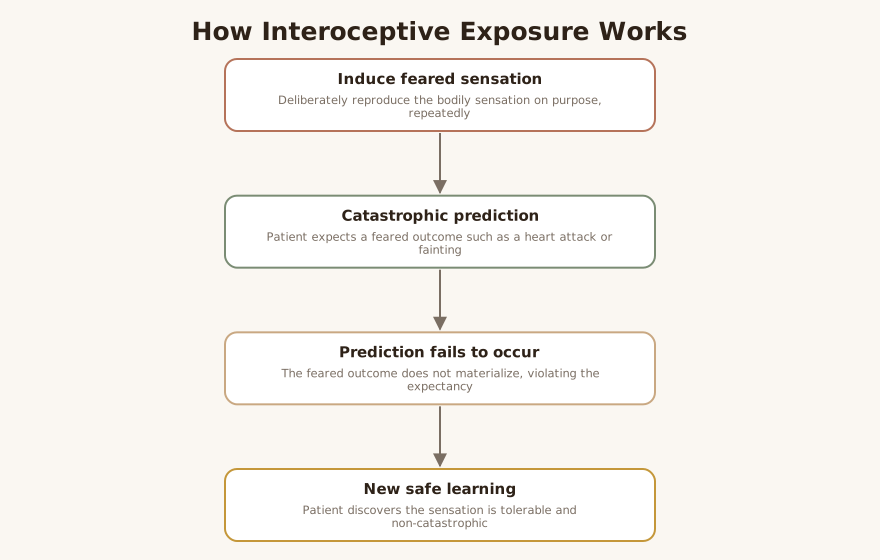
The central clinical premise is that panic and related anxiety are driven less by the sensations themselves than by the meaning the patient assigns to them 2. A racing heart becomes “I am having a heart attack”; dizziness becomes “I am about to faint or lose control” LLM. IE attacks this misinterpretation at its source by reproducing the sensation on purpose, repeatedly, until the catastrophic prediction fails to materialize 2. Several mechanisms are proposed LLM. The classic account is extinction of the conditioned fear response and cognitive disconfirmation — the feared outcome does not occur, so the prediction is revised LLM. Inhibitory-learning accounts reframe the goal as building a new, competing “safe” association that inhibits the old fear memory, which is why maximizing expectancy violation and varying contexts matters more than simply reducing anxiety within a session LLM. A third strand targets anxiety sensitivity — the trait-like fear of arousal sensations — which IE appears to reduce directly 5. Critically, the therapeutic ingredient is not habituation alone but the patient’s discovery that the sensation can be tolerated and is not a signal of catastrophe 6.
Interventions & Techniques
IE uses standardized exercises to provoke specific sensations, each chosen to mimic a feared symptom 2. Common inductions include hyperventilation or fast deep breathing (to produce lightheadedness, tingling, and derealization), breathing through a thin straw (air hunger and chest tightness), spinning in a chair (dizziness), running in place or stair-climbing (racing heart and breathlessness), head-shaking, breath-holding, and staring at a spot or into a mirror to evoke derealization 2. Treatment begins with a symptom-induction assessment in which the therapist runs through a menu of exercises and the patient rates intensity, anxiety, and similarity to their naturally occurring symptoms; exercises that closely match the patient’s feared sensations are prioritized 2. Exercises are then arranged into a graded hierarchy and rehearsed repeatedly, first in session and then as homework, with the patient dropping subtle safety behaviors so the learning is unambiguous 6. Exercise itself can serve as a naturalistic IE delivery vehicle: a controlled trial used brief intermittent intense exercise — a warm-up, a moderate walk, and a short high-intensity jog with progressive sprints — as a structured way to repeatedly elicit and tolerate cardiorespiratory arousal in panic disorder 4.
LLM-generated illustrative example (not a guideline): A clinician and patient agree that the patient’s panic is most often triggered by a “pounding heart.” After rating exercises, they find that 60 seconds of running in place reliably reproduces the sensation at an anxiety rating of 7/10. They repeat it daily for a week, the patient noting before each trial his prediction (“I’ll have a heart attack”) and afterward what actually happened (“my heart raced and then settled”). LLM
Evidence Base
The maturity of the evidence is best described as established for panic disorder and emerging elsewhere LLM. IE is a core component of empirically supported CBT packages for panic, and symptom-induction work has been studied for both its specificity and its effectiveness in this population 3. The available data support two related claims: panic patients show heightened, somewhat specific sensitivity to interoceptive cues, and structured exposure to those cues reduces the fear response 3. A 2025 assessor-blinded randomized controlled trial offers concrete support for an exercise-based IE delivery: 72 sedentary, medication-free adults with panic disorder were randomized to a 12-week brief intermittent intense exercise protocol versus progressive muscular relaxation, and the exercise group showed significantly lower Panic Agoraphobia Scale scores at week 12 (14.9 vs. 23.1) with gains maintained at 24-week follow-up and very low dropout (about 4 percent) 4. Beyond panic, the picture is more preliminary: a body of work summarized in a dedicated special issue describes novel applications of IE across anxiety and related disorders, but these extensions are characterized as developing rather than definitively established 5. Clinicians should therefore present IE to panic patients as a well-supported procedure, and to other populations as a reasonable, mechanism-driven but less-proven adjunct LLM.
Populations & Indications
The clearest indication is panic disorder, particularly when panic attacks are organized around the catastrophic misinterpretation of bodily sensations 2. Patients with agoraphobic avoidance driven by fear of having symptoms in public are strong candidates, as are those with high anxiety sensitivity, since IE directly targets the fear-of-arousal that maintains the disorder 5. IE has been adapted for adults and adolescents and applied to health anxiety, where catastrophic somatic interpretation is central, and explored in posttraumatic stress disorder and other anxiety presentations 2. Across these uses the common selection criterion is the same: the patient fears internal sensations and avoids or escapes activities that produce them LLM. The evidence is strongest in panic and most exploratory in PTSD and somatic-symptom presentations, so indication strength should track that gradient rather than treating all uses as equivalent LLM.
Problems-for-Work
Panic disorder. The prototypical target; symptom-induction exercises are matched to the patient’s signature attack sensations to disconfirm the feared outcome 2.
Agoraphobia. IE is paired with in vivo exposure so the patient can re-enter avoided places while tolerating the arousal those places trigger LLM.
Anxiety sensitivity. IE is used specifically to lower the trait-level fear of arousal that predicts relapse, by repeatedly demonstrating that sensations are safe 5.
Health anxiety. Exercises that reproduce feared bodily signals (palpitations, dizziness) help the patient practice not reacting to normal somatic noise with catastrophic interpretation LLM.
Posttraumatic stress disorder. Where hyperarousal sensations are themselves feared and avoided, IE can be folded into trauma-focused work to reduce fear of the body’s alarm response 5.
Generalized anxiety and somatic symptom presentations. IE can address the somatic-vigilance loop, though here it is best framed as an emerging, adjunctive application rather than a primary treatment 5.
Catastrophic misinterpretation and avoidance behavior. These are the trans-diagnostic processes IE most directly modifies — the procedure both supplies new corrective evidence and blocks the avoidance that prevents that evidence from registering LLM.
LLM-generated illustrative example (not a guideline): A patient with health anxiety repeatedly checks her pulse and avoids caffeine for fear that palpitations mean cardiac disease. Treatment includes brief stair-climbing to provoke palpitations on purpose, while she withholds pulse-checking, learning across trials that the sensation passes without harm. LLM
Contraindications, Cautions & Cultural Humility
IE deliberately raises physiological arousal, so medical clearance and screening are appropriate before vigorous inductions, particularly with cardiac, respiratory, pregnancy, seizure, or significant musculoskeletal conditions LLM. Hyperventilation and breath-holding exercises warrant caution in patients with asthma or cardiopulmonary disease, and spinning exercises in those with vestibular or balance problems LLM. Because exercise-based delivery has been studied in sedentary but otherwise medically stable, medication-free adults under supervision, the same controlled and graded approach should be carried into routine practice rather than improvised at high intensity 4. The technique can feel counterintuitive and even alarming to patients, so a clear rationale, informed consent, and a collaborative pace are essential to avoid the procedure being experienced as coercive 6. Cultural humility matters here: the meaning patients assign to bodily sensations, and the somatic idioms through which they express distress, vary across cultural backgrounds, so the clinician should elicit the patient’s own interpretation of a sensation rather than assume the standard “heart attack / going crazy” catastrophic scripts LLM. Avoidant or subtly resistant engagement — performing exercises half-heartedly or with hidden safety behaviors — undermines the learning and should be addressed openly LLM.
Treatment-Plan Suggestions & SMART Objectives
| Goal | SMART objective (example) | Mechanism |
|---|---|---|
| Reduce fear of cardiac sensations | Patient completes 60 seconds of running-in-place 5 days/week for 3 weeks, logging anxiety ratings, with peak rating dropping by 50% by session 6 | Extinction and cognitive disconfirmation of “racing heart = heart attack” 2 |
| Lower anxiety sensitivity | Patient completes a graded hierarchy of 6 induction exercises, advancing one step weekly, achieving willingness rating of 8/10 by week 6 | Reduction of trait fear-of-arousal 5 |
| Eliminate safety behaviors during induction | Patient performs straw-breathing without gripping a chair or holding phone for 4 consecutive sessions | Removes signals that block disconfirming learning 6 |
| Build tolerance via naturalistic arousal | Patient completes a supervised brief intense exercise routine 3x/week for 12 weeks with documented session attendance | Repeated tolerated cardiorespiratory arousal 4 |
| Disconfirm catastrophic predictions | Before each exercise patient records a specific prediction and after each records the actual outcome for 10 trials | Explicit expectancy violation LLM |
| Generalize learning to daily life | Patient applies one induction exercise in 3 different real-world contexts (home, car, public) over 2 weeks | Context variation strengthens inhibitory learning LLM |
| Re-enter avoided activities | Patient resumes one previously avoided activity that triggers sensations (e.g., exercise class) weekly for 4 weeks | Couples interoceptive with in vivo exposure LLM |
Common Misconceptions
A frequent error is treating IE as a confrontational “scare the patient out of it” exercise; in practice it is graded, consented, and collaborative, with the patient as an active experimenter 6. Another misconception is that the goal is to make anxiety go away within the session — under inhibitory-learning models, the aim is corrective learning and expectancy violation, not within-session anxiety reduction, so a patient can finish a successful trial still somewhat anxious LLM. Clinicians sometimes assume IE is interchangeable with relaxation or breathing control; in fact breathing retraining can become a safety behavior if used to avoid sensations, working against the exposure logic LLM. It is also wrongly believed that the inductions are physically dangerous, when the entire premise is that the provoked sensations are benign, time-limited, and self-correcting in medically cleared patients 2. Finally, IE is not only for panic — its trans-diagnostic targets of catastrophic misinterpretation and avoidance make it relevant across several presentations, though the evidence outside panic remains developing 5.
Training & Certification
There is no single credential that certifies a clinician in interoceptive exposure; competence is developed through training in CBT for anxiety disorders and supervised practice with exposure methods LLM. The standard route is to learn the procedure from manualized protocols such as the Barlow and Craske panic treatment guide, which sequences symptom-induction exercises within the broader package 1. Freely available clinical resources and information sheets, such as those provided by Psychology Tools, supply exercise menus, rating forms, and patient handouts to support structured delivery 2. Practitioner-oriented guides also walk clinicians through indications, exercise selection, and pacing 6. As with all exposure work, the most important “credential” is supervised experience: running inductions, troubleshooting safety behaviors, and calibrating intensity under the eye of an experienced supervisor LLM.
Key Terms
Interoception — the perception of internal bodily states (heartbeat, respiration, gut sensations) that IE targets LLM. Anxiety sensitivity — the trait-like fear that arousal sensations are dangerous, a key maintaining factor IE reduces 5. Catastrophic misinterpretation — the cognitive process of reading benign sensations as signs of imminent catastrophe, central to the panic model 2. Symptom induction — the deliberate provocation of feared sensations through standardized exercises 2. Safety behavior — a subtle avoidance maneuver (gripping, slow breathing, distraction) that prevents disconfirming learning 6. Expectancy violation — the gap between predicted catastrophe and actual benign outcome that drives new learning LLM. Inhibitory learning — a model in which exposure builds a new safe association that competes with, rather than erases, the fear memory LLM. Panic Control Treatment — the manualized CBT protocol in which IE is a defining component 1.
Resources & Further Reading
▶ Watch — a video introduction to this concept:
- Barlow, D.H. & Craske, M.G. — Mastery of Your Anxiety and Panic: Therapist Guide (Oxford, Treatments That Work)
- Interoceptive Exposure — Psychology Tools
- Interoceptive hypersensitivity and interoceptive exposure in patients with panic disorder: specificity and effectiveness (BMC Psychiatry)
- Brief intermittent intense exercise as interoceptive exposure for panic disorder: a randomized controlled clinical trial (PMC)
- Introduction to the Special Issue on Interoceptive Exposure in the Treatment of Anxiety and Related Disorders (Cognitive and Behavioral Practice)
- Your Ultimate Interoceptive Exposure Therapy Guide — PositivePsychology.com
Reflective / Supervision Questions
- How confident am I that I have matched the chosen induction exercises to this patient’s specific feared sensations, rather than running a generic menu? LLM
- When a patient completes an exercise but remains anxious, am I framing that as a failure or as evidence of successful tolerance-building under an inhibitory-learning lens? LLM
- What subtle safety behaviors might be operating during inductions, and how would I detect them? LLM
- Have I obtained appropriate medical screening and informed consent before vigorous inductions, and documented the rationale clearly? LLM
- For populations beyond panic, am I being honest with the patient and in my notes that the application is emerging rather than firmly established? LLM
- How do this patient’s cultural and personal meanings of bodily sensation shape the catastrophic interpretations I should be targeting? LLM