
Affect labeling is one of the simplest things a therapist asks a client to do — “What’s the feeling here? Can you put a word to it?” — and one of the few emotion-regulation moves with a clean, replicated neural signature behind it. This article summarizes what the evidence actually supports, where the clinical translation is still soft, and how to fold the technique into a treatment plan without overselling it.
Type & Discipline
Affect labeling is a discrete technique — the act of representing an affective experience in language, whether by selecting an emotion word, naming a feeling aloud, or writing it down 1. It is not a standalone modality; it is a micro-process that lives inside many therapies and a research construct in its own right 1. Its disciplinary home is affective neuroscience and social-cognitive neuroscience, where it has been studied primarily with functional MRI to map how verbalizing emotion changes brain activity 1. Conceptually it belongs to the family of language-and-emotion-regulation processes, alongside narrative and meaning-making approaches 4.
A defining feature, and the reason it interests clinicians, is that affect labeling appears to function as an implicit or incidental form of emotion regulation: it dampens emotional reactivity even when the person is not deliberately trying to feel better 4. This separates it from explicitly goal-directed strategies and gives it a distinctive clinical character — the regulation is, in a sense, a side effect of paying attention and naming 3.
Creators & Lineage
The construct in its modern, neuroimaging-anchored form is most associated with Matthew Lieberman and colleagues at UCLA, whose 2007 Psychological Science paper, “Putting Feelings Into Words,” gave the field its empirical anchor and its enduring shorthand 1. That work was situated within a broader social-cognitive neuroscience program studying how higher-order cognition modulates limbic responding 1.
The lineage has two notable branches. First, a contemplative one: collaborators including J. David Creswell explicitly tied affect-labeling findings to mindfulness practice, framing nonjudgmental noticing-and-naming of present-moment emotion as a mechanism with a plausible neural basis 3. The UCLA team noted that participants higher in dispositional mindfulness showed greater prefrontal engagement and more amygdala dampening during labeling 3. Second, a developmental and popular branch: Daniel Siegel and Tina Payne Bryson translated the idea into parenting practice in The Whole-Brain Child, popularizing the phrase “name it to tame it” and recasting labeling as left-brain storytelling that helps a dysregulated child integrate emotion and language 5.
A further translational branch — using labeling during exposure — is associated with work by Katharina Kircanski and colleagues, who studied whether having clients verbalize fear during confrontation with a feared stimulus improves outcomes 6. This is the line most directly relevant to anxiety treatment, and it is where affect labeling crosses from a basic-science finding toward a clinical augmentation strategy 6.
Core Principles
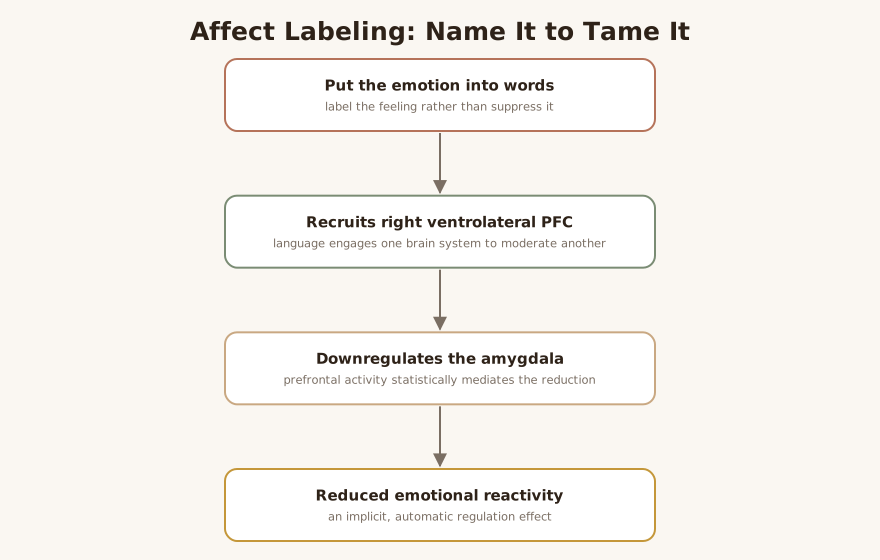
The central claim is concrete: putting feelings into words reduces amygdala reactivity to affective stimuli, and this reduction is statistically mediated by activity in the right ventrolateral prefrontal cortex 1. In Lieberman’s original paradigm, participants viewed emotionally evocative faces and either labeled the emotion or performed a control task (such as matching gender or names); labeling the emotion produced lower amygdala activity and higher right ventrolateral prefrontal cortex activity, and the prefrontal response accounted for the amygdala reduction 1. The interpretation is that language recruits one brain system to moderate another 6.
A second principle is automaticity. The downregulation appears to occur as a downstream consequence of naming rather than through effortful suppression, and — importantly for clinical framing — knowing about the effect does not seem to abolish it 3. People do not have to want to feel better for labeling to work 3.
A third, more practical principle concerns specificity. The explainer literature emphasizes that precise labels (“disappointed about not being chosen”) tend to do more than vague ones (“I feel bad”), linking the technique to emotional granularity — the capacity to differentiate among similar affective states 6. The label that does the work is often not the first one that arrives; anger, for instance, may sit atop disappointment or hurt 6.
Finally, affect labeling is positioned as implicit regulation that shares machinery with explicit regulation. When directly compared to cognitive reappraisal, labeling recruits an overlapping prefrontal network and produces comparable amygdala dampening, despite feeling phenomenologically different and despite reappraisal producing larger self-reported drops in distress 4.
Interventions & Techniques
In practice, affect labeling is less a protocol than a family of moves a clinician can deploy across modalities 1. The simplest is the in-session prompt to name a feeling as it arises — translating a somatic or behavioral signal into a word 1. Pushing for granularity is the next step: moving a client from “stressed” or “bad” toward differentiated labels such as resentful, ashamed, or apprehensive 6.
LLM-generated illustrative example (not a guideline): A client says, “I just feel awful when she texts me.” The clinician slows down: “Awful is big. If you sit with it for a second — is it more hurt, more angry, more scared she’ll leave?” The client lands on “abandoned, mostly.” Naming the specific state, rather than the global one, often loosens its grip LLM.
Written labeling — expressive writing or journaling that names emotions rather than only recounting events — is a self-directed extension 1. Mindfulness-based labeling adds a nonjudgmental, present-moment stance: noticing and naming feelings as they pass without trying to change them, the practice the UCLA group linked to the same neural pattern 3. With children and caregivers, the Siegel and Bryson approach pairs labeling with storytelling — narrating the upsetting experience so that language and emotion integrate 5.
The most clinically ambitious application is labeling during exposure: having a client verbalize their fear and bodily experience while confronting a feared stimulus, as a possible augmentation to standard exposure therapy 6. The hypothesis is that engaging the labeling system during activation harnesses the same prefrontal-limbic dynamic observed in the lab 6.
Evidence Base
The maturity here is best described as established at the level of mechanism, emerging at the level of clinical outcome 4. The basic neuroimaging finding is robust: the 2007 result has been replicated and extended across multiple paradigms, and the prefrontal-mediated amygdala dampening is one of the more reliable effects in the affective-neuroscience literature 6. The direct comparison with reappraisal strengthens the mechanistic story by showing shared prefrontal recruitment and equivalent amygdala reduction across the two strategies 4.
Honesty requires several qualifications. First, the foundational work is largely lab-based neuroimaging in healthy participants viewing standardized stimuli, not clinical trials measuring symptom change in patients 1. The Frontiers comparison study, for example, was conducted in healthy adults 4. Second, the subjective effect is more modest than the neural one: in the head-to-head comparison, reappraisal produced larger self-reported distress reductions than labeling, even though both dampened the amygdala similarly 4. Clinicians should not promise clients that naming a feeling will make it feel dramatically smaller in the moment 4. Third, effects vary by population and design, and meta-analytic support, while present, comes with that caveat 6. The translation to exposure augmentation is a reasonable, mechanistically grounded hypothesis rather than a settled clinical guideline 6.
Populations & Indications
Affect labeling has the appeal of being low-cost, low-risk, and broadly applicable across ages and presentations 1. The developmental literature, via the Whole-Brain Child framework, targets children, adolescents, and their parents, using naming-and-narrating to help young, still-integrating brains regulate emotional storms 5. The mindfulness branch indicates relevance for adults practicing meditative or acceptance-based approaches, where noticing-and-naming is already a core skill 3.
Clinically, the technique is most obviously indicated where there is a gap between emotional experience and emotional language — clients who are flooded but cannot say what they feel, who report only somatic or global distress, or who show low emotional granularity or alexithymic features 6. It is also a natural fit for anxiety and phobic presentations, given the exposure-augmentation line of work 6. More generally, it suits anyone working on emotional dysregulation, reactivity, or distress tolerance, since the core move — pause, notice, name — is compatible with most therapeutic frames 4.
Problems-for-Work
Emotional dysregulation and flooding. When a client escalates faster than they can think, prompting a specific label engages the regulatory network that dampens limbic reactivity 1. Application: in the moment of rising distress, the clinician asks for one precise emotion word rather than a story 6.
Anxiety and phobic avoidance. Pairing labeling with graded confrontation of a feared stimulus is the exposure-augmentation application — verbalizing fear during activation rather than distracting from it 6.
Low emotional granularity / alexithymic features. Systematically widening a client’s emotion vocabulary and pushing past first-pass labels addresses the differentiation deficit directly 6.
Reactivity and impulsivity. Inserting a naming step between stimulus and response builds a deliberate pause 1.
LLM-generated illustrative example (not a guideline): For a client who slams the door and texts something they regret whenever criticized, the work becomes a rehearsed sequence: feel the heat, name it (“this is humiliation, not just anger”), then choose. The label is the wedge between trigger and reaction LLM.
Contraindications, Cautions & Cultural Humility
There are no notable hard contraindications to naming a feeling, but several cautions matter. The effect on felt distress is modest and not guaranteed, so framing labeling as a cure for painful emotion sets clients up for disappointment when the feeling persists 4. With clients prone to rumination, repeatedly labeling and re-labeling can shade into cognitive over-analysis rather than regulation; the contemplative version deliberately pairs naming with letting-pass to avoid this 3. For acutely flooded or trauma-activated clients, demanding precise language while dysregulated can feel invalidating or be cognitively out of reach in the moment LLM.
Cultural humility is essential because emotion language is not culturally universal LLM. The granularity and even the categories of available emotion words differ across languages and communities, and a clinician’s preferred labels may not map onto a client’s lived vocabulary 6. The goal is the client’s own accurate word, not the therapist’s 6. The neuroscience framing itself — “your amygdala,” “name it to tame it” — can be empowering for some clients and alienating or pathologizing for others, and should be offered, not imposed 3.
Treatment-Plan Suggestions & SMART Objectives
| Goal | SMART objective (example) | Mechanism |
|---|---|---|
| Build emotional vocabulary | Client will identify and name at least three distinct emotions per session for 4 consecutive sessions | Increased granularity supports prefrontal recruitment during labeling 6 |
| Reduce in-the-moment reactivity | Client will pause and state one specific emotion word before responding in 3 logged conflict situations over 2 weeks | Naming engages right ventrolateral prefrontal cortex and dampens amygdala reactivity 1 |
| Tolerate distress without avoidance | Client will verbally label fear during 4 graded exposure trials without escaping the situation | Affect labeling during exposure as augmentation of activation-based learning 6 |
| Strengthen present-moment awareness | Client will complete daily 5-minute noticing-and-naming practice, logged 5 of 7 days for 3 weeks | Mindful labeling associated with greater prefrontal and reduced amygdala response 3 |
| Translate somatic distress into language | Client will name the emotion underlying a body sensation in 4 of 5 flooding episodes | Converting interoceptive signal to language recruits regulatory networks 1 |
| Support caregiver co-regulation | Caregiver will narrate and name the child’s feeling during 3 distress episodes per week | Left-brain storytelling integrates emotion and language to soothe (“name it to tame it”) 5 |
| Reach beneath surface affect | Client will identify the more specific emotion under “anger” or “stress” in 3 journal entries weekly | Precise labels disrupt reactivity more than global ones 6 |
Common Misconceptions
“Naming a feeling makes it go away.” The reliable effect is on amygdala reactivity, not on subjective distress, which changes more modestly — and reappraisal outperforms labeling on self-reported relief 4. Labeling loosens, it does not erase 4.
“You have to try to feel better for it to work.” The opposite appears true: the effect is incidental and survives the client knowing about it, which is part of what makes it clinically convenient 3.
“It’s just venting.” Affect labeling is specific representation in language, not emotional discharge; vague global complaint (“I feel terrible”) is precisely the form that produces weaker effects 6.
“It’s a proven anxiety protocol.” The exposure-augmentation application is mechanistically plausible and supported by translational work, but it is not yet a settled, manualized treatment 6.
“The neuroscience proves therapy talk cures emotion.” The foundational evidence is lab neuroimaging in non-clinical samples; it explains a mechanism, it does not by itself validate clinical outcomes 1.
Training & Certification
There is no certification in affect labeling — it is a technique, not a credentialed modality 1. Competence is acquired within training in the host therapies: mindfulness-based interventions, where noticing-and-naming is a core skill 3; exposure-based anxiety treatments, where labeling-during-activation is the relevant application 6; and emotion-focused or developmental/parenting frameworks, where the Whole-Brain Child material offers accessible structure for clinicians coaching caregivers 5. Clinicians wanting to ground their practice should read the primary source directly rather than rely on popular summaries 1.
Key Terms
- Affect labeling — representing an emotional experience in words (selecting, saying, or writing the emotion) 1.
- Amygdala — limbic structure central to threat detection and emotional reactivity; its response is reduced during labeling 1.
- Right ventrolateral prefrontal cortex — prefrontal region whose activity statistically mediates the amygdala reduction during labeling 1.
- Implicit (incidental) emotion regulation — regulation that occurs without explicit intent to change one’s feelings 4.
- Emotional granularity — the capacity to differentiate among similar emotional states with precise language 6.
- Name it to tame it — popular shorthand, from the Whole-Brain Child, for regulating emotion by naming it 5.
- Cognitive reappraisal — explicit reinterpretation strategy that shares prefrontal machinery with labeling but yields larger self-reported distress reduction 4.
Resources & Further Reading
▶ Watch — a video introduction to this concept:
- Lieberman et al. (2007), Putting Feelings Into Words — Psychological Science
- Lieberman et al. (2007) — full-text PDF (UCLA SANLAB)
- UCLA Health — Putting Feelings Into Words Produces Therapeutic Effects in the Brain
- Burklund et al. (2014), Common and distinct neural bases of affect labeling and reappraisal — Frontiers in Psychology
- Siegel & Bryson, The Whole-Brain Child (official site)
- Affect Labeling: The fMRI Evidence Behind ‘Name It to Tame It’ — overview
Reflective / Supervision Questions
- When I prompt a client to name a feeling, am I helping them reach their own precise word, or am I supplying my label and calling it theirs? 6
- How do I hold the gap between the strong neural finding and the modest subjective effect when a client says naming the feeling “didn’t help”? 4
- With flooded or trauma-activated clients, how do I judge when granular labeling is regulating versus when it is out of reach and invalidating? LLM
- Where in my caseload would labeling-during-exposure be a defensible augmentation, and where would I be overreaching beyond the evidence? 6
- How does emotion language differ across the clients I see, and does my emotion vocabulary quietly privilege some clients over others? LLM