
Type & Discipline
Extinction is a theory and core process within behavioral psychology, specifically the study of associative learning 4. It describes what happens to a learned response when the conditions that produced it change: when a conditioned stimulus is repeatedly presented without the unconditioned stimulus, or when an operant behavior is repeatedly emitted without reinforcement, the conditioned response gradually weakens and may eventually stop 4. It is not a clinical modality in itself but a mechanism that underlies several modalities, most importantly exposure-based treatments LLM.
The clinically decisive insight of modern extinction theory is that extinction is not unlearning 1. The original association is largely preserved; extinction adds new, context-dependent inhibitory learning that competes with the original memory rather than overwriting it 1. This single distinction explains nearly everything therapists find frustrating and hopeful about exposure work, and it reframes “relapse” as an expected property of how learning is stored rather than a failure of treatment LLM.
Creators & Lineage
The phenomenon was first systematically described by Ivan Pavlov, who observed that a conditioned salivary response in dogs declined when the conditioned stimulus was repeatedly presented without food, and who also documented its return after a rest interval 4. Pavlov’s classical conditioning provided the original paradigm; B. F. Skinner and the operant tradition extended the concept to reinforced behavior, where withholding reinforcement produces an analogous decline, often preceded by a temporary increase known as an extinction burst 4.
The modern, clinically influential account belongs largely to Mark Bouton, whose work established that extinction is fundamentally context-dependent and that the original learning survives intact beneath it 1. Building directly on Bouton’s framework, Michelle Craske and colleagues translated these laboratory findings into the inhibitory-learning model of exposure therapy, a lineage that runs from Pavlov’s classical conditioning through fear extinction research to contemporary exposure protocols 2. The intellectual line of descent is therefore: classical and operant conditioning, then fear extinction, then exposure therapy informed by inhibitory learning LLM.
Core Principles
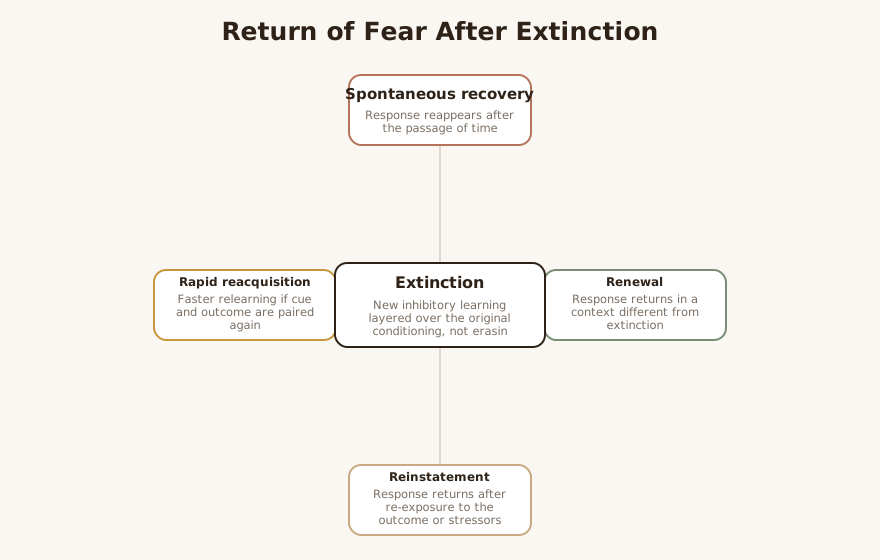
The defining principle is that extinction reflects new learning layered on top of, not erasing, the original conditioning 1. Bouton frames this as the storage of two competing memories about the same cue, with retrieval determining which one governs behavior at a given moment 1.
Four “return of fear” phenomena follow from this and are the heart of the clinical relevance. Spontaneous recovery is the reappearance of an extinguished response after the passage of time, demonstrating that extinction does not permanently abolish the association 6. Renewal is the return of the response when the cue is encountered in a context different from the one in which extinction occurred 1. Reinstatement is the return of the response after re-exposure to the unconditioned stimulus or to stressors 1. Rapid reacquisition is the faster relearning of the original response if the cue and outcome are paired again 1.
A unifying theme across these is that extinction is exquisitely context-dependent, where “context” includes physical setting, interoceptive and emotional state, time, and even the presence of safety cues 1. The original conditioning, by contrast, tends to generalize more broadly, which is why fear returns so readily and tolerates so many contexts 1. The therapeutic task, then, is not to delete fear but to make the inhibitory (safety) memory more retrievable and more generalizable across contexts 2.
Interventions & Techniques
Extinction is operationalized clinically through exposure: repeatedly and deliberately confronting a feared cue while the expected catastrophe does not occur 2. Older models framed exposure as fear habituation, expecting that within-session and between-session declines in fear were the active ingredient and the marker of success 2. The inhibitory-learning model substantially revised this, arguing that fear reduction during exposure is a poor predictor of long-term outcome and that the real goal is maximizing the violation of expectancy and the durability of new learning 2.
Craske and colleagues describe several concrete strategies drawn from this model 2:
- Expectancy violation: structure exposures so the mismatch between what the client predicts will happen and what actually happens is as large and surprising as possible 2.
- Deepened extinction: combine multiple feared cues that have each been extinguished, or present them together, to strengthen inhibitory learning 2.
- Occasional reinforced extinction: allowing the feared outcome to occur occasionally during exposure may build tolerance and reduce return of fear 2.
- Removal of safety signals and behaviors: eliminating subtle avoidance and safety cues prevents them from becoming the reason “nothing bad happened” 2.
- Variability and multiple contexts: varying stimuli, durations, and especially conducting exposures across multiple physical and internal contexts directly counteracts renewal 2.
- Retrieval cues: giving the client a portable reminder of the extinction context can help the safety memory transfer to new settings 2.
Pharmacological and neurobiological augmentation strategies have also been studied, including agents intended to enhance the consolidation of extinction learning, with the goal of making inhibitory learning stronger and more lasting 3. The evidence for these augmentation approaches is mixed and context-sensitive rather than uniformly positive 3.
Evidence Base
The evidence base for extinction as a basic learning process is established and robust, resting on decades of replicated animal and human research from Pavlov forward 4. The return-of-fear phenomena—spontaneous recovery, renewal, reinstatement—are likewise well-replicated and form a stable foundation for theory 16.
The translation of this science into exposure therapy is the most clinically validated application: exposure-based treatment for anxiety, phobia, and trauma is among the best-supported interventions in mental health, and extinction is its accepted mechanism 2. The inhibitory-learning reframe of exposure is well-articulated and theoretically coherent, but Craske and colleagues are explicit that several of its specific optimization strategies were, at the time of writing, supported more by laboratory analogue studies than by large clinical trials 2. Clinicians should treat the inhibitory-learning tactics as well-reasoned and promising rather than as settled, trial-proven protocols LLM.
Augmentation strategies—pharmacological and otherwise—are an active but unsettled research area, with results that vary by agent, timing, and disorder 3. In short: the core science is mature; exposure as its application is mature; the fine-grained optimization and augmentation layers are evolving LLM.
Populations & Indications
Extinction-based work is indicated wherever a maladaptive conditioned response sustains distress or impairment. The clearest indications are specific phobias, where a discrete cue reliably triggers fear, and anxiety disorders more broadly, including panic disorder (extinction applied to interoceptive cues) and generalized anxiety disorder 5. PTSD is a central application, with trauma reminders functioning as conditioned stimuli that exposure aims to extinguish 3.
The same principles extend to substance use disorders, where conditioned cravings are treated as conditioned responses to drug-associated cues, making cue-exposure an extinction procedure 4. Children can benefit from extinction-based approaches, including the planned withdrawal of reinforcement for problem behaviors in behavioral parent training 4. People in habit-reversal treatment and those targeting compulsive behaviors also draw on extinction logic, since compulsions are maintained by the relief (negative reinforcement) that exposure with response prevention withholds LLM.
Problems-for-Work
- Specific phobia: graded exposure to the feared object or situation, structured to violate the prediction that harm will occur 2.
- Panic disorder: interoceptive exposure to feared bodily sensations so the client learns the sensations are not dangerous 5.
- Posttraumatic stress disorder: systematic exposure to trauma memories and reminders so they no longer reliably elicit the conditioned fear response 3.
- Conditioned cravings / substance use disorder: cue exposure in which drug-related cues are presented without consumption, weakening the conditioned craving response 4.
- Compulsive behaviors: exposure with response prevention, where the urge is triggered but the neutralizing ritual is withheld, allowing extinction of the anxiety-ritual link LLM.
- Avoidance behavior: targeting avoidance directly, since avoidance prevents the disconfirming experience extinction requires 2.
- Relapse: because spontaneous recovery, renewal, and reinstatement are intrinsic to extinction, relapse prevention is built in through multi-context practice and retrieval cues rather than treated as an afterthought 1.
LLM-generated illustrative example (not a guideline): A client with panic disorder predicts that a racing heart means an imminent heart attack. The clinician has them sprint in place to deliberately provoke the sensation. The prediction (collapse) does not occur. The aim is not to make the sensation feel pleasant but to maximize the surprise of the disconfirmation, which is what builds durable inhibitory learning LLM.
Contraindications, Cautions & Cultural Humility
Extinction itself is a neutral process, but its clinical application carries real cautions. Because the original learning is never erased, clinicians must set honest expectations: some return of fear is normal and does not mean treatment failed 1. Framing it otherwise sets clients up to interpret a predictable spontaneous recovery as catastrophic relapse LLM.
In operant applications, the extinction burst—a temporary escalation of the behavior when reinforcement is first withdrawn—can be distressing or unsafe and must be anticipated, particularly with self-injurious or aggressive behavior 4. Withholding reinforcement that is genuinely protective, or conducting exposure that overwhelms a client’s window of tolerance, can do harm and demands clinical judgment LLM.
Exposure should be collaborative and informed; coercive or surprise exposure violates consent and can re-traumatize LLM. Cultural humility matters in defining what counts as a “feared” or “irrational” cue: a response that looks like pathological avoidance may be a rational adaptation to a genuinely unsafe environment shaped by discrimination or community violence LLM. Safety behaviors that are clinically counterproductive in one context may be sensible protective strategies in another, and clinicians should not extinguish responses that serve real-world protection LLM.
Treatment-Plan Suggestions & SMART Objectives
| Goal | SMART objective (example) | Mechanism |
|---|---|---|
| Reduce phobic avoidance | Within 8 weeks, client will complete a 10-step graded exposure hierarchy, reaching the top item with a peak-fear rating below a pre-agreed threshold | Expectancy violation builds inhibitory learning that competes with the original fear memory 2 |
| Build durable, context-general fear reduction | Over 6 weeks, client will conduct each mastered exposure in at least 3 distinct settings, logged weekly | Multi-context practice counteracts renewal by broadening retrieval of the safety memory 1 |
| Eliminate safety behaviors | Within 4 weeks, client will perform 5 exposures without identified safety behaviors or signals | Removing safety cues prevents them from being credited with the absence of harm 2 |
| Reduce panic via interoceptive tolerance | Over 5 weeks, client will complete interoceptive exposures (e.g., hyperventilation, exertion) twice weekly, recording disconfirmed catastrophic predictions | Interoceptive cues are extinguished as predictors of catastrophe 5 |
| Reduce cue-triggered cravings | Within 6 weeks, client will complete weekly cue-exposure sessions without use, rating craving before and after | Conditioned craving response weakens when cues occur without the outcome 4 |
| Prepare for and normalize return of fear | By session 12, client will articulate the difference between a lapse and relapse and name 2 retrieval-cue strategies | Psychoeducation reframes spontaneous recovery as expected, reducing catastrophic appraisal 16 |
| Maintain gains after termination | Over the final month, client will complete self-directed “booster” exposures every 2 weeks | Periodic re-exposure strengthens and refreshes inhibitory learning against reinstatement 3 |
Common Misconceptions
“Extinction erases the fear.” It does not; the original association persists and the inhibitory learning is context-bound and vulnerable to time, context change, and stress 1. “If fear comes back, treatment failed.” Return of fear via spontaneous recovery, renewal, or reinstatement is a predictable property of how extinction is stored, not evidence of failure 16. “The goal of an exposure session is for fear to drop.” The inhibitory-learning model holds that within-session fear reduction is a weak predictor of outcome; expectancy violation and durable learning matter more 2. “Habituation and extinction are the same thing.” Habituation is a within-session response decline; the inhibitory-learning account explicitly de-emphasizes it as the active ingredient 2. “More exposure is always better in a linear way.” Variability, surprise, and context diversity often matter more than sheer repetition or duration 2.
Training & Certification
There is no certification in “extinction” as such; it is a mechanism, not a standalone modality LLM. Clinicians acquire competence by training in the modalities that operationalize it—exposure therapy, exposure and response prevention, prolonged exposure for PTSD, and cognitive behavioral therapy—through supervised practice, workshops, and disorder-specific protocols LLM. Familiarity with the primary translational literature, particularly Bouton’s account of context and the Craske inhibitory-learning framework, is the conceptual foundation that lets a clinician design exposures that target the mechanism rather than merely reduce momentary distress 12.
Key Terms
- Conditioned stimulus / conditioned response: a previously neutral cue and the learned reaction it comes to elicit 4.
- Extinction: weakening of a conditioned response when the cue occurs without its expected outcome 4.
- Spontaneous recovery: return of an extinguished response after a rest interval 6.
- Renewal: return of the response in a context different from the extinction context 1.
- Reinstatement: return of the response after re-exposure to the unconditioned stimulus or stress 1.
- Inhibitory learning: the new, competing safety association formed during extinction 2.
- Expectancy violation: the mismatch between predicted and actual outcome that drives durable extinction 2.
- Extinction burst: temporary escalation of an operant behavior when reinforcement is first withheld 4.
Resources & Further Reading
▶ Watch — a video introduction to this concept:
- Bouton, M. E. (2004). Context and Behavioral Processes in Extinction. Learning & Memory, 11, 485-494.
- Craske, M. G., et al. (2014). Maximizing exposure therapy: an inhibitory learning approach. Behaviour Research and Therapy.
- Augmentation of Extinction and Inhibitory Learning in Anxiety and Trauma-Related Disorders (PMC review).
- Extinction (psychology) — Wikipedia.
- Extinction Psychology: What Is It? — Talkspace.
- Spontaneous recovery — Wikipedia.
Reflective / Supervision Questions
- When a client’s fear returns between sessions, do I frame it for them as expected spontaneous recovery, or do I (and they) read it as failure? LLM
- Am I designing exposures to reduce momentary distress, or to maximize expectancy violation and durable inhibitory learning? 2
- In how many genuinely distinct contexts has this client practiced, and how am I guarding against renewal when treatment ends? 1
- Which safety behaviors am I tolerating that may be quietly undermining the disconfirmation, and which are legitimately protective and should stay? 2
- How do I distinguish a maladaptive conditioned response from a rational adaptation to a real-world threat in this client’s life? LLM