
Type & Discipline
Habituation and sensitization are theoretical constructs from behavioral neuroscience that describe non-associative learning — changes in responding produced by repeated exposure to a single stimulus, with no association formed between two stimuli or between a stimulus and a response.2 This distinguishes them from associative learning such as Pavlovian (classical) conditioning, in which a previously neutral stimulus comes to predict a biologically significant one.2 Habituation is defined as the progressive decrease in the amplitude or frequency of a response to repeated sensory stimulation that does not result from sensory-receptor adaptation or motor fatigue.3 Sensitization is the opposite outcome: an increased response to a strong or noxious stimulus, which heightens an organism’s reactivity to subsequent inputs.6 LLM
For the practicing clinician, the value of this theory is conceptual rather than procedural — it is a basic-science account of how nervous systems filter the irrelevant and amplify the dangerous, and it sits upstream of the behavioral therapies clinicians actually deliver.LLM It is not itself a billable, manualized treatment.LLM
Creators & Lineage
The dual-process framework that organizes contemporary thinking on these phenomena was articulated by Philip Groves and Richard F. Thompson in their 1970 paper Habituation: A Dual-Process Theory, which proposed that habituation and sensitization are two independent underlying processes that interact to produce the response actually observed.1 Eric Kandel’s Nobel-recognized work on the marine sea slug Aplysia gave these processes a cellular address: repeated gentle prodding of the siphon produced habituation of the gill-withdrawal reflex, while an electric shock produced sensitization and heightened responsiveness to a light touch.6 That work revealed the neurochemical basis of simple learning, showing that habituation in the reflex pathway involves reduced neurotransmitter release at the synapse while sensitization recruits a separate modulatory state system that increases transmitter output.6
The lineage relevant to clinicians runs forward from this basic science into classical conditioning and then into exposure therapy, where the idea of repeated, attenuating responses to feared stimuli was borrowed to explain why facing fear repeatedly reduces it.LLM That borrowing was formalized in emotional processing theory and has since been substantially revised by inhibitory learning theory, a distinction taken up below.LLM
Core Principles
Several parametric features define genuine habituation and have been replicated across species and response systems.4 Spontaneous recovery: a habituated response returns, increasing in magnitude, after a sufficiently long interval without the stimulus.4 Potentiation of habituation: with repeated rounds of habituation and recovery, recovery becomes progressively faster, so the organism re-habituates more quickly each time.4 Frequency effects: more closely spaced (shorter interstimulus interval) presentations generally produce faster habituation, though such habituation may also recover more readily.4 Stimulus specificity and generalization: true habituation is relatively specific to the trained stimulus and generalizes only partially to similar stimuli.4 Dishabituation: presenting a novel, often stronger stimulus temporarily restores the habituated response, which is the key behavioral proof that the decrement was learning rather than sensory adaptation or fatigue.4
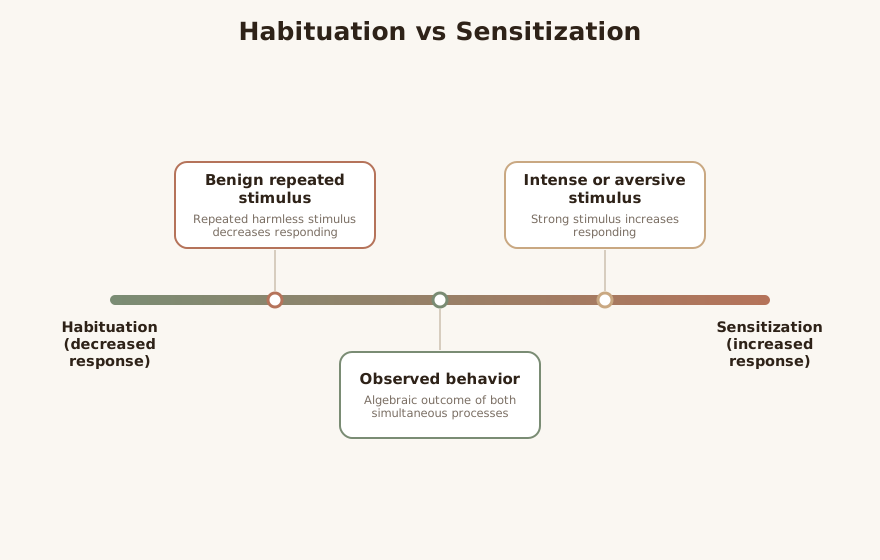
The dual-process principle holds that habituation and sensitization run simultaneously through different neural pathways, and the behavior we observe is the algebraic outcome of the two opposing processes.1 Stimulus intensity arbitrates which dominates: weak or biologically insignificant stimuli produce rapid habituation with little sensitization, whereas strong, biologically relevant stimuli (food, shock) produce marked sensitization and less habituation.5 Later network modeling complicated the original additive assumption, showing that depression (habituation) and facilitation (sensitization) interact in a complex, non-additive way in which the serial ordering of the processes matters — a depressing locus upstream of the facilitating system can cause subsequent facilitation to wane.7
Interventions & Techniques
Habituation and sensitization are not interventions in their own right; they are mechanisms that exposure-based behavioral techniques are presumed to engage.LLM The classic application is graded exposure, in which a patient confronts a feared but objectively safe stimulus repeatedly until the response attenuates — the clinical analogue of habituation to a benign repeated stimulus.LLM Systematic desensitization, in vivo and imaginal exposure, and interoceptive exposure all rest on the same intuition that repetition without catastrophe lowers reactivity.LLM
The parametric features above translate directly into technique decisions.LLM Because habituation is stimulus-specific and generalizes only partially, exposure should be varied across multiple exemplars, contexts, and cues rather than rehearsed in a single safe configuration.4 LLM Because spontaneous recovery reliably occurs after delay, clinicians should expect and normalize the partial return of fear between sessions and build in spaced, repeated practice rather than treating one good session as a cure.4 LLM Because intense or aversive stimuli sensitize rather than habituate, exposure that is paced too aggressively — flooding a trauma survivor or pushing well past tolerance — risks increasing reactivity and even re-traumatization rather than reducing it.5 LLM The clinical art is to keep the dual-process balance tilted toward attenuation by titrating intensity so the stimulus stays in the habituating range.1 LLM
Evidence Base
The maturity here must be stated carefully. The phenomena of habituation and sensitization are established to a degree rare in the behavioral sciences: they have been demonstrated and mechanistically dissected across invertebrates and mammals, with conserved short-term mechanisms (intrinsic synaptic regulation, as in Aplysia) and distinct long-term mechanisms.3 The dual-process account has been repeatedly corroborated and refined rather than overturned.17
What is not settled is the claim that habituation is the active ingredient of clinical exposure.LLM The emotional-processing model that long dominated exposure therapy held that within-session reduction in fear (within-session habituation) was the mechanism of lasting improvement; subsequent research found that within-session habituation is a poor predictor of long-term outcome, and the field largely shifted toward an extinction-plus-inhibitory-learning account in which the operative process is associative — the patient learns a new, competing safety expectation rather than simply fatiguing an old response.LLM Habituation and extinction are also conceptually distinct: extinction phenomena such as renewal and reinstatement are properties of associative learning and should not be folded into the non-associative habituation/sensitization framework.2 LLM In short: treat the basic science as solid and the “exposure works by habituation” story as a useful but contested simplification.LLM
Populations & Indications
Because the framework is mechanistic, it is indication-agnostic and informs work across the lifespan, from children to adults.LLM Altered habituation has been documented across neuropsychiatric and developmental conditions and often correlates with symptom severity, including autism spectrum disorder, schizophrenia, and migraine.4 At the cognitive level, disrupted habituation has been linked to impaired spatial learning and to dysregulated responding to reinforcers in conditions such as obesity and ADHD.3
Clinically, the model is most directly relevant to people with anxiety disorders, PTSD, chronic pain, and sensory processing differences, where the shared therapeutic premise is that maladaptive over-responding to safe or unavoidable stimuli can be reduced through structured, tolerable repetition.LLM In chronic pain and sensory hypersensitivity in particular, the sensitization arm of the theory is as important as the habituation arm, because central sensitization describes precisely the pathological amplification the theory predicts from intense, repeated aversive input.LLM
Problems-for-Work
- Specific phobia and social anxiety disorder: graded, repeated, varied exposure to feared objects or social situations, expecting partial spontaneous recovery between sessions and varying stimuli to counter stimulus specificity.4 LLM
LLM-generated illustrative example (not a guideline): A patient with a driving phobia rehearses only on one quiet residential street and reports she is “cured.” Anticipating stimulus specificity and spontaneous recovery, the clinician deliberately varies routes, times of day, and weather across spaced sessions so attenuation generalizes rather than staying yoked to a single safe context.4 LLM
- PTSD and hyperarousal: the theory’s caution against sensitization is central — titrate intensity so trauma-focused exposure stays tolerable, since overwhelming activation can sensitize and worsen reactivity.5 LLM
- Panic disorder: interoceptive exposure to feared bodily sensations leverages repeated, safe re-presentation of the sensation.LLM
- OCD: exposure and response prevention repeatedly presents the obsessional trigger while blocking the neutralizing ritual.LLM
- Generalized anxiety disorder: repeated, structured engagement with worry content rather than avoidance.LLM
- Chronic pain and sensory hypersensitivity: graded sensory or activity exposure aims to dampen amplified responding, while clinicians watch for sensitization from flares pushed too hard.5 LLM
- Avoidance behavior across all of the above: the common pathway, since avoidance prevents the repeated exposure on which any attenuation depends.LLM
Contraindications, Cautions & Cultural Humility
The most important caution is the sensitization risk: because intense and aversive stimuli increase rather than decrease responding, poorly paced, coercive, or flooding-style exposure can amplify distress and, in trauma populations, risk re-traumatization.5 LLM Exposure-based work is generally deferred or modified in the presence of acute suicidality, active psychosis, severe dissociation, or unmanaged substance use, where stabilization precedes any provocation of distress.LLM Spontaneous recovery should be framed for patients in advance so that the normal partial return of fear between sessions is not experienced as relapse or failure.4 LLM
On cultural humility, what counts as a “benign” versus a genuinely “significant” stimulus is not universal; a stimulus a clinician judges objectively safe may carry real, context-specific threat for a patient whose lived experience includes discrimination or community violence, and forcing habituation to a stimulus that signals authentic risk is neither ethical nor effective.LLM Baseline reactivity and habituation rates also differ between individuals and across conditions, so pacing must be individualized rather than standardized.4 LLM
Treatment-Plan Suggestions & SMART Objectives
| Goal | SMART objective (example) | Mechanism |
|---|---|---|
| Reduce phobic avoidance | Patient will complete 4 graded exposures from a 10-item hierarchy across 4 weeks, rating distress before/after each | Repeated benign-stimulus exposure to drive habituation24 |
| Tolerate trauma cues without escalation | Patient will engage in titrated imaginal exposure for 2 sessions/week for 6 weeks with peak SUDS kept at or below an agreed ceiling | Pacing intensity to favor habituation over sensitization15 |
| Generalize gains across contexts | Patient will practice exposure in 3 distinct settings within 3 weeks | Countering stimulus specificity of habituation4 |
| Normalize between-session fear return | Patient will log distress at the start of each session for 8 weeks and review the pattern with the clinician | Psychoeducation about spontaneous recovery4 |
| Reduce interoceptive fear (panic) | Patient will perform 3 interoceptive exposure exercises daily for 2 weeks, tracking anxiety ratings | Repeated safe re-presentation of feared sensations to drive habituation2 |
| Decrease pain-related activity avoidance | Patient will increase one graded activity by a set increment weekly for 6 weeks without provoking a flare | Graded exposure dampening amplified responding; avoiding sensitizing overload5 |
| Build distress tolerance during exposure | Patient will use a paced breathing skill and remain in 2 exposure situations to completion weekly for 4 weeks | Keeping arousal in the habituating range1 |
Common Misconceptions
“Exposure works because the patient habituates within the session.” This was the dominant claim of the emotional-processing model, but within-session habituation is a weak predictor of durable outcome, and the field now emphasizes new inhibitory (associative) learning — expectancy violation and distress tolerance — over response fatigue.LLM “Habituation and extinction are the same thing.” They are not; habituation is non-associative, extinction is associative, and extinction-specific phenomena like renewal and reinstatement do not belong to the habituation framework.2 LLM “Habituation is just your sense organs getting tired.” Habituation is a central learning process, demonstrably dissociable from sensory adaptation and fatigue via dishabituation.4 “More intense exposure is always more effective.” Intense, aversive input drives sensitization rather than habituation, so escalating intensity can backfire.5 LLM
Training & Certification
There is no certification in “habituation and sensitization” because it is a basic-science theory rather than a credentialed treatment.LLM Clinicians acquire the relevant competencies by training in the behavioral therapies that operationalize these mechanisms — supervised coursework and practicum in CBT and in exposure-based protocols, and continuing education in trauma-focused care for safe pacing.LLM The most useful upgrade for clinicians already doing exposure is explicit training in inhibitory-learning–based exposure, which reframes session goals away from chasing within-session habituation.LLM
Key Terms
- Non-associative learning — change in responding from repeated exposure to one stimulus, with no association formed.2
- Habituation — progressive decrease in response to a repeated benign stimulus, not due to receptor adaptation or fatigue.3
- Sensitization — increased response following a strong or noxious stimulus.6
- Dual-process theory — habituation and sensitization are independent, simultaneous processes whose interaction yields observed behavior.1
- Dishabituation — temporary restoration of a habituated response by a novel stimulus; evidence that habituation is learning, not fatigue.4
- Spontaneous recovery — return of a habituated response after a delay.4
- Stimulus specificity — habituation is relatively specific to the trained stimulus and generalizes only partially.4
Resources & Further Reading
▶ Watch — a video introduction to this concept:
- Groves & Thompson (1970). Habituation: A Dual-Process Theory
- Habituation, sensitization, and Pavlovian conditioning — PMC
- Habituation mechanisms and their importance for cognitive function — PMC
- Habituation — Wikipedia
- Animal learning — Sensitization — Encyclopaedia Britannica
- Habituation and sensitization — EBSCO Research Starters
- Prescott (1998). Interactions between depression and facilitation within neural networks — PubMed
Reflective / Supervision Questions
- In my current exposure cases, am I implicitly chasing within-session habituation as the goal, or am I tracking expectancy violation and distress tolerance instead?LLM
- How am I pacing intensity so that a patient’s exposure stays in the habituating range rather than tipping into sensitization?LLM
- Have I varied stimuli, contexts, and cues enough to counter the stimulus specificity of any gains?LLM
- Do I prepare patients for spontaneous recovery so that a normal return of fear between sessions is not misread as relapse?4 LLM
- For trauma or chronic-pain patients, where is the line between therapeutic activation and re-traumatizing or pain-sensitizing overload, and who decides where it sits?LLM
- When I judge a feared stimulus “objectively safe,” whose frame of reference am I using, and could the patient’s lived context make it genuinely significant?LLM