
Type & Discipline
Dynamic Attachment Re-patterning Experience (DARe) is a somatic, attachment-focused training model rather than a discrete manualized psychotherapy protocol 1. It sits at the intersection of body psychotherapy and applied attachment science, integrating attachment theory, neuroscience, and trauma-informed somatic methods into a coherent clinical framework 5. The model is also known as SATe (Somatic Attachment Training experience), reflecting its dual roots in somatic regulation and attachment repair 4. For practicing therapists, the most useful framing is that DARe supplies an assessment lens and a set of relational and body-based techniques that can be layered into an existing therapy or coaching practice 1.
The approach is delivered both as a clinician/coach training pathway and as a relational self-help framework for the public via Heller’s writing and audio work 24. Because its primary delivery vehicle is a certificate program open to a wide range of practitioners — not only licensed clinicians — DARe should be understood as a transtheoretical skill set rather than a stand-alone billable therapy in itself 1. LLM
Creators & Lineage
DARe was developed by Diane Poole Heller, PhD, described as “an established expert in the field of Child and Adult Attachment Theory and Models, trauma resolution, and integrative healing techniques” 4. Heller began her professional work in 1989 with Dr. Peter Levine, founder of the Somatic Experiencing Trauma Institute, and served as Senior Faculty teaching Somatic Experiencing internationally for over 25 years 4. This biography matters clinically: DARe’s somatic spine is Levine’s Somatic Experiencing, and the model explicitly draws on body-based trauma recovery and the “completion of protective responses previously left incomplete” 56.
The attachment side of the lineage is broad. Heller’s framework cites the foundational work of Bowlby and Ainsworth, the interpersonal-neurobiology contributions of Siegel and Stern, and couples theory from Gottman, Tatkin, and Bader 7. The unifying premise is that “our bodies and our brains are storing memories of early experiences, creating patterns that deeply affect our relationships” 6. Heller’s stated philosophy is that we are “hardwired to heal,” and that recovering broken connections — to body, self, others, and a sense of meaning — is central to trauma resolution 64. Her primary public-facing works include the book The Power of Attachment and the audio program Healing Your Attachment Wounds 43.
Two lineages frequently associated with somatic attachment work — Porges’s polyvagal theory and Ogden’s Sensorimotor Psychotherapy — are conceptually adjacent and share DARe’s emphasis on autonomic regulation and bottom-up processing, though the provided sources foreground Somatic Experiencing and attachment theory specifically as the named influences. LLM
Core Principles
DARe rests on the claim that attachment patterns are “engraved in both the mind and body” and carried “subconsciously into our adult behaviors” 7. Healing therefore cannot be purely cognitive; it must engage the nervous system and lived relational experience 7. The model emphasizes regulating autonomic nervous system responses through the body rather than through insight alone 5.
A second principle is that the attachment system is “forgiving” and remains plastic across the lifespan, so insecure patterns can be repatterned through repeated corrective experiences 7. Heller’s central therapeutic stance is “noticing when things are off and…compassion to want to do a retake” — repairing ruptures rather than avoiding them 7. This repair orientation operationalizes the move toward earned security. LLM
A third principle is that connection itself is regulating. Heller notes that tone of voice communicates safety — “a melodic voice…fosters a sense of safety,” whereas threatening vocal tones “trigger our amygdala” — and that safe, “regulated contact” can offer regulation “more effectively than conversation alone” 7. The relationship is thus treated as a physiological intervention, not only a psychological one. LLM
Interventions & Techniques
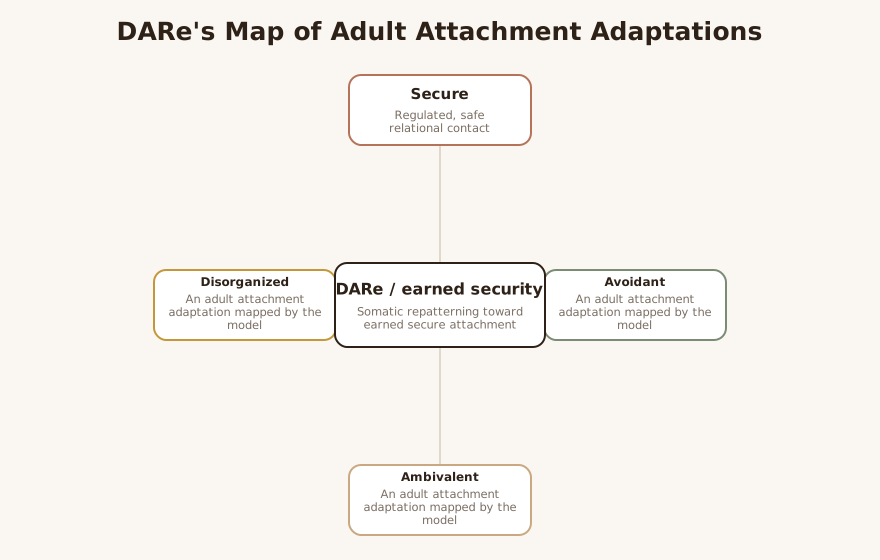
DARe organizes work around four attachment patterns: secure, avoidant, ambivalent, and disorganized 5. The model gives clinicians style-specific “concrete tools to help change deep-rooted patterns and open the path” toward healthier relating 1. Avoidant adaptations (difficulty articulating emotional needs, a preference for self-reliance, “a pattern of finding flaws in romantic connections”) are worked differently than ambivalent adaptations (an “emotional roller coaster, fluctuating between feeling secure and insecure”), and disorganized presentations — which combine avoidant and ambivalent responses — require additional safety scaffolding 5.
The signature skill set is what Heller frames as Secure Attachment Skills: deep listening (responding “with considerate questions meant to foster understanding”), practicing presence (showing up “in an undistracted way”), attunement (becoming “curious about another person’s experience”), and joint attention (being “mutually…there for each other”) 7. These are taught experientially and practiced in session as corrective relational experiences 2.
From its Somatic Experiencing roots, DARe uses bottom-up methods: tracking autonomic arousal, supporting “completion of protective responses previously left incomplete,” and using safe touch and vocal prosody to deliver co-regulation 57. Heller describes the overall method as “process-oriented techniques and relationally-based corrective experiences to restore secure attachment” 2.
LLM-generated illustrative example (not a guideline): A client with an avoidant adaptation reports going numb whenever a partner expresses need. Rather than analyzing the avoidance, the therapist slows the moment, invites the client to notice the body’s bracing, and offers a small dose of attuned presence — pausing, softening vocal tone — while the client tracks whether it feels safe to let a little contact in. The repeated micro-experience of “being met without being engulfed” is the repatterning. LLM
Evidence Base
The evidence base for DARe as a named, branded model is emerging and should be described honestly as such to clients and supervisees. LLM The publicly available sources present DARe as a practice-based, expert-developed framework grounded in Heller’s “30-plus years of research, clinical work and training programs,” but they do not present randomized controlled trials or peer-reviewed outcome studies specific to DARe 21. Marketing language such as “proven tactics” should be read as practitioner-reported rather than trial-validated 5. LLM
What gives the model credibility is the maturity of its component traditions: attachment theory (Bowlby, Ainsworth) and somatic-trauma approaches descended from Somatic Experiencing carry their own evidence and decades of clinical use 47. Clinicians can reasonably borrow DARe’s relational and regulatory techniques while being transparent that the integrated package itself is supported primarily by clinical experience and the established science of its parts, not by direct DARe efficacy data 4. LLM In documentation and consent, frame DARe-derived techniques as adjuncts within an evidence-based therapy rather than as a free-standing evidence-based treatment. LLM
Populations & Indications
DARe is positioned for adults with attachment trauma, trauma survivors, and people with insecure (avoidant, ambivalent, or disorganized) attachment patterns who struggle in relationships 57. It is explicitly relational and is applied with couples, drawing on couples-theory influences (Gottman, Tatkin, Bader) 7. It is most natural for clients already engaged in, or suited to, somatic therapy, where attention to body states is welcome 5.
Common presenting indications include adult relational difficulties, intimacy problems, and the repetitive “painful patterns that play out again and again in our adult relationships” that Heller’s work targets 2. Because the model centers nervous-system regulation, it is also applied to affect-regulation difficulties and the dysregulation associated with developmental and complex trauma 57. LLM
Problems-for-Work
- Attachment insecurity / intimacy difficulties: Identify the client’s dominant adaptation and use Secure Attachment Skills (presence, attunement, repair) to build new relational experiences 71.
- Relationship conflict (couples): Slow escalations, restore attunement and joint attention, and rehearse rupture-and-repair so partners learn to “do a retake” rather than withdraw or pursue 7.
- Complex PTSD / developmental trauma: Layer somatic regulation and “completion of protective responses” onto a trauma-stabilization frame, titrating contact to avoid overwhelm 5.
- Emotional dysregulation / affect-regulation problems: Use co-regulation through prosody and regulated touch as physiological down-regulation before cognitive work 7.
- Anxiety in relationships (ambivalent adaptation): Address the “emotional roller coaster” by building internal felt-safety and predictable relational repair 57.
LLM-generated illustrative example (not a guideline): A trauma survivor with a disorganized adaptation oscillates between clinging and pushing the therapist away. Work proceeds in small, well-bounded doses — naming the approach-avoid conflict out loud, keeping the window of tolerance narrow and explicit, and prioritizing predictability and consent over depth — so that safety and connection stop being mutually exclusive. LLM
Contraindications, Cautions & Cultural Humility
DARe is not a stand-alone treatment for acute risk, active psychosis, or unstabilized substance use, and somatic/touch-based components require explicit caution and consent. LLM Heller’s own materials note that safe touch should be “regulated contact,” which underscores that any in-session touch demands clear consent, scope-of-practice review, and licensure/ethics-board compliance — many clinicians will omit physical touch entirely and use prosody, pacing, and presence instead 7. LLM
A key scope caution: the DARe certificate program admits not only licensed mental health professionals but also bodyworkers, coaches, educators, and first responders 1. Completing DARe training does not confer a clinical license or qualify a non-clinician to treat complex trauma; therapists should not conflate DARe certification with regulated clinical credentialing 1. LLM
With disorganized presentations and complex/developmental trauma, bottom-up activation can flood a client; titration, stabilization first, and dissociation monitoring are essential, since the model itself acknowledges these as chaotic, fear-laden adaptations 5. LLM Culturally, attachment “styles,” norms around eye contact, touch, emotional expression, and family interdependence vary widely across cultures; a Western, dyadic, romantic-relationship-centered framing of secure attachment should be held humbly and adapted to each client’s relational and cultural context rather than imposed. LLM
Treatment-Plan Suggestions & SMART Objectives
| Goal | SMART objective (example) | Mechanism |
|---|---|---|
| Build felt safety in session | Within 6 sessions, client will use one grounding/orienting skill to return to baseline arousal in 3 of 4 sessions where activation arises | Autonomic regulation; bottom-up co-regulation 57 |
| Increase relational presence | Over 8 weeks, client will practice “undistracted presence” with one chosen person 2x/week and log the experience | Practicing presence as a Secure Attachment Skill 7 |
| Reduce avoidant withdrawal | Within 90 days, client will name an emotional need to a partner once weekly without going numb, by tracking and naming body bracing first | Style-specific repatterning of avoidant adaptation 5 |
| Strengthen rupture repair | Over 10 sessions, client will initiate one “retake”/repair after a conflict at least twice, rated for follow-through | Repair orientation toward earned security 7 |
| Improve attunement (couples) | Within 8 sessions, partners will demonstrate reflective listening with “considerate questions” in 2 recorded in-session exchanges | Deep listening and attunement skills 7 |
| Lower relational anxiety (ambivalent) | Over 12 weeks, client will reduce reassurance-seeking episodes by a self-rated 30% using internal felt-safety practice | Stabilizing the secure/insecure “emotional roller coaster” 5 |
| Expand window of tolerance (complex trauma) | Within 12 sessions, client will tolerate a brief attuned-contact exercise without dissociating in 3 of 5 attempts | Titrated completion of protective responses 5 |
Common Misconceptions
- “DARe is an evidence-based therapy with its own trials.” It is an emerging, expert-developed model; its credibility rests on its parent traditions (attachment theory, Somatic Experiencing) rather than DARe-specific controlled outcome studies 14. LLM
- “DARe certification makes someone a trauma therapist.” The program admits coaches, bodyworkers, and educators, so certification is not equivalent to clinical licensure or qualification to treat complex trauma 1. LLM
- “It’s just insight-oriented talk about childhood.” DARe is explicitly somatic and process-oriented, working with nervous-system states and “relationally-based corrective experiences,” not only narrative 25. LLM
- “Attachment style is fixed.” Heller’s model holds the attachment system to be “forgiving” and changeable through repeated repair, which is the basis of earned secure attachment 7. LLM
- “Touch is required.” Safe touch is one option framed as “regulated contact,” but co-regulation can be delivered through presence, prosody, and pacing alone 7. LLM
Training & Certification
The DARe Certificate Program comprises four training modules to be completed within three years 1. Level 1 (Fundamentals of Attachment Styles) is a mandatory prerequisite; the remaining levels — Attachment Strategies for Adult Relationships; Neurobiology, Attachment & Secure Relationships; and Clinical Strategies to Address Complex Trauma — may be taken in any sequence 1. Beyond coursework, certification requires 5 hours of personal sessions with approved DARe Associates, 5 hours of individual case consultation, 6 hours of group case consultation, and a final case-study presentation and evaluation 1.
Eligibility is broad, spanning licensed mental health professionals, medical professionals, bodyworkers, life coaches, educators, and first responders, with applicants expected to hold an “active practice” so they can “apply and integrate” techniques during training 1. The model is also disseminated through Heller’s books, audio programs, and the broader Trauma Solutions training organization she founded 42.
Key Terms
- DARe / SATe: Dynamic Attachment Re-patterning experience, also called Somatic Attachment Training experience — Heller’s integrative somatic-attachment model 4.
- Attachment styles: Secure, avoidant, ambivalent, and disorganized adaptations addressed within DARe 5.
- Earned secure attachment: A move from insecure adaptation toward security achieved through corrective relational experience and repair — operationalized by Heller’s emphasis on noticing rupture and choosing “a retake” 7. LLM
- Secure Attachment Skills: Deep listening, practicing presence, attunement, and joint attention 7.
- Completion of protective responses: The Somatic Experiencing principle, carried into DARe, of finishing self-protective actions left incomplete during overwhelm 5.
- Co-regulation: Using safe, regulated contact and vocal prosody to regulate another’s nervous system 7.
Resources & Further Reading
▶ Watch — a video introduction to this concept:
- DARe Certificate Program — Dr. Diane Poole Heller (Trauma Solutions)
- The Power of Attachment — book overview (Trauma Solutions)
- The Power of Attachment: How to Create Deep and Lasting Intimate Relationships (Sounds True / Macmillan)
- Diane Poole Heller — Contributor Archive (Sounds True)
- An Introduction to DARe Attachment Coaching (Redbeard Somatic Therapy)
- What is DARe? (Alicen Halquist)
- We Are Designed for Connection — Insights at the Edge podcast (Sounds True)
Reflective / Supervision Questions
- When you use DARe-derived techniques, can you clearly name the recognized billable modality you are working within, and have you documented medical necessity accordingly? LLM
- How do you assess and titrate somatic activation with disorganized or complex-trauma clients to prevent flooding or dissociation? LLM
- If you incorporate touch or “regulated contact,” how have you handled consent, scope of practice, and your licensing board’s rules — and is omitting touch the safer default for this client? LLM
- How do you hold the concept of “secure attachment” with cultural humility, given cross-cultural variation in touch, eye contact, and family interdependence? LLM
- How do you communicate to clients that DARe is an emerging, practice-based model rather than a trial-validated stand-alone treatment? LLM
- Where do you notice your own attachment adaptations activating in the therapeutic relationship, and how does that shape attunement and repair? LLM