
Type & Discipline
Sensorimotor Psychotherapy (SP) is a body-centered talking therapy that treats trauma by working simultaneously with cognition, emotion, and the body’s autonomic and movement responses 5. It sits within the discipline of body psychotherapy and the family of body-oriented trauma therapies, but it is explicitly not a hands-on or touch-based modality, which makes it integrable into conventional verbal treatment 5. The core premise is that trauma is encoded as a subcortical physiological problem—dysregulated autonomic arousal and incomplete defensive responses—that traditional cognitive or narrative work alone often fails to modify 5. Because it requires no physical contact, SP can be layered onto inpatient and outpatient verbal trauma treatment rather than replacing it 5. In practice it functions as a clinical lens and skill set that a licensed clinician brings to existing therapy hours rather than a wholly separate treatment system LLM.
Creators & Lineage
SP was developed in the 1980s by Pat Ogden, PhD, who founded the Sensorimotor Psychotherapy Institute (SPI) to teach the method 56. Janina Fisher and Kekuni Minton are closely associated co-developers and authors of the foundational texts 23. The method draws techniques from psychodynamic psychotherapy, gestalt therapy, cognitive-behavioral therapy, and the Hakomi method of body psychotherapy, and it incorporates a Focusing / Focusing-Oriented Psychotherapy-style attention to the moment-to-moment “felt sense” 5. Its theoretical scaffolding rests on attachment theory, interpersonal neurobiology, and the neuroscience of traumatic stress, including the autonomic and structural-dissociation literature 53. It shares conceptual territory with Somatic Experiencing and with polyvagal theory’s account of sympathetic and parasympathetic defense states 5. The two anchor texts are Trauma and the Body (2006) and Sensorimotor Psychotherapy: Interventions for Trauma and Attachment (2015) 23.
Core Principles
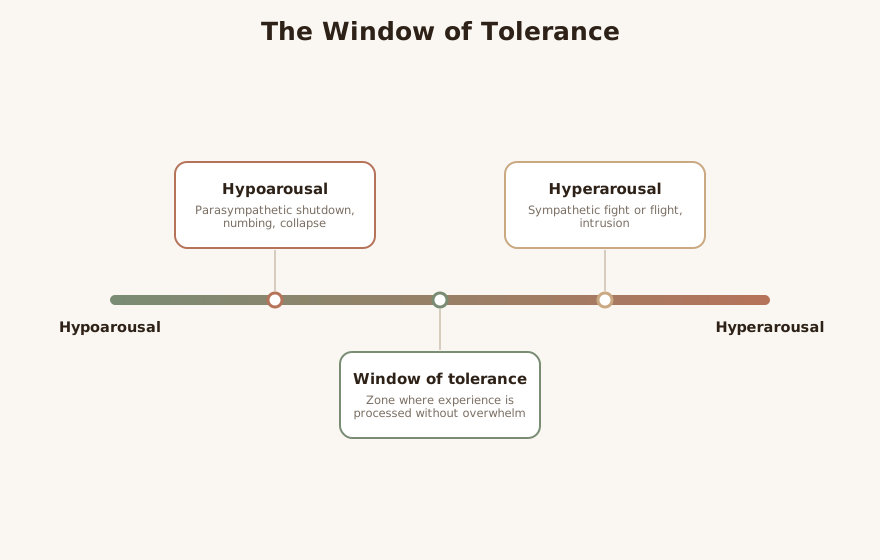
SP distinguishes top-down processing (insight, cognition, narrative) from bottom-up processing (sensation, autonomic arousal, instinctive defense), and prioritizes bottom-up regulation before narrative reprocessing 65. Trauma is understood to leave survivors chronically dysregulated, oscillating between sympathetic hyperarousal (fight/flight, intrusion) and parasympathetic hypoarousal (shutdown, numbing, collapse) 56. A central organizing concept is the window of tolerance: the zone of autonomic arousal within which a person can process experience without becoming overwhelmed or shut down 5. This capacity is understood to develop in early attachment relationships through attuned caregiver repair of the infant’s distress states 5. Trauma encodes itself idiosyncratically as a mix of images, sensations, movements, impulses, emotions, and beliefs, which is why traumatic memory is fragmented rather than sequential 5. SP therefore treats the body as both a source of information and a target for intervention 6.
Interventions & Techniques
A SP session begins like most therapy—with a client narrative—but instead of “talking about” the event, the therapist directs attention to the habitual patterns of sensation, posture, and movement the recollection evokes 5. The clinician tracks the client’s body for autonomic shifts (shallowing breath, muscular tightening, postural collapse) and uses directed mindfulness to have the client notice, without interpreting, the moment-to-moment interplay of thoughts, feelings, and sensations 5. A defining feature is fostering dual awareness: observing a past experience while simultaneously registering present-moment reactions as sensations rather than as current threat, which helps differentiate past from present and reduces reactivity 5. The therapist teaches somatic resources—grounding through the feet, lengthening the spine, a hand over the heart, orienting movements—that modulate arousal and shift psychological state 5. Where trauma left defensive actions incomplete, SP helps clients mindfully complete arrested movements (pushing, reaching, fleeing), producing what Janet called an “act of triumph” and a restored somatic sense of agency 5. Therapists also help clients uncouple over-associated stimuli so that neutral or pleasurable cues no longer trigger alarm 5.
The therapist functions as an “auxiliary cortex,” holding arousal near the edges of the window of tolerance—enough activation to process, not so much that the client dissociates—while the client gradually builds independent self-regulation 5.
LLM-generated illustrative example (not a guideline): A client recalling a verbal assault notices her jaw clench and breath stop. Rather than pressing the story forward, the therapist invites her to stay with the sensation, lengthen her spine, and feel her feet on the floor; as arousal settles, she reports the memory feels “further away,” and they note the postural shift that restored a sense of control LLM.
Evidence Base
This is where honesty matters most. SP is an established and widely recognized clinical framework—it has existed since the 1980s, has foundational texts, and is taught through a formal three-level institute—but its empirical evidence base is preliminary and uncontrolled 54. As of the most recent clinical review, no randomized controlled trials of SP efficacy had been conducted, whether as a general approach or specifically for trauma 5. The published outcome data come from small, uncontrolled group studies. Langmuir, Kirsh, and Classen (2012) ran a pilot of a hospital-based outpatient group adaptation; ten participants reported improvements in dissociative symptoms, internal awareness, and receptivity to soothing at the end of treatment and at six-month follow-up 15. Fisher additionally reports a 12-session inpatient group study (n=20) in which participants showed decreases in depressive and PTSD symptoms and improved functioning, with most able to step down to a less restrictive level of care 5. The mechanistic plausibility—mindful attention activating the medial prefrontal cortex and down-regulating amygdala-driven arousal—is supported by mindfulness neuroscience, but this is indirect evidence for SP’s specific techniques 5. Clinicians should present SP to clients as a theory-rich, practice-developed method with promising but not yet established efficacy 5.
Populations & Indications
SP was designed for trauma survivors and is most indicated for PTSD, complex PTSD, and developmental/attachment trauma where autonomic dysregulation and somatic symptoms dominate the picture 5. It is particularly suited to clients who cannot tolerate, or have dropped out of, exposure-based treatments, because its emphasis on arousal regulation is intended to reduce flooding and dropout 5. It offers a route to treat trauma in clients without clear narrative memories—for example, survivors of drug-facilitated assault or early childhood abuse—because it works with present-moment somatic responses rather than requiring event recall 5. It is applied with survivors of childhood abuse, individuals with dissociative disorders, people with complex trauma, and veterans, populations marked by chronic, repeated, or “enduring condition” trauma 5. Because trauma-related dysregulation underlies many secondary presentations—addiction, eating disorders, self-injury, suicidality—SP techniques can support stabilization across these comorbidities 5.
Problems-for-Work
Hyperarousal and intrusion. For a client whose body tightens and breath quickens at trauma reminders, the work targets early autonomic cues and somatic resources to keep arousal inside the window of tolerance 5.
Hypoarousal and dissociation. For numbing, collapse, and shutdown, the therapist tracks the parasympathetic slide and uses orienting and grounding to bring the client back toward engagement 56.
Emotion dysregulation. Building dual awareness and somatic skills is positioned as the most significant benefit of SP, increasing clear thinking and reducing impulsivity 5.
Trauma-related shame. When a belief like “it was my fault” reliably triggers a postural slump and gaze aversion, the therapist helps the client notice the pattern and experiment with countering it physically, observing how lifting the head changes the felt experience 5.
Incomplete defense and powerlessness. Mindfully completing arrested fight/flight movements is used to convert a sense of helplessness into mastery 5.
Contraindications, Cautions & Cultural Humility
SP follows a phase-oriented logic: regulate arousal and stabilize before reprocessing, then address relational and attachment effects 6. The clearest caution is sequencing—allowing a client to access fear, horror, and helplessness without the capacity to contain or process it is described as of little therapeutic benefit and risks dysregulation 5. Clients prone to decompensation or regression under stress require careful pacing within the window of tolerance, with the therapist actively monitoring for dissociation 5. Because SP intensifies attention to internal body states, clinicians should anticipate that for some trauma survivors the body itself is a phobic object, and the work of shifting from fear toward acceptance must proceed gently 6. Directing sustained attention to bodily sensation is not equally safe or culturally neutral for every client; somatic interpretation, comfort with interoceptive focus, and meanings attached to posture and movement vary across cultures and bodies, so framing and consent should be individualized LLM. The absence of controlled efficacy data is itself a clinical caution worth disclosing in informed consent LLM.
Treatment-Plan Suggestions & SMART Objectives
| Goal | SMART objective (example) | Mechanism |
|---|---|---|
| Widen window of tolerance | Within 8 weeks, client identifies 3 personal early signs of hyper- or hypoarousal and names them in 4 of 5 sessions | Interoceptive awareness; arousal self-monitoring 5 |
| Build somatic regulation skills | Within 6 weeks, client demonstrates 2 somatic resources (grounding, spinal lengthening) to reduce subjective distress by 2+ points (0–10) in session | Bottom-up arousal modulation 5 |
| Increase dual awareness | By week 10, client maintains present-moment orientation while recalling a trauma cue for 3 minutes without dissociating, 3 sessions in a row | Medial-prefrontal engagement; past/present differentiation 5 |
| Reduce trauma-related shame | Within 8 weeks, client interrupts the “it was my fault” posture and substitutes an upright/oriented posture in 3 of 4 prompts | Reorganizing habitual shame-linked motor patterns 5 |
| Restore sense of agency | By week 12, client completes one previously arrested defensive movement and reports increased felt mastery | “Act of triumph”; completing thwarted defenses 5 |
| Reduce dissociation | Within 12 weeks, client reports reduced dissociative episodes on a self-report measure relative to baseline | Stabilization and arousal regulation 15 |
| Uncouple triggers from alarm | Within 10 weeks, client reports a neutral cue (e.g., a tone of voice) no longer producing automatic alarm in 3 of 5 instances | Uncoupling over-associated stimuli 5 |
Common Misconceptions
“It’s just relaxation or breathwork.” SP is a structured trauma method built on tracking defensive responses, dual awareness, and reorganizing arousal—not generic calming exercises 5. “You have to retell the trauma in detail.” SP uses narrative only to access unresolved somatic and affective components; reorganization, not re-experiencing, is the goal, and it can treat trauma without clear event memories 5. “It involves touch.” It does not require hands-on intervention, which is precisely what allows integration into standard talk therapy 5. “It’s evidence-based in the RCT sense.” The mechanisms are theoretically grounded and clinically refined, but formal controlled efficacy research has not been completed 5. “It replaces other trauma treatments.” It is designed to be integrated alongside psychodynamic, CBT, and exposure-based approaches 5.
Training & Certification
The Sensorimotor Psychotherapy Institute offers a structured three-level curriculum: Level I focused on trauma, Level II on developmental and attachment injury, and a Level III certification pathway 4. Training is aimed primarily at licensed mental health professionals and those pursuing licensure 4. The institute also offers scholarships intended to broaden access for BIPOC, LGBTQIA+, immigrant, disabled, and nonprofit-sector practitioners 4. Clinicians integrating SP should view institute training as the recognized route to competent practice, while continuing to work within their own scope and licensure LLM.
Key Terms
Window of tolerance — the optimal arousal zone for processing experience without overwhelm or shutdown 5. Dual awareness — simultaneously observing a past experience and present-moment reactions, distinguishing memory from current threat 5. Directed mindfulness — guided, nonjudgmental attention to specific sensations, movements, and impulses 5. Somatic resources — physical actions (grounding, posture, gesture) that regulate arousal and shift psychological state 5. Hyperarousal / hypoarousal — sympathetic over-activation versus parasympathetic shutdown 5. Bottom-up processing — intervention at the level of sensation and autonomic response rather than cognition 6. Act of triumph — the empowering completion of a defensive movement arrested during trauma 5. Auxiliary cortex — the therapist’s role in interactively holding the client’s arousal at workable limits 5.
Resources & Further Reading
▶ Watch — a video introduction to this concept:
- Ogden, Minton & Pain (2006). Trauma and the Body: A Sensorimotor Approach to Psychotherapy
- Ogden & Fisher (2015). Sensorimotor Psychotherapy: Interventions for Trauma and Attachment
- Fisher, J. (2019). Sensorimotor Psychotherapy in the Treatment of Trauma (clinical paper)
- Langmuir, Kirsh & Classen (2012). A Pilot Study of Body-Oriented Group Psychotherapy
- Sensorimotor Psychotherapy Institute — official site
- Sensorimotor Psychotherapy: Body-Centered Healing for Trauma (institute overview)
Reflective / Supervision Questions
- How reliably can I track a client’s autonomic shifts in real time, and what cues do I tend to miss? LLM
- Am I sequencing correctly—stabilizing arousal before inviting reprocessing—or am I letting narrative pull the client outside the window of tolerance? LLM
- When I introduce body-focused attention, how do I check that it is safe and culturally acceptable for this client rather than assuming it is neutral? LLM
- How do I describe SP’s evidence status to clients honestly without undermining their engagement? LLM
- Where do my own arousal and posture shift in session, and how might my body be shaping the client’s regulation? LLM