
Type & Discipline
Earned security is a construct within attachment theory, not a treatment, a diagnosis, or a modality a clinician delivers LLM. It names an empirical observation: some adults who appear to have had insecure attachments to both parents in childhood nonetheless present, in adulthood, with an organized and secure state of mind regarding attachment 4. The term originated in the discourse-analytic tradition of the Adult Attachment Interview (AAI), where adults whose current narrative is coherent and secure but whose described early experience was unfavorable are distinguished from those whose security appears continuous from childhood 4. Defined more broadly across the empirical literature, earned security is the process by which individuals with insecure childhood attachment rise above adverse childhood experiences to develop a secure pattern of relating in adulthood 2. Because it is a construct rather than a therapy, its clinical value lies in formulation, in the rationale it supplies for relational and reflective work, and in the hope it lends to clients who fear their histories are destiny LLM.
Creators & Lineage
The construct grows directly out of John Bowlby’s attachment theory and Mary Ainsworth’s empirical method, in which the caregiver functions as a secure base and a haven of safety 4. Ainsworth’s Strange Situation established the infant patterns, secure, avoidant, and resistant, that ground the entire field, and Mary Main and colleagues later added the disorganized pattern and, crucially, moved attachment study “to the level of representation” with the Adult Attachment Interview 4. It was within the AAI’s scoring system that the distinction between the continuously secure subtype and the earned-secure subtype was formalized, the latter describing an adult whose early attachment to both parents appears insecure but whose current AAI profile is secure 4.
The term entered wider research currency through prospective and retrospective studies testing whether the “earned-secure” label corresponds to a real developmental trajectory, most notably Roisman, Padrón, Sroufe, and Egeland’s analysis using the Minnesota high-risk longitudinal sample 1. The lineage was extended by work on how such security is actually achieved, including Saunders and colleagues’ study of alternative support figures and time spent in therapy as pathways to earned-security in expectant mothers 3. The construct’s first comprehensive synthesis arrived with Filosa, Sharp, Gori, and Musetti’s 2024 scoping review of the empirical literature 2. Conceptually, earned security sits alongside the mentalization tradition and relationally oriented therapies such as Emotionally Focused Therapy, both of which target the reflective and corrective-relational mechanisms the construct implicates LLM.
Core Principles
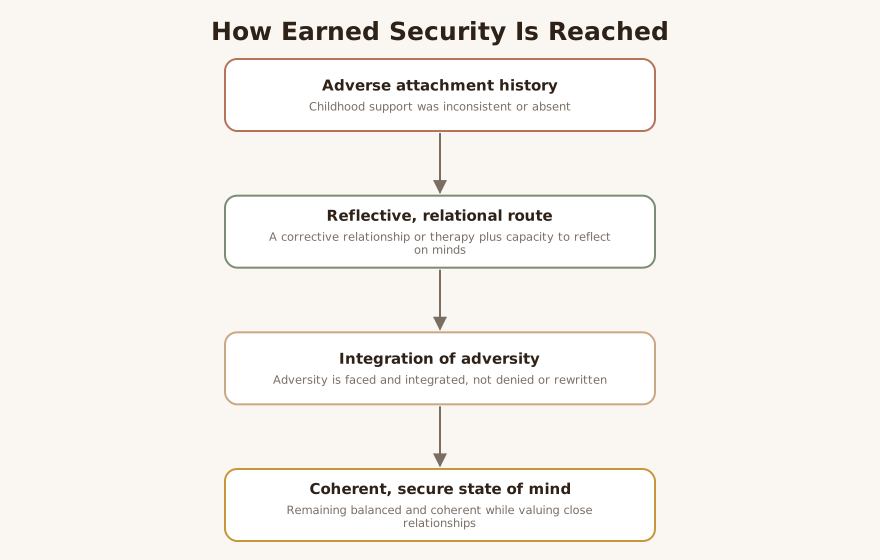
The first principle is that security can be acquired rather than only inherited 4. The basic assumption of attachment theory, as the AAI tradition frames it, is that mental health follows either from consistent support throughout childhood or from reaching a new level of understanding about self, others, and close relationships through supportive partnerships or therapy in adolescence or adulthood 4. Earned security is the name for the second route 4.
The second principle is that what is “earned” is coherence, not a rewritten past 4. The AAI is, in effect, a test of whether a person can remain balanced and coherent when thinking about emotionally upsetting attachment-related events, while still showing an understanding and valuing of the relationships concerned 4. The earned-secure adult does not deny adversity; security is defined not by the absence of adversity but by the integration of it into a coherent, balanced narrative 5. A third principle is that the route to earned security is typically relational and reflective: it involves a reflective capacity to think about one’s own mind and others’, emotional tolerance without dysregulation, narrative coherence, and corrective relational experiences offering consistent safety and attunement 5. A fourth principle, central to the construct’s clinical appeal, is intergenerational: AAI coherence and security predict secure attachment in the next generation, so earning security in oneself is one pathway to not transmitting insecurity onward 4.
Interventions & Techniques
Because earned security is a construct and not a therapy, there are no “earned-security techniques”; its clinical utility lies in assessment, formulation, and the shaping of work delivered through recognized modalities LLM. On the assessment side, the underlying instrument is the Adult Attachment Interview, a structured set of questions that ask the adult to describe and elaborate on childhood relationships, separations, illness, loss, and trauma, designed to “surprise the unconscious” and activate the attachment system in the room 4. Administered early in treatment, the AAI can help set the agenda, signal to the client that present difficulties may have relational roots, and strengthen the therapeutic alliance by being, for many clients, the first time anyone has asked for and listened to a sustained account of their family experience 4.
The intervention logic that follows centers on two mechanisms the construct implicates. The first is the corrective relationship: long-term therapy in particular can transform an insecure pattern into earned security by establishing the therapist as a secure base, and the therapeutic relationship itself becomes the agent of change because security in the therapist helps regulate the dyad 6. The second is reflective, narrative work: helping clients move from incoherent or defended accounts toward a balanced narrative that acknowledges pain while keeping perspective, which is the observable signature of earned security 5. Beyond the therapist, alternative support figures such as a grandparent, friend, or partner who listens during distress and offers emotional validation form a recognized pathway, and the empirical correlate is that earned-secure adults report higher emotional support from such figures and more time in therapy 3.
LLM-generated illustrative example (not a guideline): An adult who describes a cold, unpredictable childhood begins therapy narrating it in flat, dismissing terms (“It was fine, I don’t really remember”). Over months, within a relationally oriented treatment, the clinician holds a steady, attuned presence and gently invites specific memories. The client gradually reframes “I was always alone” into “My mother was overwhelmed and frightened herself, and I learned not to need anyone,” a more coherent and compassionate account that coexists with, rather than erases, the pain LLM.
Evidence Base
The honest appraisal places the maturity of this construct as established but with a genuine, unresolved measurement problem at its core LLM. The earned-secure subtype is a long-standing part of the AAI scoring system, the AAI’s own intergenerational validity is robust, and 2024 saw the first comprehensive scoping review of the empirical literature, drawing on 24 studies across four databases, all of which mark earned security as an accepted object of study rather than a fringe idea 42. The construct’s standing and clinical usage are not in doubt LLM.
The central caveat concerns whether the label captures a real change LLM. Earned-secure status has been operationalized in two very different ways: retrospectively, by inferring an insecure childhood from the content of a present-day secure AAI, and prospectively, by following individuals whose insecurity was documented in childhood 2. These do not converge. Roisman and colleagues found that retrospectively defined earned-secures were not more likely than continuous-secures to have been anxiously attached in infancy, and were observed in childhood and adolescence to have encountered among the most supportive and structured maternal parenting in a high-risk sample 1. In other words, the “negative childhood” that the retrospective AAI infers may partly reflect current depressed mood or narrative style rather than a documented insecure-to-secure trajectory 1. The prospective picture is more encouraging, with prospectively defined earned-secures showing successful close relationships in young adulthood 1. The scoping review’s contribution is precisely to expose this definitional heterogeneity and to caution that conclusions depend heavily on how earned security was assessed 2.
On mechanism, the evidence is suggestive rather than conclusive. Saunders and colleagues found that earned-secure expectant mothers reported significantly higher emotional support from alternative support figures and spent more time in therapy than insecure and continuous-secure women, and were more likely than insecure women to form secure attachments with their infants, effects that held even after controlling for depressive symptoms 3. The defensible stance for clinicians is that earned security is a real and hopeful phenomenon with a credible relational mechanism, while remembering that a single secure AAI cannot by itself certify that a person’s security was “earned” against a documented insecure start LLM. A further sober note from the explainer literature is that earning security may not wholly eliminate the mental-health legacy of early insecurity 6.
Populations & Indications
The construct is most directly relevant to adults with adverse childhood experiences and survivors of childhood maltreatment, the populations whose histories the very idea of earned security is meant to describe 2. It is especially pertinent to parents and expectant parents, because the AAI’s coherence predicts the next generation’s security, making the earning of security in a parent a plausible lever for primary prevention; the prenatal AAI carries the same cross-generational predictive power as one administered later 4. Saunders and colleagues studied earned-security in exactly this group, expectant mothers, and connected it to their infants’ subsequent attachment 3.
Beyond parents, the construct is indicated for adult psychotherapy clients more generally, for trauma survivors whose work involves integrating rather than avoiding a painful past, and for couples, where one partner’s growing capacity for coherence and safe closeness can become a corrective experience for the other LLM. Across these groups, earned security indicates where reflective, narrative, and relational interventions are likely to be most useful, and it offers a clinically valuable framing of hope: insecurity is a starting point, not a sentence LLM.
Problems-for-Work
The construct maps onto a recognizable cluster of presenting problems. Insecure attachment is the most direct, since earned security is, by definition, the favorable resolution of an insecure starting position 2. Difficulty with intimacy and reactive attachment patterns follow closely, as the dismissing or preoccupied stances that the AAI captures show up clinically as trouble trusting, tolerating closeness, or staying coherent when relationships activate old fears 4.
Emotion dysregulation and low self-esteem are central targets, because the move toward earned security is partly a move toward emotional tolerance without dysregulation and toward a more positive, coherent sense of self 5. Complex PTSD and childhood trauma sit within the same field, given that earning security requires integrating loss and trauma into a balanced narrative rather than being flooded or defended against it 5. Intergenerational trauma transmission and parenting difficulties are perhaps the highest-value problems-for-work here, since the construct offers a specific mechanism, achieving coherence, by which a parent can interrupt the passing-on of insecurity 4. Relationship conflict is well suited to the corrective-relationship pathway, where a stable, attuned partner or therapist supplies the safety the early environment lacked 6.
LLM-generated illustrative example (not a guideline): A new parent seeks help fearing she will “do to my child what was done to me.” Formulated through this construct, the work is not to erase her history but to help her build a coherent, compassionate account of it, so that her own unresolved fear is less likely to surface as frightening or absent caregiving, and so that her child has a steadier base than she did LLM.
Contraindications, Cautions & Cultural Humility
The foremost caution is against treating earned security as a label a brief assessment can stamp on a client LLM. Reliable AAI classification, including the earned-secure subtype, depends on trained coders and a validated procedure, not on casual clinical impression or self-report quizzes; the AAI’s estimates of past experience may themselves be in error, a limitation its own authors stress 4. Clinicians should also resist over-reading a client’s coherent, balanced telling as proof of a documented insecure-to-secure trajectory, given that retrospective earned-secures in research did not reliably have insecure infancies 1.
A second caution concerns expectations: framing earned security as a finish line can set clients up to feel they have failed if old vulnerabilities resurface, when the evidence suggests earning security may not fully erase early insecurity’s mental-health impact 6. Cultural humility is essential because the attachment paradigm and its norms were developed within particular cultural contexts, and the meaning of separation, proximity, autonomy, and what counts as a “supportive” relationship varies across collectivistic and individualistic settings; a client’s narrative must be read against their own cultural frame rather than a single Western standard 5. The construct is best held as a hopeful lens for formulation and a rationale for relational work, applied with care to history, context, and the client’s values, not as a verdict or a credential LLM.
Treatment-Plan Suggestions & SMART Objectives
| Goal | SMART objective (example) | Mechanism |
|---|---|---|
| Build a coherent attachment narrative | Within 16 sessions, client will narrate 2 painful childhood episodes in a balanced way that names both the hurt and the context, without flooding or dismissing, in 2 consecutive sessions | Targets the coherence that defines earned security 4 |
| Establish the therapist as a secure base | Over 12 weeks, client will identify 3 in-session moments of feeling safely understood and report using the relationship to settle distress | Corrective relational experience 6 |
| Strengthen reflective capacity | Within 10 sessions, client will accurately name the mental state behind 2 confusing relational interactions per week | Reflective functioning supports secure functioning 5 |
| Increase tolerance of safe closeness | Within 12 sessions, client will remain present and regulated during 3 structured closeness or vulnerability exercises and report grounding strategies used | Counters fear-within-closeness 5 |
| Mobilize alternative support figures | Over 8 weeks, client will deliberately seek emotional support from 1 trusted person during 3 distressing episodes and review the outcomes | Alternative support figures as a pathway to earned-security 3 |
| Reduce risk of transmitting insecurity (parent) | Within 16 sessions, parent will process 1 unresolved loss or trauma narrative with reduced dysregulation and report 2 instances of steadier caregiving | Coherence predicts next-generation security 4 |
| Revise negative self-perceptions | Over 12 weeks, client will reframe 3 self-critical attachment-related beliefs into more accurate, compassionate statements, logged weekly | Positive sense of self in earned-secure adults 6 |
Common Misconceptions
A frequent error is to treat earned security as a fixed adult “attachment style” that a short online quiz can identify; it originated as a coded subtype within the discourse analysis of a validated interview, not as a self-report category 4. A second misconception is that earning security means leaving the past behind or thinking only positively about one’s parents; the marker of earned security is integration, the capacity to hold pain and context together in a coherent account, not denial of adversity 5. A third is that a secure adult narrative proves the person had an insecure childhood that they then overcame; research shows retrospectively identified earned-secures were not reliably insecure as infants, so the inference from a present narrative to a documented past trajectory is not safe 1.
A fourth misconception is that earned security fully cancels the effects of early adversity; the more cautious reading is that it improves relational functioning while not necessarily eliminating all downstream mental-health vulnerability 6. A fifth is that earning security is a solo achievement of insight; the empirical pathways are relational, running through corrective relationships, alternative support figures, and time in therapy 3. Finally, some treat the earned-secure category as settled and uncontroversial, when the field’s own first scoping review highlights how differently it has been defined and measured across studies 2.
Training & Certification
There is no credential in “earned security”; it is a research construct used by clinicians within their existing scope LLM. The associated instrument, the Adult Attachment Interview, does require formal training, because reliable administration and coding depend on established procedures and inter-rater reliability rather than casual use; the protocol itself specifies that, before administering interviews, one should first be interviewed and practice interviewing another 4. Clinicians considering the AAI in their work must also weigh design choices, such as whether the treating therapist or a separate clinician conducts it, particularly when it is used to measure outcome across a test-retest design 4.
For clinical application of the construct, the relevant competence lives in recognized attachment-, mentalization-, and trauma-focused therapies that build coherence, reflective functioning, and corrective relational experience LLM. Generalist therapists can legitimately use earned security for formulation and as a source of realistic hope, provided they represent their competence honestly and refer for, or pursue, specialized training where structured attachment assessment is needed LLM.
Key Terms
Earned security – a secure adult state of mind regarding attachment achieved despite an apparently insecure early history, evidenced by a coherent narrative 4. Earned-secure subtype (F3b) – the AAI scoring subgroup distinguishing earned from continuously secure (F3a) speakers 4. Adult Attachment Interview (AAI) – a structured interview probing childhood attachment experiences, coded for coherence and state of mind, that moved attachment study “to the level of representation” 4. Coherence of mind – the capacity to discuss attachment history in a balanced, consistent, credible way while valuing relationships; the hallmark of security 4. Secure base / haven of safety – the caregiver’s, or therapist’s, dual function as a base for exploration and a refuge in distress 4. Corrective relational experience – a later relationship offering consistent safety and attunement, a primary pathway to earned security 5. Alternative support figures – non-parental sources of emotional support (e.g., grandparent, partner, therapist) associated with earned-security 3. Retrospective vs. prospective earned-security – two non-converging ways of identifying earned-secures, by inferring an insecure past from a present secure AAI versus by following documented early insecurity forward 1. Reflective capacity – the ability to think about one’s own and others’ mental states, supporting coherence and change 5.
Resources & Further Reading
▶ Watch — a video introduction to this concept:
- Earned-Secure Attachment Status in Retrospect and Prospect — Roisman, Padrón, Sroufe & Egeland (2002), Child Development
- A Comprehensive Scoping Review of Empirical Studies on Earned Secure Attachment — Filosa, Sharp, Gori & Musetti (2024)
- Pathways to Earned-Security: The Role of Alternative Support Figures — Saunders, Jacobvitz, Zaccagnino, Beverung & Hazen
- Ten Clinical Uses of the Adult Attachment Interview — Steele & Steele
- What ‘Punch’ Taught Us About Earned Secure Attachment
- From Attachment Insecurity to Earned Secure Attachment
Reflective / Supervision Questions
- When a client narrates a hard childhood with balance and compassion, am I crediting them with “earned security,” or am I quietly inferring a documented insecure past that I cannot actually verify 1?
- How am I functioning as a secure base in this work, and where do I notice the client testing whether I will be predictable and safe 6?
- Am I helping this client integrate adversity into a coherent narrative, or am I subtly steering them toward forgiving or idealizing their attachment figures 5?
- For parents, how do I hold the hopeful, preventive promise of earned security without implying that a single insight will guarantee a different outcome for their child 4?
- How does this client’s cultural frame shape what counts as a supportive relationship, appropriate closeness, or a “good enough” parent, and am I reading their narrative against their context rather than mine 5?
- Where am I operating beyond my training, for instance implying formal attachment classification from informal impression, and when should I refer for specialized assessment 4?