
Type & Discipline
Somatic Experiencing (SE) is a body-oriented psychotherapeutic modality for the treatment of trauma and stress-related conditions 4. It sits within the discipline of body psychotherapy and the broader family of body-oriented (or “bottom-up”) trauma therapies, distinguished from cognitive and narrative-exposure approaches by its primary focus on physiological rather than purely psychological processing 3. SE is best understood not as a single technique but as a clinical model applied across multiple healing professions, including mental health, medicine, physical and occupational therapy, bodywork, addiction treatment, and first response 4. Practitioners are expected to use it within their existing scope of practice, which means a licensed therapist delivers SE as a way of working within psychotherapy rather than as a separate regulated profession 4.
Its defining premise is that trauma is fundamentally a biological event in the nervous system, not only a disorder of thought or memory, and that resolution therefore requires attending to bodily sensation and incomplete physiological responses 3. This framing shapes everything that follows in this article. LLM
Creators & Lineage
SE was developed by Peter A. Levine, who built the model over several decades from observations in stress physiology and ethology 6. Levine’s foundational insight came from studying how wild animals respond to life-threatening predation: animals routinely face mortal threat yet rarely develop chronic post-traumatic symptoms, because they discharge the mobilized survival energy through shaking, trembling, and completed defensive movements before returning to baseline 6. Levine reasoned that humans possess the same self-regulatory machinery but frequently interrupt it, through cognitive override, social conditioning, immobilization, or medical intervention, leaving survival activation “stuck” in the nervous system 6. His 1997 book Waking the Tiger: Healing Trauma introduced this model to a broad clinical and lay audience and remains the canonical popular text 5.
The SE lineage intersects with several adjacent body-oriented and trauma frameworks. Polyvagal theory provides a complementary autonomic map of safety, mobilization, and shutdown that many SE practitioners draw on, and SE itself is described as operating primarily via the autonomic nervous system 3. Sensorimotor psychotherapy and Hakomi are sibling body-centered approaches that share SE’s emphasis on present-moment somatic tracking, and EMDR is a related trauma modality frequently discussed alongside SE in the broader field. LLM These related approaches are useful reference points when situating SE for clients who have encountered other body-based or trauma-focused therapies. LLM
Core Principles
The central principle of SE is that trauma represents incomplete self-protective responses that became trapped when the nervous system could not finish a fight, flight, or freeze sequence during overwhelming threat 3. Healing, in this model, involves “biological completion”, allowing the interrupted response to run to its natural endpoint so that the autonomic nervous system can return to regulated functioning 3.
SE works through interoception (awareness of internal bodily states) and proprioception (awareness of the body in space) as its core processing channels rather than through cognitive reappraisal 3. This is what makes SE a “bottom-up” therapy: it engages subcortical and autonomic systems through sensation, with cognitive insight treated as a downstream consequence rather than the primary lever of change 3.
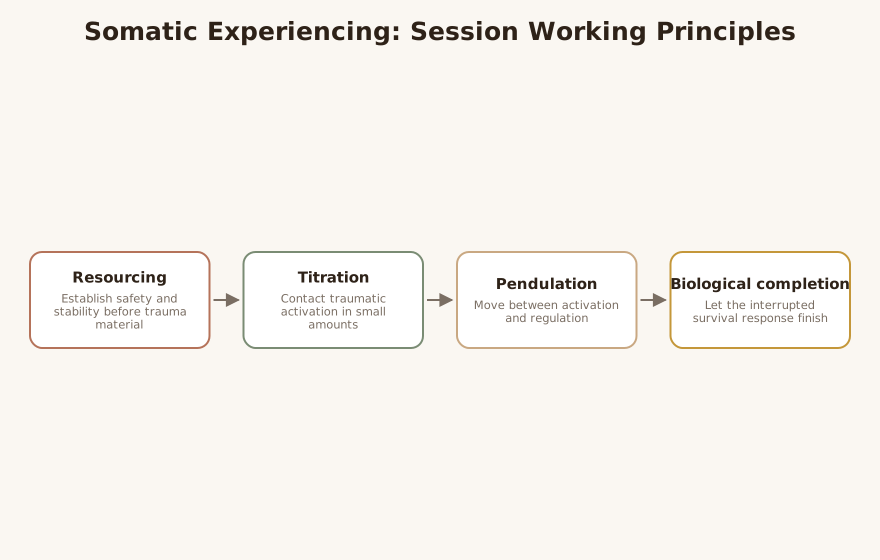
Three working principles organize most SE sessions. First, resourcing establishes internal and external sources of safety and stability before any trauma material is approached; resource activation has been identified by both practitioners and clients as a foundational ingredient of SE 2. Second, titration means contacting traumatic activation in very small doses, “one drop at a time,” rather than through full exposure, so the nervous system is never overwhelmed 67. Third, pendulation is the deliberate oscillation between states of activation and states of calm or resource, which gradually expands the client’s capacity to tolerate and discharge arousal 67.
A further structural concept often taught in SE describes experience as having multiple elements, sensation, image, behavior, affect, and meaning, that can become fragmented in trauma and are reintegrated through somatic processing; this layered model is part of SE’s conceptual vocabulary. LLM
Interventions & Techniques
SE interventions are deceptively simple in form and depend heavily on the clinician’s attunement and pacing. The foundational skill is tracking: the client notices bodily sensations in real time and observes how they shift, intensify, settle, or generate spontaneous impulses 6. The therapist mirrors and slows this attention, helping the client stay with sensation long enough for the nervous system to reorganize. LLM
Common practices include grounding and centering exercises that establish a felt sense of safety and inner strength through body awareness 7. Resourcing techniques have clients recall pleasant sensations, experiences of kindness, or a baseline sense of self to anchor regulation before approaching activation 7. Self-soothing touch and slow, deep “soothing breath” are used to engage the parasympathetic nervous system and create containment 7. The “Voo” sound, a low vocalized vibration, is used to stimulate soothing physiological effects, and “shaking it off” deliberately permits the natural trembling that discharges mobilized survival energy, the human analogue of the animal completion Levine observed 67.
Discharge support is the therapist’s facilitation of these completion responses, such as trembling, micro-movements, deeper breathing, or spontaneous defensive gestures, so the interrupted survival reaction can finish 6. Therapeutic touch, whether self-touch or, within scope and consent, therapist-provided touch supporting a sense of safety, has been identified as a method-specific factor in SE practice 2.
LLM-generated illustrative example (not a guideline): A client recalling a car accident notices a tightening in her right leg as she describes the moment before impact. Rather than narrating the crash, the therapist slows down: “Stay with that tightness, what does the leg want to do?” The client senses an impulse to press the brake. The therapist invites her to let the movement happen slowly. Her leg extends, she exhales, and the tension releases, completing a defensive response that was frozen at the time of the event. LLM
Evidence Base
SE occupies a particular position worth stating plainly: it is an established and widely practiced modality with a still-preliminary empirical base 2. The two statements are not in tension, popularity and rigorous evidence are different things, and honest clinical communication requires holding both. LLM
The strongest single study is a randomized controlled trial by Brom and colleagues (2017), which assigned 63 participants meeting full PTSD criteria to SE treatment or a waitlist control 1. The trial found significant reductions in post-traumatic symptom severity, with large effect sizes, and significant improvement in depression, concluding that SE “may be an effective therapy method for PTSD” while calling for further research 1.
A 2021 scoping review by Kuhfuss and colleagues analyzed 16 studies and found “preliminary evidence for positive effects of SE on PTSD-related symptoms,” with reductions also reported in depression and anxiety and improvements in quality of life 2. Three of four PTSD studies showed large beneficial effects and one showed small effects 2. The same review is candid about the limits: overall study quality was mixed, only two RCT designs existed, samples were small, outcome measures were highly heterogeneous (24 different instruments), and follow-up was often insufficient 2. The authors conclude that the evidence base “is weak and does not (yet) fully accomplish the high standards for clinical effectiveness research” 2.
The theoretical literature is more developed than the outcome literature: Payne, Levine, and Crane-Godreau (2015) articulate a coherent neurophysiological rationale grounding SE in interoception, proprioception, and autonomic regulation 3. The practical implication for clinicians is to present SE to clients as a promising, mechanistically plausible approach that lacks the trial volume of first-line treatments such as trauma-focused CBT. LLM
Populations & Indications
SE was designed for and is most commonly applied to trauma-related presentations across a range of populations 4. These include general trauma survivors, veterans, survivors of accidents and medical trauma, survivors of sexual assault, first responders, and people living with chronic illness 4. The breadth reflects SE’s framing of trauma as a nervous-system phenomenon that can follow many kinds of overwhelming events rather than a narrow diagnostic category. LLM
In terms of indications, the clearest empirical support is for posttraumatic stress disorder, where both the Brom RCT and the scoping review concentrate their positive findings 12. Clinically, the model is also applied to complex PTSD, developmental trauma, acute stress disorder, dissociation, and the hyperarousal and hypervigilance that characterize a chronically dysregulated nervous system, though direct trial evidence for these specific indications is thinner. LLM Because SE works through bodily activation and discharge, it is frequently extended to conditions at the body-mind interface, including chronic pain, somatic symptom disorder, medically unexplained symptoms, and anxiety disorders, where autonomic dysregulation is prominent. LLM
Problems-for-Work
The following are concrete clinical problems SE practitioners commonly address, each with a brief illustration of how the work targets it. LLM
- Hyperarousal and hypervigilance: SE directly targets a nervous system stuck in chronic sympathetic mobilization, using pendulation to expand the window in which the client can tolerate arousal without becoming overwhelmed 6. LLM
- Dissociation and freeze states: Titrated resourcing helps a client who collapses or numbs under activation re-access mobilization gradually, supporting completion of a frozen survival response rather than re-flooding 36. LLM
- PTSD intrusions tied to bodily cues: When trauma reminders trigger somatic sensations, tracking the sensation and supporting discharge addresses the physiological charge directly rather than reworking the narrative 16. LLM
- Chronic pain and somatic symptoms: For pain or medically unexplained symptoms maintained by autonomic dysregulation, interoceptive tracking and parasympathetic activation (breath, the Voo sound) target the underlying nervous-system state 37. LLM
- Anxiety and panic: Grounding, orienting, and resourcing give the client repeatable tools to down-regulate acute autonomic surges and rebuild a baseline sense of safety 7. LLM
LLM-generated illustrative example (not a guideline): A first responder reports going “blank and heavy” whenever dispatch tones sound. In session, the therapist first builds a resource (the steadiness he feels with his hands on his knees), then briefly evokes the tone-related shutdown, and pendulates between the two until the freeze gives way to a small impulse to stand and orient, restoring a sense of agency. LLM
Contraindications, Cautions & Cultural Humility
SE is not a stand-alone license to practice; clinicians must work within their professional scope and competence, and SE training assumes this constraint 4. Because the model deliberately evokes traumatic activation, even in titrated doses, it carries risk of overwhelm, re-traumatization, or destabilization if pacing is poor, which is why resourcing precedes activation and titration is non-negotiable 26. LLM
Caution is warranted with clients who have severe dissociative disorders, active psychosis, acute suicidality, or unstable medical conditions, where careful stabilization and coordination of care should precede or replace activation-based work; the evidence base does not establish SE’s safety or efficacy in these high-acuity presentations. LLM Therapeutic touch, identified as a method-specific factor in SE, requires explicit informed consent, attention to power dynamics, trauma history, and cultural meaning, and many clinicians appropriately rely on guided self-touch instead 2. LLM
Cultural humility matters in two specific ways. First, interoceptive attention, breath practices, and bodily expression carry different meanings across cultures, and what reads as “discharge” in one context may feel exposing or inappropriate in another, so the clinician should follow the client’s framing rather than impose the model’s. LLM Second, the limited and largely Western evidence base means SE should be offered transparently as one promising option among several, not as a uniquely validated cure, particularly for clients from communities underrepresented in the research 2. LLM
Treatment-Plan Suggestions & SMART Objectives
| Goal | SMART objective (example) | Mechanism |
|---|---|---|
| Expand tolerance for arousal | Within 8 sessions, client will use pendulation to remain present during moderate activation for 2 minutes without dissociating, in 3 consecutive sessions | Pendulation gradually widens autonomic regulatory capacity 6 |
| Build regulation resources | Within 4 sessions, client will independently apply 2 grounding/resourcing skills to reduce subjective distress by 3+ points (0-10) | Resource activation establishes a baseline of safety 27 |
| Reduce hyperarousal | Over 12 weeks, client will report a 30% reduction in standardized PTSD symptom score | Discharge of mobilized survival energy lowers chronic sympathetic load 16 |
| Address freeze/numbing | Within 6 sessions, client will identify and complete one interrupted defensive impulse in session, 2 times | Biological completion of a frozen survival response 3 |
| Improve interoceptive awareness | Within 4 sessions, client will name 3 body sensations and their shifts during tracking, in every session | Interoception is the core processing channel of SE 3 |
| Reduce trauma-cued somatic distress | Over 10 sessions, client will report decreased somatic reactivity to one identified trigger, by self-report log | Titrated exposure plus discharge reduces conditioned physiological charge 6 |
| Strengthen parasympathetic access | Within 3 sessions, client will use breath or the Voo sound to lower heart rate/arousal at will, daily | Parasympathetic activation counters dysregulation 7 |
Common Misconceptions
A frequent misconception is that SE is “just talking about the body” or a relaxation technique; in fact it is a structured trauma-processing model aimed at completing interrupted survival responses, with relaxation skills serving as resources rather than the goal 36. LLM Another is that SE requires the client to recount the traumatic narrative in detail, whereas the model deliberately works through sensation and titrated activation, often with minimal storytelling 6. LLM
Clinicians sometimes assume SE is strongly evidence-based on par with first-line trauma treatments; the honest position is that the evidence is positive but preliminary, with few RCTs and methodological limits 2. LLM A further error is treating “discharge” (shaking, trembling) as the objective in itself; discharge is a sign of nervous-system reorganization, not a performance to be induced, and forcing it risks overwhelm 26. LLM Finally, SE is not a separate licensed profession, it is a method applied within a clinician’s existing scope of practice 4. LLM
Training & Certification
Formal training is provided by Somatic Experiencing International (SEI), the official credentialing and training body, headquartered in Boulder, Colorado 4. The pathway begins with introductory training (SE 101) and progresses through beginning, intermediate, and advanced levels within a professional curriculum, culminating in the Somatic Experiencing Practitioner (SEP) credential awarded on completion of graduation requirements 4. Continuing education credits support ongoing professional development 4.
Training is open to a range of healing professions, including mental health, medicine, physical and occupational therapies, bodywork, addiction treatment, first response, and education, with the explicit expectation that practitioners apply SE within their own scope of practice 4. For a licensed psychotherapist, this means SE supplements an existing license rather than replacing the standards of one’s profession. LLM
Key Terms
- Titration: Approaching traumatic activation in very small, manageable doses to avoid overwhelming the nervous system 67. LLM
- Pendulation: Deliberate oscillation between states of activation and states of calm or resource to expand regulatory capacity 67. LLM
- Resourcing: Building internal and external sources of safety and stability before approaching trauma material 27. LLM
- Tracking: Noticing and following bodily sensations in real time as they shift and generate impulses 6. LLM
- Discharge / biological completion: Allowing interrupted survival responses (trembling, defensive movement) to finish so the nervous system can return to baseline 36. LLM
- Interoception: Awareness of internal bodily states, a core processing channel in SE 3. LLM
- Proprioception: Awareness of the body’s position in space, paired with interoception in SE processing 3. LLM
Resources & Further Reading
▶ Watch — a video introduction to this concept:
- Brom, D. et al. (2017). Somatic Experiencing for Posttraumatic Stress Disorder: A Randomized Controlled Outcome Study. Journal of Traumatic Stress, 30(3).
- Kuhfuss, M. et al. (2021). Somatic experiencing — effectiveness and key factors of a body-oriented trauma therapy: a scoping literature review. European Journal of Psychotraumatology.
- Payne, P., Levine, P. A. & Crane-Godreau, M. A. (2015). Somatic experiencing: using interoception and proprioception as core elements of trauma therapy. Frontiers in Psychology.
- Somatic Experiencing International — SE 101 (official organization).
- Levine, P. A. (1997). Waking the Tiger: Healing Trauma. North Atlantic Books.
- Somatic Experiencing: Peter Levine’s Approach to Healing Trauma — Simply Psychology.
- Somatic Experiencing Therapy: 10 Best Exercises & Examples — PositivePsychology.com.
Reflective / Supervision Questions
- How do I distinguish, in the moment, between a client’s productive discharge and incipient overwhelm, and what is my pacing plan when I am uncertain? LLM
- Am I clear with clients that SE has a positive but preliminary evidence base, and do I present it alongside first-line trauma treatments rather than as a superior alternative? 2 LLM
- When I consider therapeutic touch or guided self-touch, have I adequately addressed consent, cultural meaning, power dynamics, and the client’s trauma history? 2 LLM
- For higher-acuity clients (severe dissociation, psychosis, acute suicidality), how do I decide whether stabilization should precede or replace activation-based work? LLM
- How does my own nervous-system regulation in session shape the client’s capacity to track and discharge, and how am I attending to that in supervision? LLM