
Type & Discipline
Play therapy is a treatment modality within its own recognized discipline of the same name, situated in the broader family of arts-based and play therapies. LLM The Association for Play Therapy (APT) defines it as “the systematic use of a theoretical model to establish an interpersonal process wherein trained play therapists use the therapeutic powers of play to help clients prevent or resolve psychosocial difficulties and achieve optimal growth and development.” 1 The defining premise is developmental: children are often “developmentally unready or unable to express and explore their feelings, thoughts, and social behaviors in words as adults do,” so play and activity serve as their primary means of communicating needs, fears, and anxieties. 4
This is captured in the field’s organizing metaphor that “play therapy is to children what counseling is to adults,” with toys functioning as the child’s words and play as the child’s language. 6 In practice, play therapy is not a single technique but a structured, theoretically based approach that builds on the normal communicative and learning processes of children. 4 It is delivered by a trained clinician who provides selected play materials and facilitates a safe relationship within which the child can express and work through difficulties. 6
Creators & Lineage
Play therapy’s lineage runs from early psychoanalytic work with children through humanistic refinement to today’s pluralistic field. LLM In the psychoanalytic stream, Anna Freud used children’s play much as dream analysis is used with adults, and Melanie Klein treated play as direct access to the child’s unconscious; Donald Winnicott further emphasized play as central to the therapeutic experience and to child development itself. 5 Jean Piaget’s classification of play into practice, symbolic, and social forms supplied a developmental scaffold for understanding what children are doing when they play. 5
The humanistic, non-directive tradition that dominates contemporary practice traces to Virginia Axline, who pioneered play as an independent healing process and proposed eight foundational principles for the therapist’s stance. 5 Axline’s work applied Carl Rogers’s person-centered conditions to children, and Garry Landreth subsequently systematized child-centered play therapy (CCPT), describing it as “a dynamic interpersonal relationship between a child and a therapist trained in play therapy procedures who provides selected play materials and facilitates the development of a safe relationship.” 6 Landreth’s textbook Play Therapy: The Art of the Relationship established core theoretical foundations for the field. 6 Allied developments include filial therapy and parent-involved models that train caregivers to deliver therapeutic play, an approach repeatedly linked to better outcomes. 4 Social workers were involved in developing and delivering play therapies as early as the 1930s, underscoring the modality’s cross-disciplinary roots. 4
Core Principles
The first principle is that play is the child’s natural medium of expression: toys are like the child’s words, through which the child is encouraged to explore feelings and to understand and accept them. 5 The therapeutic work therefore proceeds symbolically and developmentally rather than through the verbal insight expected of adults. 4
Second, the relationship is the vehicle of change in the dominant humanistic model. LLM CCPT rests on a dynamic interpersonal relationship in which the therapist provides safety, acceptance, and selected materials and then facilitates rather than directs. 6 The therapist’s stance is the active ingredient, not any particular toy or game. 6
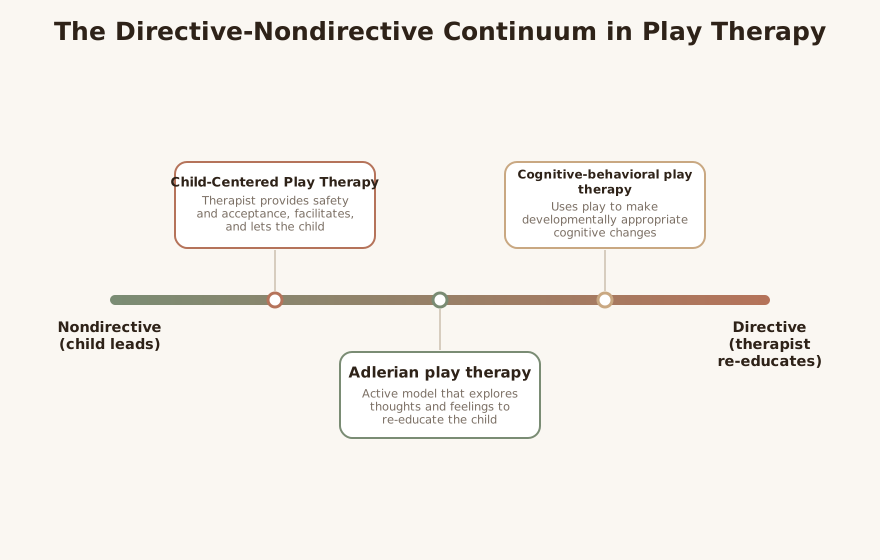
Third, play therapy spans a directive-nondirective continuum. 4 Play therapies are commonly categorized as either nondirective or directive, and some models deliberately combine both components. 4 Nondirective CCPT lets the child lead; more directive models such as Adlerian play therapy are active and aim to re-educate the child by exploring thoughts and feelings; cognitive-behavioral play therapy uses play to make developmentally appropriate cognitive changes. 57
Fourth, the field is theoretically pluralistic. LLM Many named models exist, including CCPT, Theraplay, cognitive-behavioral play therapy, and sandtray, unified less by technique than by the shared use of play’s therapeutic powers within a coherent theoretical frame. 4
Interventions & Techniques
Core methods organize around the playroom and its materials. LLM Clinicians use real-life toys (such as dolls and vehicles), aggressive-release toys (such as figures that allow expression of anger), and creative or expressive materials (such as crayons and modeling clay). 7 Sand tray work invites the child to build scenes with miniatures in sand, externalizing inner experience into a manipulable world. 7 Storytelling lets a child apply solutions modeled in a story to real situations, and role-play allows symbolic processing of traumatic or stressful experiences at a safe remove. 7 Structured games can build focus and teach socialization skills. 7
In non-directive CCPT the therapist tracks and reflects the child’s play, names feelings, sets minimal limits, and follows the child’s lead so the child directs the session while the therapist facilitates change. 76 Directive models add therapist-initiated activities, psychoeducation, or cognitive restructuring delivered through play. 5 Delivery formats include individual, group, and sibling-group play therapy, and parent-mediated filial models. 42
Dose is variable and not standardized. LLM Across the systematic-review literature, session length and frequency ranged widely (commonly 30-minute sessions, often once or twice weekly), and explicit treatment manuals were uncommon because play therapy is purposefully individualized. 4 One frequently cited clinic dataset found benefits from CCPT increasing with the number of sessions and reaching statistical significance at roughly 11-18 sessions. 2
LLM-generated illustrative example (not a guideline): A 6-year-old who witnessed domestic violence repeatedly stages a “house” scene in the sand tray where a small figure hides under furniture while larger figures fight, then over several weeks begins to introduce a “helper” figure who leads the small one to safety. The CCPT therapist tracks and reflects (“the little one found somewhere safe”) rather than interpreting or directing, letting mastery emerge through the play. LLM
Evidence Base
The evidence base is best described as established but methodologically uneven. LLM Four peer-reviewed meta-analyses of play therapy outcomes exist. 2 The landmark Bratton, Ray, Rhine, and Jones (2005) meta-analysis aggregated dozens of studies in children of mean age about 7 and reported an overall improvement of roughly 0.80 standard deviations, a large effect; humanistic and nondirective play therapies showed stronger results (d ≈ 0.93) than behavioral approaches (d ≈ 0.73), parental involvement was linked to better outcomes, and play therapy “appeared equally effective across age, gender, and presenting issue.” 43 An earlier meta-analysis (LeBlanc & Ritchie, 2001) of RCTs reported about a 0.66 SD improvement, again with parent involvement and longer duration associated with better outcomes. 42
More recent meta-analyses restricted to CCPT report smaller, still-significant effects. LLM Ray and colleagues (2015) found school-based CCPT effects of roughly d = 0.21-0.38 across externalizing, internalizing, and total problems, and Lin and Bratton (2015) reported an overall d ≈ 0.33-0.47 for CCPT, noting that effect size related to child age, ethnicity, caregiver involvement, treatment integrity, and presenting issue. 42 The Drisko, Corvino, Kelly, and Nielson (2020) systematic review screened over 5,000 citations, examined 180 studies in detail, and applied Cochrane-style criteria to 17 experimental studies; effect sizes ranged from d ≈ −0.04 to g ≈ 3.63, with most between about 0.35 and 0.80, and the authors concluded that across most concerns play therapy is “affirmed as an empirically supported therapy” meeting EST/RST criteria. 4
Honesty about maturity is warranted. LLM Critiques going back decades flagged small samples and missing control groups, and contemporary reviewers note ongoing risks: little blinding, widely varying outcome measures often normed on small non-diverse samples, frequent attribution bias because study authors were often the developers or providers of the tested therapy, and inconsistent reporting of treatment fidelity. 4 When Drisko’s team recomputed confidence intervals from pre-post data, 12 of 57 comparisons crossed zero, indicating non-significant results that differed from some originally published findings. 4 A Cochrane search found no dedicated play-therapy review, and a related Cochrane-cited synthesis found CBT modestly superior to play therapy for short-term childhood PTSD symptoms. 4 Follow-up data are sparse, so durability of gains is not well established. 4
Populations & Indications
The clearest indication is children roughly 3 to 12 years old presenting with emotional and behavioral problems, where play therapy is recommended to alleviate symptoms and support healthy development. 2 APT names a primary population of children 3-13 with a recommendation for ages 3-12. 2 Although play is sometimes adapted for adults (for example in nursing settings or with adults with developmental disabilities), that application is far less researched. 7
Within childhood, the literature supports use across both internalizing and externalizing presentations. 3 RCTs demonstrate significant improvement in disruptive behaviors, internalizing problems, academic progress, relationships, self-concept, trauma symptoms, anxiety, and functional impairment across ages 3-12 and varied presenting issues. 2 Specific evidence exists for traumatized children (including refugees and children exposed to domestic violence), children with separation and other anxiety, aggressive and oppositional behavior, ADHD-related impairment, and—in single-case designs—children with autism spectrum disorder and developmental delays. 2 Children experiencing family disruption such as divorce, loss, or relocation are a common clinical population. 7
Problems-for-Work
Play therapy lends itself to a range of childhood problems-for-work. LLM
- Trauma / PTSD symptoms: Both CCPT and trauma-focused CBT reduced trauma symptoms in refugee children by child and parent report, and sibling-group play therapy reduced symptoms in children exposed to domestic violence. 2
- Anxiety and separation anxiety: Group play therapy significantly reduced separation anxiety versus no-treatment controls, and individual CCPT improved clinically anxious young children. 2
- Disruptive behavior / ODD / aggression: CCPT and Adlerian play therapy produced significant decreases in disruptive behaviors, and sand play reduced preschool aggression with gains maintained at two months. 2
- ADHD-related impairment and emotional dysregulation: Activity-based and child-centered play therapy reduced ADHD and anxiety symptomatology and improved emotional stability. 2
- Adjustment, grief, and family disruption: Play therapy is widely used for transition stress such as divorce, loss, and relocation. 7
- Selective mutism / speech difficulties: Play-based work has been associated with improvements in speech, communication, and willingness to speak. 75
LLM-generated illustrative example (not a guideline): A 5-year-old with selective mutism who is silent in the classroom communicates fluently in the playroom through puppets and a toy phone. The clinician follows the child’s chosen channel, gradually widening the circle of “people the puppet will talk to,” scaffolding generalization without pressuring direct speech. LLM
Contraindications, Cautions & Cultural Humility
There are no absolute contraindications named in the provided sources, but several cautions follow from the evidence. LLM Play therapy is not uniformly effective—“not all treatments will prove beneficial for all clients, settings, and needs”—and outcomes differed by setting, provider, and model. 4 For acute childhood PTSD specifically, evidence favored CBT modestly over play therapy in the short term, so a clinician should weigh trauma-focused, more directive options when symptom reduction is the immediate priority. 4
Because much of the supporting research carries attribution bias, variable fidelity, and thin follow-up data, clinicians should monitor progress with structured measures rather than assuming benefit, and should be candid with caregivers that durability of gains is not well established. 4 Dose matters: benefits in at least one large dataset did not reach significance until roughly 11-18 sessions, so very brief courses may underdeliver. 2
Cultural humility is essential because many outcome measures were normed on small, non-diverse samples, and CCPT effect sizes varied by child ethnicity and caregiver involvement. 4 Play content, toy selection, and the meaning of play vary across cultures and families, so the clinician should select materials that reflect the child’s world and partner with caregivers, whose involvement is repeatedly tied to better outcomes. 42
Treatment-Plan Suggestions & SMART Objectives
| Goal | SMART objective (example) | Mechanism |
|---|---|---|
| Reduce trauma-related arousal/avoidance | Within 12 weekly CCPT sessions, child will enact and resolve a trauma-themed play sequence in 2 consecutive sessions, with caregiver-reported hyperarousal down 25% on a standardized measure | Symbolic exposure and mastery through play; safe therapeutic relationship 24 |
| Decrease disruptive/aggressive behavior | Over 10-16 sessions, teacher-rated externalizing scores will fall by ≥1 SD from baseline | Affect expression, limit-setting, and re-regulation in non-directive or Adlerian play 2 |
| Reduce separation anxiety | Within 8 weeks of group play therapy, child will separate from caregiver at session start without distress in 4 of 5 sessions | Graded mastery and peer modeling in group play 2 |
| Improve emotional regulation | Over 12 sessions, child will name and represent at least 3 distinct feelings in play, per therapist tracking logs | Reflection and naming of affect via toys as “words” 5 |
| Increase communication/expression (e.g., selective mutism) | Within 10 sessions, child will initiate verbal/symbolic communication with the puppet medium in ≥75% of sessions | Lowered verbal demand; expression through preferred play channel 76 |
| Strengthen caregiver-child relationship | Caregiver will complete a 6-session filial/parent-involvement track and report 20% reduction in relationship stress | Parent involvement consistently linked to better outcomes 24 |
| Support adjustment to family disruption | Over 8 sessions, child will represent and rehearse coping with the transition (e.g., divorce) in play with reduced distress markers | Symbolic processing of change; narrative coherence 7 |
Common Misconceptions
A common misconception is that play therapy is “just playing” or unstructured babysitting. LLM In fact it is a structured, theoretically based approach in which the play is the systematic medium and the therapeutic relationship is the engineered mechanism of change. 46 A second misconception is that play therapy is a single technique; it is a pluralistic field spanning many named models from CCPT and Theraplay to cognitive-behavioral play therapy and sandtray, along a directive-nondirective continuum. 4
A third is that strong meta-analytic effect sizes settle the question definitively. LLM The most-cited early effects (around d = 0.80) come with real caveats—frequent author-as-provider bias, varied measures, and sparse follow-up—and more recent CCPT-only meta-analyses report smaller effects. 4 Finally, it is a misconception that play therapy is only for very young, non-verbal children: while ages 3-12 are the core population and adult applications are under-researched, play-based methods are adapted across childhood and occasionally beyond. 27
Training & Certification
Play therapy is a post-graduate specialization layered onto a core mental-health license. LLM Practitioners such as Registered Play Therapists typically hold a master’s degree in fields like social work, psychology, or counseling, plus additional play-therapy coursework and clinical supervision, with credentialing through organizations such as the Association for Play Therapy. 7 Foundational training commonly draws on Landreth’s Play Therapy: The Art of the Relationship and the CCPT framework, supplemented by model-specific training for directive or specialized approaches. 6 Notably, play therapy is not yet widely taught in graduate social work programs despite student demand, so dedicated post-degree training is usually required. 4
Key Terms
- Therapeutic powers of play: The change-producing properties of play that the trained therapist harnesses systematically. 1
- Child-centered play therapy (CCPT): The dominant humanistic, non-directive model—a dynamic relationship in which the therapist provides safety and selected materials and follows the child’s lead. 6
- Directive vs. nondirective: The continuum from therapist-led, structured play (e.g., Adlerian, cognitive-behavioral) to child-led play that the therapist tracks and reflects. 4
- Filial / parent-involved therapy: Models that engage or train caregivers; parental involvement is repeatedly linked to better outcomes. 42
- Sand tray: Building scenes with miniatures in sand to externalize inner experience. 7
- EST / RST: Empirically supported / research-supported treatment—criteria play therapy is judged to meet (≥2 studies, ≥1 by non-developers, sound methods). 4
Resources & Further Reading
▶ Watch — a video introduction to this concept:
- Association for Play Therapy — Why Play Therapy / Definition
- Evidence-Based Practice Statement: Play Therapy (APT)
- Bratton, Ray, Rhine & Jones (2005) — The Efficacy of Play Therapy With Children: A Meta-Analytic Review
- Drisko, Corvino, Kelly & Nielson (2020) — Is Individual Child Play Therapy Effective?
- Chauhan et al. — An Overview of Play Therapy (PMC)
- Center for Play Therapy, University of North Texas — What is Play Therapy?
- Medical News Today — What is Play Therapy?
Reflective / Supervision Questions
- For this child, what is the clinical rationale for a non-directive versus directive play approach, and how would the evidence (e.g., CBT’s modest edge for acute PTSD) shape that choice? 4
- How am I measuring progress with structured, validated tools rather than relying on impressionistic readings of play—and have I accounted for the modality’s thin follow-up evidence on durability? 4
- Have I built in caregiver involvement where feasible, given its repeated association with better outcomes, and how am I navigating any cultural or systemic barriers to that involvement? 24
- Do my toy selection and play content reflect this child’s cultural world, and am I alert to the limits of measures normed on small, non-diverse samples? 4
- Is the planned dose adequate (recognizing benefits may not reach significance until roughly 11-18 sessions), and how will I decide whether to continue, adapt, or refer if the child is not responding? 24