
Type & Discipline
Vygotsky’s sociocultural theory is a theory of human cognitive development, not a psychotherapy 2. It belongs to developmental and educational psychology and holds that the higher mental functions, such as reasoning, voluntary attention, and self-regulation, originate in social interaction and are shaped by the cultural tools, above all language, that a community hands to the growing individual 2. Its best-known component, the zone of proximal development, names the distance between what a learner can do independently and what the same learner can accomplish with guidance from a more capable other 3. For practicing clinicians the theory is therefore a framework rather than a standalone treatment: it explains why guided, socially mediated, progressively independent skill-building works, and it sits underneath modalities a clinician already delivers rather than replacing them LLM. Used precisely, it disciplines how therapists pitch the difficulty of a task, how they lend and then withdraw support, and how they think about the social origins of a client’s self-talk and self-control LLM.
Creators & Lineage
The theory is the work of Lev Vygotsky, a Russian psychologist working in the 1920s and early 1930s, whose ideas reached the English-speaking world largely after his death and were consolidated for Western readers in the edited collection Mind in Society 5. Vygotsky argued against accounts that located development purely inside the individual child, proposing instead that learning is fundamentally a social and cultural process in which children internalize ways of thinking first practiced with others 2. His central claim, sometimes called the general genetic law of cultural development, is that every higher function appears twice: first between people, on the social plane, and only later within the individual, on the psychological plane 2.
The lineage that grew from this is dense and clinically relevant LLM. Jerome Bruner and colleagues translated Vygotsky’s zone of proximal development into the practical metaphor of scaffolding, the temporary, tailored support a teacher gives so a learner can reach beyond their current independent level, then fades 6. Vygotsky’s theory is routinely contrasted with Jean Piaget’s stage theory: where Piaget saw cognitive development as an individual child constructing knowledge through interaction with the physical world along largely universal stages, Vygotsky foregrounded social interaction, culture, and language as the engines of development, making his account a form of social constructivism 2. Reuven Feuerstein’s mediated learning experience extended the same intuition, emphasizing how a mediator interprets and structures a learner’s encounters with the world to make them developmentally productive LLM. These four strands, scaffolding, the Piagetian contrast, social constructivism, and mediated learning, form the working context in which clinicians most often meet the theory LLM.
Core Principles
The first principle is the social origin of mind: higher mental functions are not pre-installed but are built through interaction with more knowledgeable others and then internalized 2. A child who is first regulated by a caregiver’s spoken reminders gradually takes those reminders inward as private speech and finally as silent verbal thought, so that external dialogue becomes internal self-regulation 2. The second principle is mediation: human thought is carried by cultural tools and signs, the most important of which is language, and these tools fundamentally reorganize how a person perceives, remembers, and reasons 2.
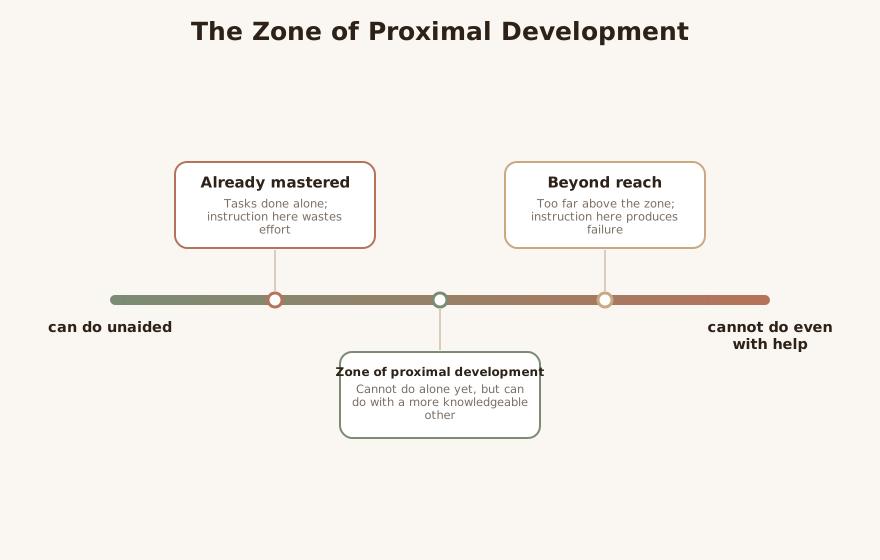
The third principle is the zone of proximal development itself, the band of tasks a learner cannot yet do alone but can do with appropriate help, which is where teaching is most productive 3. Instruction aimed below this zone targets already-mastered skills and wastes effort, while instruction aimed far above it produces failure, so effective guidance is pitched into the zone and moves upward as the learner advances 3. The fourth principle is the more knowledgeable other, the teacher, parent, peer, or clinician whose guidance makes performance within the zone possible 3. A fifth, often underappreciated, principle is that development and learning are dynamically linked: for Vygotsky good instruction does not wait for development to ripen but leads it, pulling the learner forward into capacities that are still maturing 4. Across all of these, the recurring image is of competence migrating from the social space between people into the individual mind of the learner 2.
Interventions & Techniques
Because this is a theory rather than a treatment, its clinical “interventions” are techniques it justifies and shapes inside existing modalities LLM. The flagship technique is scaffolding: the clinician offers graduated support calibrated to the client’s current level, then deliberately withdraws it as competence grows, so that responsibility transfers and the client ends up performing independently 6. Concretely, this means decomposing a skill into smaller steps, modeling the skill including the reasoning behind it, and providing prompts or cues that thin from full verbal guidance to a single word to nothing at all 6.
A second family of techniques exploits the principle of mediation through language 2. Teaching clients to talk themselves through a task, first aloud and then silently, recapitulates the developmental path by which external speech becomes internal self-regulation, which is why self-instructional and self-talk methods sit naturally on Vygotskian foundations 2. A third technique is contingent assessment: because the zone of proximal development is a moving target, the clinician continually reads the client’s response and re-pitches the difficulty, rather than fixing the task level at the outset 3. A fourth is collaborative, dialogic work, since in this tradition competence is built through shared activity and guided participation rather than solitary drill 4. The instructional literature distilled from the theory recommends pitching tasks just beyond current independent ability, providing rich modeling and worked examples, encouraging peer collaboration, and fading teacher support as learners take over 4.
LLM-generated illustrative example (not a guideline): A clinician helping an adolescent manage homework avoidance first sits beside the client and narrates each step of starting a task aloud (mediated by the clinician’s external speech), then has the client voice the steps themselves, then has the client whisper and finally think them silently, so the clinician’s spoken structure becomes the client’s own inner self-regulation, exactly the social-to-individual migration the theory predicts LLM.
Evidence Base
The honest label for this theory is established, but the word needs qualifying LLM. Vygotsky’s sociocultural theory and the zone of proximal development are foundational, near-universally cited reference points in developmental and educational psychology, and they have generated an enormous applied literature in teaching and instructional design 2. Their staying power comes from explanatory reach and pedagogical usefulness, not from a body of randomized clinical trials, because the theory is a developmental framework rather than a treatment protocol with symptom-level outcomes 4.
Several limits deserve naming LLM. First, the zone of proximal development is a powerful but loosely operationalized construct: it is widely invoked yet hard to measure precisely, and the instructional literature itself notes that translating it into concrete classroom or clinical practice is non-trivial and sometimes inconsistent 4. Second, much of Vygotsky’s work was written quickly, in difficult circumstances, and reached the West in edited and partial form, so some popular formulations are reconstructions and simplifications rather than direct quotation 5. Third, the theory predates modern neuroscience and outcome research and is best treated as a generative account of mechanism, the social and linguistic origins of self-regulation and higher cognition, rather than as evidence that any particular intervention will work 2. Clinicians should therefore present Vygotskian ideas as a well-established explanatory framework that informs how they teach and scaffold skills, with the outcome warrant supplied by the validated modalities, such as cognitive behavioral therapy or behavioral skills training, in which those techniques are embedded LLM.
Populations & Indications
The theory was built from the study of children, and children remain its primary population, particularly for early skill acquisition where adult guidance within the zone of proximal development is developmentally expected 2. It extends naturally to adolescents and to students and learners of any age, structuring the move from assisted to independent performance on academic, social, and self-management tasks 3. In clinical work it is especially apt for any skills-based intervention, where a coping, regulation, or behavioral skill must be taught, rehearsed with support, and then generalized to independent real-world use LLM.
It is highly relevant for people with intellectual or developmental disabilities, where breaking tasks into steps, supplying external structure, and fading support gradually are core accommodations rather than optional extras, and where pitching tasks accurately into the zone of proximal development prevents both boredom and failure LLM. Caregivers and parents are simultaneously a population and a delivery channel: because the theory locates self-regulation in the social interactions a child internalizes, clinicians can coach parents to scaffold their child’s attention, emotion, and behavior, transferring the method into the home 2. Educators are an explicit indicated audience, since the instructional implications of the zone of proximal development were developed precisely for teaching settings and translate directly into psychoeducational and school-based clinical work 4. Across all of these groups the consistent indication is the same: the theory applies wherever the therapeutic task is to build a capacity the client cannot yet perform alone but can perform with appropriately calibrated social support 3.
Problems-for-Work
Several presenting problems map cleanly onto Vygotskian work LLM. For learning difficulties and academic underachievement, the clinician locates the precise point at which the learner stalls and provides graduated guidance there, keeping the work inside the zone of proximal development rather than re-teaching mastered material or demanding the unreachable 3. For skills deficits and developmental delay, the target skill is decomposed, supported step by step, and the support is faded until the client performs independently, matching expectation and assistance to the client’s current functioning 6.
For self-regulation difficulties, the theory’s account of self-talk is directly applicable: a regulation strategy is first co-performed and narrated by the clinician, then voiced by the client, then internalized as silent self-instruction, reproducing the path from social to individual control 2. For executive functioning difficulties, external structures and mediating tools, spoken plans, checklists, and visual organizers, carry part of the planning and sequencing load until the client can internalize the structure 4. For language and communication delays, the theory’s emphasis on language as the master cultural tool foregrounds rich, scaffolded, dialogic interaction as the mechanism through which both communication and thought develop 2. For low self-efficacy, the experience of repeated supported success, with help thinned as competence grows, supplies the client with their own evidence that they can perform the task alone, which is itself a change mechanism LLM.
LLM-generated illustrative example (not a guideline): A young adult client with executive functioning difficulties cannot independently plan a week. The clinician first builds the plan aloud with the client and writes each step on a shared board (full mediation), then has the client dictate the steps while the clinician only listens (partial support), then sends the client home with a blank template they fill in alone (faded support), so that the externally shared planning dialogue becomes the client’s own internal planning capacity LLM.
Contraindications, Cautions & Cultural Humility
The theory has no pharmacological contraindications, but several cautions matter LLM. The most common misuse is treating support as permanent: if guidance is never withdrawn, the client becomes dependent rather than competent, which inverts the theory’s purpose, so a fading plan must be explicit 6. A second caution is miscalibration of the zone of proximal development, since aiming below it wastes effort and aiming far above it produces failure and discouragement, making ongoing assessment of the learner’s current level essential 3. A third caution is treating the zone as a fixed measure of the person’s ability rather than as a description of the support a task currently requires, which can quietly become a deficit label LLM.
Cultural humility is built into the theory itself, since its central claim is that cognition is mediated by culture, and the tools, language, and interactional norms that scaffold development differ across communities 2. This cuts two ways for clinicians LLM. It is a strength, because the theory insists that what counts as competence, the value placed on independent versus interdependent performance, the acceptable degree of adult direction, and the very meaning of “help” are culturally specific rather than universal 2. It is also a caution, because the theory and its instructional applications were articulated within particular cultural and historical settings, and applying their notions of guidance, directiveness, and independence wholesale across families and cultures risks imposing one community’s developmental norms on another LLM. The clinician should calibrate the kind and pace of support, and the end-state of “independence,” to the client’s own cultural and family context rather than to a single assumed standard LLM.
Treatment-Plan Suggestions & SMART Objectives
The contingency-and-fading structure of the zone of proximal development makes the theory a practical engine for writing measurable skill-acquisition objectives inside a broader treatment plan LLM. The examples below are illustrative templates to adapt, not prescriptions LLM.
| Goal | SMART objective (example) | Mechanism |
|---|---|---|
| Acquire a discrete coping skill | Within 3 sessions, client will perform all steps of one grounding technique with only a single-word prompt | Task decomposition and graduated guidance pitched into the zone of proximal development 6 |
| Internalize self-regulating self-talk | Over 4 weeks, client will narrate a regulation strategy aloud, then silently, in two logged real-world episodes per week | Social speech internalized as inner self-regulation 2 |
| Generalize a skill to independence | Within 6 sessions, client will initiate a target skill without clinician cueing on three of five attempts | Planned fading and transfer of responsibility from supporter to learner 6 |
| Support executive functioning | Over 3 weeks, client will complete a multi-step task using a self-managed checklist on four of five attempts | External mediating tools offloading cognitive load, then internalized 4 |
| Pitch academic work accurately | Within 2 sessions, client will identify the single step where a task breaks down and rehearse it with graduated hints | Keeping instruction inside the zone of proximal development 3 |
| Raise self-efficacy through graded success | Within 8 sessions, client will log one supported success per week with help thinned each week | Repeated faded success builds independent performance and belief 3 |
| Coach a caregiver to mediate at home | Within 4 sessions, parent will model, then prompt, then fade support for one daily routine and log the level of help given | Transfer of the mediation method into the child’s natural environment 2 |
Common Misconceptions
A frequent misconception is that the zone of proximal development simply means “help the learner,” when it specifically names the band of tasks just beyond independent ability and requires that support be calibrated to that band and then withdrawn 3. A related error is omitting the fading and internalization stage, leaving support permanently in place and producing dependence rather than the internalized competence the theory aims for 6. Another is reading Vygotsky as merely a friendlier version of Piaget, when the two differ fundamentally: Piaget centered the individual child constructing knowledge through largely universal stages, whereas Vygotsky centered social interaction, culture, and language as the drivers of development 2.
People also assume the theory says development must precede learning, when Vygotsky’s distinctive claim is closer to the reverse, that well-pitched instruction can lead development by drawing out functions that are still maturing 4. A further misconception is that the zone of proximal development is a precise, measurable quantity, when in practice it is a powerful but loosely operationalized construct that is hard to pin down and must be inferred from the learner’s responses 4. Finally, some treat Vygotskian ideas as an evidence-based therapy in their own right, when they form an explanatory framework whose clinical value is structural and whose outcome warrant comes from the validated modalities in which its techniques are embedded LLM.
Training & Certification
There is no certification in Vygotskian theory and no credential is required to apply it, because it is a public, foundational body of developmental and educational psychology rather than a proprietary clinical method LLM. Clinicians typically encounter it through graduate coursework in developmental, educational, or clinical psychology, and through training in skills-based and cognitive behavioral approaches where graded support, modeling, self-instruction, and fading are already standard practice 2. The primary historical source is the edited collection Mind in Society, which assembled Vygotsky’s key writings for Western readers, and accessible secondary summaries of the sociocultural theory, the zone of proximal development, and its instructional implications are widely available for orientation 134. No formal training is needed to apply Vygotskian principles ethically within one’s existing scope, provided they are used inside a modality the clinician is already competent to deliver LLM.
Key Terms
Sociocultural theory – Vygotsky’s account in which higher mental functions originate in social interaction and are shaped by cultural tools, especially language, before being internalized by the individual 2. Zone of proximal development – the distance between what a learner can do independently and what the same learner can do with guidance from a more capable other, the region where instruction is most productive 3. More knowledgeable other – the teacher, parent, peer, or clinician whose guidance makes performance within the zone of proximal development possible 3. Mediation – the principle that human thought is carried and reorganized by cultural tools and signs, language above all 2. Internalization – the process by which a function first practiced socially, between people, becomes an individual psychological capacity 2. Scaffolding – the temporary, tailored, contingent support, drawn from Vygotsky’s work by Bruner and colleagues, that enables performance beyond independent ability and is progressively faded 6. Private speech – the self-directed talk through which a child carries external regulation inward toward silent verbal thought 2. Social constructivism – the broader view, exemplified by Vygotsky and contrasted with Piaget’s individual constructivism, that knowledge is built through social and cultural interaction 2.
Resources & Further Reading
▶ Watch — a video introduction to this concept:
- Mind in Society: The Development of Higher Psychological Processes (Harvard University Press)
- Vygotsky’s Sociocultural Theory of Cognitive Development (Simply Psychology)
- Zone of Proximal Development (Simply Psychology)
- Vygotsky’s Zone of Proximal Development: Instructional Implications (ERIC)
- Lev Vygotsky (Wikipedia)
- Lev Vygotsky: Sociocultural Theory, Cognitive Development & the ZPD (Early Years TV)
Reflective / Supervision Questions
- For a skill you are currently teaching a client, can you name exactly where the fading plan is, or has the support quietly become permanent and dependence-producing? LLM
- How do you assess whether a task sits inside a client’s zone of proximal development rather than below it (already mastered) or far above it (set up for failure)? LLM
- Where in your work are you helping a client move from external, spoken structure toward internalized, silent self-regulation, and how do you know that migration is happening? LLM
- When you invoke the zone of proximal development, are you describing the support a task currently needs, or have you let it harden into a fixed judgment about the client’s ability? LLM
- How does your pace of fading and your definition of “independence” account for the client’s cultural and family context rather than imposing one community’s developmental norms? LLM