
Type & Discipline
The Adult Attachment Interview (AAI) is a measurement construct, not a treatment modality 2. It is a semi-structured narrative interview, developed within developmental and clinical psychology, that assesses an adult’s current “state of mind with respect to attachment” by examining how coherently the person can discuss their childhood attachment relationships 2. The instrument yields classifications that parallel the infant categories of Ainsworth’s Strange Situation: secure-autonomous, dismissing, preoccupied, and unresolved/disorganized 5. Crucially, the AAI does not assess what happened in someone’s childhood; it assesses the organization of mind the adult brings to discussing it 5. This distinction is the conceptual heart of the measure: two people with similar histories can earn opposite classifications depending on how coherently and reflectively they narrate them 5. Because scoring depends on transcript-level discourse analysis rather than self-report, the AAI is an interviewer-administered, expert-coded instrument 2. Clinicians most often encounter it as a research-grade formulation tool whose findings illuminate, but do not by themselves constitute, clinical intervention LLM.
Creators & Lineage
The AAI was developed by Mary Main, Carol George, and Nancy Kaplan at the University of California, Berkeley, in the mid-1980s, with the coding and classification system substantially elaborated by Main and Erik Hesse 5. It stands directly downstream of John Bowlby’s attachment theory and Mary Ainsworth’s Strange Situation procedure, extending the study of internal working models from observed infant behavior into adult representation and discourse 5. The intellectual move that defined the instrument was the “move to the level of representation”—shifting attachment assessment from behavior to the coherence of narrative 5. The interview asks adults to describe relationships with caregivers, supply adjectives and supporting memories, and reflect on experiences of separation, loss, rejection, and the effects of early experience on later development 2. This lineage connects the AAI to later mentalization-based approaches, which share its interest in reflective functioning, and situates it firmly within developmental psychology’s program of mapping intergenerational continuity in attachment 1.
Core Principles
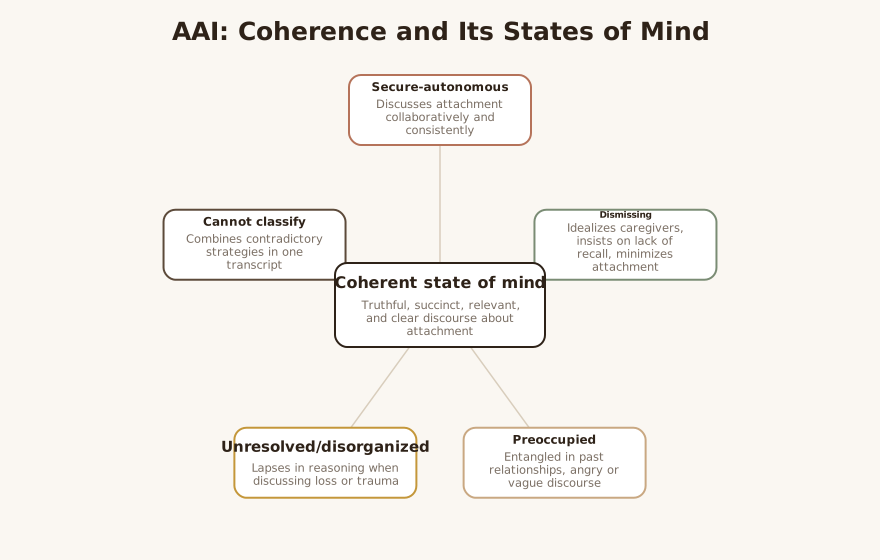
The AAI’s organizing principle is coherence: secure-autonomous speakers can discuss attachment—positive or painful—in a collaborative, internally consistent, and emotionally regulated way 5. Scoring draws on Grice’s maxims of cooperative discourse (quality, quantity, relation, manner), so that a coherent transcript is one that is truthful and evidenced, succinct yet complete, relevant, and clear 5. Dismissing states of mind are marked by idealization of caregivers without supporting memories, insistence on lack of recall, and minimization of attachment’s importance 5. Preoccupied states show entanglement in past relationships, with angry, vague, or oscillating discourse that the speaker cannot step back from 5. The unresolved/disorganized classification is assigned for lapses in reasoning or discourse specifically when discussing loss or trauma—momentary breakdowns in monitoring that can co-occur with any of the organized categories 5. A “cannot classify” designation exists for transcripts that combine contradictory strategies 2. The decisive variable throughout is not the content of memory but the regulation and structure of its telling LLM.
Interventions & Techniques
The AAI is an assessment, so it is more accurate to speak of how its formulations inform technique than to treat it as a set of interventions LLM. The interview itself is administered verbatim, audio-recorded, transcribed, and coded by a certified rater—a procedure designed to “surprise the unconscious” by outpacing rehearsed self-presentation 5. In clinical practice, the AAI framework can guide a therapist toward the form of a client’s attachment narrative: Does the client idealize caregivers without evidence, lose narrative thread when angry, or fall silent and disorganized around loss? LLM. These discourse patterns suggest where coherence-building work is needed LLM. A clinician need not formally code an interview to use the lens; noticing dismissing minimization versus preoccupied entanglement helps tailor pacing and depth LLM.
LLM-generated illustrative example (not a guideline): A client repeatedly describes their mother as “great, totally normal,” but cannot supply a single concrete memory and changes the subject. A clinician attuned to dismissing discourse might gently slow down and ask for specific episodes, treating the absence of supporting memory—not the positive adjective—as the clinical material LLM.
Evidence Base
The AAI is an established, extensively validated instrument; its maturity lies in measurement, not in being a therapy 2. Van IJzendoorn’s foundational 1995 meta-analysis demonstrated robust predictive validity: parental AAI classification predicted infant Strange Situation classification with roughly 75% correspondence on the secure-versus-insecure split and a large combined effect size 1. Yet the same meta-analysis named the “transmission gap”—the finding that parental sensitive responsiveness, the presumed mediating mechanism, accounted for only part of this transmission and left much unexplained 1. Honest practice requires acknowledging this gap rather than overstating mechanism LLM. Measurement-invariance work supports the validity of AAI states-of-mind scoring across ethnic groups, strengthening generalizability claims 4. A further tension comes from taxometric analysis: Roisman, Fraley, and Belsky (2007) found that variation underlying secure versus dismissing states of mind was better described as dimensional than as discrete categories, complicating the traditional four-type system even as the categories remain useful clinically 3. Contemporary scholarship continues to debate and re-model intergenerational transmission and the status of the unresolved category itself 6.
Populations & Indications
The AAI was designed for and validated with adults, and is widely applied with parents and expectant parents, where prenatal classification predicts later infant attachment 1. It is used with individuals in psychotherapy as a formulation aid, with couples to understand relational dynamics, and extensively by clinicians and researchers studying attachment continuity 2. Measurement-invariance evidence supports its use across ethnic groups, an important consideration for applied settings 4. Indications for an attachment-states-of-mind lens include presentations involving insecure attachment, relationship difficulties, parenting difficulties, and concerns about the intergenerational transmission of trauma 1. The unresolved classification is particularly salient where unresolved trauma and loss or complicated grief are clinically central, since disorganized discourse clusters specifically around these topics 5. Because the categories index current state of mind rather than fixed history, they can shift, making the AAI relevant to tracking representational change over a course of treatment 5.
Problems-for-Work
The AAI lens helps translate diffuse presenting complaints into workable attachment formulations LLM. For insecure attachment and relationship difficulties, identifying a dismissing versus preoccupied strategy guides whether work emphasizes accessing minimized feeling or containing entangled affect LLM. For disorganized attachment and unresolved trauma and loss, the focus shifts toward stabilizing discourse and reasoning around the traumatic or bereavement material before deeper processing 5. For complicated grief, the unresolved-loss pattern—lapses in monitoring when discussing the death—offers a concrete target 5. For intergenerational transmission of trauma and parenting difficulties, the AAI’s predictive link from parent representation to child attachment frames the clinical rationale for working on the parent’s own coherence 1. Affect regulation difficulties map onto the over-regulation of dismissing and the under-regulation of preoccupied states LLM.
LLM-generated illustrative example (not a guideline): An expectant parent who becomes flooded and disorganized whenever a deceased sibling is mentioned might, through coherence-oriented work on that loss, build a more regulated narrative—an aim consistent with the transmission literature, though no single session “fixes” classification LLM.
Contraindications, Cautions & Cultural Humility
The first caution is conceptual: the AAI is not a clinical service a generalist administers casually, and its categories should never be used as diagnostic labels or deterministic predictions about a person LLM. Valid classification requires a certified coder and a properly administered, transcribed interview; informal “AAI-style” impressions are a formulation heuristic, not a measurement 2. Clinicians should avoid pathologizing dismissing or preoccupied strategies, which are organized adaptations rather than disorders 5. Cultural humility is essential: although measurement-invariance evidence supports cross-ethnic use of states-of-mind scoring, discourse norms around emotional expression, family loyalty, and narration of suffering vary across cultures, and coherence judgments must be applied without imposing a single culturally bound storytelling ideal 4. The unresolved category in particular is contested, with recent work arguing for re-modelling how it is conceptualized and transmitted, so clinicians should hold this classification provisionally 6. Finally, raising attachment history can activate distress; pacing and trauma-informed containment are warranted LLM.
Treatment-Plan Suggestions & SMART Objectives
| Goal | SMART objective (example) | Mechanism |
|---|---|---|
| Increase narrative coherence about early relationships | Client will produce a coherent, evidence-supported account of two childhood relationships in session within 12 weeks | Coherence/Grice’s-maxims framework underlying secure-autonomous discourse 5 |
| Reduce dismissing minimization | Client will identify and describe 3 specific autobiographical memories supporting their general statements about a caregiver within 8 sessions | Targeting idealization-without-evidence in dismissing states 5 |
| Contain preoccupied entanglement | Client will use a grounding strategy to step back from angry/entangled recollection in 80% of sessions over 6 weeks | Affect regulation of under-regulated preoccupied discourse LLM |
| Stabilize discourse around loss/trauma | Client will discuss the index loss for 5 minutes without disorientation, using a co-regulation skill, within 10 weeks | Reducing monitoring lapses characteristic of unresolved states 5 |
| Strengthen reflective functioning for parenting | Client will articulate the likely internal state behind their child’s behavior in 4 recorded examples within 12 weeks | Parent representation as predictor of child attachment 1 |
| Build earned security | Client will integrate a revised, balanced account of caregivers’ strengths and limitations by treatment end | Representational change supporting secure-autonomous state 5 |
| Process complicated grief | Client will report reduced intrusive disorientation when discussing the deceased on a self-report scale over 16 weeks | Resolution of unresolved-loss discourse lapses 5 |
Common Misconceptions
A frequent error is treating the AAI as a measure of childhood experience; it measures the present organization of mind about that experience, which is why people with hard histories can be secure-autonomous and vice versa 5. A second misconception is that it is a self-report questionnaire; it is an interviewer-administered, transcript-coded instrument requiring trained raters 2. Third, clinicians sometimes assume the four categories are fixed types; taxometric evidence suggests the underlying variation is more dimensional than categorical, so classifications are best read as useful summaries of continuous variation 3. Fourth, the predictive link from parent to infant attachment is sometimes overstated as fully explained by sensitive parenting—van IJzendoorn’s transmission gap shows mechanism remains only partly understood 1. Finally, the unresolved category is sometimes treated as settled; it remains an active area of theoretical debate 6.
Training & Certification
Reliable AAI use is gated by formal training 2. Coding the interview to research standard requires completing an authorized two-week institute, followed by a reliability-testing process in which trainees code standardized transcripts and must reach criterion agreement with established coders before being certified 5. Administration also follows a standardized protocol, with the interview audio-recorded and transcribed verbatim for coding 2. This certification barrier is part of why the instrument’s psychometric reputation is strong but its routine clinical use is limited LLM. Clinicians who will not pursue full coding certification can still attend introductory trainings to use the states-of-mind framework as a formulation lens, while being explicit—in documentation and supervision—that they are applying a conceptual model rather than producing a validated classification LLM.
Key Terms
State of mind with respect to attachment — the current mental organization an adult shows when discussing attachment, the core target of AAI scoring 2. Coherence — internal consistency, collaboration, and regulation of the attachment narrative, the basis of secure-autonomous classification 5. Grice’s maxims — discourse criteria (quality, quantity, relation, manner) used to evaluate coherence 5. Dismissing (Ds) — idealizing, minimizing discourse lacking supporting memory 5. Preoccupied (E) — entangled, angry, or vague discourse the speaker cannot step back from 5. Unresolved/disorganized (U) — lapses in reasoning or discourse around loss or trauma 5. Transmission gap — the unexplained portion of parent-to-infant attachment transmission beyond sensitive responsiveness 1.
Resources & Further Reading
▶ Watch — a video introduction to this concept:
- van IJzendoorn (1995): Adult attachment representations, parental responsiveness, and infant attachment — a meta-analysis
- Adult Attachment Interview (AAI) — Springer Encyclopedia entry
- Roisman, Fraley & Belsky (2007): A taxometric study of the Adult Attachment Interview
- Adult Attachment States of Mind: Measurement Invariance across Ethnicity (PMC)
- Adult Attachment Interview (AAI): History and Applications — The Attachment Project
- In defense of unresolved attachment: re-modelling intergenerational transmission (Attachment & Human Development, 2023)
Reflective / Supervision Questions
- When I listen to a client describe their caregivers, am I attending to the coherence and structure of the telling, or am I being pulled into the content of the story? LLM
- Can I distinguish, in my own caseload, the over-regulated minimization of a dismissing presentation from the under-regulated entanglement of a preoccupied one—and does my technique flex accordingly? LLM
- Where in a session do I notice a client’s discourse “break down” around loss or trauma, and how do I respond to those moments of disorganization? LLM
- Am I treating attachment categories as useful summaries or as fixed labels, given that the underlying variation may be dimensional? LLM
- When working with parents, how do I hold the predictive link to child attachment without implying determinism or blame? LLM
- Am I being culturally humble about what “coherent” narration looks like across the clients I serve? LLM