
Type & Discipline
Active and reflective listening is a technique and core skill cluster rather than a standalone therapy. LLM It sits within humanistic psychology and counseling, where it is treated as the foundational mode of therapeutic communication. 6 Active listening is a communication technique built on the listener providing feedback to the speaker, requiring conscious effort to understand both the verbal content and nonverbal signals such as body language and tone — distinguishing it from passive hearing. 6 Rogers and Farson framed it not as a passive stance but as “a most effective agent for individual personality change and group development.” 2
For practicing clinicians, the practical point is that this skill is method-agnostic: it is operationalized inside person-centered counseling, supportive psychotherapy, family and couples work, and Motivational Interviewing (MI), and it underwrites rapport in essentially every modality. LLM In MI specifically it is codified as the “R” in the OARS framework — Open questions, Affirmations, Reflective listening, Summaries — a skills-based model adapted from a client-centered approach. 5
Creators & Lineage
The term and its modern clinical formulation come from Carl R. Rogers and Richard E. Farson’s 1957 paper “Active Listening,” written for an organizational/industrial-relations audience but rooted in Rogers’ client-centered therapy. 12 Its conceptual origins trace to Rogers’ humanistic approach to therapy, with his 1951 Client Centered Therapy emphasizing the counselor’s listening skills and empathy as a foundational component of talk therapy. 6 Thomas Gordon — a Rogers student whose Gordon Training International later reissued the Rogers/Farson text — carried the skill into parent, teacher, and leadership training, popularizing “active listening” beyond the consulting room. LLM2
The deeper scholarly lineage is mapped by Arnold (2014), who shows that Rogers revised his conception of reflective listening repeatedly across his career, moving through three “dialectical” stages: an early minimalist clarification technique demanding heavy therapist restraint (1942-46); a middle phase reframing reflection as a way of congruently expressing underlying attitudes of empathy and acceptance; and a final interactional formulation in which reflection becomes the offering of tentative, provisional understandings that are revised in response to client feedback. 3 Downstream descendants include Motivational Interviewing, which is theoretically rooted in Rogers’ tradition and adds a directional dimension toward client-chosen change goals while preserving the collaborative, nondirective spirit. 4
Core Principles
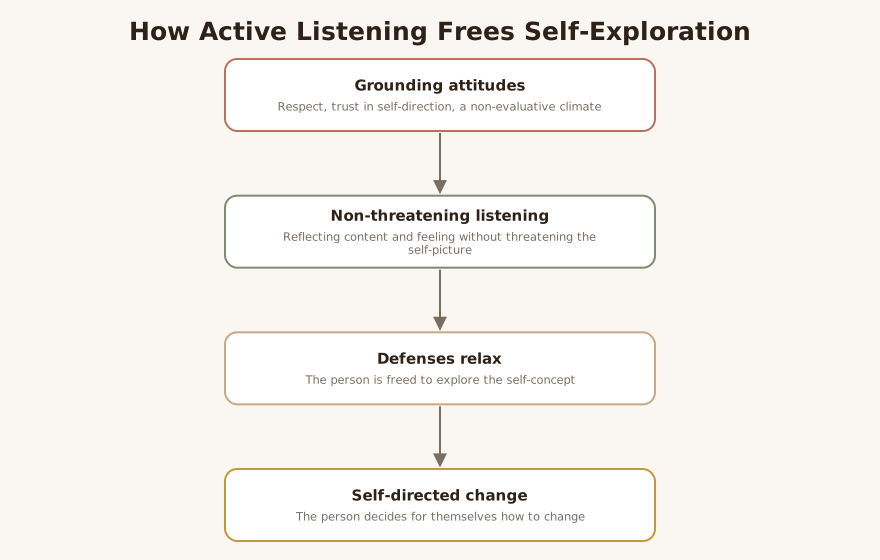
Rogers and Farson are explicit that technique is downstream of attitude: active listening “must be firmly grounded in the basic attitudes of the user,” and cannot be used as a mere technique when the listener’s fundamental attitudes conflict with its concepts — if attempted, “our behavior will be empty and sterile.” 2 The required stance is a genuine respect for the potential worth of the individual, trust in the person’s capacity for self-direction, and a climate that is “neither critical, evaluative, nor moralizing” — an atmosphere of equality, permissiveness, acceptance, and warmth. 2
The underlying rationale is a theory of the self-concept. People defend a self-picture against experiences that do not fit it; direct attempts to change someone are threatening and provoke defensiveness, whereas listening that does not threaten the self-picture frees the person to explore it, see it for what it is, and decide for themselves how to change. 2 In MI terms, this maps onto the “spirit” of partnership, acceptance, compassion, and evocation (PACE), where acceptance includes prizing the client’s worth, accurate empathy, autonomy support, and affirmation. 4
Three operational principles follow. First, listen for total meaning — every message carries both content and the feeling or attitude underlying it, and both must be understood. 2 Second, respond to feelings, which at times matter far more than content. 2 Third, note all cues — hesitations, vocal inflection, facial expression, posture, and breathing all convey the message. 2 A defining discipline is verification: assume you never really understand until you can communicate that understanding to the other’s satisfaction. 2
Interventions & Techniques
The concrete moves are well specified. Core techniques include paraphrasing (restating the message to confirm understanding), reflecting feelings (mirroring emotion back to the speaker), nonverbal attending (eye contact, leaning in, nodding, reading body language), and avoiding interruption. 6 Rogers and Farson add the verification habit: reflect in your own words what the speaker seems to mean, and let the speaker’s response tell you whether they feel understood. 2
MI’s OARS gives clinicians a usable checklist. 5 Open questions invite elaboration rather than yes/no answers and keep the client doing most of the talking. 5 Affirmations acknowledge a client’s strengths or efforts (“You took a big step in coming here today”), keeping focus on the client. 4 Reflective listening requires forming a mental hypothesis about the client’s meaning, then offering your best guess back — it is active interpretation and verification, not passivity. 4 Summaries distill multiple statements into a coherent narrative. 5
Reflections come in graded forms. Simple reflections repeat or rephrase the client’s words, signaling engagement; complex reflections reframe to surface deeper meaning or feeling and invite further exploration. 4 The OARS source enumerates additional variants used in MI: reflecting feeling (“You’re feeling ___ because ___”), reflecting behavior, amplified reflection, double-sided reflection (naming ambivalence and discrepancy), shifting focus, and reframing. 5 A consistent finding cited in MI training is that a higher ratio of reflections to questions predicts better outcomes. 4
LLM-generated illustrative example (not a guideline): A client says, “I guess I’ll go to the family dinner, it’s fine.” A simple reflection might be, “You’ve decided to go.” A complex reflection responding to feeling might be, “Part of you is dreading it, even though you’re going to show up anyway.” The therapist offers this tentatively and watches the client’s reaction to confirm or correct it LLM.
Evidence Base
Maturity is best labeled established as a foundational counseling skill rather than as an independently validated treatment package. LLM Rogers and Farson asserted, on the clinical and research evidence available to them, that “sensitive listening is a most effective agent for individual personality change and group development.” 2 Within MI, reflective listening is treated as the cornerstone skill, and the reflection-to-question ratio is described as predicting positive outcomes — situating it within a structured, evidence-supported method. 4
Honesty about the evidence requires noting that effectiveness has been contested. A 1984 couples-therapy study by Kurt Hahlweg questioned the technique’s effectiveness, although subsequent studies have contradicted those findings. 6 The broader caution is conceptual rather than statistical: Arnold documents that reflective listening is one of the most commonly misunderstood psychotherapeutic practices, often incorrectly taught as verbatim repetition of the client’s words, with its rationale rarely explicated in textbooks. 3 This matters for the evidence reading — studies that operationalize “reflection” as mechanical parroting are testing a caricature, not the practice Rogers described. LLM3 Treat active listening as a well-established common factor and process skill whose efficacy depends heavily on fidelity to its underlying attitudes. LLM
Populations & Indications
Active and reflective listening generalizes across populations because it targets the relational substrate rather than a specific disorder. LLM It is indicated in individual counseling, where therapists use it to grasp clients’ emotions and create a supportive environment for expression. 6 It is foundational in couples and family work, where reflecting each partner’s content and feeling reduces defensiveness and helps each person feel heard. LLM2 It is central to work with adolescents and caregivers, where rapport and felt understanding precede any behavior-change conversation. LLM It is explicitly applied in conflict resolution, where the technique facilitates open dialogue and helps parties feel heard, enabling more effective problem-solving. 6
Rogers and Farson’s own “ground rule” experiment — requiring each party in a heated discussion to restate the other’s prior position to that person’s satisfaction before stating their own — is a directly transferable intervention for couples, families, and people in conflict. 2
Problems-for-Work
- Relationship conflict. Each partner feels unheard and escalates. Structured reflective listening (restate before responding) lowers threat and shifts the emotional climate. 2
- Poor communication. Partners or family members talk past each other. Teaching paraphrasing and reflection of feeling builds a shared, verified understanding. 62
- Emotional disconnection. Responding to the feeling beneath the content (“Glad to have it over with, huh?”) restores contact where content-only responses miss the message. 2
- Misunderstanding / invalidation. The therapist’s habit of testing understandings against the client’s reaction directly counters invalidation. 2
- Low rapport. Reflective listening is described as the cornerstone skill that communicates respect and acceptance and establishes trust. 4
- Interpersonal difficulties. OARS provides a transferable skill set clients can practice between sessions to navigate difficult conversations. LLM5
LLM-generated illustrative example (not a guideline): A caregiver says, “I’m fine, I just don’t sleep much anymore.” Responding only to content (“How many hours?”) misses the message; reflecting feeling (“Sounds like you’re running on empty and not letting yourself admit it”) names what is underneath and invites the real conversation LLM.
Contraindications, Cautions & Cultural Humility
There are no hard contraindications to listening well, but there are meaningful cautions. LLM The chief failure mode is mechanical reflection: Arnold documents that reflective listening is frequently caricatured as parroting back the client’s words, which Rogers himself rejected. 3 Crucially, Rogers came to see that strict therapist self-restraint could itself foster insincerity, potentially violating one of his core conditions — therapist congruence — because the therapist’s inner experience (the “tain” behind the mirror) does not necessarily match the client’s. 3 The practical upshot: reflections must be congruent expressions of a genuinely empathic frame of mind, offered provisionally and open to correction, not a script. 3
Rogers and Farson also warn that active listening carries personal risk — to truly see the world as the speaker sees it is to risk being changed oneself, which requires inner security and courage. 2 A pretense of interest “always shows through” and the speaker quickly stops expressing freely. 2
On cultural humility, the OARS source is explicit that both verbal and nonverbal techniques must be adapted to be culturally sensitive and appropriate. 5 Norms around eye contact, silence, emotional disclosure, and directness vary across cultures, so the specific behaviors that signal “I am listening” are not universal and should be calibrated to the client. LLM5
Treatment-Plan Suggestions & SMART Objectives
| Goal | SMART objective (example) | Mechanism |
|---|---|---|
| Strengthen therapeutic alliance | Therapist uses at least one reflection of feeling per topic shift across 4 consecutive sessions, with client confirming accuracy | Reflective listening communicates respect and acceptance, building trust 4 |
| Reduce client invalidation/defensiveness | Within 6 weeks, client reports feeling “understood” (>=4/5 on a session-rating item) in 3 of 4 sessions | Non-threatening climate lets the client explore the self-picture without defending it 2 |
| Improve couple communication | By session 8, each partner can restate the other’s position to that partner’s satisfaction before responding, in-session, twice per session | Rogers/Farson “ground rule” shifts emotional climate and reduces argumentativeness 2 |
| Increase client change talk | Therapist maintains a reflections-to-questions ratio >=2:1 by week 6 (supervisor-coded) | Higher reflection ratio predicts better MI outcomes 4 |
| Build client’s self-reflection | Client practices paraphrasing a partner/caregiver once between each of 5 sessions and logs the exchange | Hearing one’s words reflected back deepens self-understanding 5 |
| Repair emotional disconnection | Within 4 sessions, therapist responds to the feeling (not only content) and client names the named emotion as accurate 75% of the time | Responding to feeling captures the “total meaning” of the message 2 |
| Reduce conflict escalation | Client uses one de-escalating reflection (“So you’re feeling ___ because ___”) in 2 real-world conflicts over 3 weeks | Listening lowers threat and is met with reciprocal listening 25 |
Common Misconceptions
- “It’s just repeating the client’s words.” This is the most common error; Arnold notes reflective listening is frequently and incorrectly taught as verbatim repetition, a caricature Rogers explicitly disowned. 3 Merely parroting words proves only that one heard them, not that one understood. 2
- “Listening is passive.” Rogers and Farson directly rebut this: listening is an active agent of change and a “growth experience” that constructively alters the listener too. 2
- “Positive evaluation is safe.” They warn that positive evaluations can block as much as negative ones, because praising someone can make it harder for them to disclose faults that distress them. 2
- “Advice and reassurance help.” Advice and information are usually perceived as efforts to change the person and tend to serve as barriers; “I’m sure everything will work out” is not helpful to someone deeply discouraged. 2
- “Technique is enough.” Without the underlying attitudes of respect and empathy, the behavior becomes “empty and sterile,” and reflections offered without a congruent empathic frame are likely to be ineffective. 23
Training & Certification
There is no certification in “active listening” itself; it is taught as a competency within broader trainings. LLM Rogers and Farson stress that it “is not an easy skill to acquire,” demands practice, and may require slow, difficult changes in the listener’s own basic attitudes. 2 Skill-building is well served by structured experiential exercises such as their restate-before-responding ground rule, done in dyads or groups, with attention to shifts in emotional climate. 2
The most formalized training pathway is Motivational Interviewing, where OARS is taught as a defined skill set with self-assessment checklists and coded fidelity (e.g., reflection-to-question ratios). 54 Clinicians seeking structured development can pursue MI training and supervision (e.g., MI Network of Trainers practice) and use supervisor coding of session recordings to track reflection quality and ratio over time. LLM4
Key Terms
- Active listening — feedback-based communication technique attending to verbal content and nonverbal cues, distinguished from passive hearing. 6
- Reflective listening — forming and offering a tentative hypothesis about the client’s meaning and verifying it against their response. 43
- Total meaning — the combination of a message’s content plus the feeling/attitude underlying it. 2
- Simple vs. complex reflection — repeating/rephrasing vs. reframing to surface deeper meaning or feeling. 4
- Double-sided reflection — reflecting the client’s words while naming ambivalence and pointing out discrepancy. 5
- OARS — Open questions, Affirmations, Reflective listening, Summaries; MI’s core skill model. 5
- Congruence (the “tain”) — the therapist’s genuine inner experience, which must align with reflective behavior to avoid insincerity. 3
- MI spirit (PACE) — Partnership, Acceptance, Compassion, Evocation. 4
Resources & Further Reading
▶ Watch — a video introduction to this concept:
- Rogers, C. R., & Farson, R. E. (1957). Active Listening (Google Books)
- Rogers & Farson (1957), “Active Listening” — full-text PDF
- Arnold, K. (2014). Behind the Mirror: Reflective Listening and Its Tain in the Work of Carl Rogers (PDF)
- SAMHSA TIP 35, Chapter 3 — Motivational Interviewing as a Counseling Style (NCBI Bookshelf)
- The OARS Model: Essential Communication Skills (NIDA / Center for Health Training PDF)
- Active listening — EBSCO Research Starters
Reflective / Supervision Questions
- When you reflect, are you offering a tentative hypothesis open to correction, or asserting a conclusion? How does the client’s response confirm which one it was? 3
- Recall a recent session: did you respond to content when the feeling was the real message? What cue (inflection, posture, hesitation) did you miss or catch? 2
- What is your typical reflections-to-questions ratio, and what would it take to raise it? 4
- Where do your reflections risk becoming mechanical, and is your inner experience (your “tain”) congruent with the empathy you are expressing? 3
- How do your nonverbal listening behaviors land with clients from cultural backgrounds different from your own, and how have you adapted them? 5
- Are you ever using “encouragement” or reassurance in a way that subtly steers the client toward where you want them to go? 2