
Joint attention is one of the quietest yet most consequential milestones in human development. When a nine-month-old looks at a dog, then turns to check that you are looking too, then looks back at the dog, that small triangulation of attention between infant, caregiver, and object is the behavioral signature of a mind discovering that experience can be shared 5. This article orients practicing clinicians to joint attention as a developmental construct: what it is, where it comes from, how it is measured, what it predicts, and how it informs assessment and intervention with the children and families on your caseload.
Type & Discipline
Joint attention is a developmental construct rather than a treatment modality or a discrete technique LLM. It belongs primarily to developmental psychology and the study of infant-caregiver development, sitting at the intersection of social cognition, communication, and attention 1. The phenomenon is sometimes called “shared attention,” and at its core it describes two individuals coordinating their focus on the same object or event through eye-gazing, pointing, or other verbal and non-verbal indications 6. Critically, joint attention is not merely two people happening to look at the same thing at the same time; it requires that the partners are mutually aware they are attending together 5. That element of shared awareness is what distinguishes joint attention from simple co-orientation and what makes it a building block of social cognition rather than a coincidence of gaze LLM.
For clinicians, the relevant point is that joint attention functions as a developmental hinge: it is downstream of basic attentional and social capacities and upstream of language, symbolic play, and later social understanding 4. Because it is a construct rather than an intervention, it shows up in clinical work as a target of assessment and a mechanism that other interventions try to recruit, rather than as a therapy you “deliver” LLM.
Creators & Lineage
The modern study of joint attention traces to Scaife and Bruner, who in 1975 were among the first to describe systematically children’s ability to follow another person’s eye gaze 6. Jerome Bruner’s broader work situated joint attention within the social-pragmatic scaffolding of early language, framing shared attention as the interactional context in which words acquire reference LLM.
Two figures dominate the contemporary literature. Michael Tomasello advanced the argument that around the first birthday infants come to understand others as intentional agents, and that joint attention reflects this shift toward shared intentionality 6. His comparative work, including studies of gaze-following in chimpanzees, helped delineate what is distinctively human about the way infants share attention to communicate and to learn 6. Peter Mundy developed both an influential neurodevelopmental model of joint attention and the standardized measure most widely used to assess it, the Early Social Communication Scales 1. Mundy and Crowson extended this model explicitly to autism, arguing that joint attention disturbance is central to the disorder and carries direct implications for early intervention research 2.
The lineage, then, runs from descriptive observation of gaze-following in the 1970s, through theory-of-mind and shared-intentionality accounts in the 1990s and 2000s, to a neurodevelopmental and measurement-driven framework that now anchors much of the autism early-detection and early-intervention literature 12.
Core Principles
Several principles organize how clinicians should think about joint attention.
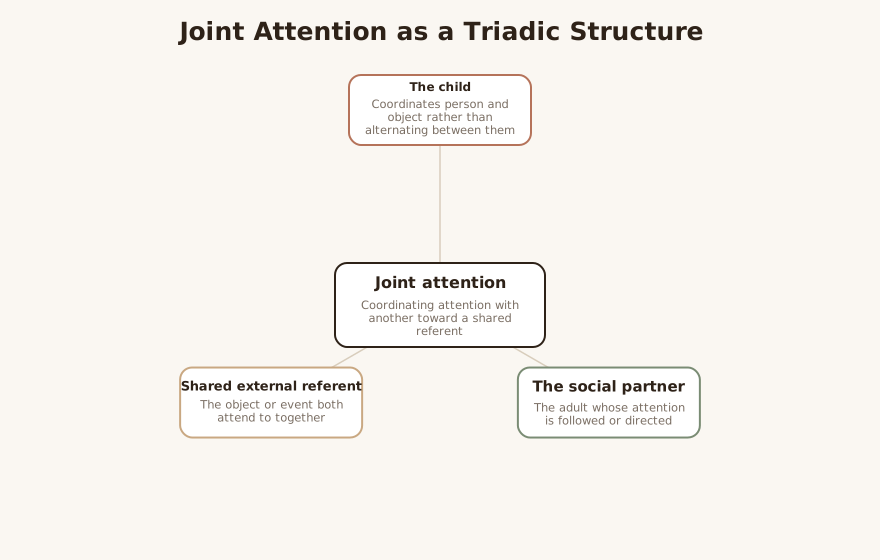
First, joint attention is triadic, not dyadic. Early infant social exchange is dyadic—face-to-face turn-taking of looks, sounds, and mouth movements observable as early as two months 6. Joint attention adds a third element, an external referent, integrating two previously separate streams of behavior: social interaction with a partner and object-directed action 5. The infant must coordinate person and object, not merely alternate between them 5.
Second, the field distinguishes two functionally and (per Mundy’s model) neurally distinct forms. Responding to joint attention (RJA) is the child following an adult’s gaze or pointing gesture to orient toward a referenced object or event 3. Initiating joint attention (IJA) is the child voluntarily directing an adult’s attention to an object or event—by pointing, showing, or alternating gaze—often to share interest rather than to obtain something 3. Mundy’s neurodevelopmental account links these to partially dissociable attention systems, with anterior (frontal) systems supporting the volitional, self-initiated attention shifts of IJA and posterior systems supporting more reflexive orienting relevant to RJA 1.
Third, joint attention reflects individual differences, not a single switch that flips on. The Early Social Communication Scales were designed precisely to capture meaningful variation among infants in the timing and trajectory of these emerging abilities 1. Clinically, this means joint attention is dimensional: children present along a continuum of frequency, flexibility, and initiative LLM.
Fourth, joint attention is self-organizing and developmental. Mundy and Crowson framed it as part of a developing system in which early social-attention behaviors recursively shape later social and communicative competence 2. The capacity does not appear fully formed; it assembles over the first eighteen months as prerequisite skills come online 6.
Interventions & Techniques
Joint attention is itself a target, and the literature describes a developmental sequence of behaviors clinicians can both observe and elicit. Gaze-following, in which the infant follows an adult’s outward-directed gaze, is observable around six months 6. Proto-declarative pointing—pointing to share interest rather than to request—emerges around eight to nine months as triadic joint attention begins 6. Showing and giving objects to a partner, alternating gaze between object and adult, and following a point are the everyday behaviors clinicians watch for 5.
The most important applied finding is that joint attention is teachable. Research demonstrates that preschool children with autism can learn joint attention and symbolic play skills, and that these gains carry forward to later functioning 4. Caregiver language is a natural facilitator: simple, well-timed prompts such as asking “What’s that you have?” support the integration of social and object attention 5. In practice, intervention typically embeds joint-attention targets within naturalistic, play-based caregiver-mediated routines rather than treating them as isolated drills LLM.
LLM-generated illustrative example (not a guideline): A speech-language pathologist coaches a parent to sit on the floor facing their 20-month-old, hold a wind-up toy at eye level, activate it, pause, and wait. When the toy stops, the child looks up at the parent’s face—an initiating-joint-attention bid—and the parent immediately responds with animated shared delight and a word (“Wow, it stopped!”). Over sessions, the clinician tracks the rate of spontaneous gaze-alternation as the index of progress LLM.
Because joint attention is a mechanism, clinicians more often recruit it inside an established intervention—naturalistic developmental behavioral approaches, caregiver coaching, early language facilitation—than deliver it as a standalone protocol LLM.
Evidence Base
The maturity of joint attention as a construct is best described as established. Decades of observational research converge on a reliable developmental timetable and on the construct’s robust association with language and social outcomes 16.
Two strands of evidence carry the most clinical weight. The first is predictive validity for language. Infants’ ability to engage in joint attention at twelve months predicts how quickly they will later learn words 5. Conversely, in children with autism, delays in developing joint attention skills lead to delays in developing language 4.
The second is predictive validity for autism risk. A longitudinal study of 32 infants assessed at 8, 12, and 18 months found that responding-to-joint-attention impairments at 12 months significantly predicted autism risk markers on the M-CHAT at 18 months (p = 0.014), explaining 45.2% of the variance; initiating-joint-attention deficits at 8 months were close to statistical significance (p = 0.051) 3. In that study, joint attention variables were stronger predictors of risk than behavioral-request variables 3. The measurement backbone for much of this work, the Early Social Communication Scales, demonstrates solid psychometric properties supporting its use in research on both normative development and individual differences 1.
Honesty about limits matters. Predictive studies are often small—the 18-month study rested on 32 infants from a relatively homogeneous, higher-education sample—so effect sizes should be read as promising rather than definitive 3. Joint attention is theorized as a precursor to theory of mind, but the evidence suggests the two are distinct constructs rather than the same capacity at different ages 6. Clinicians should treat joint attention as a well-validated marker and mechanism, not as a deterministic test LLM.
Populations & Indications
The primary population is infants and toddlers in the roughly 6-to-18-month window, where joint attention normatively emerges and where its absence is most informative 5. The construct is most clinically salient for children with, or at elevated likelihood of, autism spectrum disorder, in whom difficulty alternating attention toward a partner is described as a core deficit 6.
Joint attention is also indicated as an assessment focus for children presenting with developmental language delay, given the strong predictive link from early joint attention to later vocabulary growth 5. Caregiver-infant dyads are themselves a unit of intervention, since the caregiver’s responsiveness is part of the developmental engine 5. Siblings of autistic children and other infants under developmental surveillance are reasonable candidates for joint-attention screening because the behaviors can be observed before spoken language would otherwise reveal a delay 3.
Problems-for-Work
In clinical formulation, joint attention maps onto several concrete problems-for-work.
- Delayed or absent expressive language. Weak twelve-month joint attention forecasts slower word learning, making it an early, actionable target before vocabulary delay is entrenched 5.
- Impaired social communication. Reduced initiating of joint attention signals difficulty sharing experience for its own sake, a hallmark of social-communicative disturbance 3.
- Reduced social reciprocity. Difficulty alternating attention between object and partner reflects compromised back-and-forth engagement 6.
- Difficulty with shared/triadic engagement. A child who can attend to people or to objects but not coordinate both is showing the specific triadic deficit joint attention names 5.
- Early autism risk markers. Impaired responding to joint attention at 12 months is a measurable contributor to elevated autism risk and a flag for further evaluation and early intervention 3.
LLM-generated illustrative example (not a guideline): An early-intervention team formulates a 14-month-old’s case. The child orients well to objects and tolerates face-to-face play but rarely points to show, follows a caregiver’s point inconsistently, and does not yet check back for the adult’s reaction. The team frames the problem-for-work as “reduced initiating of joint attention” and targets caregiver-mediated routines that create frequent, low-pressure opportunities to share interest LLM.
Contraindications, Cautions & Cultural Humility
Joint attention is a developmental marker, not a diagnosis, and it should never be used as a standalone test for autism LLM. The strongest predictive study explained under half the variance in risk markers and drew on a small, demographically narrow sample, so a single low score warrants further evaluation rather than a conclusion 3.
Cultural humility is essential because joint-attention behaviors are embedded in caregiving practices that vary across communities. Norms for eye contact, pointing, the directiveness of caregiver speech, and how much infants are addressed as conversational partners differ widely, and the scaffolding behaviors that facilitate joint attention—such as a caregiver asking “What’s that you have?”—are culturally shaped 5. Clinicians should interpret joint-attention observations against a child’s actual interactional ecology rather than a single normative template, and should be cautious about over-pathologizing behavior that may reflect caregiving style rather than capacity LLM. Developmental timing also varies normally across individuals, which is precisely why the field frames joint attention in terms of individual differences 1. A further caution: because joint attention recruits both gaze and gesture, sensory or motor differences (for example visual impairment) can depress observed scores without indicating a social-cognitive deficit, and assessment should account for this LLM.
Treatment-Plan Suggestions & SMART Objectives
| Goal | SMART objective (example) | Mechanism |
|---|---|---|
| Increase responding to joint attention | Within 12 weeks, child will follow a caregiver’s point/gaze to a target in 8 of 10 structured opportunities across 3 sessions | Strengthens orienting/RJA system that supports shared reference 13 |
| Increase initiating joint attention | Within 12 weeks, child will spontaneously point-to-show or gaze-alternate to share interest at least 5 times per 15-minute play sample | Recruits volitional, anterior-system attention shifts underlying IJA 1 |
| Build triadic engagement | Within 8 weeks, child will coordinate attention between an object and the caregiver (look-object-look-adult) in 60% of presented routines | Integrates social and object attention into shared episodes 5 |
| Support emerging language via shared reference | Over 16 weeks, child will produce or approximate a label within joint-attention episodes in 5 routines per session | Leverages joint attention’s predictive link to word learning 54 |
| Increase caregiver responsiveness to bids | Within 6 weeks, caregiver will respond contingently to ≥80% of the child’s attention bids during coached play, per session review | Caregiver scaffolding facilitates joint-attention development 5 |
| Generalize joint attention across partners/settings | Within 12 weeks, child will demonstrate gaze-alternation with 2 partners in 2 settings in 70% of opportunities | Promotes flexible, self-organizing social-communicative use 2 |
| Expand showing and giving | Within 10 weeks, child will show or give an object to share (not request) at least 4 times per session | Builds declarative, interest-sharing function of joint attention 56 |
Common Misconceptions
A frequent misconception is that joint attention is simply two people looking at the same object. It is not—simultaneous looking without mutual awareness of attending together does not qualify; the shared awareness is constitutive 5. A second misconception is that joint attention and theory of mind are the same thing or are interchangeable; while joint attention is theorized as a precursor, the evidence indicates they are distinct constructs 6. A third is that initiating and responding to joint attention are a single skill—but the field treats them as functionally and likely neurally distinct, which is why a child can show one and not the other 13. A fourth, and clinically important, misconception is that joint-attention deficits in autism are fixed; on the contrary, preschoolers with autism can learn these skills, with downstream benefits 4. Finally, joint attention is sometimes treated as a pass/fail milestone when it is better understood dimensionally, as an individual-differences variable 1.
Training & Certification
There is no certification in “joint attention” as such, because it is a construct rather than a credentialed modality LLM. The relevant competency for clinicians is twofold: reliable assessment and embedding joint-attention targets in evidence-based early intervention LLM. On the assessment side, the Early Social Communication Scales is the standard structured observational measure, administered in roughly 15-20 minute sessions in which an examiner presents toys and codes the child’s initiating and responding behaviors; competent use requires training to acceptable reliability, which the measure’s psychometric work supports 13. On the intervention side, joint-attention goals are typically pursued by professionals trained in early intervention, speech-language pathology, developmental-behavioral approaches, and caregiver coaching, who learn to elicit and reinforce shared-attention bids within play 4. Clinicians extending this work to autism should be familiar with the model linking joint attention to autism and its intervention implications 2.
Key Terms
- Joint attention (shared attention): coordinating attention with another person on a shared object or event, with mutual awareness of attending together 56.
- Responding to joint attention (RJA): following another’s gaze or point to a referenced object 3.
- Initiating joint attention (IJA): spontaneously directing another’s attention to share interest, via pointing, showing, or gaze-alternation 3.
- Triadic engagement: coordination of self, partner, and external referent (vs. dyadic, face-to-face exchange) 56.
- Proto-declarative pointing: pointing to share interest rather than to request, emerging around 8-9 months 6.
- Early Social Communication Scales (ESCS): the standard structured measure of infant joint attention and early social communication 1.
- Anterior/posterior attention systems: partially dissociable neural systems Mundy’s model links to IJA and RJA respectively 1.
Resources & Further Reading
▶ Watch — a video introduction to this concept:
- Individual Differences and the Development of Joint Attention in Infancy (Mundy et al., 2007) — full-text PDF
- Joint Attention and Early Social Communication: Implications for Research on Intervention with Autism (Mundy & Crowson)
- Joint Attention and Its Relationship with Autism Risk Markers at 18 Months (PMC)
- About Joint Attention — UNC ASAP
- Joint Attention — Before Their First Words (Universitat Pompeu Fabra)
- Joint Attention — Wikipedia
Reflective / Supervision Questions
- When you assess a young child, do you distinguish initiating from responding to joint attention, and does your formulation reflect that they may be dissociable? 13
- How do you guard against reading a low joint-attention observation as diagnostic rather than as one marker warranting further evaluation? 3
- In what ways might a family’s caregiving practices shape the joint-attention behaviors you observe, and how do you adjust your interpretation accordingly? 5
- Where in your intervention do you actively recruit joint attention as a mechanism—and could caregiver coaching create more frequent, lower-pressure opportunities to share attention? 45
- How do you communicate to caregivers that joint-attention skills are teachable, while remaining honest about the modest, probabilistic nature of the predictive evidence? 34