
Type & Discipline
Decolonial, or decolonizing, psychology is a critical framework and an ethical reorientation of the discipline, not a treatment modality or a manualized protocol 2. It begins from the claim that mainstream psychology was built largely within European and North American institutions and carries, often invisibly, the assumptions of the colonial project that funded and shaped modern science 3. Its aim is twofold: to critique — to expose how psychology’s theories, methods, and standards of “normality” universalize a particular Western, individualist worldview and pathologize departures from it — and to reconstruct — to recenter and reclaim Indigenous, non-Western, and otherwise marginalized knowledges as legitimate bases for understanding mind, distress, and healing 2. It belongs to the family of liberation and critical psychology, alongside community psychology and the broader decolonial theory that emerged from postcolonial and Latin American scholarship 6.
For the practicing clinician, decolonial psychology is best understood as a lens and a stance rather than something one “does” in a session LLM. It does not supply a new symptom-reduction technique; it changes how a clinician understands the origins of a client’s distress, which knowledge they treat as authoritative, and how they hold their own training as one tradition among many rather than as neutral truth LLM. Everything that follows translates a body of critical theory into questions and orientations a clinician can use, and that translation is clinical reasoning rather than a direct prescription from the source literature LLM.
Creators & Lineage
It is worth separating two timelines LLM. The older and broader tradition is decoloniality as a school of social and political thought, which analyzes “coloniality” — the enduring patterns of power, knowledge, and being that outlived formal colonial administration — and which is associated with Latin American and Caribbean scholars who developed concepts such as the coloniality of power 6. Within psychology specifically, the intellectual ancestry runs through Frantz Fanon, the Martinican psychiatrist whose analysis of the psychological wounds of colonization is foundational to thinking about race, internalization, and liberation, and through Ignacio Martín-Baró’s liberation psychology, which located mental suffering partly in social oppression and insisted that psychology take the side of the marginalized LLM. Critical psychology and community psychology supplied the further conviction that distress cannot be understood apart from social structure LLM.
Decolonial psychology as a named, organized project is much more recent, taking shape largely in the 2010s and 2020s 2. A foundational text is Decolonial Psychology: Toward Anticolonial Theories, Research, Training, and Practice by Lillian Comas-Díaz, Hector Y. Adames, and Nayeli Y. Chavez-Dueña, published by the American Psychological Association, which gathers the critique and proposes anticolonial directions for theory, research, training, and clinical work 1. The field is being actively constituted in real time: the American Psychological Association issued a call for papers toward a decolonial psychology, framing the work as recentering and reclaiming globally marginalized knowledges, and the British Psychological Society has published on “decolonising psychological science” as a set of encounters and cartographies of resistance 23. That a flagship journal is soliciting this scholarship is itself a sign that the project is emerging rather than settled 2.
Core Principles
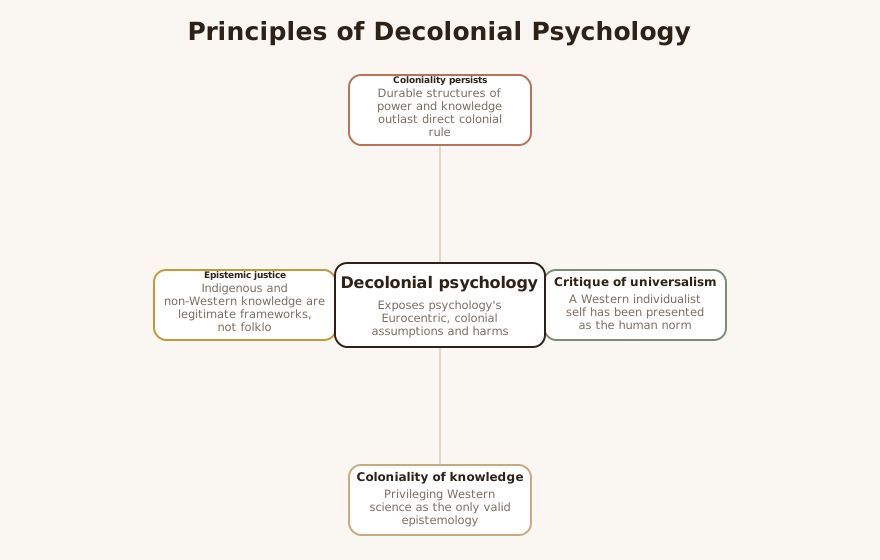
The first principle is that coloniality persists 6. Decolonial thought distinguishes colonialism — the historical period of direct domination — from coloniality, the durable structures of power, knowledge, and identity that continue to organize the world long after independence 6. Applied to psychology, this means the discipline’s categories and hierarchies may still reproduce colonial logics even where no one intends harm 3.
The second principle is the critique of Eurocentric universalism: mainstream psychology has often presented a culturally specific, Western, individualist account of the person as if it were the human norm, and has treated other ways of knowing the self — relational, communal, spiritual, land-based — as primitive, deficient, or merely “cultural” exceptions to the rule 2. Decolonial psychology names this as the coloniality of knowledge, the privileging of Western science as the only valid epistemology 3. A closely related principle is epistemic justice: the insistence that Indigenous and non-Western knowledge systems are not folklore to be studied but legitimate frameworks for understanding mind and healing in their own right 2.
The third principle is that coloniality is not only historical but a present cause of harm, expressed as internalized oppression, the loss of cultural identity, and the intergenerational transmission of collective wounds 4. The fourth is reconstruction over mere critique: the goal is not only to deconstruct psychology’s colonial assumptions but to build anticolonial theory, research, and practice that recenter marginalized knowledges and serve liberation 1. The fifth is reflexivity — the demand that psychologists examine their own positionality, training, and complicity, treating the discipline as an object of analysis rather than a neutral instrument 3.
Interventions & Techniques
Decolonial psychology supplies no proprietary techniques, so what follows is the clinical application of the framework, and these are the author’s synthesis rather than directives from the source literature LLM. The most basic application is at the level of stance and formulation: extending the case conceptualization to ask how colonial history, displacement, racism, and cultural disruption are shaping the presenting problem, and treating those forces as legitimate clinical material rather than background 4. This pairs with epistemic humility — holding the clinician’s own theoretical model as one tradition among several, and inviting the client’s cultural, spiritual, and communal frameworks for distress and healing into the room as authoritative rather than decorative 2.
A second application is naming coloniality: helping a client distinguish wounds that originate in oppressive history and structure from defects they have come to attribute to themselves, which directly counters internalized oppression 4. A third is cultural reclamation — supporting reconnection to language, ancestral practices, ceremony, community, and identity that colonization disrupted, where the client wishes it, as a source of meaning and resilience 2. A fourth, drawn from the liberation lineage, is collective and community orientation: linking the individual to community resources, peer connection, and, where the client chooses it, collective action, on the understanding that healing from collective wounds is rarely a solitary task LLM. A fifth is methodological and relational decolonizing — flattening the expert-over-patient hierarchy, co-constructing goals, and where appropriate collaborating with traditional and community healers rather than positioning the clinician as the sole authority 3.
LLM-generated illustrative example (not a guideline): A clinician sees an Indigenous client presenting with depression, shame, and a sense of being “caught between two worlds.” A decolonial-informed clinician does not treat the cultural disconnection as peripheral to the mood symptoms; they name the historical disruption of language and ceremony honestly, treat the client’s wish to reconnect with community practice as a legitimate part of the plan, and — alongside evidence-based treatment of the depressive symptoms — work in a way that holds the client’s own framework for healing as authoritative rather than secondary LLM.
Evidence Base
The honest characterization is that decolonial psychology is an emerging framework whose literature is overwhelmingly theoretical, critical, and programmatic rather than built on outcome trials 2. Its most prominent products are a recent foundational text, critical essays, and journal special issues and calls for papers, not a body of randomized controlled trials 12. The British Psychological Society’s treatment of the subject is framed as “encounters and cartographies of resistance” — a description of an intellectual and political movement, not a report of clinical efficacy data 3. The American Psychological Association’s piece is, quite literally, a call for papers, which signals that the scholarly field is still being assembled 2.
This is not a manualized treatment, and it would be a category error to present it to a client as an evidence-based therapy with a demonstrated effect size LLM. What the framework does have is a coherent and well-argued critique, increasing institutional uptake at major psychological associations, and a serious normative case that mainstream psychology’s claims to universality are themselves empirically and historically questionable 3. Where it draws empirical credibility, it does so indirectly, by alignment with adjacent and better-evidenced areas — historical and intergenerational trauma, racial trauma and minority stress, and the cultural adaptation of established treatments 4. Those allied literatures lend plausibility to decolonial psychology’s clinical orientation, but they are not the same thing as outcome evidence for “decolonial psychology” as a defined intervention, and the framework’s distinctive aims — epistemic justice, cultural reclamation, structural change — are not well captured by conventional symptom-reduction metrics by design LLM. The candid clinical stance is to use it as a credible, ethically compelling lens that improves formulation and cultural responsiveness, while not overclaiming it as a validated method LLM.
Populations & Indications
The framework is most salient for populations whose distress is entangled with colonization, displacement, racism, and cultural disruption 4. Indigenous peoples are a paradigmatic population, given the direct legacy of colonization on land, language, family systems, and ceremony, and the well-documented burden of historical and intergenerational trauma 4. Colonized and formerly colonized populations more broadly, including diasporic communities, are a core indication for the same reasons 6. Racial and ethnic minorities facing racism and structural exclusion are central, because the framework’s move of relocating part of the cause of suffering from the self to oppressive conditions directly addresses their reality 2.
Refugees and migrants are particularly relevant, since their mental health is shaped by displacement, loss of homeland and language, and acculturative pressure, all of which the lens treats as legitimate clinical concerns rather than peripheral context 4. Communities affected by historical trauma — where the wounds of past collective violence are transmitted across generations — are a natural fit for a framework that takes collective and intergenerational harm seriously 4. More broadly, the lens is indicated whenever a clinician notices that a client’s distress tracks cultural disruption, internalized inferiority, or a clash between their own worldview and the assumptions embedded in standard treatment LLM.
Problems-for-Work
In internalized oppression, the work is helping a client recognize that beliefs in their own or their group’s inferiority were absorbed from a colonial environment rather than discovered as truths, and loosening their grip through naming coloniality and reclaiming a positive cultural identity 4. In historical and intergenerational trauma, the framework offers a language for wounds that are collective and inherited, locating them in the documented disruptions of colonization rather than in individual pathology, and pointing toward community and cultural practice as part of repair 4. In cultural identity loss and acculturative stress, the lens supports reconnection to language, practices, and community as a source of coherence and resilience, treating the loss itself as a clinical problem worth direct attention 2.
LLM-generated illustrative example (not a guideline): A second-generation immigrant client describes chronic anxiety and a sense of “never being enough,” tracing it to years of being told, implicitly, that their family’s traditions and language were backward. A decolonial-informed clinician helps the client see how that message was absorbed from a broader hierarchy of cultures rather than being an accurate verdict on their worth, supports whatever reconnection to heritage the client wants, and treats the anxiety symptoms while reframing the self-criticism as internalized, changeable, and not the client’s fault LLM.
In racial trauma and race-based stress, naming the social and historical source of harm counters self-blame and isolation and situates a private wound within a shared, unjust pattern 4. In marginalization-related distress and disempowerment, the framework reframes hopelessness as an intelligible response to genuinely constraining conditions and works to rebuild agency and collective connection LLM. In collective trauma, it legitimizes group-level and community-based responses rather than treating recovery as a purely individual project LLM. Across these problems, the consistent therapeutic move is to honor the colonial and structural source of suffering while still mobilizing the client’s individual and communal agency LLM.
Contraindications, Cautions & Cultural Humility
Because decolonial psychology is a framework rather than a procedure, the cautions concern stance and misapplication rather than patient selection LLM. The gravest risk is the clinician imposing their own political or cultural analysis on a client, deciding for them what “decolonizing” should mean — which reproduces the very coloniality of knowledge the framework condemns, the expert depositing the correct consciousness into a passive recipient 3. Genuine practice requires that the client’s own meaning, including the possibility that they do not frame their distress in these terms at all, leads the work LLM. There is a related danger of romanticizing or essentializing culture — treating a heterogeneous group as if all its members share one authentic identity, or pressuring a client toward a “return to roots” they have not chosen LLM.
The framework is poorly suited as a stand-alone response to acute symptoms — active suicidality, psychosis, severe trauma reactions — which require their own evidence-based, often individual and stabilization-focused, intervention; the lens informs how that care is delivered, not whether it is delivered LLM. There is also the symmetric error of over-attributing all distress to coloniality in a way that neglects biological, relational, or intrapsychic contributors, just as the opposite error neglects history and structure entirely; the skill is calibration in each case LLM.
Cultural humility is intrinsic to the model rather than an add-on, since its core demand is reflexivity about one’s own positionality and the limits of one’s training 3. A clinician working across a cultural or power difference from their client must take particular care not to presume to know which knowledge or practice matters most to the client, and must be willing to collaborate with community and traditional resources rather than centering their own authority 2.
Treatment-Plan Suggestions & SMART Objectives
| Goal | SMART objective (example) | Mechanism |
|---|---|---|
| Reduce internalized inferiority | Over 6 sessions, client will identify three self-beliefs about their group or culture and trace each to an external, colonial or social source | Names coloniality and counters internalized oppression 4 |
| Reconnect with cultural identity | Over 8 weeks, client will engage in one self-chosen practice tied to language, community, or heritage and review its effect on mood and meaning | Cultural reclamation as a source of coherence and resilience 2 |
| Situate distress in historical context | Within 3 sessions, client will articulate how historical or intergenerational factors relate to a presenting problem they currently attribute solely to personal failing | Locates collective trauma in documented history rather than individual defect 4 |
| Reduce self-blame in race-based stress | Over 5 sessions, client will name the social source of a distressing experience and track change in self-blame and isolation ratings | Relocates harm to shared, unjust patterns 4 |
| Strengthen agency amid marginalization | Over 6 weeks, client will identify and complete one realistic, self-chosen action within their influence and rate its effect on their sense of efficacy | Rebuilds agency without denying real constraints LLM |
| Reduce isolation through community connection | Over 6 weeks, client will connect with one community, cultural, or peer resource relevant to their identity and situation | Links the individual to collective sources of healing LLM |
| Increase the clinician’s epistemic responsiveness | Within 2 sessions, clinician and client will co-construct a shared formulation that incorporates the client’s own cultural framework for distress and healing | Epistemic humility and decolonizing the clinical relationship 3 |
Common Misconceptions
A frequent error is to hear “decolonizing psychology” as a demand to discard all of Western psychology; the project is reconstructive as much as critical, aiming to recenter marginalized knowledges and correct false universalism, not to forbid established treatment 2. A second misconception is that it is purely about historical grievance with no present relevance; its central claim is that coloniality persists in current structures of knowledge and power and produces ongoing harm such as internalized oppression and identity loss 6. A third is that it is a discrete, manualized therapy with its own outcome evidence; it is an emerging framework and stance whose literature is largely theoretical and whose clinical elements are delivered within established modalities LLM.
A fourth is that it amounts to imposing a fixed political identity on clients; in fact its method is reflexive and dialogical, and imposing the clinician’s “correct” analysis reproduces the coloniality of knowledge it critiques 3. A fifth is the conflation of “culturally adapting an existing treatment” with “decolonizing”; cultural adaptation tailors a Western protocol to a group, whereas decolonial psychology questions the protocol’s underlying assumptions and treats other knowledge systems as authoritative in their own right, a deeper and more epistemological move 2. A sixth, clinically important, is treating it as carrying the same kind of trial-based evidence as a disorder-specific protocol; the framework is ethically compelling and institutionally rising but its direct outcome evidence is still emerging LLM.
Training & Certification
There is no certification or credential in decolonial psychology, because it is a body of critical theory and an ethical orientation rather than a proprietary modality LLM. Clinicians typically encounter it through coursework in multicultural, liberation, and community psychology, through critical and decolonial theory, and through the primary literature, of which the Comas-Díaz, Adames, and Chavez-Dueña volume is a foundational reference 1. Professional bodies are beginning to formalize engagement with it: the American Psychological Association’s global-insights work and call for papers, and the British Psychological Society’s publications on decolonising psychological science, signal that institutional training resources are growing even as the field is still being constituted 235.
Practitioners who want to apply its elements formally generally do so within an adjacent, structured approach — narrative therapy, culturally responsive and trauma-informed care, community-based participatory work — and use the decolonial framework as the underlying rationale and stance LLM. No new scope of practice is created by adopting the lens; competence in the host modality the clinician is already credentialed in remains the relevant qualification, and the substantive work is the harder, ongoing task of reflexivity, cultural humility, and genuine engagement with knowledge systems outside one’s own training 3.
Key Terms
Decolonial / decolonizing psychology — a critical framework that exposes psychology’s Eurocentric, colonial assumptions and works to recenter Indigenous and non-Western knowledge in theory, training, and practice 2. Coloniality — the enduring patterns of power, knowledge, and being that persist after the formal end of colonialism, distinct from colonialism as a historical period 6. Coloniality of knowledge — the privileging of Western science as the only valid way of knowing, which marginalizes other epistemologies 3. Epistemic justice — the recognition of Indigenous and non-Western knowledge systems as legitimate frameworks for understanding mind and healing rather than as folklore 2. Eurocentric universalism — the presentation of a culturally specific, Western account of the person as if it were the universal human norm 2. Internalized oppression — the absorption by members of an oppressed group of the dominant culture’s negative image of them, experienced as personal inferiority 4. Cultural reclamation — the reconnection to language, practices, community, and identity disrupted by colonization, used as a source of meaning and resilience 2. Reflexivity / positionality — the clinician’s critical examination of their own social location, training, and complicity in coloniality 3.
Resources & Further Reading
▶ Watch — a video introduction to this concept:
- Comas-Díaz, Adames & Chavez-Dueña — Decolonial Psychology: Toward Anticolonial Theories, Research, Training, and Practice (APA)
- Towards a decolonial psychology: Recentering and reclaiming global marginalized knowledges — American Psychologist call for papers (APA)
- Decolonising psychological science: encounters and cartographies of resistance — The Psychologist (BPS)
- Decoloniality as a social issue for psychological study — Journal of Social Issues (2022)
- Toward a decolonial psychology — APA Global Insights
- Decoloniality — Wikipedia
Reflective / Supervision Questions
- When I bring a structural or historical analysis into the room, how do I confirm it is emerging from the client’s own meaning rather than being imposed by me LLM?
- Where in my caseload might I be over-attributing distress to coloniality and missing a biological, relational, or intrapsychic contributor — or doing the reverse LLM?
- Which assumptions in the model I was trained in do I treat as neutral truth, and how would I notice if they were a culturally specific tradition rather than a universal one LLM?
- When a client’s framework for distress and healing differs from mine, do I hold theirs as authoritative, or quietly as a lesser version of my own LLM?
- How do I support cultural reclamation without romanticizing or essentializing a client’s heritage, or pressuring a “return” they have not chosen LLM?
- When my social position or power differs from my client’s, how do I guard against deciding for them what “decolonizing” should mean LLM?
- What would tell me this lens is not serving a particular client, and what would I turn to instead LLM?