
Type & Discipline
Critical Theory (capital-C, in the Frankfurt School sense) is a tradition within philosophy and the social sciences rather than a school of psychotherapy 1. It aims at “a critique and transformation of society by integrating normative perspectives with empirically informed analysis,” distinguishing itself from descriptive social science by an explicit emancipatory intent 1. The label “Frankfurt School” names the loose group of researchers associated with the Institute for Social Research in Frankfurt am Main who applied a revised Marxism to an interdisciplinary social theory 3. For practicing clinicians it belongs to the family of critical social theory, alongside its later psychological descendants such as liberation and community psychology LLM. It is essential to be clear at the outset: this is a lens and an ethical stance you bring to clinical work, not a manualized treatment you deliver LLM.
Creators & Lineage
The Institute for Social Research was founded in 1923 at Goethe University in Frankfurt, made possible by a donation from Felix Weil, with Carl Grünberg as its first director 2. The intellectual program most clinicians associate with the term began when Max Horkheimer (1895-1973) assumed the directorship around 1930 and redirected the Institute toward an interdisciplinary blend of philosophy, social theory, psychology, and cultural analysis 1. The first generation included Horkheimer, Theodor W. Adorno (1903-1969), Herbert Marcuse (1898-1979), Walter Benjamin, Friedrich Pollock, Leo Lowenthal, and Erich Fromm 2. After the 1933 Nazi takeover the Institute relocated, first to Geneva and then to Columbia University in New York in 1935, returning to Frankfurt in 1946 with Horkheimer’s inaugural address delivered in 1951 2. Jürgen Habermas (b. 1929) led the second generation beginning in the 1970s, and third-generation scholars such as Axel Honneth carried the tradition forward 2.
This original lineage is philosophical, not clinical LLM. The bridge into mental health practice was built later and largely outside Frankfurt: by community psychologists such as Julian Rappaport, who centered empowerment; by Isaac Prilleltensky, who reframed psychology around wellbeing, oppression, and social justice; and by liberation psychologists drawing on Latin American philosophy, including Enrique Dussel’s ethics of liberation LLM. Clinicians encountering “critical theory” in a therapy context are usually meeting these descendants, who translated the Frankfurt School’s structural critique into a stance on how psychology can either reproduce or contest injustice LLM.
Core Principles
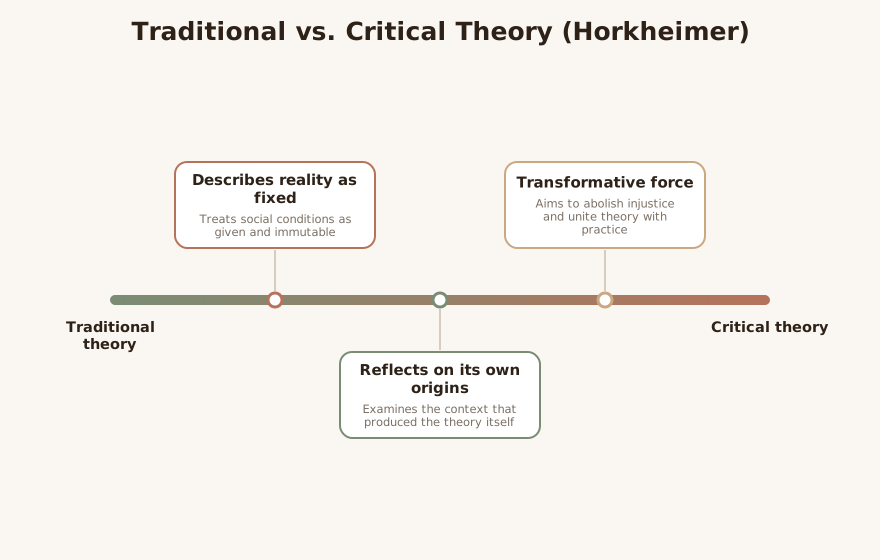
Several Frankfurt School commitments matter for clinical thinking LLM. First is the distinction Horkheimer drew in his 1937 essay “Traditional and Critical Theory”: traditional theory describes social reality as fixed and given, whereas critical theory “reflects on the context of its own origins and aims to be a transformative force,” pursuing the abolition of social injustice and the union of theory and practice 1. Translated clinically, this warns against treating a client’s social conditions as an immutable backdrop and invites attention to whether our formulations naturalize what is actually historical and changeable LLM.
Second is the revision of Marxism: the school maintained Marx’s critique of capitalism and commitment to emancipation while integrating Freud, Weber, and Nietzsche, drawing on psychoanalysis, sociology, and existential philosophy 23. This early marriage of psychoanalysis and social critique is the historical taproot of the idea that intrapsychic suffering and social domination are entangled LLM.
Third is the critique of instrumental reason and the “culture industry.” In Dialectic of Enlightenment (1947), Horkheimer and Adorno argued that mass culture is manufactured through standardized, profit-oriented methods rather than arising spontaneously, with entertainment displacing critical thought 1. Marcuse’s One-Dimensional Man (1964) extended this into a theory of ideological domination in which a comfortable society narrows the capacity to imagine alternatives 2. Clinically, this gives language for how clients internalize cultural messages about worth, productivity, and normalcy that are not neutral facts but artifacts of a particular social order LLM.
Fourth is Habermas’s turn to communication: his Theory of Communicative Action (1981) grounded critique in everyday communicative practice and warned of the “colonization of the lifeworld” by market and bureaucratic rationality 1. And running through the whole tradition is immanent critique, which draws its normative standards from the implicit ideals already embedded in existing social practices rather than imposing them from outside 1.
Interventions & Techniques
Critical theory does not prescribe techniques; its clinical value is in how it shapes assessment, formulation, and relational stance LLM. In practice, clinicians informed by this lens tend to do several things LLM.
They conduct structural formulation: explicitly mapping how systemic factors such as racism, poverty, immigration status, gendered expectations, and ableism contribute to presenting distress, alongside intrapsychic and interpersonal factors LLM. They practice consciousness-raising in a clinically titrated way, helping clients name and externalize oppressive conditions so that self-blame can be distinguished from socially produced harm LLM. They attend to power in the room, naming the clinician’s institutional authority and cultural location rather than presenting the therapeutic relationship as power-neutral LLM. They favor empowerment and praxis, supporting clients to move from insight toward agency and, where the client chooses, collective or community action LLM. And they pursue reflexivity, examining how the clinician’s own assumptions and the diagnostic frameworks they use may carry the very norms under critique LLM.
LLM-generated illustrative example (not a guideline): A client presenting with chronic guilt over “not being productive enough” while working two precarious jobs might, within this lens, be helped to see the productivity standard as a cultural demand rather than a personal failing, reducing shame and freeing energy for problem-solving. This reframing would still be delivered through a recognized modality such as cognitive or narrative therapy LLM.
Evidence Base
Honesty about maturity is important here LLM. Critical Theory is “established” in the sense that it is a mature, influential intellectual tradition with a century of scholarship behind it, not in the sense of being an empirically validated treatment LLM. It has no randomized controlled trial base because it is not a therapy and was never designed as one; the Frankfurt School produced philosophy and social analysis, and was itself criticized for lacking concrete strategies for transformation 2. The applied evidence that does exist sits with its clinical descendants, such as community psychology’s empowerment interventions and liberation-psychology approaches, and that literature is considerably thinner and more heterogeneous than the trial bases for, say, CBT LLM. Clinicians should therefore present critical theory to clients, supervisors, and payers as a case-conceptualization framework that informs evidence-based modalities, not as an outcomes-validated intervention in its own right LLM.
Populations & Indications
A critical-theory lens is most clinically useful where distress is meaningfully bound up with social position LLM. This includes marginalized and oppressed communities and cultural and ethnic minorities, for whom discrimination and structural exclusion are direct contributors to symptom burden LLM. It is relevant for clients affected by systemic inequity, including working-class populations facing economic precarity that the culture industry’s productivity norms can intensify 1LLM. It resonates for activists and community organizers, whose distress often centers on powerlessness against unjust systems and the toll of sustained engagement LLM. Finally, it speaks directly to clinicians and trainees, offering a reflexive frame for examining how the mental health field itself can reproduce the norms it treats LLM.
Problems-for-Work
The lens maps onto a recognizable cluster of clinical problems LLM.
- Internalized oppression and discrimination distress: helping a client separate socially imposed messages about their worth from their actual self, reducing shame and self-blame LLM.
- Alienation: naming the disconnection from meaningful work and community that Marcuse’s analysis of one-dimensional society anticipates, and supporting reconnection 2LLM.
- Systemic and institutional harm: validating that some distress originates in real institutional injury rather than distorted cognition, which protects the therapeutic alliance LLM.
- Powerlessness and disempowerment: moving from analysis of constraints toward identifying domains of realistic agency LLM.
- Identity and meaning crises: using consciousness-raising to reframe a “broken self” narrative as a response to contradictory social demands LLM.
- Social injustice-related distress and demoralization: restoring a sense of efficacy and, where chosen, channeling distress into collective action LLM.
Contraindications, Cautions & Cultural Humility
The most important caution is matching pace to the client’s readiness LLM. Introducing structural critique before a client is ready, or imposing it on a client who does not share the clinician’s political frame, risks invalidating the client’s own meaning-making and ruptures the alliance LLM. The clinician’s authority makes this a real ethical hazard: the same power the lens teaches us to name can be misused to recruit clients into the therapist’s worldview LLM.
A second caution is the risk of “structural bypass,” in which everything is externalized to systems and the client’s own agency, choices, and treatable symptoms are neglected; acute risk, trauma, and biological contributors still require direct clinical attention LLM. Critical theory complements rather than replaces symptom-focused and safety-focused care LLM.
Cultural humility is intrinsic to the lens but also turns back on it: the original tradition is a product of mid-twentieth-century European thought, and Habermas’s notion of idealized rational discourse can undervalue communicative norms and ways of knowing outside that frame 1LLM. The clinician should hold the client as the authority on their own social experience and treat the theory as a set of questions, not conclusions LLM.
Treatment-Plan Suggestions & SMART Objectives
| Goal | SMART objective (example) | Mechanism |
|---|---|---|
| Reduce internalized oppression and shame | Over 8 sessions, client will identify and verbally challenge at least 3 internalized oppressive messages, rated weekly on a 0-10 shame scale | Externalization separates socially imposed messages from self-worth LLM |
| Restore sense of agency from powerlessness | Within 6 weeks, client will name 2 domains where they hold realistic influence and take 1 concrete action in each | Empowerment converts structural analysis into experienced efficacy LLM |
| Distinguish structural from personal causes of distress | By session 4, client will articulate a structural-plus-personal formulation of their primary concern in their own words | Immanent critique reframes “broken self” as a response to social contradiction 1 |
| Address alienation and reconnection | Over 10 weeks, client will re-engage 1 meaningful relationship or community activity, tracked weekly | Counters the disconnection theorized in one-dimensional society 2 |
| Build reflective capacity for discrimination distress | Within 5 sessions, client will keep a log distinguishing externally caused harm from self-critical interpretation, reviewed each session | Consciousness-raising protects against misattributing systemic harm to the self LLM |
| Channel social-injustice distress into sustainable action | Over 12 weeks, client will set 1 boundary that makes their activism sustainable and report burnout on a 0-10 scale biweekly | Praxis links meaning and agency while limiting demoralization LLM |
| Strengthen clinician reflexivity (for trainee clients/supervisees) | Each session, supervisee will name 1 assumption their formulation imported from a dominant cultural norm | Reflexivity reduces unexamined reproduction of oppressive norms LLM |
Common Misconceptions
A first misconception is that critical theory is a therapy or technique you can be “trained in” as a discrete intervention; it is a philosophical and social tradition that informs how you think, not a protocol you administer 1LLM. A second is that it is simply “being political in session”; the tradition’s emphasis on immanent critique and reflexivity actually demands restraint about imposing the clinician’s own commitments 1LLM. A third is that “established” implies an outcomes base; here it means established as an intellectual tradition, while the empirical work belongs to descendant fields and remains comparatively thin 2LLM. A fourth is that it ignores individual psychology; in fact the Frankfurt School integrated psychoanalysis from the start, holding the psychic and the social together 23.
Training & Certification
There is no certification in Critical Theory as a clinical credential, and clinicians should be wary of anything marketed as such LLM. The relevant preparation is graduate and continuing education in critical, community, and liberation psychology, multicultural and social-justice competencies, and primary or secondary reading of the tradition itself LLM. Foundational philosophical literacy can be built from authoritative overviews such as the Stanford and Internet encyclopedias of philosophy and Britannica before moving to primary texts like Horkheimer and Adorno’s Dialectic of Enlightenment or Habermas’s later work 123. Applied skill develops through supervision focused on structural formulation and reflexivity, not through a stamped credential LLM.
Key Terms
- Critical theory: social theory aimed at critique and transformation of society, uniting normative aims with empirical analysis and embracing emancipatory intent 1.
- Traditional theory: theory that describes social reality as fixed; the foil Horkheimer set against critical theory in 1937 1.
- Culture industry: Horkheimer and Adorno’s term for mass culture manufactured by standardized, profit-driven means that displaces critical thought 1.
- Instrumental reason: reason reduced to efficient means-ends calculation, critiqued as a vehicle of domination 1.
- One-dimensional society: Marcuse’s account of how an apparently comfortable order narrows the capacity to imagine alternatives 2.
- Communicative action / colonization of the lifeworld: Habermas’s framework grounding critique in everyday communication and warning of its erosion by market and bureaucratic rationality 1.
- Immanent critique: evaluating a society by the ideals already implicit within it rather than by externally imposed standards 1.
- Emancipation: the tradition’s organizing aim, the freeing of human beings from avoidable domination 1.
Resources & Further Reading
▶ Watch — a video introduction to this concept:
- Critical Theory — Stanford Encyclopedia of Philosophy
- Frankfurt School and Critical Theory — Internet Encyclopedia of Philosophy
- Frankfurt School — Encyclopaedia Britannica
Reflective / Supervision Questions
- Where in my current caseload have I formulated as “individual pathology” something that is partly a response to social conditions, and how would the picture change if I named the structural contributors? LLM
- How do I hold the line between offering a structural reframe and imposing my own political worldview on a client who has not invited it? LLM
- When a client externalizes all distress to “the system,” how do I honor the truth in that while still protecting their sense of agency and addressing treatable symptoms and risk? LLM
- What norms about productivity, normalcy, and worth does the diagnostic framework I use carry, and how might those affect this particular client? LLM
- How does my own institutional authority and cultural location shape what feels sayable in the room, and how can I make that power more visible and accountable? LLM