
Type & Discipline
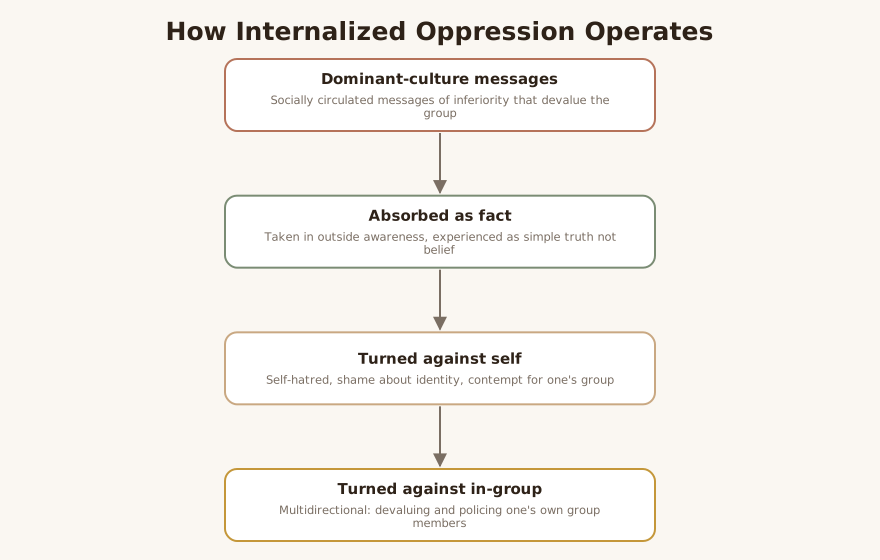
Internalized oppression is a psychological construct from social and clinical psychology, not a treatment, technique, or therapeutic modality 4. It names the process by which members of marginalized or stigmatized groups absorb the dominant culture’s negative beliefs about their own group and turn those beliefs against themselves and one another 5. Where oppression is the external, structural subordination of a group, internalized oppression is its psychological residue — the moment the demeaning messages of the surrounding society are taken in and experienced as self-evident truths about the self 4. For the practicing clinician it functions as an explanatory lens and a case-formulation tool rather than something one “does” in session: a way of understanding why a client may hold themselves, and people like them, in contempt for qualities the dominant culture has stigmatized LLM.
Because it is a construct rather than a protocol, internalized oppression prescribes no particular intervention, and its clinical value is interpretive and orienting 2. It equips the clinician to recognize when a client’s self-criticism, shame, or self-stigma is not idiosyncratic pathology but the internalized voice of a marginalizing environment LLM. Everything that follows translates a descriptive social-psychological construct into stances and questions a clinician can use, and that translation is the author’s clinical reasoning rather than a direct claim of the source literature LLM.
Creators & Lineage
The conceptual roots of internalized oppression lie in mid-twentieth-century anticolonial and liberation thought 5. The Martinican psychiatrist and theorist Frantz Fanon, writing on the colonial situation, described how colonized people come to internalize the values and the contemptuous gaze of the colonizer, experiencing their own culture and bodies as inferior 5. The Brazilian educator Paulo Freire, in his account of the “oppressed,” argued that subjugated people may “host” the oppressor within themselves, adopting the oppressor’s image of them and coming to believe their condition is natural or deserved 5. These lineages established the core insight that oppression does not remain wholly external but is taken inside and reproduced from within 5.
In contemporary psychology the construct has been consolidated and extended most visibly through the work of the Filipino American psychologist E.J.R. David and colleagues, whose edited volume Internalized Oppression: The Psychology of Marginalized Groups treats the phenomenon as a cross-cutting process operating across many oppressed populations rather than a quirk of any single group 1. This scholarship situates internalized oppression as a transtheoretical construct that can be brought into clinical work, examining its relationship to psychopathology and to cognitive-behavioral approaches for historically oppressed groups 2. The construct is also increasingly studied in specific communities, including in qualitative work on how oppression and internalized oppression shape access to healthcare, and in research on the mental health of Deaf people 67.
For clinicians, the relevant lineage runs through liberation psychology, which locates psychological suffering partly in social oppression, and through multicultural counseling, feminist therapy, and the critical-race tradition, all of which share the conviction that distress in marginalized people cannot be understood apart from the structures that subordinate them LLM. Internalized oppression is the psychological hinge of that shared project — the mechanism by which a structural reality becomes a private wound LLM.
Core Principles
The defining claim is that the negative beliefs marginalized people may hold about themselves and their group are not generated from within but are absorbed from a dominant culture that devalues them 4. On this account, when a member of an oppressed group experiences self-hatred, shame about their identity, or contempt for others who share it, the content of those feelings originates in external, socially circulated messages of inferiority that have been taken in as if they were true 5. The construct thereby relocates part of the cause of the distress from a defect in the person to a marginalizing environment that the person did not create 2.
A second principle is that internalized oppression operates largely outside awareness: because the devaluing messages are pervasive, repeated from childhood, and embedded in ordinary institutions and media, they are often experienced not as beliefs one could question but as simple facts about the way things are 4. A third principle is that it is multidirectional: internalized oppression turns not only inward against the self but laterally against one’s own group — manifesting as devaluing in-group members, policing those who fail to assimilate, or preferring the dominant group’s standards of worth and beauty 5. A fourth principle is harm to mental health: the construct is theorized and increasingly studied as a contributor to lowered self-esteem, shame, depression, anxiety, and self-stigma, distinct from, though entangled with, the direct stress of experiencing discrimination 27. A fifth principle is that, because it is learned, it is in principle unlearnable — a stance that grounds the possibility of clinical and consciousness-raising work LLM.
Interventions & Techniques
Internalized oppression supplies no interventions of its own, so what follows is the clinical application of the construct, and these recommendations are the author’s synthesis rather than directives drawn from the source literature LLM. The most basic application is naming: helping a client recognize that the demeaning beliefs they hold about themselves or their group were absorbed from an oppressive environment rather than discovered as truths about who they are 2. This externalizing move — putting the belief outside the person and identifying its social source — is the conceptual core of clinical work with the construct, and it dovetails with the externalizing conversations of narrative therapy and with the cognitive work of identifying and re-examining maladaptive beliefs LLM.
A second application is cognitive-behavioral: the negative self-beliefs installed by internalized oppression can be treated as targets for cognitive restructuring, with the crucial adaptation that the clinician validates the social truth behind the belief rather than disputing it as a simple distortion 2. The point is not to argue a client out of an accurate perception that the world devalues them, but to separate the world’s verdict from their worth LLM. A third application, drawn from the empirical literature, uses acceptance- and mindfulness-based methods: a community-based acceptance and commitment therapy intervention has been developed specifically to interrupt internalized racial oppression, working to undermine fusion with self-stigmatizing thoughts and to support valued action despite them 3. A fourth application is consciousness-raising and connection to the collective — linking private self-rejection to a shared social pattern, often in group or community formats, so the work of resisting internalized devaluation is not borne alone LLM.
LLM-generated illustrative example (not a guideline): A client from a marginalized racial background describes feeling “less than” in professional settings and quietly disparages colleagues from their own community as “not trying hard enough.” Using internalized oppression as a lens, the clinician helps the client trace these reactions to a lifetime of absorbed messages about whose competence is presumed, validates that the bias the client perceives in the workplace is real, and works to separate that external verdict from the client’s sense of their own and their community’s worth — while treating the accompanying anxiety and shame LLM.
Evidence Base
The honest characterization is that internalized oppression is an established and well-developed construct, but one whose maturity is the maturity of a theory and a measurement literature rather than of a manualized treatment with a deep randomized-trial base 1. It has decades of conceptual lineage running back through Fanon and Freire, a consolidated contemporary scholarship that treats it as a cross-group psychological process, and an expanding empirical literature documenting its forms and correlates across marginalized populations 15. There is meaningful evidence linking internalized oppression to psychopathology and to poorer mental-health outcomes, and a developed argument for addressing it within cognitive-behavioral therapy for historically oppressed groups 2.
Honesty requires distinguishing the maturity of the construct from the evidence for treating it as a clinical target LLM. Much of the literature is theoretical, qualitative, or correlational — for example, qualitative findings on how oppression and internalized oppression emerge as a barrier to accessing healthcare, and studies of internalized oppression and mental health in specific communities such as Deaf people — rather than controlled trials of interventions 67. The most direct intervention evidence is still emerging: a community-based acceptance and commitment therapy program designed to interrupt internalized racial oppression represents the kind of focused, manualized work that the field has begun to test, but the body of efficacy trials remains thin 3. For the clinician the practical implication is to treat internalized oppression as a credible, well-grounded framework that prompts useful formulation and humane practice, while not overclaiming that “reducing internalized oppression” is an empirically supported treatment in the way a disorder-specific protocol is LLM.
Populations & Indications
The construct is most salient for populations whose members live under chronic social devaluation, which is where internalized oppression does its work 1. Racial and ethnic minorities are a paradigmatic population, and internalized racism — the absorption of a racial hierarchy that positions one’s own group as inferior — is among the most studied forms 23. LGBTQ+ individuals are a core population, where internalized homophobia and related forms of internalized stigma name the turning of societal heterosexism against the self 4. Women are a relevant group, insofar as internalized sexism can shape self-worth, ambition, and relationships to other women 5.
People with disabilities are an important population, including Deaf people, among whom internalized oppression has been examined as a factor in mental health 7. Immigrants and refugees are particularly relevant, since pressures to assimilate and to devalue one’s culture of origin are a recognized vehicle for internalized oppression, and religious minorities likewise contend with absorbed stigma about their identity and practices 45. More broadly, the construct is indicated whenever a clinician notices that a client’s self-criticism, shame, or contempt for their own group seems to echo the dominant culture’s devaluation of a stigmatized identity rather than to arise from the client’s own experience LLM.
Problems-for-Work
The construct speaks directly to low self-esteem and shame, helping the clinician understand a client’s sense of inferiority not as an isolated cognitive habit but as the internalized echo of social devaluation, and shaping a response that names and contests the absorbed message rather than treating self-worth as a purely individual repair 2. It addresses internalized racism and internalized homophobia specifically, locating the source of self- and in-group contempt in a hierarchy the client absorbed rather than chose, which counters the isolation and self-blame that compound these injuries 34. It bears on self-stigma, the process by which a person applies society’s negative stereotypes about their group to themselves, eroding confidence and willingness to seek care or opportunity 6.
LLM-generated illustrative example (not a guideline): A young gay client presents with depression and a pervasive conviction that their relationships are “doomed to be unstable.” The clinician, attending to internalized homophobia, helps the client notice how much of this belief is a script absorbed from a hostile environment rather than a verdict drawn from their own life, validates the genuine discrimination the client has faced, and works on both the depressive symptoms and the absorbed self-stigma — without implying the client invented the hostility LLM.
The construct is also a lens for depression, anxiety, and demoralization, reframing the corrosive sense of unworthiness or futility as an intelligible response to chronic devaluation rather than as a free-standing pathology to be argued away 2. It applies to identity confusion and to minority stress, situating the strain of holding a stigmatized identity within a shared and unjust pattern and helping the client integrate a coherent, valued sense of self rather than one organized around absorbed stigma 47. Across these problems the consistent therapeutic move is to honor the reality of the social source while mobilizing the client’s capacity to reclaim worth and agency LLM.
Contraindications, Cautions & Cultural Humility
Because internalized oppression is a construct rather than a procedure, the cautions concern stance and misapplication rather than patient selection LLM. The central caution is imposition: a clinician who names a client’s experience as “internalized oppression” before the client perceives it that way risks depositing their own analysis into a person who did not ask for it, and may pathologize an identity the client experiences as whole and chosen LLM. The construct should illuminate the client’s own emerging understanding, not overwrite it, and the clinician must be ready to be wrong about whether a given belief is absorbed oppression or an authentic value LLM.
A second caution is over-attribution: not all distress in a marginalized client is internalized oppression, and reflexively reading every self-critical thought as absorbed stigma can cause a clinician to miss biological, relational, or intrapsychic contributors that also need treatment LLM. A third caution concerns the clinician’s own position: a clinician who shares the client’s identity may over-identify, while a clinician from a dominant group may both miss the phenomenon and carry their own unexamined biases into the room, so the construct calls the clinician to examine their own internalized hierarchies as much as the client’s 4. A fourth caution is fatalism: framing a client’s self-rejection as the inevitable product of an overwhelming system can deepen the very hopelessness the work aims to lift, so structural honesty must be paired with attention to agency LLM.
Cultural humility is intrinsic rather than an add-on, because what counts as devaluation, assimilation, or a worthy self is itself shaped by culture and by the person’s own values 6. A clinician must let the client define which parts of their identity carry pride and which carry absorbed shame, rather than presuming to know, and must resist the assumption that a Western, individualist account of self-esteem is the universal endpoint of healing LLM.
Treatment-Plan Suggestions & SMART Objectives
| Goal | SMART objective (example) | Mechanism |
|---|---|---|
| Recognize absorbed messages as external in origin | Over 6 sessions, client will identify and record three self-beliefs about their group and trace each to a social or cultural source | Naming and externalizing internalized oppression 2 |
| Separate the world’s verdict from self-worth | Within 4 sessions, client will reframe two “I am inferior” statements into accurate, condition-specific terms that distinguish social devaluation from personal worth | Validating the social truth while loosening its grip on self-worth 2 |
| Reduce fusion with self-stigmatizing thoughts | Over 8 weeks, client will practice a defusion or acceptance skill when a self-stigmatizing thought arises and rate its hold on behavior weekly | Acceptance- and mindfulness-based interruption of internalized oppression 3 |
| Reduce in-group devaluation | Over 6 sessions, client will identify two instances of devaluing their own group and articulate the absorbed standard behind each | Surfacing the lateral, multidirectional form of the construct 5 |
| Counter self-stigma that blocks help-seeking | Within 4 weeks, client will identify one self-stigmatizing belief that has limited their access to care or opportunity and take one step despite it | Reducing self-stigma as a barrier to care 6 |
| Reduce isolation in shared adversity | Over 6 weeks, client will connect with one peer or community resource relevant to their identity and shared experience | Linking private self-rejection to a collective pattern 3 |
| Support an integrated, valued identity | Over the course of treatment, client will name one valued aspect of their identity and one action expressing it, reviewed biweekly | Rebuilding identity around worth rather than absorbed stigma 7 |
Common Misconceptions
A frequent error is to hear “internalized oppression” as a claim that the client is to blame for their own subordination; the construct says the opposite — that the demeaning beliefs were absorbed from an external, devaluing environment the client did not create, which relocates cause away from personal defect 4. A related misconception is that naming internalized oppression means disputing a client’s accurate perception of discrimination as a “cognitive distortion”; in clinically adapted use the social truth behind the belief is validated, and only its application to the client’s worth is contested 2. Another is that the phenomenon is rare or confined to a single group; the contemporary scholarship treats it as a cross-cutting process operating across many marginalized populations 1.
Some clinicians assume the construct is purely political and has no place in clinical formulation; in fact it has been theorized in relation to psychopathology and integrated into cognitive-behavioral approaches for historically oppressed groups, with concrete implications for self-esteem, shame, and self-stigma 2. A further misconception is that internalized oppression turns only inward against the self; it is multidirectional and frequently shows up as devaluing or policing one’s own group 5. Finally, the construct is sometimes treated as a fully validated treatment target; the theory and measurement are well developed, but the intervention-outcome literature is still emerging and should be described as such 3.
Training & Certification
There is no certification, credential, or licensing body in internalized oppression, because it is a construct and an area of scholarship rather than a proprietary modality LLM. Clinicians typically encounter it through coursework and reading in multicultural and social-justice counseling, liberation psychology, feminist therapy, and the critical-race tradition, and through the consolidating contemporary literature 1. The foundational clinical reading is the edited volume Internalized Oppression: The Psychology of Marginalized Groups, supplemented by the scholarship linking internalized oppression to psychopathology and cognitive-behavioral therapy and by community- and population-specific studies 127.
Practitioners who wish to work with the construct formally generally train in an adjacent, structured approach — cognitive-behavioral therapy, acceptance and commitment therapy, narrative therapy, or culturally responsive and trauma-informed care — and use internalized oppression as the underlying rationale and case-formulation lens within the modality they are already credentialed to deliver LLM. No new scope of practice is created by adopting the lens; the relevant competence is in the host modality, together with sustained reflection on the clinician’s own absorbed hierarchies and biases 4.
Key Terms
Internalized oppression — the process by which members of a marginalized group absorb the dominant culture’s negative beliefs about their group and turn them against themselves and one another 4. Internalized racism — the form in which a racial hierarchy positioning one’s own group as inferior is absorbed and applied to the self and in-group 2. Internalized homophobia — the absorption of societal heterosexism, turning anti-gay stigma inward against one’s own identity 4. Self-stigma — the application of society’s negative stereotypes about one’s group to oneself, eroding self-esteem and help-seeking 6. Lateral / horizontal hostility — the multidirectional turning of internalized oppression against members of one’s own group rather than only the self 5. The oppressor within — Freire’s image of the oppressed “hosting” the oppressor’s image of them, adopting it as their own 5. Liberation psychology — the tradition locating psychological suffering partly in social oppression, the conceptual home of clinical work with the construct LLM. Consciousness-raising — the process of bringing absorbed, taken-for-granted devaluation into awareness so it can be questioned and resisted LLM.
Resources & Further Reading
▶ Watch — a video introduction to this concept:
- Internalized Oppression: The Psychology of Marginalized Groups — E.J.R. David, ed. (Springer Publishing)
- Internalized oppression, psychopathology, and cognitive-behavioral therapy among historically oppressed groups (David & Derthick)
- Interrupting internalized racial oppression: A community-based ACT intervention (ScienceDirect)
- What Is Internalized Oppression, and So What? — Springer Publishing (Connect)
- Internalized oppression — Wikipedia
- Oppression and internalized oppression as an emerging theme in accessing healthcare — PubMed
- Internalized oppression and deaf people’s mental health — PubMed
Reflective / Supervision Questions
- When a client criticizes themselves or their own group, how do I tell the difference between an authentic value and an absorbed message of inferiority — and am I letting the client lead that distinction LLM?
- Where in my caseload might I be over-attributing distress to internalized oppression and missing a biological, relational, or intrapsychic contributor — or doing the reverse LLM?
- How do I validate the genuine discrimination a client perceives while still helping them separate the world’s verdict from their worth LLM?
- What are my own absorbed hierarchies and biases, and how might they shape what I notice, name, or miss in this client’s experience LLM?
- When my identity matches my client’s, how do I guard against over-identifying; when it differs, how do I guard against missing the phenomenon entirely LLM?
- How do I name the social source of a client’s self-rejection honestly without sliding into a fatalism that deepens their hopelessness LLM?