
Type & Discipline
Community psychology is a subfield of psychology that studies individuals in relation to their social contexts and works to promote well-being, prevention, and positive social change across multiple ecological levels rather than focusing solely on individual remediation 6. It is best understood as a value-driven framework and field of research and action rather than a single, manualized treatment, and it is represented professionally by the Society for Community Research and Action (SCRA), Division 27 of the American Psychological Association 3. The field emphasizes the relationship between social systems and individual wellness, attending to context, diversity, prevention, and empowerment as guiding orientations 6. For practicing clinicians, it sits alongside clinical psychology as a complementary lens: where clinical work often centers the individual, community psychology insists that the same distress also lives in settings, organizations, communities, and the broader society LLM. Its family of models is ecological and empowerment-based, drawing heavily on systems thinking LLM.
Creators & Lineage
Community psychology in the United States is conventionally dated to the 1965 Swampscott Conference in Massachusetts, where psychologists articulated a vision of practitioners working as agents of social change and prevention rather than only as treaters of established disorder 6. The field grew out of dissatisfaction with a purely individual, deficit-focused model of mental health and an interest in the social and environmental roots of distress 6. George Albee was a central early figure who argued that the prevalence of mental disorders could never be reduced through individual treatment alone and that prevention required reducing organic factors, stress, and exploitation while increasing coping skills, self-esteem, and social support LLM. Julian Rappaport gave the field one of its defining theoretical statements, proposing empowerment as an organizing value and contrasting it with a needs- or rights-based stance that can inadvertently keep people dependent 1. The intellectual lineage includes Urie Bronfenbrenner’s ecological systems theory, which supplies the nested-levels model the field uses to locate problems and interventions; prevention science; empowerment theory; and the broader tradition of social justice and liberation psychology 6. These influences converge on a single commitment: understanding and changing the fit between people and their environments LLM.
Core Principles
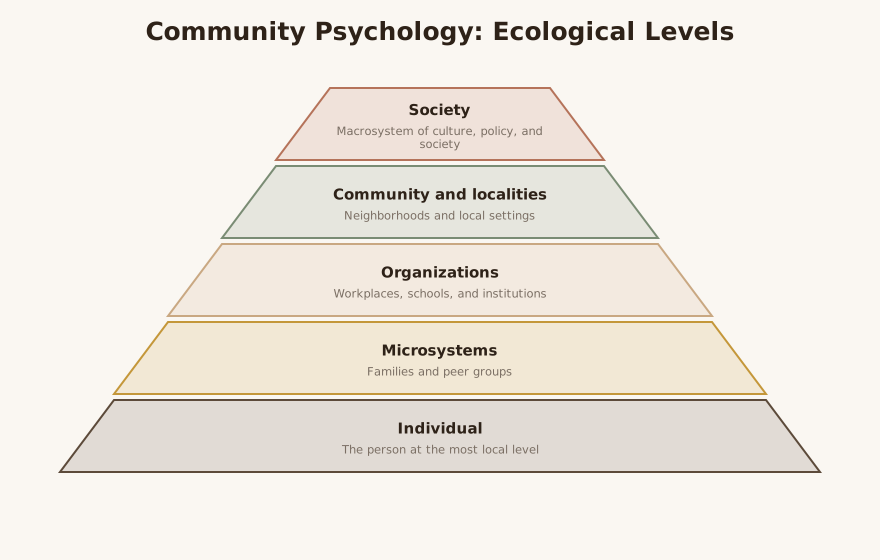
The first principle is the ecological, multi-level perspective. Community psychology analyzes phenomena across levels that run from the individual, through microsystems such as families and peer groups, to organizations, localities, and the macrosystem of culture, policy, and society 6. A presenting problem is rarely located at only one level, and effective change usually requires intervening at more than one 6.
The second principle is prevention rather than only treatment. The field distinguishes promoting wellness and reducing the incidence of new problems from treating problems already present, and it prioritizes upstream action on the conditions that generate distress 6. This reflects the recognition that no field has ever reduced the population burden of a disorder primarily by treating affected individuals one at a time LLM.
The third principle is empowerment. Rappaport defined empowerment as a process by which people, organizations, and communities gain mastery over their own affairs, and argued that genuine help should enhance, rather than diminish, the recipient’s sense of control 15. Empowerment is explicitly framed as operating at individual, organizational, and community levels, so that an empowered person is also embedded in empowering settings 5.
Additional core values include respect for human diversity, a sense of community and belonging, social justice and equitable distribution of resources, citizen participation and collaboration, and grounding action in empirical research 6. A distinctive stance is the collaborative, non-expert relationship: community psychologists position themselves as partners who share power with the people and settings they work with, rather than as detached authorities 6.
Interventions & Techniques
Because the field works across levels, its methods are broader than individual psychotherapy. Common approaches include prevention programs designed to reduce the incidence of problems before they arise, often delivered in schools, workplaces, or neighborhoods 6. Community psychologists also build and study settings: they help create or strengthen organizations, mutual-help groups, and natural support networks that function as empowering environments 5.
A second cluster of techniques is participatory and collaborative. Practitioners use approaches in which community members help define the problem, design the response, and interpret the results, consistent with the value of citizen participation 6. Empowerment-oriented practice deliberately structures programs so participants exercise real decision-making and develop competencies rather than receiving services passively 5.
A third cluster is advocacy and systems change aimed at policy, resource allocation, and the social determinants that shape mental health 6. Throughout, the field insists on rigorous evaluation, using research to test whether interventions actually improve outcomes and to avoid imposing unhelpful programs 6.
LLM-generated illustrative example (not a guideline): A clinician noticing that several immigrant clients miss appointments might, in addition to individual scheduling problem-solving, partner with a community organization to host group sessions in a familiar neighborhood setting with interpreters, shifting an individual “no-show” problem to a setting-level access problem LLM.
Evidence Base
Community psychology is an established discipline with a defined professional society, a body of theory, and dedicated peer-reviewed journals, and it has trained practitioners and researchers for decades 32. Its foundational concepts, empowerment and prevention, are well-developed theoretically and have been articulated and refined in the field’s literature since the 1980s 1.
It is important to be precise about what “established” means here. The maturity of the field as a discipline is not the same as uniform, strong efficacy evidence for any single intervention LLM. Community psychology is a value-and-methods framework under which many distinct programs are designed, so the quality of evidence is intervention-specific: some prevention and empowerment programs are well-evaluated and others are not 6. The field’s own emphasis on empirical evaluation reflects an internal expectation that programs should be tested rather than assumed effective 6. Clinicians should therefore treat community psychology as a robust orienting framework while evaluating any specific program on its own evidence LLM. Empowerment in particular was offered by Rappaport as a guiding value and theory rather than as a validated treatment protocol 1.
Populations & Indications
Community psychology is especially relevant to populations whose distress is closely tied to social context and inequitable conditions. These include marginalized and underserved communities, low-income populations, racial and ethnic minority groups, immigrants and refugees, at-risk youth, people living with serious mental illness, and survivors of community or collective violence LLM. The field’s attention to diversity, justice, and context makes it a natural fit where individual treatment alone cannot address the environmental drivers of a problem 6.
The framework is indicated whenever a clinician suspects that setting-level or structural factors, such as limited access to care, unsafe environments, discrimination, or lack of social support, are maintaining or amplifying a client’s symptoms LLM. It is also indicated for prevention work with populations at elevated risk, where the goal is to reduce incidence rather than treat existing cases 6. For people from collectivist or community-centered cultural backgrounds, the field’s emphasis on belonging and participation can align treatment with clients’ own values about healing LLM.
Problems-for-Work
Health disparities and barriers to care access. A community-psychology lens reframes missed care and untreated conditions as problems of fit between systems and people, prompting attention to where, how, and by whom services are delivered 6.
LLM-generated illustrative example (not a guideline): For a low-income client repeatedly unable to attend daytime appointments, the clinician treats transportation, work schedules, and clinic hours as part of the clinical formulation rather than as the client’s “resistance” LLM.
Disempowerment and learned helplessness. Empowerment theory directly targets the experience of having no control over one’s circumstances, aiming to restore mastery at the individual and collective level 15.
Social isolation. The field’s focus on sense of community and natural support networks supports interventions that connect isolated individuals to belonging-generating settings 6.
Stress related to social determinants and stigma. Locating chronic stressors and stigma in the macrosystem helps clinicians validate that some distress originates in conditions, not character, and can be partly addressed through advocacy and setting change 6.
Community and collective trauma, substance use disorder. For problems with strong community-level dimensions, multi-level and prevention-oriented thinking complements individual treatment by addressing the environments in which the problem is sustained 6.
Contraindications, Cautions & Cultural Humility
Community psychology is a framework rather than a standalone acute treatment, so it does not replace evidence-based individual care for diagnosable disorders, crisis intervention, or safety planning; a clinician should not substitute community-level work for indicated clinical treatment of acute risk LLM. The framework is a complement, not a competitor, to clinical psychotherapy 6.
A central caution comes from within the field itself. Rappaport warned that well-intentioned helping can be disempowering when it casts people as passive recipients of expert solutions, reinforcing dependency under the guise of meeting needs 1. Clinicians adopting this lens must therefore guard against imposing their own definition of a community’s problems or solutions 1.
Cultural humility is intrinsic to the field’s value of respecting human diversity and is operationalized through collaboration that shares power with the people served rather than positioning the professional as the sole expert 6. In practice this means soliciting community members’ own framing, recognizing the limits of one’s perspective, and treating cultural context as central rather than peripheral 6. Empowerment work specifically requires letting participants exercise real decision-making authority, which can be uncomfortable for clinicians accustomed to directing treatment 5.
Treatment-Plan Suggestions & SMART Objectives
| Goal | SMART objective (example) | Mechanism |
|---|---|---|
| Increase sense of mastery (empowerment) | Within 8 weeks, client will identify and act on at least 2 areas of life over which they can exercise meaningful control, tracked weekly | Empowerment as a process of gaining mastery over one’s affairs 15 |
| Reduce social isolation | Within 6 weeks, client will participate in at least 1 community or peer setting twice monthly | Building sense of community and natural support networks 6 |
| Improve access to care | Within 30 days, client and clinician will resolve at least 2 identified logistical barriers (e.g., scheduling, transport) | Treating access as a setting-level, not individual, problem 6 |
| Address social-determinant stressors | Over 12 weeks, client will connect with at least 1 resource targeting a structural stressor (housing, benefits, legal aid) | Macrosystem-level intervention on conditions 6 |
| Reduce internalized stigma | Within 8 weeks, client will articulate a context-based (vs. character-based) understanding of their distress in session | Reframing distress as person-in-context 6 |
| Increase participation/agency | Over 10 weeks, client will take a defined decision-making role in a group, program, or family decision | Citizen participation and shared power 6 |
| Strengthen prevention/coping | Within 6 weeks, client will adopt 2 coping or protective practices to reduce risk before crisis | Prevention orientation, reducing incidence 6 |
Common Misconceptions
“Community psychology is just clinical psychology done in groups or neighborhoods.” It is a distinct field with its own values, the multi-level ecological perspective, prevention, empowerment, justice, that reframes problems as person-in-context rather than relocating individual therapy to a new venue 6.
“Empowerment means simply giving people resources or services.” Rappaport specifically distinguished empowerment from a needs- or rights-based provision of services, arguing that empowerment is about enhancing control and mastery, which provision alone can actually undermine 1.
“It’s primarily an activist movement, not a research field.” The field is explicitly grounded in empirical research and evaluation, and is represented by an APA division and peer-reviewed scholarship 36.
“Prevention and treatment are the same activity.” The field draws a clear distinction between reducing the incidence of new problems and treating problems already present, with prevention operating upstream of clinical care 6.
Training & Certification
Community psychology is not a license-granting credential in the way clinical licensure is; it is a field of graduate study, research, and practice LLM. Professional identity and continuing engagement are anchored in the Society for Community Research and Action (SCRA), APA Division 27, which serves community psychologists and allied researchers and practitioners 23. Clinicians can develop competence through graduate coursework in community psychology, involvement with SCRA, and the field’s literature and journals 3. A freely available, open-access foundational text, Introduction to Community Psychology, edited by Jason, Glantsman, O’Brien, and Ramian, offers a structured entry point into the field’s concepts, including dedicated treatment of empowerment 45. For practicing therapists, the realistic path is integration: adding the ecological-empowerment lens to existing licensed practice rather than pursuing a separate certification LLM.
Key Terms
- Ecological levels — The nested contexts (individual, microsystem, organization, community, macrosystem) across which problems and interventions are analyzed 6.
- Empowerment — A process by which people, organizations, and communities gain mastery and control over their own affairs 15.
- Prevention — Action to reduce the incidence of new problems or promote wellness, distinguished from treating existing problems 6.
- Sense of community — The experience of belonging, mattering, and mutual support within a setting or group 6.
- Citizen participation / collaboration — Sharing power so community members help define problems and shape solutions 6.
- Social justice — Equitable distribution of resources and opportunity as a core value of the field 6.
- Second-order change — Change in the system or setting itself, not only in the individual within it LLM.
Resources & Further Reading
▶ Watch — a video introduction to this concept:
- Rappaport, J. (1987). Terms of empowerment/exemplars of prevention: Toward a theory for community psychology. American Journal of Community Psychology.
- Society for Community Research and Action (SCRA), APA Division 27 — official site
- APA — Society for Community Research and Action: Division of Community Psychology (Division 27)
- Jason, Glantsman, O’Brien & Ramian (Eds.) — Introduction to Community Psychology (open access)
- Introduction to Community Psychology — Empowerment chapter
- Introduction to Community Psychology — Introduction to the Field chapter
Reflective / Supervision Questions
- For a current client, at which ecological levels, individual, microsystem, organization, community, society, does the presenting problem actually live, and at which level am I currently intervening? 6
- Where in my caseload might I be inadvertently disempowering clients by positioning myself as the expert who provides solutions rather than building their mastery? 1
- Which of my clients’ difficulties are best understood as problems of fit between people and settings, including barriers to accessing my own services? 6
- How am I sharing power and inviting clients’ own framing of their problems, and where does my cultural perspective limit what I can see? 6
- For populations I serve, what prevention-oriented or setting-level action could reduce the incidence of the problems I keep treating one client at a time? 6
- When I claim an intervention “works,” am I relying on evaluated evidence or on the appeal of the framework itself? 6