
Type & Discipline
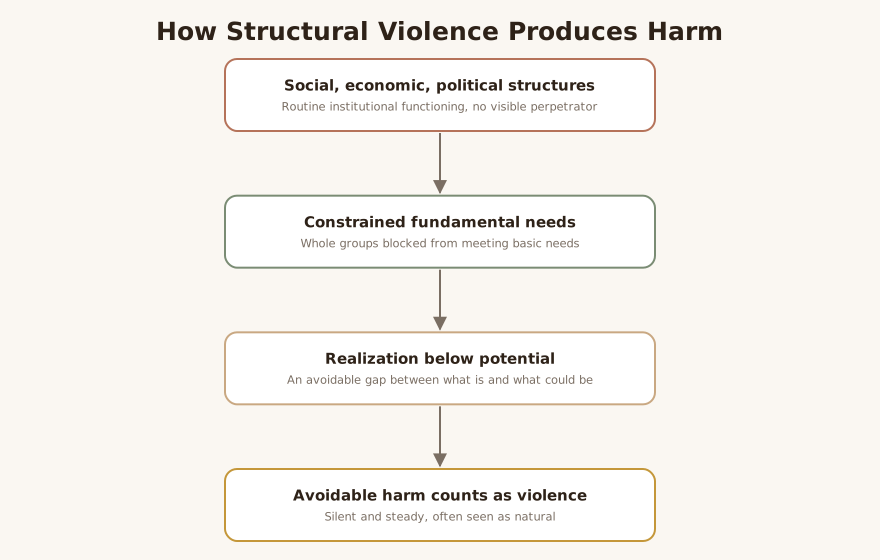
Structural violence is a theoretical concept from peace studies and medical anthropology, not a treatment, technique, or clinical modality 1. It names the harm built into social, economic, and political structures — arrangements that constrain whole groups of people from meeting fundamental human needs and from realizing their potential, even when no identifiable individual is striking the blow 4. The term was coined to describe a form of violence that has no discrete perpetrator and no single moment of impact, but that nonetheless deprives, sickens, and kills, often slowly and invisibly, through the ordinary workings of institutions 1. For a practicing therapist, structural violence is best understood as an analytic and ethical lens rather than something one “does” in session; it sharpens awareness of how a client’s suffering may be produced or worsened by forces outside the consulting room — poverty, racism, immigration policy, the geography of who gets care LLM.
Because it is a critical-theoretical construct rather than a protocol, structural violence makes no prescription about how to treat anyone, and its clinical value is interpretive and orienting 6. It equips the clinician to hold a client’s environment as a legitimate object of clinical attention, to notice when distress is a reasonable response to unjust conditions rather than a defect in the person, and to weigh what individual therapy can and cannot reach LLM. Everything that follows translates a descriptive social theory into questions and stances a clinician can use, and that translation is the author’s clinical reasoning rather than a direct claim from the source literature LLM.
Creators & Lineage
The concept was introduced by the Norwegian sociologist and peace researcher Johan Galtung in his 1969 paper “Violence, Peace, and Peace Research,” which argued that violence should be defined not only as direct physical harm but as any avoidable gap between what people could be and what they actually are 1. Galtung’s move was to broaden the definition of violence so that “peace” could mean more than the mere absence of war 1. Where one person harms another, he called it direct or personal violence; where harm is built into the structure itself and shows up as unequal power and unequal life chances, he called it structural or indirect violence, violence with no clear actor 1. He later added a third vertex, cultural violence — the beliefs, ideologies, and narratives that make direct and structural violence look natural or right — completing what is often taught as the “triangle of violence” 4.
The concept’s second great elaborator is the American physician and medical anthropologist Paul Farmer, who carried it from peace studies into clinical medicine and global health 2. Drawing on decades of work in Haiti, Rwanda, and elsewhere, Farmer argued that the large-scale forces of racism, gender inequality, poverty, political violence, and war determine who falls ill and who receives care, and that these forces become written into the body itself 2. His and Philippe Bourgois’s anthropological development of the idea pressed clinicians and social scientists to attend to the experience of the people who bear the brunt of these arrangements, not merely to map them from above 3.
The lineage relevant to clinicians runs through and beyond these two figures LLM. Structural violence is a member of the broader family of critical and political theory, kin to the social-determinants-of-health framework that names the conditions in which people are born, grow, work, and age as the primary drivers of health 6. It is closely tied to structural competency, an explicit attempt to train health professionals to recognize and respond to the structural causes of illness, and it shares ancestry and aims with liberation psychology, which locates psychological suffering partly in social oppression LLM. The concept has also been imported into nursing science and other care disciplines, where it has been formally analyzed to clarify its defining attributes and its bedside implications 6.
Core Principles
The defining claim is that violence need not have a visible perpetrator to be real: harm produced by social structure counts as violence, because it represents an avoidable impairment of fundamental human needs 1. Galtung’s foundational formulation is that violence is present whenever human beings are influenced so that their actual realization falls below their potential realization, when that gap is avoidable 1. If a person dies of a treatable disease that the wealthy survive, or lives in chronic deprivation that the surrounding society has the means to prevent, the difference between what is and what could have been is, on this account, violence — even though no one pulled a trigger 1.
A second principle is invisibility and stability LLM. Direct violence is an event with a beginning and an end and an identifiable actor; structural violence is a steady state, built into the routine functioning of institutions, and precisely because it is normal and continuous it tends to go unseen 4. Galtung’s striking contrast is that personal violence shows, while structural violence is silent and “may be seen as about as natural as the air around us,” which is part of what makes it so durable 1. A third principle is avoidability: structural violence refers specifically to constraints that are not inevitable, that a society has the resources to remove, which is what distinguishes a tragedy from an injustice 6.
A fourth principle, central to Farmer’s contribution, is embodiment — the idea that social inequalities do not stay social but become biological, shaping who is exposed to pathogens, who is diagnosed, who is treated, and who recovers 2. On this view, disparities in disease and death are, in Farmer’s framing, the biological reflections of social fault lines, and illness is a biosocial phenomenon rather than a purely molecular one 2. A fifth principle concerns scale and agency: structural violence constrains individual agency, so that what looks like a “choice” — to skip a medication, to miss an appointment, to stay in a dangerous situation — is often the product of conditions that have foreclosed the alternatives 3.
Interventions & Techniques
Structural violence supplies no interventions of its own, so what follows is the clinical application of the lens, and these recommendations are the author’s synthesis rather than directives from the source literature LLM. The most basic application is structural formulation: extending the case conceptualization beyond the intrapsychic and interpersonal to ask which economic, political, and social arrangements are shaping the presenting problem, and naming them explicitly as contributors rather than as background noise LLM. This pairs with structural validation — communicating to the client that their distress is an intelligible response to genuinely constraining or unjust conditions, which counters the self-blame that structural violence tends to install 3.
A second application is de-individualizing the problem where that is accurate: helping a client distinguish what belongs to them from what belongs to their circumstances, so that, for example, the exhaustion of working three jobs is not mistaken for a personal failing of motivation LLM. A third is concrete structural intervention within the clinician’s reach — case management, warm handoffs, addressing transportation, food, documentation, and access barriers — because, as the clinical literature on health disparities shows, removing such barriers can erase outcome gaps that look biological but are structural 2. A fourth is connecting the individual to the collective: linking clients to community resources, peer groups, and, where the client chooses, advocacy, so that the response to a shared condition is not borne in isolation LLM. A fifth, drawn from Farmer’s stance that clinicians are positioned to act as advocates for the poor, is the use of the clinician’s professional voice in letters, documentation, and systems-level advocacy on the client’s behalf 2.
LLM-generated illustrative example (not a guideline): A client referred for “treatment-resistant depression and non-adherence” turns out to be a low-wage shift worker who cannot afford the prescribed medication, cannot reach the clinic during its hours, and lives in housing insecurity. Using a structural-violence lens, the clinician reframes the “non-adherence” as a predictable result of structural barriers, validates that the hopelessness tracks a genuinely constraining situation, and shifts the early work toward access — sliding-scale medication, telehealth appointments, a benefits referral — while still treating the depressive symptoms, rather than escalating the diagnosis or attributing the lack of progress to the client’s character LLM.
Evidence Base
The honest characterization is that structural violence is an established and influential theoretical concept, not a treatment with an outcome-trial evidence base 4. Its maturity is the maturity of a theory: more than half a century of development since Galtung’s 1969 paper, sustained elaboration in medical anthropology by Farmer and Bourgois, and continuous use across peace studies, public health, medical anthropology, and, more recently, nursing and the helping professions 3. There are no randomized controlled trials of “structural violence” because it is not an intervention, and it would be a category error to present it to a client as an evidence-based therapy LLM.
What the concept does have is strong descriptive, ethnographic, and epidemiological support: well-documented case studies of how social arrangements shape the course of specific diseases, and large-scale estimates that situate structural violence as a major source of premature death 2. The descriptive epidemiology behind the idea is striking — by some accounts, between roughly ten and twenty million excess deaths each year are attributable to the conditions of poverty and inequality, a toll that dwarfs deaths from direct violence such as homicide, suicide, and war combined 4. The concept is also actively contested: critics such as Katherine Hirschfeld have argued that it has become loosely theorized and overextended, and that calling all manner of social harm “violence” can blur causal mechanisms rather than clarify them 4. For the clinician, the practical implication is to treat structural violence as a credible, well-developed interpretive framework that prompts useful questions and humane practice, while not overclaiming it as a validated clinical method, and while remaining precise about which structures actually bear on a given case LLM.
Populations & Indications
The lens is most salient for populations whose suffering is entangled with marginalization, deprivation, and exclusion, which is where structural violence does its heaviest work 2. Marginalized communities and low-income populations are the paradigmatic indication, because the framework’s central move — relocating part of the cause of distress from the self to changeable conditions — directly addresses their reality 6. Racial and ethnic minorities are a core population, given the well-documented disparities in disease and care that Farmer and others describe as the biological expression of social fault lines 2. Immigrants and refugees are particularly relevant, because their health and mental health are powerfully shaped by documentation status, displacement, exploitation, and the policies that govern their access to care 4.
People with chronic illness are an important group, since structural barriers determine not only who becomes sick but who can sustain treatment, and the same diagnosis carries very different prognoses across the social gradient 2. More broadly, the lens is indicated whenever a clinician notices that a client’s presenting problem — the “non-adherence,” the “stress,” the “hopelessness” — seems to track external conditions more than internal pathology LLM. It is also a corrective for any caseload, prompting the clinician to ask, even with relatively privileged clients, how social structure is shaping what arrives in the room LLM.
Problems-for-Work
The lens speaks most directly to health disparities, helping the clinician understand a client’s worse outcomes not as a failure of the client but as the downstream effect of unequal access and exposure, and shaping a response that targets the barriers 2. It addresses minority stress and trauma related to discrimination, by locating the source of harm in social arrangements and shared patterns rather than in the individual, which counters the isolation and self-blame that compound such injuries 3. It bears on chronic stress and poverty-related distress, framing the relentless wear of deprivation as an intelligible response to a genuinely depleting environment rather than as a personal deficiency 6.
LLM-generated illustrative example (not a guideline): An asylum-seeking client presents with insomnia, hypervigilance, and a pervasive sense that “something is wrong with me.” A structural-violence-informed clinician names the obvious — that living with an uncertain immigration status, the threat of deportation, and the loss of home is a condition that would disturb almost anyone’s sleep and sense of safety — and treats the trauma symptoms while being explicit that the client’s reactions are a sane response to a structurally precarious situation, not evidence of a broken mind LLM.
The lens is also a tool against barriers to care, making visible the transportation, cost, language, hours, and documentation obstacles that masquerade as patient “non-compliance” 2. It applies squarely to hopelessness and demoralization, the corrosive sense that effort is futile, which the framework reframes as a reasonable read of genuinely constraining conditions rather than a cognitive distortion to be argued away — and which it answers, in part, by rebuilding agency and connection to others facing the same conditions 3. Across these problems, the consistent therapeutic move is to honor the reality of the structural source of suffering while still mobilizing whatever individual and collective agency remains LLM.
Contraindications, Cautions & Cultural Humility
The central caution is that the lens must not tip from structural awareness into structural fatalism LLM. If a clinician communicates, even implicitly, that a client’s situation is wholly determined by forces beyond any influence, the framework can deepen the very hopelessness it aims to address; the corrective is to pair honest structural analysis with attention to the agency, resourcefulness, and collective power that remain LLM. A second caution is over-attribution: not all distress is structural, and reflexively externalizing every problem can cause a clinician to miss biological, relational, or intrapsychic contributors that also need treatment, just as ignoring structure entirely is its own error LLM. The skill is calibration — asking, in each case, how much of this is structure and how much is something else — rather than applying the lens as a blanket explanation LLM.
A third caution concerns scope and consent: structural problems are real but often lie outside what individual therapy can change, and a clinician who pushes advocacy or activism the client has not chosen risks imposing their own agenda and recruiting the client into the clinician’s cause, while the client bears risks the clinician does not LLM. The framework should expand the menu of responses, not mandate a political one LLM.
Cultural humility is intrinsic rather than an add-on, because what counts as deprivation, injustice, or a life worth striving for is itself shaped by culture and by the person’s own values 3. A clinician who is more socially privileged than their client must take particular care not to romanticize struggle, not to presume to know which structures matter most to the client, and to let the client’s own analysis of their conditions lead 3. The honest stance treats structural violence as a powerful but partial lens, held alongside the client’s lived understanding of their world LLM.
Treatment-Plan Suggestions & SMART Objectives
| Goal | SMART objective (example) | Mechanism |
|---|---|---|
| Reduce self-blame for a structurally driven problem | Within 3 sessions, client will identify and articulate two external, condition-based contributors to a problem they currently attribute solely to personal failing | Structural validation and de-individualizing 3 |
| Remove a concrete barrier to care | Within 4 weeks, client and clinician will resolve one identified access barrier (cost, transportation, scheduling, documentation) so treatment can proceed | Concrete structural intervention on access 2 |
| Reframe demoralization as a response to conditions | Over 6 sessions, client will reframe two “nothing I do matters” statements into accurate, condition-specific terms that still name what remains in their control | Countering hopelessness without denying structure 3 |
| Rebuild a sense of agency through achievable action | Over 8 weeks, client will identify and complete one realistic, self-chosen action within their influence and rate its effect on their sense of efficacy | Restoring agency within real constraints 6 |
| Reduce isolation in shared adversity | Over 6 weeks, client will connect with one community resource, peer group, or support service relevant to their situation | Linking the individual to the collective 4 |
| Situate distress in its structural context | Within 2 sessions, client will map current stressors across income, housing, work, immigration, and access to care and identify which the distress is signaling | Structural formulation of the presenting problem 2 |
| Address discrimination-related stress | Over 5 sessions, client will name the social source of a distressing experience and track change in self-blame and isolation | Locating harm in social patterns rather than the self 3 |
Common Misconceptions
A frequent error is to hear “structural violence” as a claim that everything is society’s fault and the individual has no agency; the concept names structural constraints on agency, but it does not erase agency, and clinical use of it depends on mobilizing what agency remains 3. A related misconception is that the word “violence” is mere rhetoric or exaggeration; Galtung’s point is precisely that avoidable, structurally produced harm to human life and potential is a form of violence by definition, even without a perpetrator, and the term is meant analytically rather than as a slogan 1. Another is that structural violence is the same as direct violence; the two are distinct vertices of Galtung’s triangle, distinguished by the presence or absence of an identifiable actor and by event versus steady state 4.
Some clinicians assume the concept is purely political and has no place in a clinical formulation; in medical anthropology and the health sciences it has been developed as a way of understanding disease causation and care, with concrete bedside implications such as removing barriers that produce disparate outcomes 2. Finally, structural violence is sometimes treated as a settled doctrine; in fact it remains contested, with serious critics arguing it is loosely theorized and overextended, which is a reason to apply it precisely rather than to abandon it 4.
Training & Certification
There is no certification, credential, or licensing body in structural violence, and any clinician who claimed to be a “certified” practitioner of it would be misrepresenting a theoretical concept as a credential LLM. The concept is encountered in the academic literature of peace studies and medical anthropology, where Galtung’s and Farmer’s work is foundational, and increasingly in nursing and other care disciplines that have analyzed it for practice 6. Within clinical training it typically appears in coursework on the social determinants of health, in structural competency curricula designed to train clinicians to recognize and respond to structural causes of illness, and in multicultural, community, and social-justice-oriented training LLM. Clinicians who wish to deepen their understanding are best served by reading Galtung’s original paper and Farmer’s clinical writing, engaging the anthropological and nursing literature that has refined and critiqued the concept, and integrating its questions into their everyday case formulation rather than seeking a separate qualification 1.
Key Terms
Structural violence — avoidable harm built into social, economic, and political structures that constrains people from meeting fundamental needs and realizing their potential, without a discrete perpetrator 1. Direct (personal) violence — harm inflicted by an identifiable actor in a discrete event, the contrasting vertex of Galtung’s triangle 1. Cultural violence — the beliefs, ideologies, and narratives that legitimize direct and structural violence and make them appear natural or just 4. Triangle of violence — Galtung’s model of the interrelation among direct, structural, and cultural violence 4. Avoidable impairment of fundamental human needs — the operational core of the definition: the gap between potential and actual realization, when that gap could be prevented 1. Embodiment — the process by which social inequalities become biological, shaping exposure, diagnosis, treatment, and outcome 2. Social determinants of health — the conditions in which people are born, grow, work, and age that drive health outcomes, the framework most closely allied to structural violence 6. Structural competency — the trained capacity of clinicians to recognize and respond to the structural causes of illness and distress LLM.
Resources & Further Reading
▶ Watch — a video introduction to this concept:
- Galtung, “Violence, Peace, and Peace Research” (Journal of Peace Research, 1969)
- Farmer et al., “Structural Violence and Clinical Medicine” (PLOS Medicine, 2006)
- Farmer, “An Anthropology of Structural Violence” (Current Anthropology)
- Structural violence — Wikipedia
- Johan Galtung and structural violence — Open University / OpenLearn
- Structural violence: a concept analysis to inform nursing science and practice — PubMed
Reflective / Supervision Questions
- When a client presents as “non-adherent,” “unmotivated,” or “stuck,” how do I distinguish a personal difficulty from a structural barrier I have not yet asked about LLM?
- Where in my caseload might I be over-attributing distress to social structure and missing a biological, relational, or intrapsychic contributor — or doing the reverse LLM?
- How do I name the structural sources of a client’s suffering honestly without sliding into a fatalism that deepens their hopelessness LLM?
- Whose analysis of the client’s conditions am I working from — the client’s, or my own political assumptions imported into the room LLM?
- When my social position differs from my client’s, how do I guard against romanticizing their struggle or recruiting them into advocacy they have not chosen LLM?
- What structural intervention is actually within my reach for this client, and where does the honest limit of individual therapy lie LLM?