
Type & Discipline
Conscientization (Portuguese conscientização), usually rendered in English as “critical consciousness,” is a theory and process drawn from critical pedagogy, not a treatment modality 1. It names the development of a critical awareness of one’s social, political, and economic conditions, coupled with action to transform the conditions that produce oppression 3. The concept belongs to the family of liberation pedagogy and, by extension, liberation psychology and community psychology, where it functions as a theoretical lens and an orienting aim rather than a manualized protocol LLM. For the practicing clinician it is best understood as an explanatory and ethical framework: a way of understanding how oppression becomes internalized, why insight alone is insufficient without action, and how a person can move from feeling that their suffering is a private defect to seeing it as partly the product of changeable conditions LLM. It is not a billable therapy in itself, and its primary value in clinical work is to inform how an established modality is framed and delivered, especially with people whose distress is entangled with marginalization LLM.
Creators & Lineage
The concept was developed by the Brazilian educator Paulo Freire (1921–1997), whose work with adult literacy among impoverished peasants in Brazil’s northeast shaped his theory of education 1. Freire’s foundational text, Pedagogy of the Oppressed, written during exile and published in 1968 in Portuguese and 1970 in English, set out conscientização as the central aim of a liberating education 2. Freire argued against what he called the “banking model” of education, in which teachers deposit information into passive students, and proposed instead a dialogical, problem-posing approach in which learners and teachers co-investigate their reality and act on it 5. His philosophy was rooted in a humanist and broadly Marxist analysis of oppression, influenced by liberation theology and by phenomenology, and oriented toward the restoration of full humanity to both the oppressed and, in a different way, their oppressors 1.
From critical pedagogy the idea moved outward into the helping professions LLM. Liberation psychology, associated with the Salvadoran social psychologist Ignacio Martín-Baró, adapted Freire’s insistence on consciousness-raising and praxis to mental health and the study of oppression’s psychological toll LLM. Community psychology and empowerment theory similarly absorbed the conviction that distress in marginalized groups cannot be understood apart from social structure, and that intervention should build collective capacity rather than only individual coping LLM. More recently the concept has entered public-health and social-determinants-of-health discourse, where critical consciousness is proposed as a core mechanism for collective impact on health inequities 4. This lineage — critical pedagogy, liberation psychology, community psychology, empowerment theory — is the relevant ancestry for clinicians who want to use the concept responsibly LLM.
Core Principles
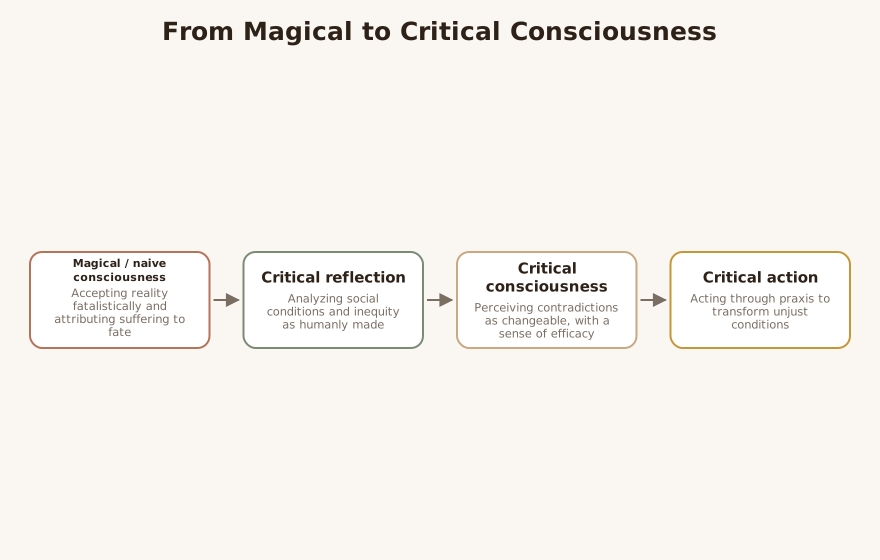
The central principle is that oppression is not only external but is internalized, so that the oppressed may come to accept the oppressor’s image of them and to see their condition as natural, deserved, or inevitable 2. Freire described a “culture of silence” in which people who have been denied voice and agency stop questioning the conditions of their lives 1. Conscientization is the process of breaking that silence: moving from a naïve or magical consciousness, which accepts reality fatalistically or attributes suffering to fate, toward a critical consciousness that perceives social, political, and economic contradictions and recognizes them as humanly made and therefore humanly changeable 3. Critical consciousness is commonly described as having three interlocking components: critical reflection (a critical analysis of social conditions and inequity), political or social efficacy (the perceived capacity to effect change), and critical action (actual participation in changing unjust conditions) 3.
A second principle is praxis: the cycle of reflection and action upon the world in order to transform it 3. Reflection without action degenerates into empty verbalism, while action without reflection becomes mere activism or impulsivity; only their union constitutes genuine praxis 2. A third principle is dialogue: knowledge and awareness are not transmitted from an expert to a passive recipient but are co-created through respectful, horizontal dialogue between people who are each subjects, not objects 5. Dialogue requires humility, faith in others’ capacity, and love, and it stands opposed to the banking model in which the educator (or, by analogy, the clinician) holds all the knowledge 6. Together, conscientização, praxis, and dialogue form the conceptual core of Freire’s project 6.
Interventions & Techniques
There is no “conscientization therapy”; the concept shapes which techniques a clinician selects and, more importantly, the stance from which they are offered LLM. The most direct translation is the dialogical stance itself: replacing an expert-deposits-knowledge posture with collaborative, horizontal inquiry in which the client’s lived experience is treated as the primary text and the clinician as a co-investigator rather than an authority 5. Freire’s “problem-posing” method — presenting the situation back to learners as a problem to be analyzed rather than a fact to be accepted — maps onto Socratic questioning and guided discovery already familiar in cognitive and narrative work, but reoriented toward social and structural causes of distress as well as cognitive ones LLM.
Concrete applications cluster around naming and externalizing oppression, distinguishing what belongs to the person from what belongs to their conditions, and connecting private troubles to shared social patterns LLM. Generative themes — words or images charged with meaning in the person’s own world — can be used to open reflection, much as Freire used generative words drawn from peasants’ daily lives in literacy work 1. Group and community formats are especially congruent with the model, because critical consciousness was conceived as a collective rather than purely individual achievement, and because political efficacy and critical action are more readily built in concert with others 4. In clinical settings these elements typically appear as adjuncts within an established modality — for example, integrating a structural analysis into narrative therapy’s externalizing conversations, or pairing values-based action with collective participation LLM.
LLM-generated illustrative example (not a guideline): A therapist working with a client who carries deep shame about long-term unemployment notices the client describing themselves as “just lazy and broken.” Rather than only restructuring the thought as a cognitive distortion, the therapist invites a dialogue about the local job market, disability, and the messages the client absorbed about worth and work. The aim is not to argue the client out of accountability but to help them distinguish a humanly made, changeable condition from a fixed personal defect — and then to identify one small, agentic action within reach LLM.
Evidence Base
The maturity label here is established, but it must be read carefully LLM. Conscientization is an established and influential theory within education, the social sciences, and increasingly public health; Pedagogy of the Oppressed is one of the most widely cited texts in the social sciences 2. As a body of educational and social theory it is mature, has been elaborated for over half a century, and has a developed measurement literature in which critical consciousness is operationalized through its reflection, efficacy, and action components 3. In public health, critical consciousness has been argued to be a core construct for addressing social determinants of health and for sustaining collective impact on inequities 4.
Honesty requires distinguishing the maturity of the theory from the evidence for clinical outcomes LLM. The construct is well developed and the educational and developmental research is substantial, but conscientization is not a standardized psychotherapy with the kind of randomized-trial efficacy base that defines an empirically supported treatment for a diagnosis LLM. Much of the literature is theoretical, qualitative, or correlational — for instance, associations between higher critical consciousness and better academic, civic, or occupational outcomes among marginalized youth — rather than experimental tests of conscientization as a clinical intervention LLM. The concept also resists conventional symptom-reduction metrics by design, since its declared aims are awareness and social transformation rather than only individual symptom change LLM. Clinicians should therefore present it as a well-grounded and influential framework that informs stance and case conceptualization, while being candid that “critical consciousness reduces depression” is not a claim the evidence base licenses in the way it would for an established disorder-specific protocol LLM.
Populations & Indications
The framework is most useful where distress is entangled with marginalization, oppression, or disempowerment rather than arising in relative social privilege LLM. It was developed with and for oppressed and minority groups and impoverished communities, and these remain its central population 2. Marginalized communities and people facing discrimination, poverty, or structural exclusion are the paradigmatic indication, because the framework’s core move — relocating some of the cause of suffering from the self to changeable conditions — directly addresses their reality 4. Adolescents and emerging adults are a well-studied group, since critical consciousness has been examined as part of identity development and as a protective factor for youth contending with racism and inequity 3. Adults in community mental health settings, where presentations are routinely shaped by economic precarity and social adversity, are a natural fit for a structurally informed stance LLM. Justice-involved individuals, whose trajectories are heavily shaped by systemic factors, may benefit from a frame that neither excuses harm nor reduces a person to their worst circumstances LLM. Across these groups the concept is an orienting lens and an adjunct, not a diagnosis-specific protocol LLM.
Problems-for-Work
In internalized oppression, the work is helping a client recognize that the demeaning beliefs they hold about themselves or their group were absorbed from an oppressive environment rather than discovered as truths, and then loosening their grip through dialogue and structural analysis 2. In learned helplessness and demoralization, the framework reframes a fatalistic “nothing I do matters” as a naïve consciousness shaped by genuinely constraining conditions, and the therapeutic task becomes rebuilding perceived efficacy through small, achievable critical actions 3. In low self-efficacy and empowerment deficits, political or social efficacy — the belief that one can contribute to change — is treated as a buildable capacity, cultivated through graded action and, where possible, collective participation 3. In trauma related to discrimination, naming the social source of harm can counter self-blame and isolation, situating a private wound within a shared and unjust pattern LLM. In identity development, particularly for adolescents from marginalized groups, critical reflection on inequity can support a coherent, agentic sense of self rather than one organized around internalized stigma 3. In social isolation, the model’s emphasis on dialogue and collective action points toward connection and shared purpose as both means and end 4.
LLM-generated illustrative example (not a guideline): A clinician in a community clinic sees an adolescent from a marginalized background who is withdrawn, self-critical, and convinced that school “isn’t for people like me.” Within an established therapy, the clinician uses dialogue to help the youth examine where that message came from, names the structural barriers honestly, and supports one concrete action the youth chooses — joining a peer group, speaking with a counselor. The goal is a shift from fatalism toward agency, paired with, not replacing, attention to mood and safety LLM.
Contraindications, Cautions & Cultural Humility
Because conscientization is a framework rather than a procedure, the cautions concern misapplication and stance rather than patient selection LLM. The gravest risk is the clinician imposing their own political analysis on a client, which reproduces the very banking model — depositing the “correct” consciousness into a passive recipient — that Freire repudiated; genuine dialogue must let the client’s own analysis emerge and may lead somewhere the clinician did not expect 5. Pushing critical action prematurely can be harmful where a client is unsafe, in acute crisis, or not stabilized, since action carries real social and physical risk for marginalized people, and the clinician does not bear the consequences the client does LLM. The framework is poorly suited as a stand-alone response to acute symptoms — active suicidality, psychosis, severe trauma reactions — which require their own evidence-based, often individual and symptom-focused, intervention LLM. There is also a risk of over-attributing all distress to social structure in a way that neglects biological, relational, or intrapsychic contributors, just as the opposite error neglects structure entirely LLM.
Cultural humility is intrinsic to the model rather than an add-on, since Freire insisted the educator approach learners with humility and faith rather than as the holder of truth 6. Clinicians should be alert that what counts as “oppression,” “agency,” or “liberation” varies across cultures and individuals, and that collectivist or faith-based worldviews may frame both the problem and the desirable response differently than a Western individualist or activist lens would LLM. A clinician who is more socially privileged than their client must take particular care not to romanticize struggle or to recruit a client into the clinician’s own cause LLM.
Treatment-Plan Suggestions & SMART Objectives
| Goal | SMART objective (example) | Mechanism |
|---|---|---|
| Increase critical reflection on internalized messages | Client will, over 6 weeks, identify and record in session three self-beliefs and trace each to a social or environmental source | Builds critical reflection by distinguishing internalized oppression from fixed personal defect 3 |
| Reframe fatalism as changeable condition | Client will reframe two “nothing I do matters” statements into condition-specific, partly changeable terms in 4 of 6 sessions | Targets naïve consciousness and demoralization through dialogical re-examination 2 |
| Build perceived social/political efficacy | Client will identify, weekly for 8 weeks, one realistic action within their control and rate confidence before and after attempting it | Strengthens political efficacy as a buildable capacity 3 |
| Take a graded critical action | Client will complete one self-chosen, safe agentic action (e.g., a request, a meeting, joining a group) within 30 days and review the outcome | Operationalizes praxis as reflection joined to action 3 |
| Reduce self-blame in discrimination-related distress | Client will, over 5 sessions, articulate the structural contributors to a distressing experience and notice change in self-blame ratings | Counters self-blame and isolation by locating harm in shared patterns LLM |
| Reduce social isolation through connection | Client will engage in one dialogical or collective activity (peer group, community space) weekly for 6 weeks | Uses dialogue and collective participation to build connection and efficacy 4 |
| Support agentic identity in adolescents | Adolescent client will, over the term, name one value tied to their identity and one action expressing it, reviewed biweekly | Links critical reflection to identity development and agency 3 |
Common Misconceptions
The first misconception is that conscientization is simply “raising awareness,” with awareness as the endpoint; in Freire’s account, reflection that does not issue in action is empty, and the construct explicitly includes critical action as a component 2. A second is that it is a method for installing the clinician’s or educator’s political views; it is the opposite — a dialogical process in which the participant’s own analysis emerges, and imposing a ready-made consciousness reproduces the banking model Freire condemned 5. A third is that it is a complete, standalone therapy; it is a framework and stance that informs techniques delivered within established modalities LLM. A fourth is that “critical consciousness” means cynicism or grievance; it pairs a clear-eyed analysis of injustice with efficacy and constructive action, and its declared aim is the restoration of full humanity, including a refusal to dehumanize the oppressor in turn 1. A fifth, clinically important, is treating it as having the same kind of randomized-trial outcome evidence as a disorder-specific protocol; the theory is mature and influential, but its clinical-outcome evidence is largely theoretical, qualitative, and correlational LLM.
Training & Certification
There is no certification in conscientization itself, because it is a body of educational and social theory rather than a proprietary modality LLM. Clinicians typically encounter it through coursework in critical pedagogy, liberation psychology, multicultural and social-justice counseling, or community psychology, and through Freire’s primary texts and the secondary literature 1. The foundational reading is Pedagogy of the Oppressed, supplemented by encyclopedic and explanatory overviews and by the measurement and applied literatures in psychology and public health 234. Practitioners who want to apply its elements formally generally train in an adjacent, structured approach — narrative therapy, ACT, culturally responsive and trauma-informed care, or community-based participatory work — and use conscientization as the underlying rationale and stance LLM. No new scope of practice is created by adopting the lens; competence in the host modality the clinician is already credentialed in remains the relevant qualification, and the practical task is to understand the theory well enough to embody its dialogical, non-imposing stance honestly LLM.
Key Terms
Conscientização / conscientization — the process of developing critical awareness of one’s social, political, and economic conditions and acting to transform them 3. Critical consciousness — the English rendering of conscientização, commonly described through three components: critical reflection, political/social efficacy, and critical action 3. Banking model of education — Freire’s term for education in which an authority deposits information into passive recipients, the antithesis of dialogical learning 5. Problem-posing education — the dialogical alternative in which learners and teacher co-investigate reality as a problem to be analyzed and acted upon 5. Praxis — the union of reflection and action upon the world in order to transform it; neither alone suffices 2. Dialogue — horizontal, respectful co-creation of knowledge between subjects, grounded in humility, faith, and love 6. Culture of silence — the state in which oppressed people, denied voice, cease to question the conditions of their lives 1. Naïve / magical consciousness — a fatalistic awareness that accepts reality as natural or inevitable, contrasted with critical consciousness 3.
Resources & Further Reading
▶ Watch — a video introduction to this concept:
- Paulo Freire — Internet Encyclopedia of Philosophy
- Pedagogy of the Oppressed (Paulo Freire, 1968/1970) — foundational text (Bloomsbury)
- Critical consciousness — Wikipedia
- Social determinants of health: critical consciousness as the core to collective impact — PMC
- Paulo Freire’s Pedagogy of the Oppressed: Education as a Tool for Liberation — Sociology.Institute
- Conscientizacao, Praxis & Dialogue: Three Main Concepts of Paulo Freire — YouTube
Reflective / Supervision Questions
- When you bring a structural analysis into the room, how do you confirm it is emerging from the client’s own dialogue rather than being deposited by you? LLM
- How do you distinguish a client who is ready to take a critical action from one for whom action carries risks you will not personally bear? LLM
- In which of your cases might over-attributing distress to social structure cause you to miss a biological, relational, or intrapsychic contributor — or the reverse? LLM
- How do you hold the tension between honoring a client’s collectivist or faith-based worldview and a framework that can carry an individualist or activist assumption about what liberation looks like? LLM
- When your own social position differs from your client’s, how do you guard against romanticizing their struggle or recruiting them into your cause? LLM
- What would tell you this lens is not serving a particular client, and what would you turn to instead? LLM