
Type & Discipline
A unique outcome is a clinical construct and technique within narrative therapy rather than a stand-alone modality; it names a moment, action, intention, or thought that contradicts the dominant, problem-saturated story a person tells about their life 1. Michael White borrowed the term from the sociologist Erving Goffman and put it to therapeutic use to mark exactly those events that “would not have been predicted” by the problem narrative — the time the person resisted the problem, refused its demand, or behaved in a way the problem-story says is impossible for them 4. Because it is a building block of narrative practice and not a free-floating procedure, the unique outcome is best understood as a target that the therapist listens for and then helps the client elaborate, rather than a script the therapist delivers 1.
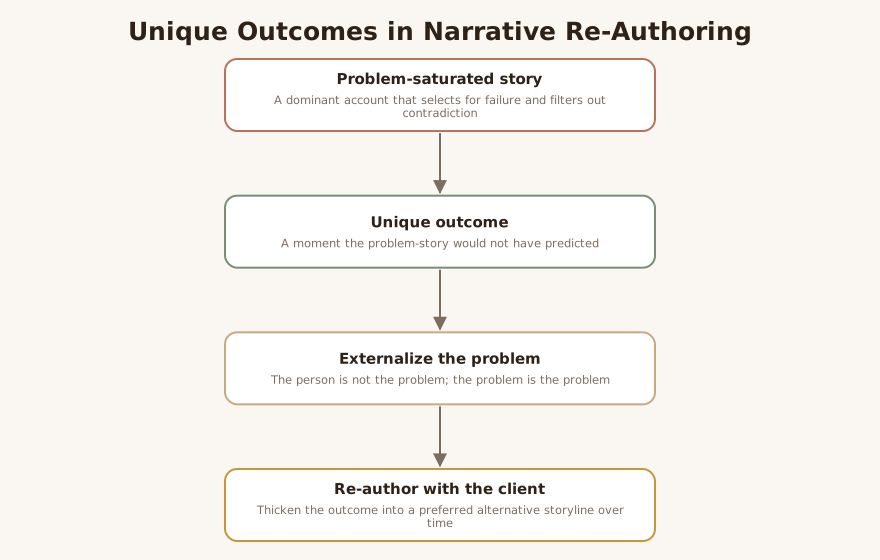
The discipline is family therapy in its origins, with narrative therapy developed and taught primarily within counseling and clinical psychology, social work, and systemic practice 2. Narrative therapy treats the problem, not the person, as the problem, and works by helping clients identify, deconstruct, and re-author the stories through which they make sense of their lives 1. The unique outcome is the pivot point of that re-authoring: it is the foothold of lived experience that does not fit the dominant story, from which a “preferred narrative” — an account of identity organized around the client’s values, competencies, and intentions — can be thickened 5. Treated this way, the unique outcome is a technique embedded in a coherent therapeutic philosophy, and its power depends on the surrounding narrative stance of curiosity, non-expert positioning, and externalization rather than on the phrase itself 1.
Creators & Lineage
The term unique outcome originates with the sociologist Erving Goffman, whose analysis of how institutions and dominant accounts shape identity supplied the idea that there are always events a totalizing description fails to predict or contain 4. Michael White, the Australian co-founder of narrative therapy, imported the concept into clinical practice and made it central, pairing it with the work of his collaborator David Epston to build a therapy organized around stories and their re-authoring 3. White and Epston’s foundational text, Narrative Means to Therapeutic Ends, set out the approach in which unique outcomes, externalization, and re-authoring conversations form an integrated method 6.
The lineage is post-structural and social-constructionist LLM. The most proximate parent is narrative therapy itself, which supplies the premise that identity is constituted in language and story rather than fixed in the self, and that problems are sustained by dominant cultural and personal narratives that crowd out alternative accounts 1. Social constructionism is the deeper philosophical root, contributing the view that meaning, including the meaning of a person’s difficulties, is built socially and can therefore be rebuilt 1. White’s reading of Michel Foucault added attention to how dominant “truths” exert normalizing power over self-description, which is why narrative therapy treats the problem-saturated story as something imposed and contestable rather than simply accurate 3. The approach is a sibling of solution-focused brief therapy, with which it shares a non-pathologizing, resource-oriented turn; the solution-focused “exception” and the narrative “unique outcome” are close cousins, though the unique outcome is embedded in a richer project of identity re-authoring rather than pure behavioral exception-spotting LLM. Its home discipline of family therapy supplies the systemic sensibility and the early clinical context in which White worked 2.
Core Principles
The organizing premise is that the dominant story is never the whole story — however totalizing a problem-saturated account feels, there are always lived events it cannot accommodate, and these unique outcomes are the raw material of change 4. Narrative theory holds that people develop problem stories that select for evidence of failure or deficiency and filter out contradicting experience, so the therapist’s task is to help the client notice and richly describe what the dominant story has discarded 1. A unique outcome has leverage precisely because it “would not have been predicted” by the problem-story 4.
A second principle is that the person is not the problem; the problem is the problem — externalization separates the client’s identity from the difficulty, so the unique outcome is heard as the person acting against an external problem rather than as a fluke within a defective self 1. A third is re-authoring: a unique outcome matters not as an isolated bright spot but as the seed of an alternative storyline the therapist and client thicken over time into a preferred account of who the person is and what they value 5. A fourth is the client as author and expert: the therapist adopts a decentred, curious, not-knowing posture and helps the client elaborate their own meanings rather than supplying interpretations 1.
A fifth principle is meaning over behavior: where a solution-focused exception is mined chiefly for repeatable behavior, the unique outcome is explored for what it reveals about the person’s intentions, hopes, and values, linking a single action to a broader identity claim 4. A sixth is that identity is socially and politically situated: the dominant story often carries cultural, gendered, or institutional assumptions, so re-authoring is partly an act of resisting imposed descriptions, not merely thinking more positively 3.
Interventions & Techniques
The core clinical sequence is to identify a unique outcome and then thicken it through questioning 5. The therapist listens, often across an externalizing conversation, for any event — a refusal, a small act of resistance, an intention not carried out by the problem, a moment of competence — that the problem-saturated story would not have predicted, and names it as significant 4. Practitioner accounts describe a recognizable progression once such a moment surfaces: confirm that it genuinely contradicts the problem-story, invite a detailed account of what happened, and then move from the single event toward its meaning for identity 5.
White structured this thickening through two characteristic lines of inquiry LLM. Landscape-of-action questions elaborate the concrete event — what the person did, how they prepared, what steps made it possible, who was present — so the unique outcome becomes a vivid, sequenced account rather than a vague claim 5. Landscape-of-identity (or consciousness) questions then ask what the event says about the person: what it reveals about their values, hopes, commitments, and what kind of person would take such a step 4. The pivot from action to identity is what turns a discrete exception into evidence for a preferred narrative 5.
Surrounding techniques support this work 1. Externalizing conversations position the problem as separate from the person, which both makes unique outcomes easier to spot and protects them from being re-absorbed into a story of personal deficiency 1. Re-authoring conversations weave a series of unique outcomes into a sustained alternative storyline with history and trajectory, linking past instances to future intentions 5. Re-membering conversations and definitional ceremonies / outsider-witness practices recruit the client’s relationships and an audience to witness and circulate the preferred story, so it gains social reality beyond the consulting room 1. Documents and letters record unique outcomes and the emerging preferred narrative in writing, a practice White and Epston used to make the new story durable 6.
LLM-generated illustrative example (not a guideline): A client describes herself as “someone anxiety completely controls — I can never say no to anyone.” In an externalizing conversation the clinician asks whether there was ever a time Anxiety expected her to comply but she didn’t. She recalls declining an unreasonable favor from a relative last month. The clinician slows down: first the landscape of action — “How did you prepare to say no? What did you actually say?” — then the landscape of identity — “What does it tell you about what you value that you were willing to disappoint someone to protect your own limits?” The single refusal becomes the opening line of a different story about a woman with standards, not a woman ruled by fear LLM.
Evidence Base
The honest label for narrative therapy’s maturity is established as a recognized, widely taught modality, with a thinner outcome-trial base than its standing implies 2. Narrative therapy is a well-developed approach with a substantial conceptual and clinical literature, an international training infrastructure, and a recognized place in the family-therapy and counseling fields, presented in standard professional descriptions as an established therapy used across a broad range of presentations 2. In that sense the modality housing the unique outcome is mature and recognized, not experimental, reflecting decades of practice since White and Epston’s foundational work 6.
The unique outcome specifically, however, has been the subject of conceptual rather than trial-based scrutiny 4. The most directly relevant scholarship examines the nature of unique outcomes in the construction of therapeutic change — how they function, how they are identified, and what role they play in re-authoring — rather than testing them as an isolated active ingredient in controlled trials 4. The wider scholarly literature on White’s narrative therapy is similarly weighted toward theory, method, and clinical illustration within post-structural and social-constructionist thought, more than toward randomized outcome research under the technique’s own name 3. This is partly principled: narrative therapy’s epistemology is skeptical of the standardized, decontextualized measurement that controlled trials require, which is itself part of why component-isolated evidence is sparse LLM.
The fair summary for practice is that the unique outcome is a well-theorized, foundational technique inside an established and widely practised modality, but its direct, component-isolated empirical support is modest and largely conceptual rather than trial-based 4. It is responsibly presented to clients and supervisees as a credible, established narrative-therapy method whose strength lies in its coherence, clinical utility, and theoretical grounding, rather than as a stand-alone, trial-proven intervention for any specific diagnosis LLM.
Populations & Indications
Narrative therapy and unique-outcome work were developed in family and community practice and are broad in their indications 2. Individuals carrying a problem-saturated identity — a global “I am depressed / a failure / damaged” account — are core, because the technique directly targets the totalizing story and looks for the lived experiences it excludes 1. Couples and families are a natural fit given the family-therapy lineage, where a shared problem story (a recurring conflict, a “difficult” member) can be externalized and unique outcomes located in the system’s better moments 2. Adolescents often respond well to the non-pathologizing, externalizing style, which avoids positioning the young person as the diagnosed problem and instead recruits them as the author of an alternative account 2.
People with chronic illness and trauma survivors are an important indication, because illness and trauma narratives can become identity-engulfing, and unique-outcome work can help recover a sense of agency and a self that exists alongside, rather than under, the condition or the trauma 5. The general indication is any presentation marked by a dominant, identity-level story of deficiency, stigma, or hopelessness where the therapist can realistically help the client locate and thicken contradicting experience — including internalized stigma, demoralization, grief, and identity disturbance 5.
Problems-for-Work
In major depressive disorder and demoralization, the work pairs externalization of “Depression” with identification of unique outcomes — times the client acted against the problem’s demand to withdraw or give up — then thickens those moments into evidence of agency and values, on the principle that an owned alternative storyline erodes the global hopeless self-account 4. In low self-esteem, the landscape-of-identity inquiry functions as competence-revelation: the client supplies, in their own words, evidence of what a single capable act says about who they are, rather than receiving reassurance from the therapist 5.
LLM-generated illustrative example (not a guideline): A man recovering from a serious accident says, “I’m useless now — the injury took everything.” The clinician externalizes (“the injury”) and asks for a moment the injury expected him to quit but he didn’t. He mentions teaching his daughter chess from bed last week. The clinician explores what that act required and what it reveals — patience, fatherhood, a refusal to be only a patient — and they begin documenting a storyline of a man who is still a teacher and a father, not only an injured body LLM.
In internalized stigma, unique-outcome work is a counter-story to an imposed, often culturally or institutionally sourced description, helping the client find moments that contradict the stigmatizing account and link them to a preferred identity 3. In grief, narrative practice can locate unique outcomes that re-member the relationship with the person lost and recover a continuing, valued connection rather than a story of only absence 5. In relationship conflict, a couple’s shared problem story is externalized and exceptions to the recurring cycle are elaborated for what they reveal about the partners’ commitments to each other 2. In trauma, unique outcomes — acts of resistance, protection of self or others, survival — are thickened into a narrative of response and agency rather than only victimhood, used carefully within a paced, safety-first plan 5. In anxiety and identity disturbance, the technique converts a fixed “this is just who I am” account into a contestable story with exceptions that point toward a preferred self 1.
Contraindications, Cautions & Cultural Humility
The central caution is timing and validation: reaching for a unique outcome before the client feels their suffering has been genuinely heard can read as dismissive or as a subtle insistence on looking on the bright side, and is especially damaging with the acutely traumatized, the freshly bereaved, and clients in crisis LLM. Externalization and the search for contradicting experience must follow, not pre-empt, an authentic acknowledgment of the weight of the problem LLM. The technique is also not a substitute for risk assessment: with active suicidality, psychosis, severe eating disorders, or acute safety concerns, narrative re-authoring is insufficient on its own and should at most be integrated within a comprehensive, safety-prioritizing plan LLM.
A further caution is that a unique outcome can misfire when the “exception” depended on circumstances outside the client’s control or names something the client does not actually value; insisting on its significance then becomes the therapist imposing a story rather than helping the client author one, which contradicts the model’s own decentred ethic 1. The clinician must let the client confirm that an event is genuinely meaningful and preferred, rather than declaring it so 5. The technique can also slide into minimization when distress is driven by active abuse, poverty, or discrimination; re-authoring an identity cannot substitute for naming and addressing real external harm, and narrative therapy’s own attention to power should keep the therapist alert to this rather than blind to it 3.
Cultural humility is built into the model’s premises but still requires vigilance LLM. Because narrative therapy holds that dominant stories carry cultural, gendered, and institutional power, the therapist should treat the client as the expert on what counts as a preferred identity in their own cultural world, and avoid importing a Western, individualist template of the “authored self” 3. For clients from collectivist or relational contexts, unique outcomes and preferred stories may be best framed in terms of family, community, and relationship rather than autonomous individual agency, and the re-membering and outsider-witness practices lend themselves naturally to that relational framing 1. The honest stance is to fit the technique to the client’s worldview, not the reverse LLM.
Treatment-Plan Suggestions & SMART Objectives
| Goal | SMART objective (example) | Mechanism |
|---|---|---|
| Loosen a totalizing problem-saturated identity | Client identifies and richly describes one unique outcome — an event the problem-story would not have predicted — each week for 4 consecutive weeks | Unique outcomes provide lived counter-evidence that the dominant story cannot accommodate 4 |
| Separate the person from the problem | Client uses externalizing language for the named problem in session for 3 consecutive sessions | Externalization frees unique outcomes from being re-absorbed into a story of personal deficiency 1 |
| Build an alternative, preferred storyline | Across 6 sessions, client and clinician link three unique outcomes into a coherent re-authored account with past and future references | Re-authoring thickens isolated exceptions into a sustained preferred narrative 5 |
| Move from action to identity meaning | For each unique outcome explored, client articulates one value or commitment the event reveals, over 4 sessions | Landscape-of-identity questions connect a single act to a broader identity claim 4 |
| Make the preferred story socially durable | Client identifies one trusted person to witness or be told the emerging preferred story within 4 weeks | Re-membering and outsider-witness practices give the new story social reality 1 |
| Record and consolidate change | Client and clinician co-author one document or letter capturing a unique outcome and the preferred narrative within 5 sessions | Therapeutic documents make the re-authored story durable beyond the session 6 |
| Counter an internalized, imposed description | Client names one culturally or institutionally sourced “truth” about themselves and one experience that contradicts it, over 3 sessions | Deconstructing dominant truths exposes the problem-story as contestable, not factual 3 |
Common Misconceptions
The first misconception is that a unique outcome is “just positive thinking” or a refusal to discuss problems; in fact it is a disciplined search for real, lived experience that contradicts a dominant story, and it follows rather than replaces genuine acknowledgment of the client’s pain 1. A second is that it is interchangeable with the solution-focused exception; while the two are close cousins, the unique outcome is explored chiefly for what it reveals about identity, values, and intentions, not merely for repeatable behavior, and it lives inside a larger project of re-authoring 4. A third is that unique outcomes must be large or dramatic; the technique treats even a small refusal or fleeting act of resistance as significant, because its value lies in contradicting the problem-story, not in its size 4. A fourth is that the therapist supplies the meaning of the unique outcome; in fact the decentred, not-knowing stance requires that the client author what the event means, with the therapist asking rather than interpreting 1. A fifth is that narrative therapy ignores real-world hardship by reducing everything to “story”; its grounding in social constructionism and analyses of power is meant to take cultural and institutional harm seriously, not to dissolve it 3. A sixth is treating the technique as a fully trial-validated stand-alone intervention; its component-isolated evidence is modest and largely conceptual, and its strength is inherited from an established but unevenly evidenced modality 4.
Training & Certification
There is no separate license for unique-outcome work; it is learned as part of training in narrative therapy, taught through the foundational texts of Michael White and David Epston — above all Narrative Means to Therapeutic Ends — and through workshops and supervised practice 6. Narrative therapy is disseminated through dedicated training institutes and centres that grew out of White and Epston’s work, and through the wider family-therapy and counseling training landscape in which the approach is recognized 2. Practitioner-facing explainers offer accessible introductions to identifying and leveraging unique outcomes for clinicians new to the approach 5.
The practical path for a licensed clinician is to study the source material, learn the linked practices of externalization, landscape-of-action and landscape-of-identity questioning, and re-authoring, and then practice the validation-before-re-authoring sequencing and the decentred questioning under supervision, integrating the technique within their existing scope of practice rather than treating it as a separate credential LLM. Because the difficulty lies less in spotting a unique outcome than in the patient, curious questioning that thickens it into a preferred story, observation of experienced narrative practitioners and supervised role-play are especially valuable LLM.
Key Terms
Unique outcome — a moment, action, intention, or thought that contradicts the dominant, problem-saturated story and would not have been predicted by it; the entry point to a preferred narrative 4. Problem-saturated story — a dominant, totalizing account of a person’s life that selects for evidence of deficiency and filters out contradicting experience 1. Externalization — the linguistic practice of separating the person from the problem, so the problem is treated as the problem rather than the person 1. Re-authoring — the process of weaving unique outcomes into a coherent, preferred alternative storyline with history and trajectory 5. Preferred narrative — the account of identity, organized around the client’s values, competencies, and intentions, that re-authoring builds toward 5. Landscape of action — the line of questioning that elaborates the concrete events of a unique outcome 5. Landscape of identity (consciousness) — the line of questioning that elaborates what those events reveal about the person’s values, hopes, and commitments 4. Re-membering / outsider-witness practices — relational and audience-based methods that recruit others to witness and circulate the preferred story 1. Social constructionism — the philosophical view, underpinning narrative therapy, that meaning is built socially and can therefore be rebuilt 1.
Resources & Further Reading
▶ Watch — a video introduction to this concept:
- Narrative therapy — Wikipedia
- Narrative Therapy — Psychology Today
- Michael White’s Narrative Therapy (Contemporary Family Therapy, Springer)
- Narrative therapies and the nature of ‘unique outcomes’ in the construction of change (ResearchGate)
- Identifying and Leveraging Unique Outcomes in Narrative Therapy — Psychology Town
- ‘Narrative Means to Therapeutic Ends’ — Book Summary and Review
Reflective / Supervision Questions
- When a client answers your search for a unique outcome with “that never happens, it’s always like this,” how do you persist without pressuring, and what tells you to narrow the frame versus pause and return to validating their distress? LLM
- How do you confirm a client feels their suffering was genuinely heard before you turn toward externalization and contradicting experience, especially with trauma survivors and the acutely grieving? LLM
- How do you ensure the client, not you, authors the meaning of a unique outcome, and what does it look like when you have slipped into imposing a preferred story? LLM
- How do you distinguish a unique outcome the client genuinely produced and values from a lucky event that depended on circumstances outside their control? LLM
- When a client’s distress is rooted in active abuse, poverty, or discrimination, how do you use re-authoring without implying the burden of change rests on their story rather than on real external harm? LLM
- Where might your template of the “authored, autonomous self” carry individualist cultural assumptions, and how could you frame unique outcomes and preferred stories relationally for a client from a collectivist context? LLM
- Given that the component-specific evidence for unique outcomes is modest and largely conceptual while narrative therapy is an established modality, how do you describe the technique honestly to a client or supervisee? LLM