
Type & Discipline
Historical (or intergenerational) trauma is a construct — an explanatory framework — rather than a discrete DSM disorder or a single branded modality LLM. It originates at the intersection of clinical psychology, social work, and community/public health, and is concerned with how massive collective trauma transmits across generations 1. The construct frames present-day individual symptoms (PTSD, depression, substance use, suicide) as partly the downstream product of a population-level legacy rather than as isolated individual pathology 1. Because of this dual focus on the individual and the collective, it is best understood as a community-psychology construct with direct implications for individual clinical work LLM.
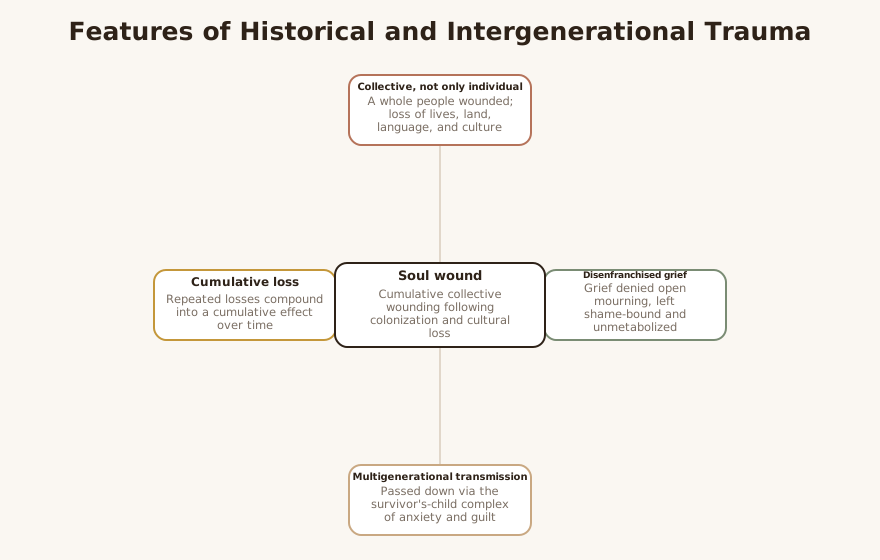
The original authors defined two linked terms: historical trauma (cumulative emotional and psychological wounding across the lifespan and across generations from massive group trauma) and historical unresolved grief (the grief that accompanies that trauma and has never been mourned to resolution) 1. Eduardo Duran and Bonnie Duran contributed the parallel and now widely used metaphor of the soul wound, locating the injury at the level of collective spirit and identity rather than only individual neurobiology 2.
Creators & Lineage
The construct as used in clinical mental health was articulated principally by Maria Yellow Horse Brave Heart (Hunkpapa/Oglala Lakota, clinical social worker) with Lemyra DeBruyn, who developed the terms “historical unresolved grief” and “historical trauma” in 1988 to explain the impact of one generation’s trauma on subsequent generations 1. Their foundational 1998 paper drew an explicit analogy between the American Indian experience of genocide and the Jewish Holocaust survivor literature, borrowing concepts such as the survivor syndrome, the survivor’s child complex, and transposition to describe how trauma reverberates into descendants 1. Eduardo and Bonnie Duran independently developed the “soul wound” / postcolonial psychology framing, which emphasizes colonization itself as the etiological agent 2.
The intellectual lineage is layered LLM. From trauma theory and PTSD models the construct borrows the language of intrusion, numbing, and the survivor syndrome 1. From attachment theory and family systems it borrows the mechanisms by which a traumatized parent’s unprocessed grief and disrupted caregiving shape a child’s development LLM. From liberation psychology (the authors cite Freire’s Pedagogy of the Oppressed) it borrows the concept of internalized oppression — the absorption of a colonizer’s devaluing messages into the self-concept of the colonized 1. The construct has since been extended, by the authors’ own argument, to other colonized and oppressed peoples worldwide 1.
Core Principles
1. Trauma is collective, not only individual. The wound is sustained by a people, and the loss includes lives, land, language, and culture — not only discrete violent events 1. The injury is therefore historical and political as well as psychological 1.
2. The grief is unresolved because it was disenfranchised. Brave Heart and DeBruyn drew on Doka’s concept of disenfranchised grief — grief that cannot be openly acknowledged or publicly mourned — and argued that dominant-culture views of Native people as stoic or “incapable of feeling” denied them the right and the rituals to grieve, leaving the grief shame-bound and unmetabolized 1. Where mourning rituals are absent, pathological bereavement reactions are fostered 1.
3. Transmission is multigenerational. Trauma and grief, and the self-destructive behaviors that accompany them, are passed from generation to generation through what the authors describe as the survivor’s-child complex: anxiety, intrusive imagery, depression, guilt, a perceived obligation to share in ancestral pain, and identification with deceased ancestors 1.
4. Cumulative loss has a cumulative effect. The construct emphasizes cumulative wounding across the lifespan and across generations — the soul wound deepens with each unaddressed loss 2.
5. Healing is communal as well as clinical. The original model held that individual, family, and community healing are all necessary; the past must be actively grieved at all three levels for present manifestations to resolve 1.
LLM-generated illustrative example (not a guideline): A client whose grandparents attended boarding schools presents with depression and a vague, chronic “heaviness” she cannot trace to a specific event. Reframing her distress as connected to an unmourned collective loss — rather than a personal deficiency — can reduce shame and open space for grieving LLM.
Interventions & Techniques
The original applied intervention is the Historical Trauma and Unresolved Grief (HTUG) psychoeducational group model, first demonstrated in the Black Hills in September 1992 and later associated with the Takini Network (Lakota Holocaust Survivors’ Association) 1. Brave Heart described this work as a “return to the sacred path” — healing the historical trauma response through a structured group process 3.
Key components of the model as described by the authors 1:
- Psychoeducation on historical trauma. Participants learn the concepts of historical unresolved grief and the survivor’s child complex, which normalizes and names experiences that previously felt shameful or “crazy” 1.
- Stimulating affect through historical material. Audiovisual material depicting traumas such as the Wounded Knee Massacre and boarding-school ordeals is used to heighten awareness and access associated grief 1.
- The trauma lifeline exercise. Participants diagram a lifeline of their traumatic experiences and share it in partners and small groups led by trained facilitators 1.
- Cathartic group processing. Emotional expression of pain is encouraged through small- and large-group work and cathartic exercises 1.
- Ceremony and traditional grief resolution. The four-day process includes daily prayer and the inipi (purification ceremony) and concludes with “wiping the tears of the mourners,” a traditional Lakota grief-resolution ceremony that incorporates participants into an extended-kin support network 1.
- Re-attachment to traditional values. The model deliberately stimulates reconnection to cultural identity and extended-kin networks as a source of belonging and resilience 1.
The authors reported that the 1992 process produced a cathartic release, reduction in perceived grief, increased joy, and decreased guilt among participants 1. Clinician training is treated as a core technique in its own right: facilitators must be trained specifically in historical unresolved grief and must address their own unresolved grief, transference, and countertransference, including survivor guilt 1.
Evidence Base
The construct itself is established and widely cited as an explanatory framework across Indigenous mental-health, collective-trauma, and public-health scholarship 15. There is broad agreement that colonization, genocide, forced assimilation, and the boarding-school system inflicted population-level harm with intergenerational consequences 16.
The intervention and measurement evidence is less mature LLM. The early HTUG demonstrations relied largely on qualitative reports of cathartic release and reduced grief rather than controlled trials 1. Standardized measurement is still developing; the Historical Intergenerational Trauma Transmission Questionnaire is one example of an instrument built to operationalize transmission for research and assessment 7. Contemporary scholarship also debates the construct critically: a recent analysis frames Indigenous historical trauma as offering “alter-Native” explanations for mental-health inequities and cautions against treating the framework uncritically — for example, against locating the problem solely in the past when ongoing, structural colonialism continues to drive disparities, and against framings that risk pathologizing or essentializing whole communities 5. Honest practice means holding the construct as clinically useful and well-supported as a frame, while acknowledging that the question of what most effectively heals historical trauma remains actively contested 45.
Populations & Indications
The construct was developed with and for Indigenous and Native American communities and remains most directly evidenced there 1. Its theoretical machinery was explicitly imported from the Holocaust survivor and descendant literature, making that population a second core reference group 1. The original authors argued the framework extends to other colonized and oppressed peoples throughout the world 1.
In contemporary practice it is commonly applied, by extension and clinical judgment, to descendants of enslaved people, refugees and forced migrants, other marginalized and colonized populations, and more broadly to families carrying transmitted trauma across generations LLM. The relevant clinical indication is not a single diagnosis but a pattern: distress that is better explained by a multigenerational, collective legacy than by the client’s own discrete event history 1.
Problems-for-Work
The construct connects a population-level legacy to concrete, workable clinical targets LLM:
- Grief and unresolved collective loss — naming and mourning losses that were never permitted public expression; e.g., supporting a client to grieve a grandparent’s boarding-school separation as a legitimate, mournable loss rather than ancient history 1.
- Internalized oppression — identifying and challenging absorbed devaluing messages about one’s people and self 1.
- PTSD and Complex PTSD — addressing intrusion, numbing, and survivor-syndrome features in the context of cumulative, identity-level trauma 1.
- Depression, substance use, and anxiety — reframing these as partly downstream of unresolved grief and disrupted attachment, which can reduce self-blame and widen the treatment target 1.
- Intergenerational transmission — interrupting the survivor’s-child-complex pattern (guilt, over-protectiveness toward parents, identification with ancestral pain) so it is not passed forward 1.
- Identity disturbance — supporting re-attachment to cultural identity and extended-kin belonging 1.
- Health disparities and somatic distress — situating chronic somatic and health burdens within a recognized collective context 6.
LLM-generated illustrative example (not a guideline): A young adult presents with substance use and persistent guilt about “leaving” his family for college. Mapping a trauma lifeline reveals a pattern of caretaking and protectiveness toward parents who are boarding-school descendants — consistent with the survivor’s-child complex. Work focuses on disentangling inherited obligation from his own life, while honoring the loss LLM.
Contraindications, Cautions & Cultural Humility
This is not a framework to apply at a distance or as a checklist LLM. Several cautions are central.
Do not appropriate ceremony or culture. The ceremonial elements of the original model (the inipi, wiping-the-tears) are tribally specific, community-led, and not portable interventions for a non-Native clinician to administer 1. Cultural and ceremonial healing should be community-grounded and led by appropriate cultural authorities 4.
Avoid pathologizing whole peoples. Critical scholarship warns that the construct can be misused to essentialize communities or to imply inherent damage; clinicians should hold it as a frame for understanding context, not as a deficit label 5.
Do not relocate the problem entirely to the past. Ongoing structural racism and colonialism continue to produce harm in the present, and framing distress as purely historical can obscure current, modifiable injustices 5.
Require cultural competence and self-work. The original model insisted that clinicians develop awareness of their own cultural limitations, achieve therapeutic congruence with the client’s culture, and manage their own transference, countertransference, and survivor guilt before doing this work 1. Defining what “healing” even means is itself contested and should be approached with humility and in partnership with the client and community 4.
Treatment-Plan Suggestions & SMART Objectives
| Goal | SMART objective (example) | Mechanism |
|---|---|---|
| Reduce shame around inherited distress | Within 6 sessions, client will articulate two ways current symptoms connect to a collective/family legacy, reducing self-blame on a 0-10 scale by ≥2 points | Psychoeducation reframes distress as contextual, not personal deficiency 1 |
| Mourn disenfranchised loss | Within 8 sessions, client will complete a trauma-lifeline exercise and identify one previously unmourned loss to grieve in session | Naming and grieving disenfranchised loss interrupts shame-bound, unresolved grief 1 |
| Interrupt transmission patterns | Over 10 sessions, client will name and modify one survivor’s-child-complex pattern (e.g., over-protectiveness of caregivers) | Identifying transposition allows differentiation of inherited from personal obligation 1 |
| Address internalized oppression | Within 6 sessions, client will identify three absorbed negative beliefs about their group and generate a counter-statement for each | Externalizing internalized oppression reduces its hold on self-concept 1 |
| Strengthen cultural identity and belonging | Over 12 weeks, client will take two concrete steps toward reconnecting with culture, community, or extended kin | Re-attachment to identity and kin networks supports resilience and belonging 1 |
| Reduce trauma symptom burden | Within 12 sessions, client will report a ≥30% reduction on a validated PTSD measure | Processing within a culturally congruent frame supports symptom resolution 1 |
| Engage community-level healing | Within 90 days, client will participate in one community- or culturally grounded healing activity (community-led) | Communal healing addresses the collective dimension of the wound 1 |
Common Misconceptions
- “It is a DSM diagnosis.” It is not; it is an explanatory construct that contextualizes diagnoses such as PTSD, Complex PTSD, depression, and substance use disorders 1LLM.
- “It is only about the past.” The framework explicitly links a historical legacy to present social conditions and ongoing oppression; some critics argue clinicians underweight the ongoing, structural component 5.
- “It means a community is inherently broken.” Used well, it explains context and points toward collective strength and re-attachment to identity, not inherent deficiency 5.
- “Any clinician can run the ceremonies.” The ceremonial components are tribally specific and community-led, not generic techniques 1.
- “It applies only to one group.” Its originators argued for broad applicability to colonized and oppressed peoples, while cautioning against flattening important differences between groups 1LLM.
Training & Certification
There is no single licensing body or universal certification for historical-trauma work LLM. The original applied training lineage runs through Brave Heart’s work and the Takini Network, which provided training on historical trauma among American Indians 1. The authors specified that facilitators be trained specifically in the concept of historical unresolved grief and that they do their own grief and countertransference work before facilitating 1. In practice, competence is built through trauma-focused clinical training, supervised experience, and — critically — through developing cultural competence and congruence with the specific community served, ideally in partnership with that community’s cultural authorities 14.
Key Terms
- Historical trauma — cumulative emotional and psychological wounding across the lifespan and across generations from massive group trauma 1.
- Historical unresolved grief — the unmourned grief accompanying historical trauma, which fuels present social and clinical distress 1.
- Soul wound — Duran’s metaphor for the collective, spirit- and identity-level injury of colonization 2.
- Disenfranchised grief — grief that cannot be openly acknowledged or publicly mourned, fostering pathological bereavement 1.
- Survivor’s child complex / transposition — the constellation by which descendants absorb, identify with, and feel obligated to undo ancestral trauma 1.
- Internalized oppression — absorption of the oppressor’s devaluing messages into the self-concept of the oppressed 1.
Resources & Further Reading
▶ Watch — a video introduction to this concept:
- Brave Heart & DeBruyn (1998), The American Indian Holocaust: Healing Historical Unresolved Grief
- Duran & Duran, Healing the American Indian Soul Wound (Springer)
- Brave Heart (1998), The Return to the Sacred Path (Smith College Studies in Social Work)
- What Does It Mean to Heal From Historical Trauma? (AMA Journal of Ethics)
- Indigenous Historical Trauma: Alter-Native Explanations for Mental Health Inequities (Daedalus)
- Healing Historical Trauma (Johns Hopkins Bloomberg Public Health Magazine)
- Historical Intergenerational Trauma Transmission Questionnaire (APA PsycTests)
Reflective / Supervision Questions
- When a client’s distress maps onto a collective legacy, how do I hold both the historical context and the client’s individual agency without collapsing one into the other? LLM
- What is my own relationship to the histories of the communities I serve, and what unexamined grief, guilt, or countertransference might I bring to this work? 1
- Am I at risk of locating the problem entirely in the past and underweighting ongoing, modifiable structural harms in my client’s present? 5
- Where is the line between contextualizing distress and pathologizing or essentializing a whole community, and how do I know when I have crossed it? 5
- Whose authority does culturally grounded or ceremonial healing belong to, and am I partnering with the right community-led resources rather than appropriating them? 14