
Type & Discipline
Liberation psychology is a framework and orientation toward practice rather than a manualized treatment package, and it sits within critical and liberation theory at the intersection of clinical, community, and social-justice psychology 1. It is best understood as a paradigm — a stance on the purpose of psychology, the location of human suffering, and the role of the practitioner — that can inform many specific modalities rather than replace them 3. The discipline reframes psychological distress as arising substantially from the interaction of intrapsychic factors with systemic factors such as sociopolitical injustice, discrimination, and inequality 3. Because it grew out of Latin American community psychology, its theory and method are more developed than its formalized clinical applications, and several of its core constructs are still expressed in Spanish and Portuguese terms 3. For practicing therapists, liberation psychology functions less as a “what to do in session” protocol and more as a lens that changes how you formulate a case, where you locate blame, and what you consider a legitimate therapeutic outcome LLM.
Creators & Lineage
The framework was founded by Ignacio Martín-Baró, a Spanish-born Salvadoran social psychologist and Jesuit priest who developed psicología de la liberación through his work with oppressed communities in El Salvador 1. His writings were collected and translated into English in Writings for a Liberation Psychology, edited by Adrianne Aron and Shawn Corne, which remains the canonical primary text in English 2. Martín-Baró argued that mainstream psychology mistook itself for value-neutral, falsely universalized theories built on narrow (white, middle-class, male) samples, and remained largely irrelevant to social inequality 1.
The method’s intellectual taproot is Paulo Freire, the Brazilian educator whose Pedagogy of the Oppressed introduced conscientización — the raising of critical sociopolitical consciousness — and the idea that the oppressed carry an “internalized oppressor” that must itself be liberated 64. The lineage also draws on the anticolonial work of Frantz Fanon and on critical, feminist, and decolonial traditions 3. The field was extended after Martín-Baró’s death by Latin American colleagues such as Maritza Montero, and in the United States by clinicians including Lillian Comas-Díaz and Edil Torres Rivera, who edited the APA volume bringing liberation psychology explicitly into therapeutic practice 13. The British Psychological Society has framed the field as a tradition with both a documented history and an ongoing future in professional psychology 5.
Core Principles
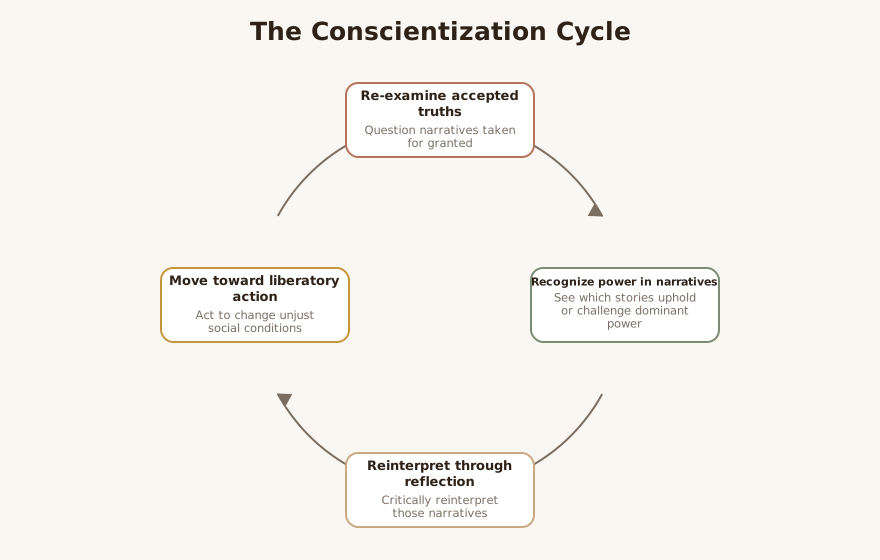
Several principles recur across the literature. First is the social orientation of distress: rather than attributing suffering to individual pathology, liberation psychology locates it within sociopolitical, historical, and cultural context, treating individual characteristics as partly a product of social relations 1. Second is conscientization itself — a continuous cycle of re-examining accepted “truths,” recognizing which narratives uphold or challenge dominant power, reinterpreting them through critical reflection, and potentially moving toward liberatory action 4.
Third is deideologization: because ideology obscures the social forces that maintain oppression, the practitioner helps people see social reality transparently rather than through the distortions of dominant ideology 1. Fourth is the recovery of historical and social memory — anchoring work in vivencia (lived experience), lo cotidiano (everyday reality), and the suppressed memories Comas-Díaz calls papelitos guardados 3. Fifth is the preferential option for the oppressed majorities: psychology should be built from and with marginalized communities, not merely for them 1. Finally, liberation psychology holds that personal and collective liberation are linked — Freire argued that healing emerges for both the oppressed and the oppressor once the oppressed begin their own liberation 36.
Interventions & Techniques
Liberation psychology supplies a set of methods and clinical practices rather than a fixed session structure. Conscientization dialogue is foundational: the clinician uses Socratic, problem-posing questioning to help the client connect personal symptoms to structural conditions, replacing Freire’s “banking” model of expert-to-novice transmission with co-investigation 64. Useful prompts include asking who benefits from a given belief or arrangement, who is harmed, and whose voice is missing — questions drawn directly from the critical-thinking practices of the tradition 4.
Testimonio is a clinical method in which the client narrates lived experience of oppression and survival, which can build solidarity and externalize suffering from private shame to shared political reality 3. Acompañamiento (accompaniment) names the relational stance of intentionally working with, being with, and experiencing alongside those impacted by systemic oppression, repositioning the therapist as a companion rather than a detached authority 3. Liberation psychotherapy, as articulated by Comas-Díaz, is a culturally, contextually, and sociopolitically embedded approach anchored in lived experience and psychospirituality that emphasizes the uniqueness of the therapeutic relationship 3. At the community level, participatory action research positions community members as co-researchers who define the problem and own the findings, and social justice action invites clients to define and pursue forms of engagement they are comfortable with — from voting to community service to artivism 3.
LLM-generated illustrative example (not a guideline): A first-generation immigrant client describes “failing” because she cannot get ahead despite working two jobs. Rather than reinforcing a purely individual reframe, the clinician asks who designed the systems she is navigating, what barriers other people in her position face, and how she learned to read her exhaustion as personal inadequacy. The work shifts from “fix my deficiency” toward “understand my situation and decide what I want to do about it” LLM.
Evidence Base
Honesty about the evidence is important here. Liberation psychology is an established and influential framework with a substantial theoretical, conceptual, and applied literature, a canonical primary text, an APA-published clinical volume, and international networks of practitioners 123. Its constructs have been incorporated into mainstream guidance — for example, APA’s revised practice guidelines for girls and women drew on liberation-psychology elements 3. The British Psychological Society has presented it as a serious, enduring tradition within the discipline 5.
What it largely lacks is the kind of evidence base built from randomized controlled trials and standardized outcome measurement that supports established symptom-focused treatments LLM. This is partly by design: the tradition is methodologically eclectic and explicitly critical of “value-neutral,” decontextualized, positivist research, holding that research is neither neutral nor fully objective because it is embedded in cultures of privilege 13. Much of its empirical support therefore comes from qualitative work, participatory action research, case studies, and testimonio rather than effect sizes 3. For clinicians, the practical implication is to use liberation-psychology principles as an integrative lens layered onto evidence-based modalities, while being candid with clients and supervisors that the structural reframe is well-theorized but not validated in trial form LLM.
Populations & Indications
The framework was developed specifically to address the sociopolitical oppression of disadvantaged and marginalized communities, and U.S. practitioners have applied it across many such groups 3. Documented populations include People of Color and Indigenous individuals, African Americans, Latinx clients, immigrants and refugees, women and Women of Color, low-socioeconomic-status communities, and LGBTQ+ individuals people 31. It has also been used internationally with survivors of political violence and colonization, including transnational applications across the Philippines, Thailand, South Africa, the United Kingdom, and Ireland 3.
Indications cluster around distress that is plausibly driven or compounded by oppression: internalized oppression, racial and ethno-racial trauma, minority stress, demoralization, disempowerment, identity concerns, and collective trauma, as well as depression, low self-esteem, and post-traumatic stress that have a clear structural dimension 13. The editors of the APA volume note that because most people hold areas of both privilege and oppression, liberation approaches can have relevance beyond the most acutely marginalized — though the preferential focus remains the oppressed majorities 3.
Problems-for-Work
Internalized oppression. Freire’s notion of the internalized oppressor gives clinicians a target: the client has absorbed the dominant group’s appraisal of their worth, and the work is to surface and contest it rather than simply boost “self-esteem” in a vacuum 63. Application: with a Black client who describes himself in terms that mirror racist stereotypes, the clinician names the historical source of those messages and distinguishes the client’s identity from the ideology imposed on it 41.
Racial and ethno-racial trauma. Liberation psychology supplies a framework that treats racism and oppression as the etiological context, not background noise, allowing the client to locate symptoms in a comprehensible external reality 3.
Minority stress in LGBTQ+ individuals clients. Rather than focusing only on the effects of homophobia, the approach reframes a client’s distress as an understandable incorporation of homonegative attitudes embedded in social structures — a deideologizing move that reduces self-blame 1.
Demoralization and disempowerment. Conscientization reframes “there is something wrong with me” as “I am responding to something wrong around me,” which can restore agency and a path toward action 4LLM.
Contraindications, Cautions & Cultural Humility
There are no formal medical contraindications, but several cautions matter. The structural reframe should not be imposed; deideologization is meant to help people “understand for themselves,” not to substitute the therapist’s politics for the client’s 14. A premature or clinician-led political interpretation can replicate the very “banking” dynamic Freire warned against, in which the expert deposits conclusions into a passive recipient 6. Clinicians should also be careful not to dismiss biological, relational, or intrapsychic contributors to a client’s suffering in the name of structural analysis — the framework’s own model is the interaction of intrapsychic and systemic factors, not a replacement of one with the other 3.
Cultural humility is central rather than incidental. The tradition is explicitly decolonial and skeptical of Eurocentric, individualist, “universal” frameworks, and it asks practitioners to honor multiple ways of knowing, including Indigenous and spiritual traditions and popular wisdom (sabiduría popular) 3. The critical-thinking stance turns inward too: practitioners are asked to consider who developed the theories they use, who benefits, and whose voices were excluded 4. Clinicians from privileged positions working with oppressed clients should attend to power in the room and to their own areas of unexamined privilege 3LLM.
Treatment-Plan Suggestions & SMART Objectives
| Goal | SMART objective (example) | Mechanism |
|---|---|---|
| Reduce internalized oppression | Within 8 sessions, client will identify and verbally challenge 3 self-statements that echo dominant-group appraisals of their identity 63 | Surfacing and contesting the internalized oppressor |
| Build critical consciousness | Over 6 weeks, client will articulate at least 2 structural factors contributing to a presenting stressor previously framed as personal failing 4 | Conscientization / deideologization |
| Lower self-blame in minority stress | Within 6 sessions, client will reattribute 2 recurring distress episodes from self-deficiency to a structural source, rated weekly 1 | Reframing distress as response to oppression |
| Recover suppressed memory | Across 10 sessions, client will narrate one testimonio of an oppression-related experience and note its impact 3 | Recovery of historical/social memory |
| Strengthen cultural identity | Within 12 weeks, client will name 3 valued aspects of their cultural identity and one source of community connection 3 | Affirming cultural identity; acompañamiento |
| Restore agency through action | Within 8 weeks, client will choose and complete one self-defined social or community engagement they feel comfortable with 3 | Linking personal and collective liberation |
| Reduce demoralization | Over 6 sessions, client will report a measurable increase in sense of agency on a brief self-rating after structural reframing 4LLM | Shifting locus of blame from self to system |
Common Misconceptions
“It is just politics, not therapy.” The framework treats sociopolitical analysis as clinically load-bearing because it locates the etiology of much distress in real external conditions, while still operating through a therapeutic relationship and recognized clinical methods such as liberation psychotherapy and testimonio 31.
“It blames society for everything and ignores the individual.” The actual model is the interaction of intrapsychic and systemic factors; it expands rather than abolishes attention to the person 3.
“It is only for Latin American or only for the most oppressed.” Although it originated in Latin American community psychology, it has been applied across many populations and countries, and its editors argue most people hold both privilege and oppression 3.
“It is anti-evidence.” It is critical of claims that research is neutral and objective, and it favors participatory and qualitative methods — which is different from rejecting rigor 31.
Training & Certification
There is no single licensing body or certification credential for liberation psychology; it is a tradition learned through scholarship, mentorship, and applied practice rather than a registered, certifiable modality LLM. Foundational reading begins with Freire’s Pedagogy of the Oppressed and Martín-Baró’s Writings for a Liberation Psychology, with the APA volume Liberation Psychology: Theory, Method, Practice, and Social Justice serving as the most practice-oriented English-language text 623. International congresses and an English-language network established around 2011 provide ongoing community, and the field is increasingly taught within community, multicultural, feminist, and critical psychology programs 13. The British Psychological Society’s coverage signals its growing institutional recognition 5.
Key Terms
Conscientization (concientización) — the raising of critical sociopolitical consciousness; a cycle of re-examining accepted truths and moving toward liberatory action 14. Deideologization — helping people see social reality transparently rather than through dominant ideology 1. Internalized oppressor — the absorbed consciousness of the dominant group that the oppressed carry within themselves 63. Acompañamiento — the relational stance of intentionally accompanying those impacted by oppression 3. Testimonio — first-person narration of oppression and survival used as a clinical and solidarity-building method 3. Vivencia / lo cotidiano — lived experience and everyday reality as the anchor of practice 3. Papelitos guardados — suppressed or “put away” memories and experiences recovered in therapy 3. Preferential option for the oppressed — building psychology from and with marginalized communities 1.
Resources & Further Reading
▶ Watch — a video introduction to this concept:
- Liberation psychology (Wikipedia)
- Writings for a Liberation Psychology — Martín-Baró (Harvard University Press, 1994)
- Liberation Psychology: Theory, Method, Practice, and Social Justice — sample chapter (APA, 2020)
- What is Liberation Psychology? Consciousness Raising and Critical Thinking (CUNY Pressbooks)
- Liberation psychology – a history for the future (The Psychologist, BPS)
- Pedagogy of the Oppressed — Freire (1970)
Reflective / Supervision Questions
- When I formulate this client’s distress, how much weight am I giving to structural conditions versus intrapsychic and relational factors, and is that balance defensible 3?
- Whose appraisal of this client’s worth is operating in the room — theirs, mine, or a dominant group’s — and am I helping them distinguish these 64?
- Am I helping the client reach their own critical understanding, or am I depositing my interpretation into a passive recipient 6?
- What are my own areas of privilege relative to this client, and how might they be shaping what I notice and what I overlook 34?
- Whose voices and ways of knowing are excluded from the theories and measures I am using with this client 4?
- If the client moves toward social or community action, am I supporting their self-defined choices rather than my own agenda 3?