
Type & Discipline
Fallibilism is not a therapy. It is a doctrine in epistemology — the branch of Western philosophy concerned with knowledge, justification, and belief.1 Its core claim is that “no belief… can ever be rationally supported or justified in a conclusive way,” so that all of our beliefs are, at best, only fallibly justified.1 In this wiki it sits as a cross-disciplinary philosophical stance whose mechanisms map cleanly onto cognitive and acceptance-based clinical practice. LLM The clinically relevant translation is simple: any belief I hold — including a conviction that feels certain — might be wrong, and my knowledge is provisional and open to revision in light of new evidence. LLM This stance, when held as an attitude rather than recited as a slogan, is what clinicians and clients alike call epistemic humility. LLM
Creators & Lineage
The word fallibilism “comes from the nineteenth century American philosopher Charles Sanders Peirce,” even though the underlying idea is much older.1 Peirce rejected the search for indubitable foundations: he “cannot be any type of epistemological foundationalist or believer in absolute or apodeictic knowledge. He must be, and is, an anti-foundationalist and a fallibilist.”2 For Peirce, inquiry is always unfinished — “at any temporal point in the process of scientific inquiry we are only at a provisional stage” — yet this is not despair, because methodical inquiry tends to converge over time, and his governing maxim was “Do not block the way of inquiry!”25 In the twentieth century Karl Popper carried a closely related spirit into the philosophy of science, arguing that scientific theories can never be conclusively proven, only provisionally held and tested against attempts to refute them — a critical-rationalist outlook usually summarized as “conjectures and refutations.” LLM Within psychotherapy, this fallibilist temper runs through several traditions on the lineage chart: Socratic questioning (testing beliefs by examining their grounds), Stoicism (distinguishing judgments from facts), Cognitive Behavioral Therapy (CBT) (treating thoughts as hypotheses to be checked), and Acceptance and Commitment Therapy (ACT) (holding thoughts lightly rather than fusing with them). LLM
Core Principles
- No conclusive justification. Even our best-supported beliefs are “only, at best, fallibly justified”; certainty is not a precondition of holding them.1 LLM
- Knowledge without certainty is still knowledge. Fallibilism does not deny that we know things; the majority of epistemologists are fallibilists who are not skeptics, seeking “a theory that allows perpetually fallible people to have knowledge and justified beliefs.”1 LLM
- Beliefs are provisional and revisable. What we hold now is a “provisional stage” of inquiry, to be updated as evidence accrues, not a final verdict.2 LLM
- Inquiry is self-correcting. Error is expected and informative; the appropriate response to being wrong is revision, not collapse — “Do not block the way of inquiry.”2 LLM
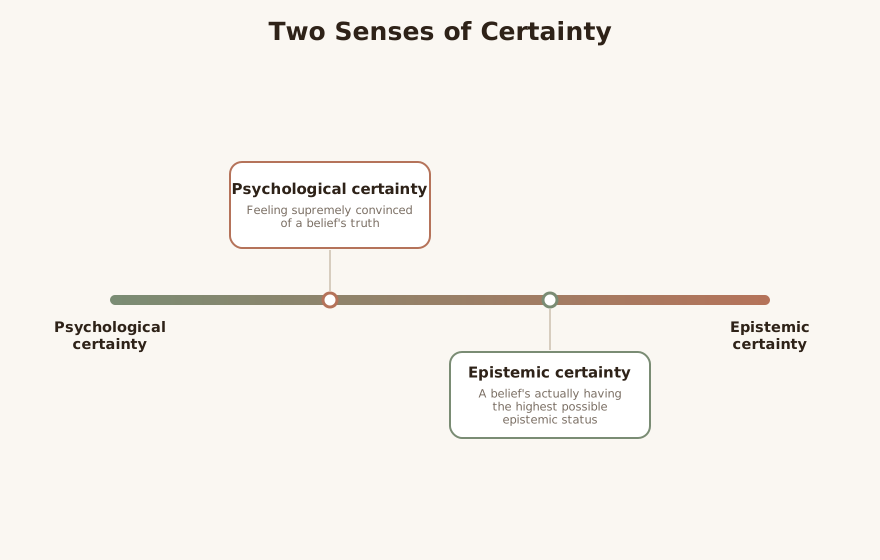
- Certainty is layered. Philosophy distinguishes psychological certainty (feeling “supremely convinced of its truth”) from epistemic certainty (a belief’s actually having “the highest possible epistemic status”); the two can diverge, and the felt sense of certainty is no guarantee of the epistemic kind.3 LLM
The clinical payoff of that last distinction is large: a client can feel 100% certain (“I know they’re judging me”) while that belief enjoys no special epistemic standing at all. LLM Fallibilism gives the therapist a principled, non-pejorative way to separate the feeling of certainty from its justification. LLM
Interventions & Techniques
Because fallibilism is a stance rather than a protocol, it is operationalized inside recognized, billable modalities rather than delivered on its own. LLM
- Treating thoughts as hypotheses (CBT). The whole logic of cognitive restructuring presupposes fallibilism: a thought is a guess about reality that can be examined and may turn out to be inaccurate. LLM Techniques such as examining the evidence, generating alternative explanations, and rating confidence in a belief before and after review are fallibilism in action. LLM
- Behavioral experiments (CBT). The most direct clinical analogue of Popperian testing: the client states a prediction, designs a real-world test, and updates the belief based on what actually happens. LLM The therapeutic frame is “let’s find out,” not “let me convince you.” LLM
- Socratic questioning. Guided, curious questioning that invites the client to discover the limits and grounds of a belief themselves — the dialogic engine of epistemic humility. LLM
- Cognitive defusion (ACT). Holding a thought as a thought (“I’m having the thought that I’ll fail”) rather than fusing with it as literal truth is the experiential form of “this belief might be wrong.” LLM
- Modeling fallibility (therapeutic relationship). A clinician who can say “I had that wrong — thank you for correcting me” demonstrates that revising a belief is a competence, not a humiliation. LLM
LLM-generated illustrative example (not a guideline): A client certain that “everyone at the party will think I’m boring” co-designs a behavioral experiment — attend for 30 minutes, count actual reactions — and afterward updates the prediction from “certain” to “I assumed the worst and was mostly wrong.” The therapist frames the surprise as evidence the original belief was a hypothesis, not a fact. LLM
Evidence Base
Honesty about maturity here requires a careful distinction. As a philosophical doctrine, fallibilism is established and mainstream — it is the position held by the majority of contemporary epistemologists, not a fringe or speculative view.1 What is not established is fallibilism as a standalone, manualized treatment: it has never been tested as such and carries no randomized-controlled-trial base of its own. LLM Its clinical weight is therefore indirect but substantial, flowing through the evidence-based therapies it underwrites — the empiricism of CBT, the experimental method of behavioral experiments, the defusion procedures of ACT, and the long pedagogical tradition of Socratic questioning. LLM The accurate framing for clinicians: use fallibilism as a conceptual scaffold and a therapeutic stance, and deliver measurable change through its evidence-based descendants. LLM
Populations & Indications
Epistemic humility is most indicated where the rigidity of a belief, rather than its content, is the engine of distress. LLM This includes adults with cognitive rigidity or dogmatic thinking, who treat contestable beliefs as settled facts; people with anxiety disorders and perfectionism, whose suffering is fed by demands for certainty and for being “right”; and clients with obsessive thinking, for whom an unattainable standard of proof drives compulsive checking and reassurance-seeking. LLM It is also valuable in couples and interpersonal conflict, where each party’s felt certainty about the other’s motives forecloses curiosity. LLM Finally, it is a stance for clinicians and therapists themselves and for cross-cultural work, where humility about one’s own assumptions is an ethical baseline. LLM
Problems-for-Work
- Cognitive distortions — fallibilism supplies the rationale for treating an automatic thought as one possible reading among several, not a transcription of reality. LLM
- Cognitive rigidity & dogmatic thinking — the work is to convert “I know” into “I currently believe, on this evidence,” restoring the possibility of revision. LLM
- Perfectionism — relocating worth away from being conclusively right and toward acting well under unavoidable uncertainty. LLM
- Generalized anxiety disorder & intolerance of uncertainty — here the application is delicate (see Cautions): the goal is accepting that certainty is unavailable and acting on best-available evidence anyway, not dismantling the client’s beliefs or proving safety. LLM
- Obsessive thinking — naming the impossible standard of proof that compulsions chase, then practicing tolerance of doubt rather than its elimination. LLM
- Interpersonal conflict (couples) — substituting “I might be misreading you” for certainty about a partner’s intent reopens dialogue. LLM
LLM-generated illustrative example (not a guideline): In couples work, a partner convinced “you left the dishes to spite me” is invited to hold that as one hypothesis and ask directly; the disclosed reason (“I got a call about my mother”) disconfirms the certainty and de-escalates the conflict. LLM
Contraindications, Cautions & Cultural Humility
The central clinical hazard is iatrogenic doubt. LLM Delivered naively to clients with GAD, intolerance of uncertainty, or OCD, the message “you can never be certain” can backfire badly — it feeds rumination, reassurance-seeking, and chronic indecision, because the client hears it as a problem to solve rather than a condition to accept. LLM The therapeutic target is acceptance of irreducible uncertainty plus committed action on best-available evidence; fallibilism must never become a tool for dismantling a client’s confidence or for endless re-examination of beliefs. LLM
A second caution is misuse against the client in the room: “you can’t be certain you were harmed/discriminated against” weaponizes epistemic humility to invalidate real experience, and is contraindicated where a client is describing abuse, trauma, or injustice. LLM Provisional knowledge is still knowledge; fallibilism does not license gaslighting.1 LLM
Culturally, the very framing of belief as private, revisable, and evidence-based reflects a particular epistemology; some clients locate truth in tradition, faith, family, or community authority, and an aggressive “test your beliefs” stance can read as disrespectful. LLM Hold the method lightly, and apply epistemic humility first to your own assumptions about the client. LLM
Treatment-Plan Suggestions & SMART Objectives
| Goal | SMART objective (example) | Mechanism |
|---|---|---|
| Reduce belief-as-fact rigidity | For 6 weeks, client logs 3 automatic thoughts/week and rates belief 0–100% before and after examining the evidence | Treating thoughts as revisable hypotheses (CBT) |
| Test catastrophic predictions | Over 8 weeks, client completes ≥1 behavioral experiment/week with a written prediction and outcome | Popperian conjecture-and-refutation; behavioral experiment |
| Increase tolerance of uncertainty | Daily for 4 weeks, client practices a “leave it uncertain” exercise (no reassurance-seeking) and rates distress 0–10 | Acceptance of irreducible uncertainty |
| Loosen perfectionistic “must be right” | For 6 weeks, client deliberately acts on best-available (not perfect) information ≥3×/week and logs the result | Decoupling worth from conclusive certainty |
| Reduce dogmatic interpretation in conflict | Across 6 sessions, couple replaces ≥2 “I know you meant…” statements/session with a curiosity question, logged | Provisional reading of others’ intent |
| Build epistemic flexibility | Weekly for 8 weeks, client generates ≥2 alternative explanations for a distressing event before concluding | Multiple-hypothesis generation |
| Strengthen defusion from sticky thoughts | Daily for 4 weeks, client uses an “I’m having the thought that…” frame for a recurrent thought, rating fusion 0–10 | Cognitive defusion (ACT) |
Illustrative; deliver via CBT/ACT methods and measure with validated instruments. LLM
Common Misconceptions
- “Fallibilism means we can’t really know anything (skepticism).” False. Fallibilists are, in the main, not skeptics; the standard view “allows perpetually fallible people to have knowledge and justified beliefs” — knowledge simply does not require infallibility.1 LLM
- “It means all views are equally valid (relativism).” No. That some belief might be wrong does not make every belief equally well-supported; fallibilism is fully compatible with one view being far better justified than another.1 LLM
- “Holding beliefs provisionally means you can’t act decisively.” A belief can be both provisional and action-guiding; Peirce’s point is that we act on the best available conclusion while keeping inquiry open, not that we freeze.2 LLM
- “If I feel certain, I am certain.” The feeling of psychological certainty is distinct from epistemic certainty and can occur for poorly justified beliefs.3 LLM
Training & Certification
There is no certification in “fallibilism” or “epistemic humility,” and none is needed. LLM Competent clinical use rests on two things: basic philosophical literacy (the entries below give a sufficient grounding), and formal training in the evidence-based modalities that operationalize the stance — CBT, ACT, and the Socratic method as taught within them. LLM The relevant clinical skill is delivering the stance (curiosity, hypothesis-testing, modeled fallibility) competently inside those modalities, not reciting epistemology to clients. LLM
Key Terms
- Fallibilism — the thesis that no belief is ever conclusively or “infallibly” justified; all justification is, at best, fallible.1
- Anti-foundationalism — the rejection of indubitable foundations for knowledge, a commitment Peirce shared.2
- Provisional knowledge — belief held as the current, revisable best stage of inquiry rather than a final verdict.2
- Psychological vs. epistemic certainty — being subjectively “supremely convinced” versus a belief actually having “the highest possible epistemic status”; the two can come apart.3
- Epistemic humility — the practiced attitude that one’s beliefs may be mistaken and warrant openness to revision. LLM
Resources & Further Reading
▶ Watch — a video introduction to this concept:
- Fallibilism — Internet Encyclopedia of Philosophy (Stephen Hetherington)
- Charles Sanders Peirce — Stanford Encyclopedia of Philosophy
- Certainty — Stanford Encyclopedia of Philosophy
- Fallibilism — Routledge Encyclopedia of Philosophy
- Peirce’s Fallibilism — PhilArchive
Reflective / Supervision Questions
- When I help a client “test a belief,” am I cultivating genuine openness, or am I covertly steering them toward the conclusion I already hold? LLM
- With an anxious or obsessive client, am I offering uncertainty as something to accept, or am I inadvertently feeding the search for certainty I mean to relax? LLM
- Where do I treat my own clinical formulations as provisional hypotheses, and where have they hardened into certainties I no longer test against the client’s feedback? LLM
- How do I distinguish helpful epistemic humility from a use of “you can’t be certain” that invalidates a client’s real experience of harm? LLM