
Type & Discipline
Cultural, multicultural, and intersectional systemic frameworks are not a single therapy but a family of organizing lenses that situate a client’s presenting concern within cultural identity, migration and acculturation, family structure and expectations, and experiences of discrimination and power 5. They sit at the intersection of family therapy and cultural theory, asking the clinician to treat the family and its surrounding social systems — not only the individual — as the unit of understanding 5. Within this family of approaches, multicultural family counseling specifically attends to how cultural values, immigration history, and acculturation shape family roles, communication, and conflict 5.
The intersectional strand of these frameworks draws on the legal and feminist scholarship of Kimberlé Crenshaw, who coined the term to describe how overlapping systems of oppression — for example race and gender together — produce experiences that cannot be understood by examining each category in isolation 2. The American Psychological Association formalized a complementary professional stance in its 2017 Multicultural Guidelines, which adopt an ecological approach attending to context, identity, and intersectionality across the systems in which a person is embedded 1. Taken together, these frameworks function as a lens for assessment and case formulation that can be layered onto family-based and relational treatment rather than as a standalone modality LLM.
Creators & Lineage
The lineage of these frameworks runs through family systems therapy, which established that symptoms are best understood in relational and structural context rather than as properties of an isolated individual 5. Within multicultural family work, several theorists are conventionally credited with bringing culture to the center of systemic practice: Celia Falicov, known for a multidimensional ecological comparative framework for working with migrating families; Monica McGoldrick, associated with culturally informed genograms and the study of ethnicity in family life; and Nancy Boyd-Franklin, known for a multisystems approach to therapy with Black families LLM. Multicultural family counseling as a field synthesizes these contributions into attention to cultural values, acculturation, and family hierarchy in assessment and intervention 5.
The intersectional strand has a distinct origin in critical and feminist scholarship 2. Crenshaw introduced intersectionality in 1989 to capture how Black women’s experiences fell between the cracks of antidiscrimination frameworks built around single-axis categories, and she has continued to clarify that the concept is a lens for seeing compounded disadvantage rather than a fixed identity label 6. This lens has since been imported into acculturation research, where scholars argue that acculturative experience is itself shaped by intersecting social positions and cannot be reduced to a single ethnic dimension 3. The frameworks also share intellectual kinship with liberation psychology and multicultural counseling, traditions that foreground sociopolitical context, oppression, and the client’s social location LLM.
Core Principles
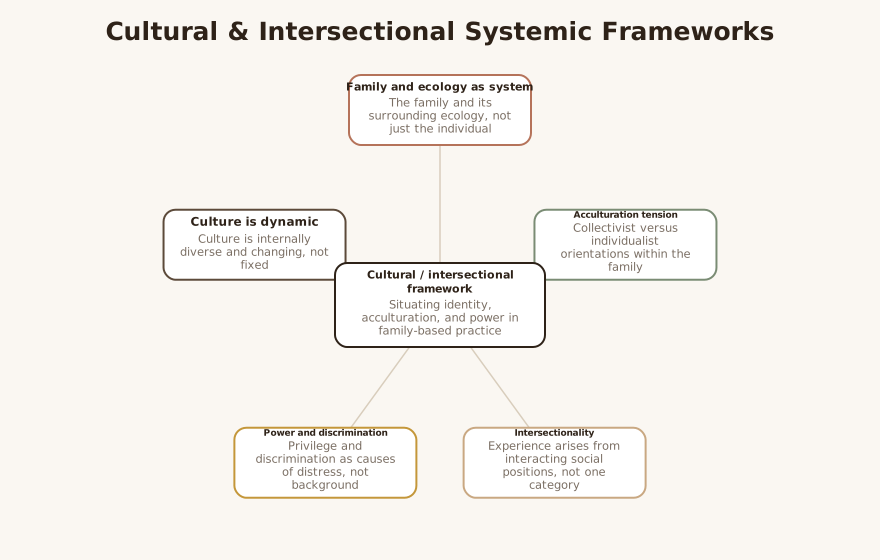
A first principle is that the family and its surrounding ecology, not just the individual, form the relevant system; cultural values, immigration history, and family roles are treated as central clinical data 5. A second is the salience of acculturation and the tension between collectivist and individualist orientations, which can generate friction when family members acculturate at different rates or hold differing expectations about autonomy, obligation, and authority 5. A third is intersectionality: a client’s experience arises from the interaction of multiple social positions — race, gender, class, sexual orientation, immigration status — rather than from any single category considered alone 2.
A fourth principle is attention to power, privilege, and discrimination as causes of distress, not merely as background 1. The APA framework’s ecological orientation directs clinicians to consider the layered contexts — relationships, community, institutions, and the broader sociopolitical environment — that shape identity and well-being 1. A fifth principle, drawn from the application of intersectionality to acculturation, is that culture is dynamic and internally diverse: two people from the same nominal group may have very different experiences depending on their other social positions and contexts 3. A sixth, emphasized in culturally informed family treatment, is flexibility — adapting the structure and content of therapy to the family’s values rather than imposing a fixed model 4.
Interventions & Techniques
The foundational technique is culturally informed assessment, in which the clinician maps the family’s cultural background, migration and acculturation history, family hierarchy, and the salience of various identities to the presenting problem 5. In manualized form, this has been operationalized in culturally informed and flexible family-based treatment, which combines structural and strategic family therapy techniques with explicit attention to the cultural and acculturative themes affecting the family 4. That approach is deliberately flexible, allowing the clinician to weight engagement, family hierarchy, and acculturation conflict according to each family’s circumstances 4.
A second technique is intersectional formulation, in which the clinician examines how overlapping social positions combine to shape both the problem and the client’s access to support, rather than treating identity categories one at a time 2. Applied to acculturation, this means asking how a client’s specific configuration of positions — for instance, immigration status alongside gender and class — shapes the acculturative demands they face 3. A third technique is contextual and ecological inquiry consistent with the APA guidelines, situating the client within nested systems and considering institutional and sociopolitical influences on the presenting concern 1.
Family-based engagement strategies are also central, since culturally informed treatment with adolescents and families often hinges on joining successfully with parents whose expectations about authority and respect differ from mainstream clinical assumptions 4. The clinician uses these strategies to reframe intergenerational conflict in terms of differing acculturation and to mobilize family strengths 4.
LLM-generated illustrative example (not a guideline): A clinician sees a 16-year-old referred for defiance whose immigrant parents emphasize family obligation and deference, while the teen voices a more individualist, peer-oriented stance. Using a culturally informed family lens, the clinician reframes the conflict as an acculturation gap rather than pure adolescent pathology, joins with the parents around their values, and helps the family negotiate revised expectations — addressing intergenerational conflict directly. LLM
Evidence Base
The maturity of these frameworks is best described as established as teaching and clinical-organizing models, with a growing but uneven outcome evidence base for the culturally adapted treatments derived from them LLM. As conceptual frameworks, multicultural and intersectional approaches are well institutionalized: the APA codified them in formal multicultural guidelines, intersectionality is documented across scholarly and reference sources, and multicultural family counseling is an established subfield 1 2 5. The application of intersectionality to acculturation is comparatively newer, framed in the literature as bringing theory to practice rather than as a settled, trial-tested method 3.
On the treatment side, the strongest empirical support comes from culturally adapted, manualized family interventions rather than from the broad frameworks themselves 4. Culturally informed and flexible family-based treatment was developed and studied specifically for Hispanic adolescents and their families, integrating diversity considerations into a structured family therapy model 4. Clinicians should therefore distinguish two claims: that culturally responsive, intersectional formulation improves the thoroughness and fairness of assessment, which rests largely on conceptual grounding and professional consensus, and that any specific culturally adapted family protocol improves symptom outcomes, which must be evaluated against that protocol’s own evidence LLM. The honest summary is that the lens is mature and widely endorsed, while the comparative outcome evidence for “culture-as-intervention” is still developing LLM.
Populations & Indications
These frameworks are most clearly indicated for immigrant families and bicultural individuals, where migration history, acculturation, and differing rates of cultural change among family members are often central to the presenting concern 5. They are also salient for racial and ethnic minorities, whose experiences of discrimination and minority stress are foregrounded by the intersectional and ecological lens rather than treated as peripheral 1. Because intersectionality attends to compounded disadvantage, the frameworks are particularly relevant for clients holding multiple non-dominant positions, including LGBTQ+ individuals individuals whose sexual or gender identity interacts with race, class, or immigration status 2.
At the relational level, the frameworks apply naturally to families and couples, where cultural values about gender roles, authority, and obligation shape conflict and expectations 5. They are indicated whenever the clinician suspects that acculturation, cultural mismatch with mainstream clinical assumptions, or experiences of discrimination are shaping engagement, the problem, or the therapeutic relationship LLM. Culturally informed family treatment has been applied specifically with adolescents and their families in minority and immigrant communities 4.
Problems-for-Work
The frameworks directly support work on acculturative stress by mapping the family’s migration history and the differing acculturation trajectories of its members, clarifying which demands are generating distress 3. They are well suited to intergenerational conflict, which culturally informed family treatment often reframes as a gap in acculturation and values between generations rather than as simple oppositionality 4.
LLM-generated illustrative example (not a guideline): A bicultural young adult presents with depression and guilt over wanting to move out before marriage, which their parents experience as rejection. The clinician uses an acculturation and intersectional lens to separate a depressive episode from a values conflict rooted in collectivist family expectations, then frames the work around negotiating autonomy and obligation — addressing acculturative stress and family conflict. LLM
The intersectional and ecological lens helps conceptualize minority stress and discrimination-related distress by naming experiences of oppression as legitimate clinical material situated in social context rather than minimizing them 1. The frameworks assist with identity disturbance and internalized oppression by giving client and clinician shared language for how intersecting identities are negotiated and how dominant narratives are sometimes turned inward 2. They support work on family conflict and relationship conflict by surfacing culturally patterned expectations about roles and authority 5. And by distinguishing context-driven distress from primary disorder, they aid accurate formulation of adjustment difficulties and depression that are entangled with cultural transition 3.
Contraindications, Cautions & Cultural Humility
These frameworks have no clinical contraindication in the usual sense, but they carry important cautions in use LLM. The central risk is essentialism: treating “culture” as a fixed set of group traits, which collapses the within-group diversity that intersectionality and acculturation theory specifically warn against 3. Two clients from the same nominal background may differ profoundly depending on their other social positions, so the clinician must explore salience collaboratively rather than assume it 3.
A second caution concerns intersectionality’s own contested boundaries; the concept has been the subject of debate and critique as it has spread from legal scholarship into wider use, and clinicians should apply it as an analytic lens for compounded experience rather than as a rigid identity taxonomy 2. Crenshaw herself has emphasized that intersectionality is about lived disadvantage and structural patterns, not a contest of labels 6. A third caution is that endorsing multicultural principles is not the same as practicing them; the APA guidelines frame cultural responsiveness as an ongoing, context-sensitive commitment rather than a competency one finishes acquiring 1. Finally, the frameworks should complement, not replace, direct and respectful inquiry into how the client and family understand their own identities, values, and concern LLM.
Treatment-Plan Suggestions & SMART Objectives
| Goal | SMART objective (example) | Mechanism |
|---|---|---|
| Reduce acculturative stress | Over 8 weeks, client will identify 3 specific stressors tied to migration or acculturation and apply 2 coping strategies, with weekly distress ratings | Mapping acculturation history makes diffuse distress specific and workable 3 |
| De-escalate intergenerational conflict | Within 6 family sessions, family will renegotiate 2 disputed expectations (e.g., autonomy, obligation), with parent- and youth-rated conflict reduced | Reframing the dispute as an acculturation gap and joining with parents mobilizes change 4 |
| Strengthen engagement across cultural difference | Within 3 sessions, clinician and family will discuss at least 2 salient cultural or identity influences, with family-rated alliance maintained or improved | Culturally informed joining reduces mismatch with mainstream clinical assumptions 4 |
| Clarify cultural contributors to the problem | By session 3, complete a culturally informed assessment identifying the 2-3 identities the client rates as most salient to the concern | Intersectional, ecological formulation prevents reducing culture to one dimension 1 |
| Address minority stress and discrimination | Over 10 weeks, client will name 3 discrimination-related stressors and develop 2 protective responses, tracked session by session | Naming oppression as legitimate clinical material in context validates and targets distress 1 |
| Support intersectional identity integration | Over 12 weeks, client will articulate how 2 intersecting identities relate to a values-based goal, rated each session | Shared intersectional language clarifies competing identity demands 2 |
| Reduce internalized oppression | Within 8 sessions, client will identify 2 internalized negative messages and reframe each, with self-report change | Externalizing oppression as structural rather than personal counters self-blame 6 |
| Improve clinician cultural responsiveness | Before formulation, clinician will document the family’s ecological context and 2 areas of potential bias relevant to this case | Ecological, humility-oriented self-assessment grounds responsive practice 1 |
Common Misconceptions
One misconception is that these frameworks are themselves a discrete therapy; they are organizing lenses for assessment and formulation applied within family-based and relational treatments 5. A second is that “culture” means race or ethnicity alone, when the intersectional and ecological framing specifically directs attention to the interaction of many social positions 2. A third is that members of a cultural group are interchangeable, which acculturation-and-intersectionality scholarship rejects in favor of within-group diversity and dynamic, context-dependent experience 3.
A fourth misconception is that intersectionality is a hierarchy of victimhood or a fixed identity label; its originator describes it as a lens for understanding compounded, structurally produced disadvantage 6. A fifth is that adopting multicultural guidelines is a one-time achievement, whereas the APA frames cultural responsiveness as an ongoing, contextual commitment 1. A sixth is that attending to acculturation conflict means siding with the more acculturated family member; culturally informed family treatment instead seeks to join with and balance the whole system 4.
Training & Certification
There is no single certification that confers mastery of these frameworks; they are taught within family therapy, multicultural counseling, and clinical psychology training rather than credentialed as one unit LLM. The APA Multicultural Guidelines provide an authoritative, freely available statement of the ecological and intersectional stance and are a standard reference for training programs 1. Foundational understanding of intersectionality can be built from accessible reference and primary-voice sources, including Britannica’s overview and Crenshaw’s own clarifying interviews 2 6.
Applied skill in culturally informed family work is developed through study of the specific manualized treatments and the broader multicultural family counseling literature, and through supervised practice with diverse families 4 5. Clinicians seeking to operationalize the acculturation-intersectionality link can draw on the practice-oriented scholarship that translates that theory into assessment questions and case formulation 3.
Key Terms
Intersectionality: A lens, originating with Crenshaw, for understanding how overlapping social positions produce compounded experiences of advantage or disadvantage that single-axis analysis misses 2.
Acculturation: The process of cultural change and adaptation following sustained contact between groups, now understood as itself shaped by a person’s intersecting social positions 3.
Ecological approach: The orientation, central to the APA Multicultural Guidelines, that situates identity and well-being within nested contexts from relationships to the broader sociopolitical environment 1.
Collectivism versus individualism: Contrasting value orientations regarding obligation, autonomy, and family authority, whose mismatch within and across generations often drives family conflict 5.
Culturally informed and flexible family-based treatment: A manualized, structurally rooted family therapy that integrates cultural and acculturation themes and adapts to each family’s values 4.
Minority stress: The excess stress arising from a stigmatized or non-dominant social position, foregrounded by the intersectional and ecological lens as a contributor to distress 1.
Resources & Further Reading
▶ Watch — a video introduction to this concept:
- APA Multicultural Guidelines: An Ecological Approach to Context, Identity, and Intersectionality (2017)
- Intersectionality — Britannica (definition, Crenshaw, history, applications, criticism)
- Considering intersectionality in acculturation: Bringing theory to practice — International Journal of Intercultural Relations (2022)
- Bridging Diversity and Family Systems: Culturally Informed and Flexible Family-Based Treatment for Hispanic Adolescents
- Multicultural Family Counseling — Psychology iResearchNet
- Kimberlé Crenshaw on What Intersectionality Means Today — TIME
Reflective / Supervision Questions
- When I assess a family from a culture different from my own, do I explore the salience of each identity collaboratively, or assume it from group membership? LLM
- How do I distinguish an acculturation-and-values conflict from primary psychopathology in a bicultural client? LLM
- Where in this family’s presentation am I treating “culture” as a fixed trait rather than a dynamic, internally diverse, context-dependent process? LLM
- Whose perspective do I implicitly side with when intergenerational acculturation conflict surfaces, and how do I keep joined with the whole system? LLM
- How does my own social location and its intersecting positions shape what I notice — and miss — with this client? LLM
- Am I naming discrimination and minority stress as legitimate clinical material in context, or quietly reframing them as individual distortion? LLM