
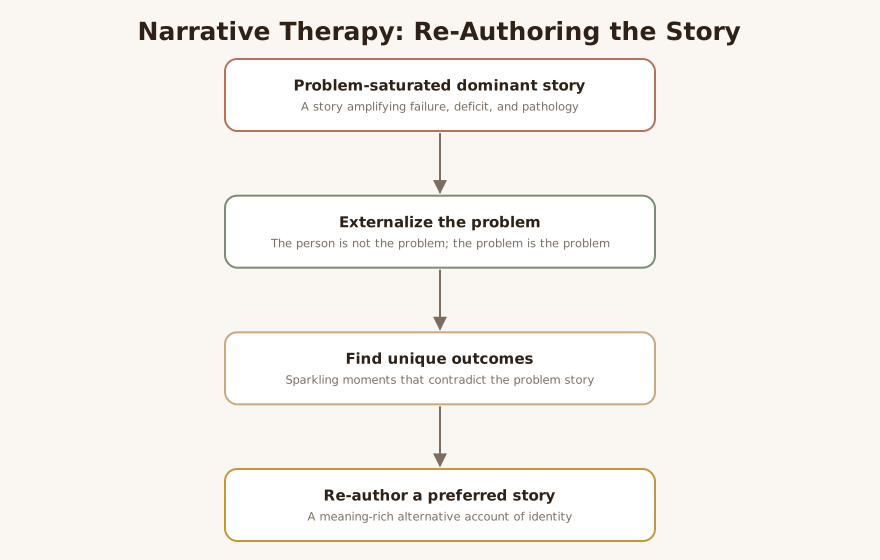
Narrative therapy invites clinicians to treat the stories people tell about their lives not as mere reports of an underlying reality but as the very material from which identity is constructed. 1 For practicing therapists trained primarily in symptom-and-syndrome models, the shift in stance can be disorienting at first: the problem is no longer located inside the person, and the therapist is no longer the expert on the client’s life. LLM What follows is a working orientation to the model, its techniques, its evidence, and the practical question of how to deliver it within recognized billable care.
Type & Discipline
Narrative therapy is a psychotherapeutic modality that sits within the family-therapy tradition and is classified as a postmodern, social-constructionist approach. 4 It belongs to the same broad lineage as solution-focused brief therapy and other postmodern practices that reject the idea of a single objective truth about a person’s difficulties in favor of multiple, socially constructed meanings. 5 The model is sometimes described as collaborative and non-pathologizing, positioning the client as the expert on their own life and the therapist as a curious, decentered but influential inquirer. 1 Because its theoretical roots lie in social constructionism, narrative therapy treats language, culture, and power as central rather than peripheral to clinical work. 4
Creators & Lineage
Narrative therapy was developed principally by the Australian social worker and family therapist Michael White, in close collaboration with the New Zealand-based therapist David Epston. 7 White co-founded the Dulwich Centre in Adelaide, which remains the field’s primary training and publishing hub, and he later established the Adelaide Narrative Therapy Centre. 7 The approach was crystallized for an international audience in White and Epston’s 1990 book Narrative Means to Therapeutic Ends, which introduced the now-signature ideas of externalizing the problem and re-authoring lives through letters and documents. 2 White drew on a range of intellectual influences, including the work of Michel Foucault on power and knowledge and ideas from anthropology and literary theory, weaving these into a clinical practice. 4 The model’s place within the family-systems field is explicit: it grew out of, and partly in reaction to, systemic family therapy, retaining attention to relationships and context while rejecting the more mechanistic systems metaphors. 4 Its kinship with solution-focused brief therapy reflects a shared postmodern moment in the 1980s and 1990s when several traditions moved away from deficit-focused assessment toward client competence and meaning. 5
Core Principles
The foundational claim of narrative therapy is that human beings make sense of their lives by organizing experience into stories, and that the dominant stories people hold about themselves shape what they notice, expect, and do. 1 A second principle is that the person is never the problem; the problem is the problem. 1 This externalizing stance separates the person’s identity from the difficulty, opening space to examine the problem’s tactics and influence rather than the person’s defects. 3 A third principle is that dominant stories are frequently “problem-saturated,” meaning they recruit and amplify evidence of failure, deficit, or pathology while editing out moments of competence, resistance, and hope. 5 Narrative therapists therefore attend closely to “unique outcomes” or “sparkling moments” — instances that contradict the problem story and could seed an alternative account. 3 A fourth principle is that identity and problems are constituted within social, cultural, and political contexts, so that experiences such as internalized oppression are understood as the absorption of dominant cultural narratives rather than as individual flaws. 4 Finally, the model holds that therapy is a collaborative, transparent process in which the therapist is decentered but influential, contributing skilled questions rather than authoritative interpretations. 1
Interventions & Techniques
The signature technique is externalizing conversation, in which the problem is linguistically separated from the person and often named as a distinct entity with its own habits and intentions, so that a client and therapist can map its effects and the person’s relationship to it. 3 Closely tied to this is the “statement of position map,” in which the therapist explores how the problem influences the person’s life and then invites the person to evaluate that influence and justify their evaluation, surfacing the values and commitments behind it. 6 Deconstruction questions trace a problem story to its origins in culture, family, and discourse, exposing taken-for-granted assumptions and the power relations that sustain them. 4 Identifying unique outcomes — events that the problem story cannot account for — gives the therapist an entry point to begin re-authoring, the collaborative construction of a richer, preferred narrative. 3
Re-authoring conversations move deliberately between the “landscape of action” (events, sequences, what was done) and the “landscape of identity” (what those events reveal about values, intentions, hopes, and commitments), thickening the alternative story across both dimensions. 6 White and Epston are well known for therapeutic documents — letters, certificates, and declarations that record and circulate the emerging preferred story, extending the work beyond the session. 2 Narrative therapists also use “definitional ceremonies” and “outsider-witness” practices, in which invited witnesses retell and resonate with what they have heard, lending the new identity claim social acknowledgment. 1 “Re-membering conversations” invite the client to revise the membership of their “club of life,” foregrounding figures who affirm the preferred identity. 1 These techniques are not a fixed protocol but a repertoire deployed in a particular conversational posture of respectful curiosity. LLM
LLM-generated illustrative example (not a guideline): A clinician working with an adolescent who has been labeled “defiant” might ask, “When did Anger first start telling you that adults can’t be trusted? What does Anger get you to do that you’d rather not do?” — externalizing the difficulty and inviting the young person to evaluate its influence. LLM
Evidence Base
Narrative therapy is best described as an established and widely practiced modality whose conceptual and clinical literature is far larger than its base of rigorous controlled trials. 4 It is taught internationally and disseminated through the Dulwich Centre and allied training organizations, and it has accumulated decades of detailed case description, theoretical development, and practitioner accounts. 1 At the same time, much of the empirical support takes the form of qualitative studies, case reports, and small studies rather than large randomized controlled trials, and methodological commentary has noted that the postmodern epistemology of the approach sits uneasily with the assumptions of standardized outcome measurement. 4 Clinicians should therefore present narrative therapy to clients and payers as a coherent, theoretically grounded, and broadly adopted approach while being candid that its trial-based evidence is more modest than that of, for example, manualized cognitive-behavioral protocols. LLM Where stronger empirical accountability is required, narrative methods are frequently integrated into broader evidence-based treatment frames rather than delivered as a freestanding intervention. LLM
Populations & Indications
Narrative therapy has been applied across the developmental span and across relational configurations, including adults, adolescents, children, couples, and whole families. 5 Its non-pathologizing, externalizing language is often described as particularly accessible for children and young people, for whom naming and “defeating” a problem can be developmentally engaging. 3 The model has been used with marginalized populations and communities, where its explicit attention to power, culture, and internalized oppression makes the connection between personal distress and social context an explicit part of the work. 4 It has also been applied with trauma survivors, drawing on its emphasis on identity reconstruction and on re-authoring accounts of survival and response rather than focusing solely on the traumatic events themselves. 5 Clinically, narrative work is described as relevant to difficulties including depression, anxiety, grief, low self-esteem, identity concerns, relationship conflict, behavioral problems, and eating difficulties, among others. 5
Problems-for-Work
In depression, the externalizing move reframes the client’s relationship to a problem-saturated story in which depression speaks with the authority of fact, allowing the therapist and client to map its claims and look for contradicting moments. 3 With anxiety, the model invites the client to notice when Worry recruits them into avoidance and to recover times they acted on their own values despite its presence. LLM For PTSD and trauma survivors, the work centers on thickening the survivor’s account of how they responded to and resisted what happened, restoring agency to an identity that the trauma story may have flattened. 5 In grief, narrative practices such as re-membering conversations help the client renegotiate, rather than sever, the relationship with the person who died. 1 For low self-esteem and identity concerns, deconstruction exposes the cultural and familial standards against which the person has been measuring themselves and judging themselves to fall short. 4 In relationship and family conflict, externalizing a shared problem — naming “the Argument” that comes between partners — can move couples from blaming each other to jointly examining the problem’s effects. LLM
LLM-generated illustrative example (not a guideline): With a client who describes herself as “a failure,” a therapist might ask for one recent moment, however small, that “Failure didn’t see coming,” then explore what that moment says about what she values — building a landscape-of-identity description of competence. LLM
For internalized oppression and behavioral problems, the model’s framing of distress as the uptake of dominant cultural narratives offers a route to externalize standards that have been imposed rather than chosen. 4 With eating difficulties, externalizing the eating problem as a separate, controlling voice is a long-standing application in the narrative tradition. LLM
Contraindications, Cautions & Cultural Humility
Narrative therapy is not a crisis-stabilization model, and its meaning-making, conversation-based methods do not substitute for acute risk assessment, safety planning, or medical intervention when a client is in danger. LLM Externalizing language should be applied thoughtfully: a clinician must avoid using “the problem is the problem” framing in a way that minimizes accountability for harmful behavior, particularly where there are issues of violence or abuse. LLM Clients who prefer a directive, expert-led approach, or who are looking for concrete skills training, may experience the decentered narrative stance as evasive unless the therapist explains the rationale and adapts the pace. LLM The model’s strong attention to culture, power, and context is itself a discipline of cultural humility, but it can become its opposite if a therapist imposes a sociopolitical interpretation that the client does not share; the client remains the author and authority on their own story. 1 Because narrative therapy is honest about its modest controlled-trial base, clinicians should be transparent with clients about the state of the evidence and willing to integrate or refer when a problem has a strong indication for a more empirically supported treatment. 4
Treatment-Plan Suggestions & SMART Objectives
| Goal | SMART objective (example) | Mechanism |
|---|---|---|
| Reduce the dominance of a problem-saturated story | Within 6 sessions, client will name and describe the problem as separate from self in 2 of 3 sessions, rated by clinician observation | Externalizing conversation 3 |
| Strengthen client agency | Over 8 weeks, client will identify and document at least 3 “unique outcomes” contradicting the problem story | Mapping unique outcomes 3 |
| Build a preferred identity narrative | By session 10, client will articulate 2 personal values that anchor a preferred story, in their own words | Re-authoring across landscapes of action and identity 6 |
| Decrease internalized self-criticism | Within 8 sessions, client will trace 1 self-critical standard to its cultural/familial origin and state whether they endorse it | Deconstruction questioning 4 |
| Reduce isolation around the problem | Within 6 weeks, client will identify 2 supportive figures for their “club of life” and describe their contribution | Re-membering conversation 1 |
| Consolidate gains socially | By the final phase, client will produce or receive 1 therapeutic document recording the preferred story | Therapeutic letters/documents 2 |
| Improve relational conflict | Within 8 sessions, couple will jointly name a shared externalized problem and list 3 of its effects on the relationship | Relational externalizing 1 |
Common Misconceptions
A frequent misunderstanding is that narrative therapy denies the reality of suffering or “just tells people to think positive”; in fact, it takes problems seriously and works to understand their tactics and effects in detail. 1 Another is that externalizing means excusing behavior, when the statement-of-position work explicitly invites the client to evaluate and take a stand on the problem’s influence. 6 Some assume the model is purely verbal and individualistic, but its outsider-witness, re-membering, and definitional-ceremony practices are deeply relational and community-oriented. 1 A further misconception is that narrative therapy is anti-diagnosis or incompatible with medical settings; the postmodern stance is skeptical of treating diagnostic labels as the whole truth of a person, not necessarily opposed to using diagnosis where it serves the client. LLM Finally, clinicians sometimes assume that because the approach is collaborative, the therapist contributes little, when in fact the model describes the therapist as decentered but influential, doing skilled and intentional work through questions. 1
Training & Certification
There is no single licensing body that “certifies” narrative therapists; the modality is learned through specialized training rather than through a regulated credential that replaces a clinician’s underlying license. LLM The Dulwich Centre in Adelaide, co-founded by Michael White, is the principal international source of narrative therapy training, publications, and workshops, and a range of affiliated centers and trainers offer courses worldwide. 7 Practitioner-facing resources such as the Narrative Approaches website provide detailed interview frameworks and teaching materials that therapists use to structure their learning. 6 Clinicians typically integrate narrative training into an existing scope of practice as a licensed mental health professional, using continuing-education workshops, intensive courses, supervision, and the foundational literature to develop competence. LLM
Key Terms
Externalizing conversation — linguistically separating the problem from the person so it can be examined as something the person has a relationship with rather than something they are. 3 Problem-saturated story — a dominant account of the self that is dense with evidence of failure or deficit and thin on competence. 5 Unique outcome (sparkling moment) — an event the problem story cannot explain, used as an entry point to an alternative narrative. 3 Re-authoring — collaboratively building a richer, preferred story across the landscapes of action and identity. 6 Landscape of action / landscape of identity — the distinction between the events of a story and the meanings, values, and intentions they reveal. 6 Deconstruction — exposing the cultural and power-laden assumptions that hold a problem story in place. 4 Re-membering — revising the significant figures who make up a person’s “club of life.” 1 Definitional ceremony / outsider witness — structured retelling by invited witnesses that gives social acknowledgment to a preferred identity. 1 Therapeutic document — a letter, certificate, or written declaration that records and circulates the emerging story. 2
Resources & Further Reading
▶ Watch — a video introduction to this concept:
- What is Narrative Therapy? — The Dulwich Centre 1
- Narrative Means to Therapeutic Ends (White & Epston, 1990) — Goodreads listing 2
- Narrative Therapy: Definition, Techniques & Interventions — Simply Psychology 3
- Michael White’s Narrative Therapy — Contemporary Family Therapy (Springer) 4
- Narrative therapy — EBSCO Research Starters 5
- Framework for a White/Epston Type Interview — Narrative Approaches 6
- Michael White (psychotherapist) — Wikipedia 7
Reflective / Supervision Questions
- When I describe a client’s difficulty in my notes, am I locating the problem inside the person, or am I leaving room to externalize it? LLM
- Where in my recent sessions did a “unique outcome” appear that I passed over without thickening it into the client’s story? LLM
- How do I hold the tension between honoring the client as author of their own life and my responsibility for risk assessment and accountability where harm is present? LLM
- Whose cultural standards am I, perhaps unconsciously, importing into my reading of this client’s “problem,” and have I checked that interpretation with the client? 1
- How would I explain to a skeptical client or payer both the value and the evidentiary limits of the narrative approach I am using? 4
- In what ways am I staying decentered but influential, rather than slipping into either expert directiveness or passive neutrality? 1