
Type & Discipline
Samatha (Sanskrit śamatha; Pali samatha) is a technique, not a complete therapeutic system, drawn from Buddhist contemplative practice 1. The word translates as “calm,” “calm abiding,” “tranquility,” or “serenity,” and the underlying sense is one of pacification — the slowing and cooling of mental activity so the mind can “abide or remain” in a settled state 15. It belongs to the concentration (focused-attention) family of meditation, distinguished from insight or open-monitoring practices by its single, sustained object 5. Within traditional Buddhist taxonomy, samatha is one of two complementary branches of meditation, the other being vipassanā (insight); samatha builds the concentrated, stable mind, and vipassanā uses that stability to investigate the nature of experience 15.
For the practicing clinician, the cleanest framing is this: samatha is the source tradition for what contemporary contemplative neuroscience calls focused-attention (FA) meditation LLM. Most of the clinical tools therapists already use — the breath anchor in Mindfulness-Based Stress Reduction, the “return to the breath” instruction, paced breathing in relaxation training — descend from or rhyme with this concentrative root LLM.
Creators & Lineage
Samatha has no single author; it is a pan-Buddhist practice transmitted across the Theravāda, Mahāyāna, and Vajrayāna traditions 15. Early Buddhist texts present samatha and vipassanā as qualities developed together rather than as separate disciplines 1. The sharper separation of the two into distinct meditative paths — concentration versus insight — was crystallized in later scholastic literature, most influentially in Buddhaghosa’s fifth-century Visuddhimagga (Path of Purification) 1.
The Tibetan and Indian Mahāyāna traditions systematized samatha into a graded map of attentional development (described below), and these maps are what reached Western clinical culture 15. In the modern transmission, two contemporary voices are useful reference points: B. Alan Wallace, whose The Attention Revolution lays out a ten-stage path of attentional training accessible to secular readers 2, and teachers such as Lama Rod Owens, whose plain-language breathing instructions exemplify how the practice is taught today 3.
The clinical lineage runs forward from here: concentrative meditation and relaxation training share samatha’s mechanics of a stabilizing anchor; Vipassana / insight meditation is its traditional sibling; and Mindfulness-Based Stress Reduction (MBSR) operationalized the breath-anchor concentration step as the entry point of nearly every secular mindfulness curriculum LLM. When a client “watches the breath and comes back when the mind wanders,” they are doing the first movement of samatha LLM.
Core Principles
A single object, held steadily. The defining instruction is to choose one object — most commonly the breath, but also a visualized image or the mind itself — and remain with that one object until concentration stabilizes 4. The breath is favored because it is always available, self-regulating, and emotionally neutral 3.
Two balancing faculties. Traditional psychology names two mental factors that do the work. Mindfulness functions as “mental glue” that maintains the hold on the object, and alertness (introspective vigilance) automatically checks whether the grip is slipping and triggers a correction 4. Clinically, these map onto sustained attention and meta-awareness — the capacity to notice that you have wandered LLM.
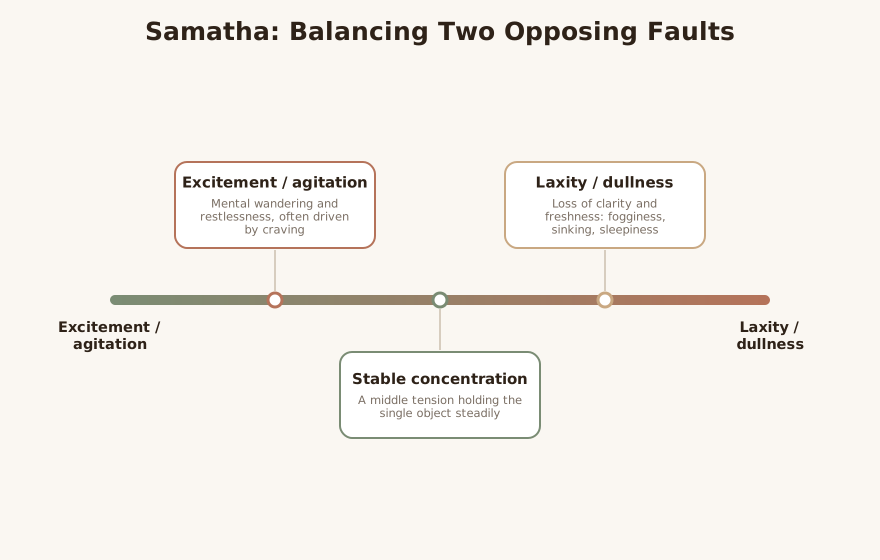
Two opposing faults. Progress is obstructed by two errors that must be continuously balanced. Excitement / flightiness / agitation is mental wandering and restlessness, often driven by craving, ranging from total loss of the object to subtle background restlessness 14. Laxity / dullness is the loss of clarity and freshness — fogginess, sinking, sleepiness — which can masquerade as calm 14. The skill is to hold a middle tension: stable but not slack, vivid but not agitated LLM.
The five hindrances. Samatha practice is framed as overcoming five obstacles to a settled mind: sensory desire, ill-will (aversion), sloth-and-torpor, restlessness-and-worry, and doubt 15. These map remarkably well onto the phenomenology clients report when they try to settle — craving distraction, irritation, drowsiness, anxiety, and “this isn’t working” LLM.
Calm precedes insight. The aim is not relaxation for its own sake but a stable, pliable platform — concentration (samādhi) — on which clarity, stillness, and contentment can arise, and upon which insight practice can later build 5.
Interventions & Techniques
Posture and setup. Sit with a straight, self-supporting back on a cushion or chair, adapting the traditional posture to the body rather than forcing an uncomfortable position 3. Comfort that does not collapse into slumping is the target 3.
Breath as anchor. Rest attention on the natural cycle of inhalation and exhalation, without manipulating the breath 3. As the practice deepens, awareness can be allowed to follow the exhalation “dissolving into space” 3.
Working with the wandering mind. When thought pulls attention away, simply “return to the breath” — repeatedly, without self-criticism 3. The redirection is the practice, not a failure of it; it is “natural to have so much happening in the mind,” and thoughts are observed with acceptance rather than suppressed 3.
The graded path. Both the nine “mental abidings” of the Indo-Tibetan tradition and Wallace’s ten-stage formulation describe the same trajectory: from placement of the mind (brief focus, frequent distraction), through continuous and repeated placement (lengthening attention with quicker recovery), through increasingly tamed, pacified, and single-pointed attention, to attentional balance — effortless, sustained focus 152. Wallace frames the early work specifically around developing relaxation, then stability, then vividness of attention 2.
LLM-generated illustrative example (not a guideline): A clinician introducing the anchor to an anxious client might say: “For the next two minutes, your only job is to feel the breath at the nostrils. The instant you notice you’ve drifted into planning, that noticing is the win — gently come back. We’re not clearing the mind; we’re practicing the return.” LLM
Dose. In secular adaptation, short, frequent sessions (a few minutes, several times daily) tend to be more sustainable for clinical populations than long sittings, which can amplify dullness or distress early on LLM. Traditional attainment of full śamatha — culminating in absorptive states (dhyāna / jhāna) — requires sustained, intensive practice well beyond any therapeutic dose and is not a clinical goal 14.
Evidence Base
Honesty about maturity requires a two-level answer. The broad focused-attention / concentrative meditation family — of which samatha is the parent — is established: its secular descendants, especially MBSR and standardized breath-anchor practices, have a large clinical literature for stress, anxiety, and related conditions LLM. The provided source set, however, is composed of contemplative and reference materials (encyclopedic entries, a practice book, and teaching pieces) rather than clinical trials 12345. None of these sources reports controlled outcome data, and this article does not assert effect sizes that those sources do not contain LLM.
What the tradition itself claims is a graded, replicable training of attention, producing greater calm, stability, clarity, and contentment, and culminating in absorptive concentration 25. Wallace’s contribution is to present this as a structured attentional curriculum with definable stages and faculties (relaxation, stability, vividness, mindfulness, introspection) 2. Those constructs translate cleanly into measurable clinical targets — sustained attention, meta-awareness, arousal down-regulation LLM.
The honest bottom line: treat the mechanism (a stabilizing attentional anchor that down-regulates arousal and builds meta-awareness) as well-supported in its secular form, while treating any claim that traditional samatha as such is a validated standalone treatment for a specific disorder as unproven by the sources at hand LLM. Use it as a transdiagnostic skill component, not as a monotherapy LLM.
Populations & Indications
Concentrative breath practice is most readily indicated for adults with anxiety and chronic stress, where a portable down-regulation skill addresses hyperarousal directly LLM. Meditation practitioners seeking to deepen stability are the population for whom the full graded path was designed 2. People with insomnia may benefit from a non-striving anchor that interrupts the effortful “trying to sleep” loop, though practice is taught for wakeful settling rather than as a sedation technique LLM. Individuals with attention difficulties are a conceptually apt fit, since the practice is, at root, attention training 2. People with chronic pain often use a breath or body anchor to alter the relationship to pain sensation rather than to abolish it LLM.
Problems-for-Work
- Generalized anxiety disorder / chronic stress / hyperarousal: the breath anchor provides an always-available object to which attention returns from anxious projection, reducing physiological arousal 3LLM.
- Rumination: repeatedly disengaging from elaborated thought and returning to a neutral object weakens the pull of the ruminative loop — the “return” is the trained skill 3LLM.
- Attention deficits: the graded stages explicitly train sustained focus and quick recovery after lapses, the exact deficits at issue 12.
- Emotional dysregulation: introspective alertness (noticing the slip early) is the prerequisite for catching affect before escalation 4LLM.
- Panic disorder: a steady, unforced breath focus can serve as an interoceptive grounding object, though it requires care (see cautions) LLM.
- Insomnia: a non-striving anchor reduces the effortful struggle that perpetuates wakefulness LLM.
- Chronic pain: concentration on a chosen object can shift attentional allocation away from pain elaboration LLM.
Contraindications, Cautions & Cultural Humility
Clinical cautions. Sustained internal attention is not universally safe. For some clients — particularly those with trauma histories, dissociation, or active psychosis — closing the eyes and turning attention inward can intensify intrusions, flashbacks, or derealization LLM. In panic disorder, fixed attention on the breath can heighten interoceptive sensitivity and trigger panic; offer an external or grounding anchor and titrate carefully LLM. Dullness practiced as relaxation can reinforce avoidance or, in depression, slide into rumination disguised as calm 1LLM. Distress during practice is common and is not always therapeutic; have a plan to open the eyes, shorten the dose, or stop LLM.
Scope humility. Full śamatha, jhāna, and the attainments described in the tradition are spiritual goals requiring conditions no therapy provides; clinicians should not promise or pursue them, and should not present a portable attention skill as the whole of the path 4LLM.
Cultural humility. Samatha is a living religious practice embedded in Buddhist soteriology, not a neutral “technique” invented for stress relief 15. Naming its source, avoiding appropriative flattening, and respecting that a client’s own faith tradition may have analogous contemplative forms are all part of competent, humble use LLM. Offer it as one option, framed transparently, never imposed LLM.
Treatment-Plan Suggestions & SMART Objectives
| Goal | SMART objective (example) | Mechanism |
|---|---|---|
| Reduce physiological hyperarousal | Client will practice a 3-minute breath-anchor sit twice daily for 2 weeks and rate pre/post tension on a 0–10 scale | Stabilizing anchor down-regulates arousal 3 |
| Strengthen meta-awareness | Client will, over 3 weeks, log the number of “noticed returns” per sit, demonstrating earlier detection of wandering | Introspective alertness catches the slip 4 |
| Interrupt rumination | Client will use a 90-second breath return whenever a rumination loop is noticed, ≥4×/day, for 14 days | Repeated disengagement weakens the loop 3 |
| Build sustained attention | Client will progress from 3- to 8-minute sits over 4 weeks while maintaining a single object | Graded attentional training 12 |
| Improve sleep-onset settling | Client will apply a non-striving breath focus at lights-out nightly for 2 weeks and track sleep-onset latency | Non-striving anchor reduces effortful wakefulness LLM |
| Increase tolerance of distress | Client will remain with the anchor through one wave of discomfort per sit, 5×/week, without abandoning practice | Equanimity toward arising experience 3 |
| Recover focus after lapses | Client will demonstrate, by week 4, return to the anchor within ~10 seconds of noticing distraction | Quickened recovery across stages 1 |
Common Misconceptions
“Meditation means clearing the mind.” No. The instruction is to return attention to the object when it wanders, not to eliminate thought; having “so much happening in the mind” is expected 3. Clients who believe they are “failing” because thoughts arise are misunderstanding the task LLM.
“Calm is the goal.” Calm is a by-product and a foundation, not the endpoint; samatha exists to build a stable platform for insight 5. Treating relaxation as the whole aim can drift into cultivating dullness, one of the two recognized faults 1.
“Samatha and mindfulness are the same thing.” Samatha (concentration) and vipassanā (insight) are complementary but distinct in the developed tradition; secular “mindfulness” blends both, but the concentrative anchor is specifically the samatha component 15.
“Stillness equals progress.” A foggy, sinking quiet (laxity) can feel peaceful while being the opposite of trained attention; stability without vividness is not the target 14.
Training & Certification
There is no clinical credential in samatha; it is transmitted within Buddhist lineages through teachers and retreats, not licensure 1. For clinicians, the responsible path is twofold: gain personal familiarity with concentrative practice through established secular training, and integrate it as a skill within an evidence-based therapy in which one is already competent LLM. Structured curricula such as MBSR offer recognized teacher-training pathways for the secular descendant of this practice LLM. Wallace’s The Attention Revolution serves as an accessible self-study map of the graded path for practitioners who want to understand the full attentional trajectory 2, and contemporary teaching resources illustrate plain-language instruction 3. Personal practice before teaching is a near-universal expectation in this domain LLM.
Key Terms
- Samatha / śamatha: calm abiding; tranquility; pacification of mental activity 15.
- Vipassanā: insight meditation; the complementary practice samatha supports 1.
- Samādhi: concentration; the stabilized, collected mind that samatha develops 5.
- Dhyāna / jhāna: states of meditative absorption reached through deep concentration 1.
- Nine mental abidings / ten stages: the graded maps of attentional development, from initial placement to effortless single-pointedness 152.
- Mindfulness (“mental glue”) and alertness: the faculties that hold the object and monitor the hold 4.
- Laxity/dullness and excitement/flightiness: the two faults of too little versus too much attentional tension 14.
- Five hindrances: sensory desire, ill-will, sloth-torpor, restlessness-worry, doubt 15.
- Ānāpānasati: mindfulness of breathing, the primary samatha object 1.
Resources & Further Reading
▶ Watch — a video introduction to this concept:
- Samatha-vipassanā — Wikipedia
- The Attention Revolution: Unlocking the Power of the Focused Mind — B. Alan Wallace
- How to Practice Shamatha (Breathing) Meditation — Lion’s Roar
- Achieving Shamatha — Study Buddhism (Berzin Archives)
- Samatha — Encyclopedia of Buddhism
Reflective / Supervision Questions
- For this specific client, am I offering samatha as a portable arousal-regulation skill, or am I implicitly importing a spiritual goal the therapy cannot support? LLM
- How will I screen for trauma, dissociation, or panic before assigning eyes-closed internal attention, and what is my fallback anchor if the breath focus destabilizes? LLM
- Can I tell, from the client’s report, whether they are achieving stable-and-vivid attention or merely sinking into pleasant dullness — and how would I coach the difference? LLM
- Have I named the practice’s Buddhist origins and checked the client’s own faith and comfort, rather than presenting it as a neutral technique? LLM
- Am I measuring something concrete (noticed returns, sit duration, pre/post tension) so that “they meditated” becomes an observable clinical objective? LLM
- When the client reports “it isn’t working,” am I recognizing doubt as a named hindrance to work with, rather than evidence the intervention has failed? 5LLM