
Type & Discipline
Anatta (Pali; Sanskrit anatman) is a doctrine of Buddhist philosophy, not a treatment protocol or a clinical technique 1. The term is usually translated as “non-self” or “no-self,” and it holds that there is no permanent, unchanging, independent self or soul underlying experience 1. It is one of the three marks of existence (tilakkhana) that, in Buddhist analysis, characterize all conditioned phenomena: anicca (impermanence), dukkha (unsatisfactoriness or suffering), and anatta (non-self) 4.
For practicing therapists, the relevant framing is that anatta is a contemplative-philosophical lens, not a billable modality in itself LLM. Its clinical value lies in how it has been operationalized inside secular, evidence-based interventions — particularly mindfulness-based cognitive therapy (MBCT) and acceptance and commitment therapy (ACT) — where processes such as decentering, cognitive defusion, and “self-as-context” carry much of the same functional logic without metaphysical commitments LLM. Treating anatta as a frame rather than a stand-alone therapy keeps the work both honest and defensible LLM.
Creators & Lineage
The teaching is attributed to the Buddha (Siddhartha Gautama) and is among the foundational doctrines of early Buddhism, presented as a direct contrast to the atman (eternal self/soul) of the surrounding Brahmanical traditions 16. Where those traditions posited a permanent self at the core of a person, the Buddha’s analysis denied that any of the constituents of experience could be identified as a stable, owner-self 6.
In the early discourses, the self is deconstructed into five aggregates (khandhas): form (the body), feeling, perception, mental formations, and consciousness 3. The teaching is that none of these — individually or collectively — constitutes a fixed self; each is impermanent, conditioned, and not fully under one’s control 34. The “self,” on this view, is better understood as a process or an activity than as a thing 3.
An important interpretive lineage runs through the contemporary Theravada teacher Thanissaro Bhikkhu, who argues that the Buddha taught not-self rather than a flat metaphysical assertion of no-self 2. On this reading, “non-self” functions less as an ontological claim (“there is no self”) and more as a practical strategy: a way of relating to experience that loosens clinging and reduces suffering 2. This distinction matters clinically, because it reframes anatta from a belief a client must adopt into a stance a client can practice LLM.
The therapeutic lineage most relevant to clinicians includes Buddhist psychology more broadly, MBCT, and ACT’s defusion and self-as-context constructs, all of which import the functional core of anatta — disidentification from a reified self — into secular practice LLM. The closely paired teaching of anicca (impermanence) is its conceptual sibling: if everything changes moment to moment, no static self can be found within the flux 4.
Core Principles
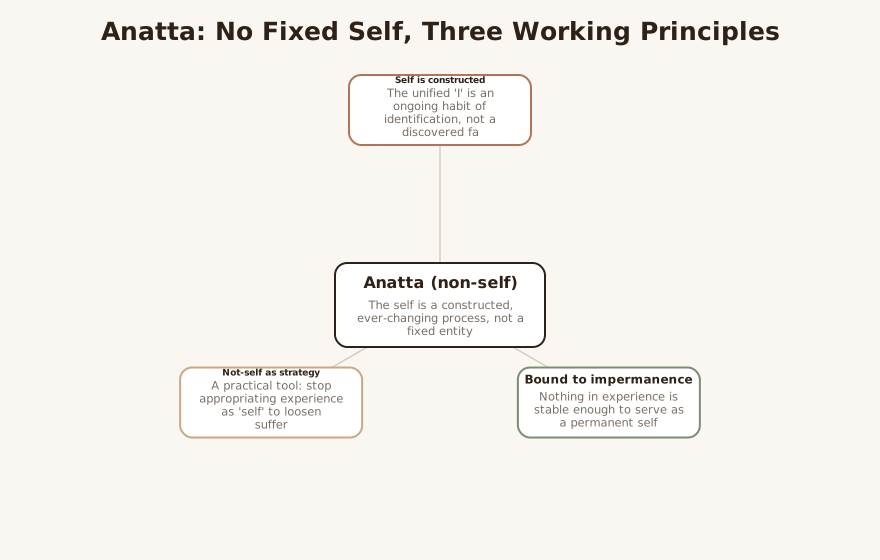
The central claim is that the self we take to be solid, continuous, and “in charge” is a construction — an ever-changing process rather than a permanent entity 13. Three principles organize this for clinical use LLM.
First, the self is constructed and processual. What feels like a unified, enduring “I” is an ongoing activity of identification — a mental habit of taking experiences as “me” or “mine” — rather than a discovered fact 36. The aggregates that make up experience arise and pass continuously, so the sense of a fixed center is assembled moment by moment 34.
Second, non-self is bound to impermanence. Because all conditioned phenomena are impermanent (anicca), nothing within experience is stable enough to serve as a permanent self 4. Clinging to a fixed self-image is therefore clinging to something that cannot hold still, which generates suffering (dukkha) 4.
Third, not-self is a practical strategy, not only a metaphysics. Following Thanissaro Bhikkhu, the teaching can be used as a tool: when one stops appropriating thoughts, feelings, and roles as “self,” the grip of identification loosens, and suffering tied to that identification eases 2. This is the principle clinicians can most directly borrow: the question is not “Do you have a self?” but “Does identifying with this thought help you right now?” LLM.
Interventions & Techniques
Anatta itself prescribes no technique; the techniques come from the secular modalities that have absorbed its logic LLM. The following are the most clinically usable translations.
Decentering / disidentification. Helping clients observe thoughts and feelings as passing mental events rather than as literal truths or core identity is a direct functional analogue of the not-self stance 23. The shift is from “I am anxious” to “I notice anxiety arising,” which loosens the equation of a transient state with the whole self LLM.
Cognitive defusion (ACT). Techniques that separate a person from the content of their thoughts — labeling (“I’m having the thought that I’m a failure”), repetition exercises, or observing thoughts as words — operationalize the insight that thoughts are not the self LLM. They map onto the not-self strategy of declining to appropriate mental formations as “me” 23.
Self-as-context (ACT). Cultivating the perspective of the observing awareness that notices changing experiences — rather than the changing content itself — gives clients a stable vantage point that does not depend on a fixed self-image LLM. This parallels the aggregate analysis: consciousness observes form, feeling, and perception arising and passing without being identical to any of them 3.
Aggregate-style inquiry. A gentle contemplative exercise invites the client to look for the “self” inside body sensations, feelings, perceptions, thoughts, and awareness, and to notice that no single fixed thing is found — only changing processes 34. Used carefully, this can soften rigid, globalized self-judgments LLM.
LLM-generated illustrative example (not a guideline): A client says, “I’m a fundamentally broken person.” Rather than disputing the content, the clinician guides a brief inquiry: “Where is the ‘broken person’ right now — is it the tight chest, the thought, the memory, or the part of you noticing all of it?” The client reports the sensations and the thought come and go, but the noticing stays. The aim is not to prove a doctrine but to demonstrate experientially that the global self-label is thinner and more changeable than it felt. LLM
Evidence Base
Honesty about maturity is essential here. As a philosophical doctrine, anatta is well established within the Buddhist canon and centuries of commentarial and scholarly literature; its textual and conceptual basis is mature and thoroughly documented 16. It is “established” in the sense of being a stable, well-attested teaching — not in the sense of being a validated clinical intervention LLM.
There is no body of randomized controlled trials testing “anatta therapy,” because anatta is not a discrete therapy LLM. The defensible clinical evidence belongs to the secular modalities that carry its functional core — MBCT for depressive relapse prevention and ACT’s processes of defusion and self-as-context — and clinicians should anchor evidentiary claims there rather than to the doctrine itself LLM. Stated plainly: the philosophy is mature; the secular mechanisms it informs have their own evidence base; the doctrine as such has not been independently trialed and should not be presented to clients as a proven treatment LLM.
Populations & Indications
The framing is most apt for mindfulness practitioners already comfortable with observing experience, who can extend that skill toward disidentifying from a fixed self-image LLM. It is also indicated for people with a rigid self-concept — clients locked into globalized, fused self-labels (“I am worthless,” “I am the anxious one”) — where loosening identification is the therapeutic lever LLM.
It can support clients with anxiety or depression, where the functional analogues (decentering, defusion) are most evidenced via MBCT and ACT, and for clients in existential distress, where the impermanence-and-non-self frame can reduce the felt threat of change and loss 4LLM. With clients who have identity disturbance, the concept must be used with particular caution (see contraindications) and only as adjunctive to stabilizing, structure-building work LLM.
Problems-for-Work
Rumination and self-criticism. Anatta-informed decentering targets the fusion that makes critical thoughts feel like verdicts about a fixed self; the move is to observe the thought as a passing event rather than as a true description of “who I am” 23.
LLM-generated illustrative example (not a guideline): A perfectionistic client ruminates, “I always ruin everything.” The clinician helps her notice the thought as a recurring mental formation that arises, peaks, and fades — not a stable fact about a permanent self. Over weeks, the thought’s authority diminishes even as its frequency only slowly declines. LLM
Ego-attachment / over-identification with thoughts. This is the most natural fit: the not-self strategy directly addresses the habit of appropriating mental content as “me” and “mine” 23.
Low self-esteem and identity disturbance. Here the work is delicate — softening a punishing self-image without destabilizing a fragile one — and is best framed as loosening rigidity rather than dissolving identity LLM.
Anxiety, depression, emotion dysregulation, and existential distress. The shared mechanism is reduced clinging to a fixed self and to permanence; recognizing impermanence can reframe distress as a passing process rather than a defining state 4LLM.
Contraindications, Cautions & Cultural Humility
The most important caution: clients with identity disturbance, dissociative symptoms, or a fragile or unstable sense of self may experience “no-self” language as destabilizing, invalidating, or frightening, and may hear it as confirmation that they “don’t exist” or “don’t matter” LLM. The teaching’s own internal reading guards against this — Thanissaro Bhikkhu emphasizes not-self as a strategy rather than a blanket assertion that “there is no self,” precisely to avoid the nihilistic misreading 2. Clinically, prioritize stabilization and a coherent, valued sense of identity before introducing disidentification work LLM.
Avoid presenting anatta as metaphysical truth a client must believe; keep it functional (“Does identifying with this help you?”) rather than doctrinal 2LLM. Watch for spiritual bypassing — using “non-self” to avoid feeling, responsibility, or grief — which inverts the intended effect LLM.
Cultural humility matters in both directions. Anatta is a sacred teaching within living Buddhist traditions, and secularizing it for therapy risks decontextualizing or appropriating it; name its origins, hold it with respect, and do not present a stripped-down version as the whole tradition 16LLM. Conversely, for clients with their own religious or cultural commitments to a soul or enduring self, a non-self frame may conflict with deeply held belief, and the secular ACT/MBCT processes can be offered without the metaphysical packaging LLM.
Treatment-Plan Suggestions & SMART Objectives
| Goal | SMART objective (example) | Mechanism |
|---|---|---|
| Reduce fusion with self-critical thoughts | Within 6 weeks, client will use a defusion phrase (“I’m having the thought that…”) for self-critical thoughts at least once daily, logged 5 of 7 days | Cognitive defusion; disidentification from mental formations 23 |
| Increase decentering capacity | Within 8 weeks, client will report observing 2 distressing emotions as “passing events” per week without acting on them, per session review | Decentering; non-identification with transient states 24 |
| Strengthen observing perspective | Within 8 weeks, client will complete a brief self-as-context exercise 3x/week and rate sense of a stable “observer” ≥6/10 | Self-as-context; perspective-taking on changing experience 3 |
| Loosen rigid global self-labels | Within 10 weeks, client will reframe one globalized self-judgment into a specific, time-limited statement in 4 of 5 sessions | Aggregate-style inquiry; deconstructing reified self 34 |
| Reduce rumination | Within 6 weeks, client will redirect from rumination to present-moment noticing within 5 minutes, ≥4x/week (self-report) | Decentering; reduced appropriation of repetitive thought 23 |
| Reframe distress as impermanent | Within 8 weeks, client will identify the rise-peak-fall arc of one distressing state per week | Anicca-informed reappraisal; impermanence 4 |
| Reduce existential threat tied to change | Within 10 weeks, client will articulate one valued action despite uncertainty in 3 of 4 sessions | Non-clinging; acceptance of impermanence 4LLM |
Common Misconceptions
“Anatta means you don’t exist / nothing matters.” This nihilistic reading is the most common and most harmful error; the teaching denies a permanent, fixed self, not the conventional, functioning person who acts and is responsible 12. Thanissaro Bhikkhu’s “not-self” framing exists precisely to block this misreading 2.
“Anatta is a metaphysical fact clients must believe.” It is better used as a practical strategy for relating to experience than as a doctrine to be accepted 2. The clinical question is functional, not philosophical LLM.
“Non-self means dissolving or annihilating the self.” The point is to stop clinging to a reified self-image, not to destroy personality, agency, or values 23. Clients can become less fused and more able to act on what matters LLM.
“It’s the same as low self-esteem or self-erasure.” Healthy non-identification can coexist with self-respect and assertiveness; loosening a fixed self-image is not self-deprecation 3LLM.
Training & Certification
There is no certification in “anatta” as a clinical method, because it is a philosophical teaching rather than a credentialed therapy LLM. Clinicians who wish to use its functional core responsibly should pursue training in the secular modalities that carry it: MBCT teacher training and ACT training (including supervised practice in defusion and self-as-context) LLM. Personal mindfulness practice and study of the source teaching — for example, accessible scholarship and primary-tradition expositions on the three marks and not-self — deepen the clinician’s ability to use the concept skillfully and respectfully 124. Familiarity with the tradition’s own internal debates (notably the no-self vs. not-self distinction) protects against the destabilizing misreadings described above 2.
Key Terms
- Anatta / anatman — non-self; the doctrine that there is no permanent, independent self 16.
- Anicca — impermanence; the constant flux of all conditioned phenomena 4.
- Dukkha — suffering or unsatisfactoriness; the discomfort generated by clinging to what cannot last 4.
- Three marks of existence (tilakkhana) — anicca, dukkha, and anatta together 4.
- Five aggregates (khandhas) — form, feeling, perception, mental formations, consciousness; the constituents into which “self” is analyzed 3.
- Atman — the permanent self/soul of pre-Buddhist Indian traditions, which anatta denies 16.
- Not-self (as strategy) — Thanissaro Bhikkhu’s framing of anatta as a practical stance rather than a flat metaphysical assertion 2.
- Decentering / self-as-context / cognitive defusion — secular clinical processes that carry the functional core of disidentification LLM.
Resources & Further Reading
▶ Watch — a video introduction to this concept:
- Anatta | No-Self, Non-Attachment & Impermanence — Encyclopaedia Britannica
- No-self or Not-self? — Thanissaro Bhikkhu (Access to Insight)
- What is No Self, or Anatta? — Buddhism A–Z (Lion’s Roar)
- Three Marks of Existence — Wikipedia
- The Three Marks and the Teaching of Not-Self (Anatta) — The Zen Studies Podcast
- Anatta (Anatman): The Buddhism’s concept of non-self — scholarly paper (Academia.edu)
Reflective / Supervision Questions
- When I introduce non-self language, am I assessing first whether this client’s sense of self is stable enough to tolerate disidentification work? LLM
- Am I presenting anatta as a functional strategy (“Does identifying with this help?”) or slipping into asserting it as metaphysical truth the client must accept? 2LLM
- How am I distinguishing healthy non-identification from self-erasure, invalidation, or spiritual bypassing in this client’s presentation? LLM
- Am I documenting the active clinical mechanism (defusion, decentering, self-as-context) within a recognized modality, rather than charting a philosophy? LLM
- Am I holding this teaching with cultural humility — naming its Buddhist origins and avoiding a decontextualized, appropriated version? 16LLM
- For a client whose faith affirms an enduring soul, can I offer the secular processes without imposing a conflicting metaphysics? LLM