
Type & Discipline
Mindfulness-Based Stress Reduction (MBSR) is a structured, manualized group education program rather than a one-to-one psychotherapy, sitting within behavioral medicine and integrative health 3. It is the original member of the broader family of mindfulness-based interventions and is the historical anchor of what clinicians now call acceptance, mindfulness, and process-based therapies 7. MBSR is explicitly secular and nonsectarian, framed as an educational, skills-building course in cultivating present-moment attention rather than as treatment for a specific diagnosis 2. For practicing therapists, this distinction matters: MBSR is most accurately understood as a complementary, evidence-based program that supports medical and psychological care across a wide range of conditions, not as a stand-alone replacement for diagnosis-specific psychotherapy 3. LLM
Creators & Lineage
MBSR was created by Jon Kabat-Zinn, PhD, who founded the Stress Reduction Clinic at the University of Massachusetts Medical Center in 1979 3. The program emerged from behavioral medicine and the mind-body tradition, and Kabat-Zinn drew its contemplative techniques from wisdom teachings in Zen Buddhism, Hatha yoga, and Samatha-vipassanā, deliberately stripping them of religious framing for a clinical and research context 7. Kabat-Zinn’s working definition of mindfulness as “moment-to-moment, non-judgmental awareness” became the operational backbone not only of MBSR but of the interventions it later seeded 7. The first published clinical application was a 10-week stress reduction and relaxation program for chronic pain patients who had not responded to conventional medical care, which established the template that was later standardized into the 8-week course 1. MBSR is the direct parent of Mindfulness-Based Cognitive Therapy (MBCT) and shares theoretical foundations with Acceptance and Commitment Therapy (ACT) and Dialectical Behavior Therapy (DBT), all of which integrate mindfulness principles into psychological intervention 7.
Core Principles
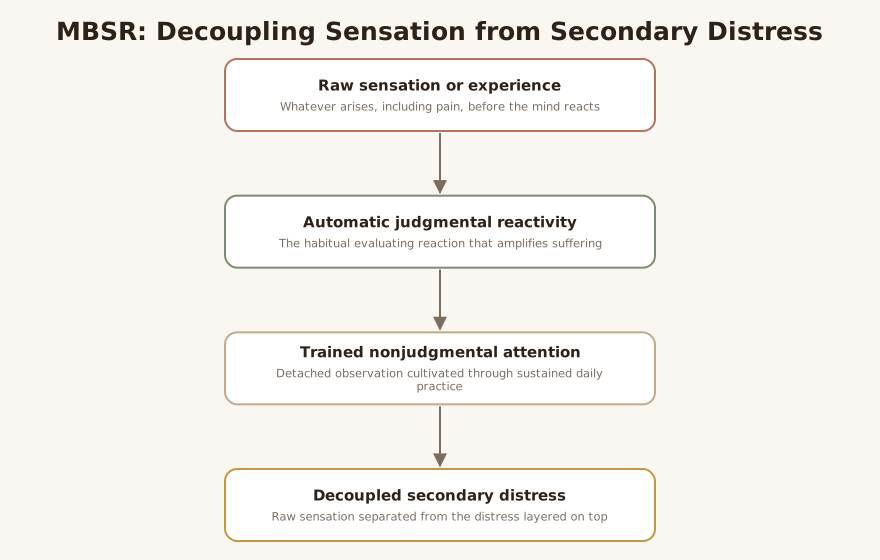
The central premise is that much human suffering is amplified by automatic, judgmental reactivity to experience, and that systematically training non-judgmental present-moment attention can decouple raw sensation from the secondary distress layered on top of it 7. In the original chronic-pain work, Kabat-Zinn proposed that mindfulness meditation allows “detached observation” of pain, separating the physical sensation from the emotional and cognitive reaction to it 1. The practice cultivates an open, nonjudgmental stance toward whatever arises, alongside an attitude of acceptance and investigation of present experience rather than avoidance or suppression 7. A defining principle is that mindfulness is trained, not merely understood intellectually: the program assumes that meaningful change requires sustained, daily personal practice rather than insight alone 3. The orientation is fundamentally educational and experiential, building resilience, balance, and equanimity rather than targeting a symptom for elimination 2. LLM
Interventions & Techniques
The standardized program runs eight weeks, with weekly group classes of roughly 2.5 hours and one additional all-day session, typically held on a weekend between weeks six and seven 3. Participants are asked to commit to daily home practice of about 45 to 60 minutes, which is considered integral rather than optional to the intervention 3. The three signature formal practices are the body scan, sitting meditation, and mindful movement (Hatha yoga), supplemented by walking meditation 3. The body scan involves systematically moving attention through the body, beginning at the toes and progressing to the top of the head, noticing sensation without trying to change it 7. Sitting meditation typically anchors attention on the breath and then widens to include sounds, body sensations, thoughts, and emotions as objects of observation 7. Mindful yoga introduces gentle movement and stretching done with the same attentive, nonjudgmental awareness 7. Beyond formal practice, MBSR emphasizes informal mindfulness woven into daily activities, so that present-moment attention generalizes into ordinary life 2. Classes are delivered both in person and live online, and the group format itself is a working ingredient, offering shared inquiry and normalization of difficulty 2. LLM
Evidence Base
The evidence base for MBSR is mature and large, and the program is appropriately labeled established; it is one of the most extensively studied mind-body interventions in behavioral medicine 7. Kabat-Zinn’s foundational 1982 study of 51 chronic pain patients reported that 65% achieved at least a 33% reduction and 50% achieved at least a 50% reduction in their mean total Pain Rating Index, with accompanying improvements in mood and psychiatric symptoms that remained stable at follow-up and were independent of pain category 1. Subsequent meta-analyses indicate moderate evidence that MBSR reduces anxiety, depression, and psychological distress, and supports stress reduction, pain management, and quality of life 7. In cancer care specifically, mindfulness-based programs have shown improvements in fatigue, anxiety, depression, and quality of life 7. Neuroscience work cited in popular and clinical summaries points to structural and functional brain changes correlated with practice, including findings by Sara Lazar that long-term practitioners show brain features proportional to hours practiced 4.
Clinicians should hold this evidence with appropriate calibration. Direct comparisons find MBSR is generally not more effective than traditional cognitive behavioral therapy and shows only moderate efficacy relative to other active treatments 7. The broader mindfulness literature has also been candidly described as still relatively young, with a caution that it will take “years and decades” of further peer-reviewed study before some claims rest on firm evidence, and that correlational neuroimaging cannot by itself establish that meditation caused observed brain differences 4. The honest summary for practice: MBSR reliably outperforms waitlist and usual care and is a credible option, but it is not demonstrably superior to established active therapies and should not be oversold to clients 7. LLM
Populations & Indications
MBSR was designed for adults and has its strongest historical footing with people managing chronic medical conditions, where it complements rather than replaces medical care 3. It is widely used for chronic pain, the population in which it was first developed and tested 1. The program is commonly applied for stress, anxiety, and sleep difficulties, and is offered as support for a wide range of conditions in medical settings 3. People adjusting to chronic illness, including cancer patients managing treatment-related distress, fatigue, and mood, are well-represented in the evidence and in clinical use 7. MBSR is also frequently delivered to healthcare professionals and other high-stress occupational groups as a resilience and burnout-mitigation intervention, reflecting its non-pathologizing, educational framing that suits people who would not identify as patients 2. LLM
Problems-for-Work
In practice, MBSR is most useful when the clinical target is reactivity, avoidance, and the secondary suffering layered onto a primary stressor 1. LLM
- Stress and burnout: The program’s core purpose is reducing stress reactivity and building equanimity, making it a natural fit for clinicians, caregivers, and high-demand professionals experiencing burnout 2.
- Chronic pain: MBSR helps patients relate differently to persistent pain by observing sensation without the amplifying emotional reaction, the mechanism demonstrated in the original cohort 1.
- Anxiety and depression: Meta-analytic evidence supports moderate reductions in anxiety and depressive symptoms, useful as adjunctive work or relapse-oriented maintenance 7.
- People with chronic illness adjustment and cancer-related distress: Mindfulness training improves quality of life, fatigue, and mood in people living with serious illness 7.
- Insomnia and hypertension: MBSR is commonly used to support sleep and is delivered in medical settings as a complement to care for stress-linked physiological problems 3.
LLM-generated illustrative example (not a guideline): A 47-year-old nurse with tension headaches and rising burnout enrolls in an 8-week MBSR group. Through daily body scans she begins to notice the early shoulder and jaw tension that precedes a headache, and rather than bracing against it she practices breathing into the sensation. By week six she reports that the headaches are not necessarily fewer, but that they distress her less and disrupt her shifts less often. LLM
Contraindications, Cautions & Cultural Humility
MBSR is generally low-risk, but it is not universally appropriate, and therapists should screen rather than refer reflexively. The substantial home-practice demand of 45 to 60 minutes daily plus weekly 2.5-hour classes is a real barrier, and clients who cannot commit may experience the program as one more failure 3. LLM Intensive meditation can transiently intensify difficult internal experiences; for clients with acute trauma, active psychosis, severe untreated depression, or current suicidality, unstructured sustained attention to inner experience may be destabilizing and warrants careful clinical judgment, stabilization first, or a trauma-sensitive adaptation. LLM MBSR is explicitly framed as a complement to, not a substitute for, medical and psychological treatment, and should not displace indicated care 3. On cultural humility, although MBSR is presented as secular and compatible with diverse faith traditions, its techniques are adapted from Buddhist and yogic contemplative lineages, and clinicians should be transparent about these roots, avoid presenting the practice as culturally neutral, and remain attentive to clients for whom meditation carries religious meaning or for whom it conflicts with their own tradition 27.
Treatment-Plan Suggestions & SMART Objectives
| Goal | SMART objective (example) | Mechanism |
|---|---|---|
| Reduce stress reactivity | Client will complete a daily 20-30 minute formal mindfulness practice at least 5 of 7 days for 8 weeks, logged on a practice sheet | Repeated nonjudgmental attention training reduces automatic reactivity 7 |
| Improve relationship to chronic pain | Within 8 weeks, client will use a body-scan practice during 3 pain flares per week and rate associated distress, targeting a measurable drop in distress ratings | Detached observation separates sensation from secondary suffering 1 |
| Decrease anxiety symptoms | Client will reduce GAD-7 score by a clinically meaningful margin over the 8-week course | Mindfulness training shows moderate reductions in anxiety 7 |
| Build present-moment awareness in daily life | Client will identify and practice 2 informal mindfulness anchors (e.g., mindful eating, transitions) daily for 4 weeks | Generalization of attention from formal to everyday activity 2 |
| Support sleep | Client will complete a wind-down body scan on at least 5 nights per week and track sleep-onset latency for 6 weeks | Reduced cognitive arousal and rumination supports sleep 3 |
| Sustain the all-day intensive | Client will attend the full-day silent practice session between weeks 6-7 | Extended practice consolidates and deepens skill 3 |
| Reduce burnout in a clinician/caregiver | Over 8 weeks, client will rate weekly perceived stress and report a downward trend by program end | Resilience and equanimity building through repeated practice 2 |
Common Misconceptions
A frequent misconception is that mindfulness means clearing or stopping the mind; in MBSR the instruction is the opposite, to notice thoughts and sensations nonjudgmentally as they arise rather than to eliminate them 7. Another is that MBSR is a relaxation technique whose goal is to feel calm; relaxation may occur, but the explicit aim is awareness and a changed relationship to experience, including difficult experience 2. Some clinicians assume MBSR is a religious or Buddhist practice; it is delivered as a secular, nonsectarian program, though its techniques have contemplative roots that should be acknowledged honestly 27. There is also a tendency to overstate the science, treating “your brain changes in 8 weeks” headlines as settled fact, when the field itself cautions that the research is comparatively young and that some neuroimaging findings remain correlational 4. Finally, MBSR is not demonstrably superior to other active treatments; assuming it outperforms CBT is not supported by direct comparisons 7. LLM
Training & Certification
MBSR teacher training has historically been anchored at the institutions that originated and standardized the program, with UMass and its lineage establishing the curriculum and instructor pathways 3. The Brown University Mindfulness Center is among the centers that now train and certify MBSR teachers and define the program’s standards 2. Becoming a qualified MBSR instructor typically requires a substantial personal meditation practice and supervised teaching experience; for example, the creator of the widely used free Palouse Mindfulness course completed full MBSR certification through the University of Massachusetts Medical School and had taught live classes for many years 6. Therapists who want to learn the content before committing to formal teacher training can work through the standardized 8-week curriculum themselves via free, self-paced resources modeled on the original program 6. LLM
Key Terms
- Mindfulness: Moment-to-moment, nonjudgmental awareness of present experience, the core skill MBSR trains 7.
- Body scan: A formal practice of systematically moving attention through the body from the toes upward, observing sensation without trying to change it 7.
- Sitting meditation: Seated practice anchoring attention on the breath and widening to sounds, sensations, thoughts, and emotions 7.
- Mindful yoga / mindful movement: Gentle Hatha-derived movement performed with attentive, nonjudgmental awareness 7.
- Walking meditation: Bringing the same present-moment attention to the act of walking 3.
- All-day session: A full-day, largely silent intensive held between weeks six and seven to consolidate practice 3.
- Informal practice: Applying mindful attention to ordinary daily activities outside of formal sitting 2.
Resources & Further Reading
▶ Watch — a video introduction to this concept:
- Kabat-Zinn (1982), foundational chronic-pain study (PubMed) 1
- Brown University Mindfulness Center — What is MBSR? 2
- UMass Memorial Health — MBSR program details 3
- Mindful magazine — The Science of Mindfulness 4
- PositivePsychology.com — The Ultimate MBSR Guide 5
- Palouse Mindfulness — free online 8-week MBSR course 6
- Wikipedia — Mindfulness-based stress reduction 7
Reflective / Supervision Questions
- For a given client, am I recommending MBSR because the evidence fits their problem, or because it is familiar and low-conflict to suggest? LLM
- Have I assessed whether this client can realistically meet the daily home-practice demand, and what it would mean for them if they cannot? LLM
- For clients with trauma histories, active depression, or destabilizing internal experiences, have I considered whether sustained inward attention could intensify distress, and whether a trauma-sensitive adaptation or prior stabilization is needed? LLM
- Am I being honest with clients that MBSR is generally no more effective than active comparators such as CBT, rather than implying it is superior? LLM
- How am I acknowledging the contemplative and cultural roots of these practices, and am I attentive to clients for whom meditation carries religious meaning or conflict? 7 LLM
- When I deliver mindfulness components inside individual therapy, am I documenting them clearly as skills targeting a diagnosed condition within a recognized modality? LLM